
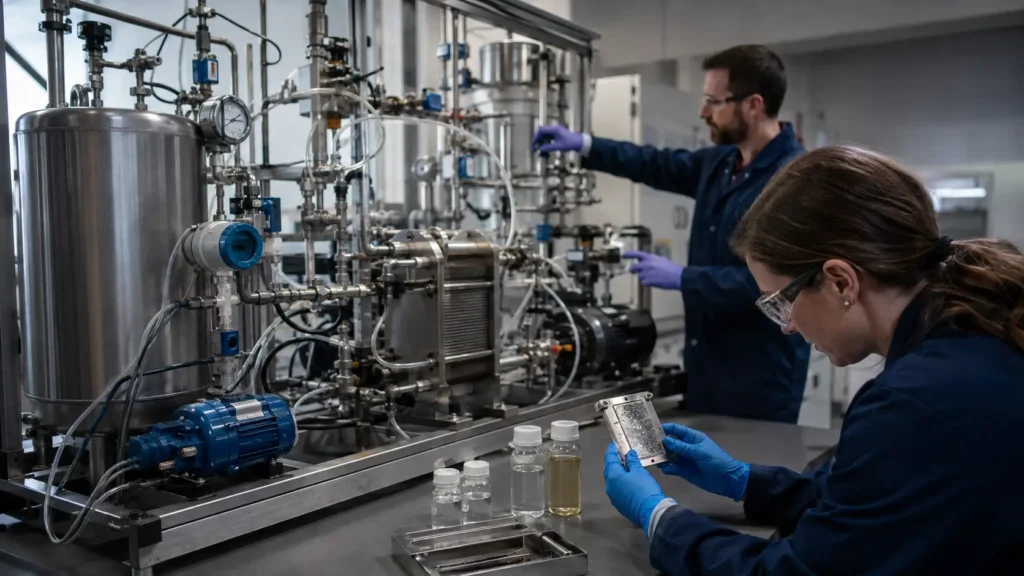
Establish a calculation language that closes water, dissolved species, reagents, products, solids, moisture and residuals across every process boundary.
Controlled principleA flow diagram is not a mass balance. Every external and internal stream must carry a flow, composition, phase, time basis and destination. Water recovery, volume reduction, salt recovery and product yield answer different questions and must not be substituted for one another. |
|---|
9.1 Close the boundary before optimizing the process
The calculation begins by naming the system boundary and the period over which it is evaluated. A unit-operation balance can support equipment design; a train balance can support recovery and residual accounting; a whole-site balance can support water, disposal and economic claims. The same stream may be internal to one boundary and an external product or waste to another.
At steady state, total mass entering a boundary equals total mass leaving it. For an individual element, ion or conserved component, the incoming load plus additions equals the amount in product water, concentrate, solids, gases, purge, cleaning waste and accumulation. When a reaction occurs, species can disappear but elements cannot. Sodium hydroxide added for magnesium precipitation does not vanish: sodium and hydroxide are incorporated into water, dissolved salts and precipitated material according to stoichiometry and reaction extent.
The U.S. Bureau of Reclamation describes mass-balance diagrams as tools for tracking process chemistry, inputs, outputs and the composition and quantities of every product and waste stream. USGS PHREEQC applies the same elemental discipline internally by converting solution composition to moles and distributing elements among aqueous, solid, gas, exchange and surface phases.
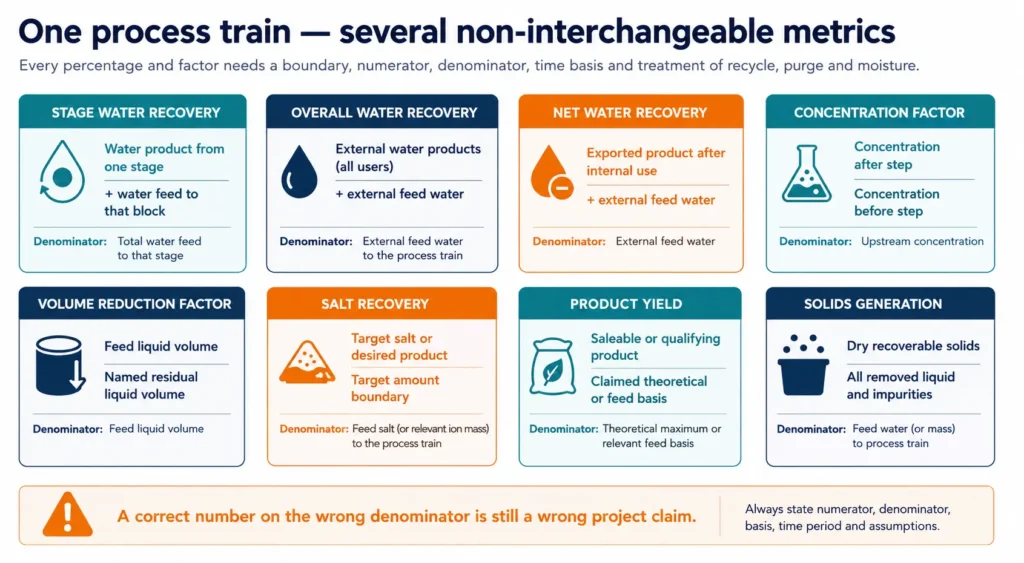
Figure 9.1. The principal recovery and yield metrics are related but not interchangeable.
9.2 Minimum stream table and closure equations
Each stream row should contain enough information to reproduce the calculation. At minimum: stream name and number; source and destination; phase; average, design and peak flow; density; temperature; water mass; dissolved and suspended constituent loads; chemical additions; dry solids; entrained liquid; and the normal, design or upset case to which the row belongs.
| Balance | General steady-state form | Required basis | What must be explicit | Typical hidden term |
|---|---|---|---|---|
| Total mass | Σṁ_in + Σṁ_added = Σṁ_out | kg/h or t/d on one time basis. | All liquids, solids, gases and reagents. | Cake moisture, wash water, vent loss or inventory change. |
| Water | Water in feed/additions = product + evaporation + residual water + moisture | Mass of water preferred where density changes. | Product water, condensate, evaporation, purge, cake moisture and cleaning losses. | Water in reagent solutions or wet solids. |
| Element / ion | Load in + reagent load = dissolved + solid + gas + product + purge | kg/h, kmol/h or equivalents with declared species basis. | Elemental versus ionic reporting and reaction stoichiometry. | Counter-ions introduced with chemicals. |
| Suspended / dry solids | Solids formed + solids entering = product solids + waste solids + carryover | Dry mass and wet mass reported separately. | Purity, hydration state, retained mother liquor and wash losses. | Calling a wet cake a dry product. |
| Accumulation | Input − output = dM/dt | Required for tanks, batch cycles, mother-liquor recycle and start-up. | Inventory at start/end of period. | Assuming steady state in a filling or purging system. |
Table 9.1. Minimum balance equations and the terms most often omitted.
| Closure error is a result, not a correction factorReport the closure error on the same basis as the balance: (inputs − outputs) ÷ inputs. Investigate method uncertainty, density, unmeasured ions, reaction extent, phase transfer, sampling timing, entrainment, purge and accumulation. Do not force closure by assigning the difference to a convenient ion or product. |
9.3 Water recovery: stage, overall, gross and net
For a membrane or other water-producing block, stage recovery is the product-water flow divided by the water feed to that block. DuPont defines membrane recovery as the ratio of permeate flow to feed flow; the same numerator and denominator discipline applies beyond membranes, provided the named product and feed are unambiguous.
Overall recovery must be calculated from the external boundary, not by averaging stage recoveries. For two serial blocks in which the second treats only the first residual and no recycle, bypass or loss is present, the overall recovery is R₁ + (1−R₁)R₂. Once recycles, wash-water use, bypass, batch purge, product-water consumption or multiple feeds exist, the stream balance—not a shortcut—controls.
Gross recovery counts all water products generated within the boundary. Net recovery counts only water that leaves the boundary as useful product after subtracting product water consumed internally and not returned. The distinction matters for crystal washing, membrane flushing, chemical dilution, cooling and cleaning.
| Metric | Equation | Numerator | Denominator | Boundary warning |
|---|---|---|---|---|
| Stage water recovery | R_stage = Q_product / Q_feed,stage | Water product from one unit or pass. | Water feed entering that unit or pass. | Do not use total recirculating flow as fresh feed. |
| Overall gross recovery | R_gross = ΣQ_external water products / Q_external feed water | All water products leaving the selected train/site boundary. | External feed water only. | Count neither internal recycle nor the same water twice. |
| Net water recovery | R_net = (Q_exported product − Q_internal product consumed) / Q_external feed water | Useful water exported after internal non-returned consumption. | External feed water. | State whether wash/CIP/chemical-dilution water returns. |
| Serial recovery shortcut | R_overall = 1 − Π(1−R_i) | Cumulative water product from strictly serial residual treatment. | Original feed water. | Valid only without recycle, bypass, extra feeds or losses. |
Table 9.2. Water-recovery definitions and their required boundaries.
9.4 Concentration factor and volume reduction factor
Concentration factor and volume reduction factor are useful only when the conserved quantity and residual stream are named. For a non-reacting, completely retained solute, concentration factor can be written as C_concentrate/C_feed and approximated by Q_feed/Q_concentrate. That approximation fails when solute passes to product water, precipitates, reacts, volatilizes, enters a wash stream or is added with chemicals.
Volume reduction factor is feed liquid volume divided by residual liquid volume. It is not water recovery. A system can achieve a high VRF while losing water in wet solids or evaporation, and two projects can report different VRFs from the same flows if one counts only free mother liquor while the other includes cake moisture and cleaning waste.
| Metric | Worked-example value | Visible calculation | Interpretation |
|---|---|---|---|
| Membrane stage recovery | 75.0% | 74.380 ÷ 99.173 | Water recovered by the membrane block after wet-cake removal. |
| Ideal membrane concentration factor | 4.00× | 99.173 ÷ 24.793 | Complete dissolved-salt retention is an explicit teaching assumption. |
| Overall gross water recovery | 97.17% | (74.380 + 22.793) ÷ 100.000 | Product water from membrane plus thermal block. |
| Free-liquid VRF | 50.0 | 100.000 ÷ 2.000 | Counts only final free mother-liquor water. |
| Liquid-burden VRF | 35.4 | 100.000 ÷ (2.000 + 0.827) | Also counts water retained in the softening cake. |
Table 9.3. The worked example produces different answers when the residual-liquid boundary changes.
9.5 Salt recovery, product yield and purity
Salt recovery is the mass of a target salt or element captured in the intended product divided by the mass entering the defined boundary. Product yield is broader and must state its basis: theoretical stoichiometric product, recoverable inventory, crystallizer feed or total feed. Saleable yield must also include the fraction meeting the product specification. Product purity is the target constituent or phase divided by dry product mass and should not be confused with recovery.
Recent crystallization research reports water recovery, crystal yield and product composition or purity as separate outputs, which is the correct discipline. A process can recover a large mass of solids while producing an impure mixture, or produce a high-purity product at low recovery.
| Metric | Definition | Worked-example result | Basis | Commercial caution |
|---|---|---|---|---|
| Mg recovery as Mg(OH)₂ | Moles of Mg in Mg(OH)₂ product ÷ moles Mg entering precipitation. | 90.0% | Assumed reaction conversion. | Dry precipitate is not automatically a qualified product. |
| NaCl crystal recovery | Dry NaCl crystals ÷ NaCl available to crystallizer. | 85.0% | 3019.6 ÷ 3552.4 kg/h | Does not include specification rejection or wash loss. |
| NaCl saleable yield | Qualifying NaCl product ÷ NaCl available to crystallizer. | 80.75% | 85% crystal recovery × 95% qualifying fraction | A visible teaching assumption; actual qualification requires product testing. |
| CaSO₄ crystal recovery | Dry CaSO₄ solid ÷ CaSO₄ entering crystallizer. | 90.0% | 450.0 ÷ 500.0 kg/h | Hydration state and purity must be measured. |
| Product purity | Target phase or constituent ÷ dry product mass. | Not assigned | Requires analysis of each dry product. | Never infer purity from precipitation stoichiometry alone. |
Table 9.4. Recovery, yield and purity answer different technical and commercial questions.
9.6 Chemical incorporation and dry-versus-wet solids
Chemical additions must be entered as active reagent plus carrier water and impurities. Stoichiometry establishes the theoretical incorporation; reaction extent, excess dose, competing reactions and unreacted reagent determine the actual outputs. The worked example uses pure NaOH only to keep the calculation transparent. A real calculation would add the water and impurities in the commercial reagent solution.
The precipitation reaction is MgCl₂ + 2 NaOH → Mg(OH)₂(s) + 2 NaCl. With 500 kg/h MgCl₂ entering and 90% conversion, 450 kg/h reacts. This is 4.726 kmol/h MgCl₂, requiring 9.452 kmol/h or 378.1 kg/h NaOH. The reaction produces 275.6 kg/h dry Mg(OH)₂ and 552.4 kg/h additional dissolved NaCl. The reacted feed plus reagent mass equals the two products.
Dry solids and wet cake must be reported separately. EPA guidance defines sludge solids content on a weight basis and notes that dewatering changes a flowing mixture into a cake whose characteristics depend on the feed and treatment. In the worked example, 275.6 kg/h dry Mg(OH)₂ at 25 wt% cake solids leaves as 1,102.5 kg/h wet cake and carries 826.9 kg/h of water.
| Calculation | Equation | Worked value | Why it matters |
|---|---|---|---|
| Theoretical dry solid | n_reacted × molecular weight of product | 275.6 kg/h Mg(OH)₂ | Determines dry product/sludge generation. |
| Wet cake mass | Dry solids ÷ mass fraction dry solids | 275.6 ÷ 0.25 = 1102.5 kg/h | Sets handling, transport and disposal load. |
| Cake moisture | Wet cake − dry solids | 826.9 kg/h | Reduces net water recovery and carries dissolved mother liquor. |
| Reagent incorporation | Elemental input from reagent distributed among all outputs | 378.1 kg/h active NaOH | Prevents chemical mass from disappearing from the salt and sludge balance. |
Table 9.5. Chemical dose and cake moisture are part of the process balance, not auxiliary notes.
9.7 Worked example: from feed to water, crystals and mother liquor
The worked case below is a synthetic teaching calculation created solely to demonstrate closure. It is not a representative industrial feed or a recommended flowsheet. The feed is 100.000 m³/h of solution containing 100.000 t/h water and 4.000 t/h idealized dissolved salts: 3.000 t/h NaCl, 0.500 t/h CaSO₄ and 0.500 t/h MgCl₂. The implied solution density is 1.040 kg/L.
The calculation assumes 90% conversion of MgCl₂ using pure NaOH, a softening cake containing 25 wt% dry solids, 75% membrane-stage water recovery with complete salt retention, 85% NaCl crystallization, 90% CaSO₄ crystallization, 2.000 m³/h water remaining in the final mother liquor and no product-water consumption for washing or cleaning. Every assumption is visible so it can be replaced rather than hidden.
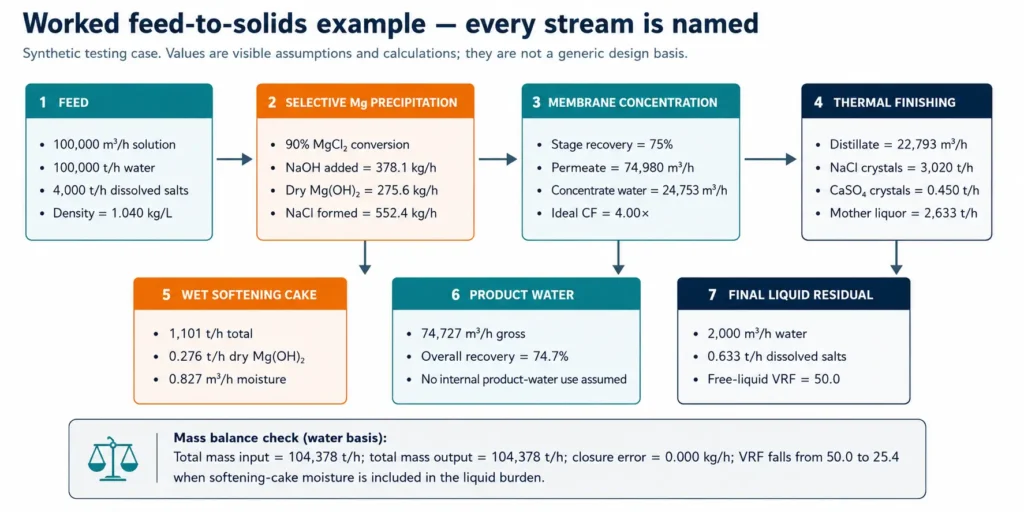
Figure 9.2. Worked feed-to-solids example with all major water, reagent, solid and residual streams named.
| Stream | Water, kg/h | NaCl, kg/h | CaSO₄, kg/h | MgCl₂, kg/h | Other dry solid / reagent, kg/h | Total, kg/h |
|---|---|---|---|---|---|---|
| Feed solution | 100000.0 | 3000.0 | 500.0 | 500.0 | — | 104000.0 |
| NaOH addition | 0.0 | — | — | — | 378.1 NaOH | 378.1 |
| Wet Mg(OH)₂ cake | 826.9 | — | — | — | 275.6 Mg(OH)₂ | 1102.5 |
| Membrane permeate | 74379.8 | 0.0 | 0.0 | 0.0 | — | 74379.8 |
| Thermal distillate | 22793.3 | 0.0 | 0.0 | 0.0 | — | 22793.3 |
| Dry NaCl crystals | 0.0 | 3019.6 | 0.0 | 0.0 | — | 3019.6 |
| Dry CaSO₄ crystals | 0.0 | 0.0 | 450.0 | 0.0 | — | 450.0 |
| Mother liquor | 2000.0 | 532.9 | 50.0 | 50.0 | — | 2632.9 |
Table 9.6. Worked-example stream ledger. Dashes indicate that the component is not applicable to that row.
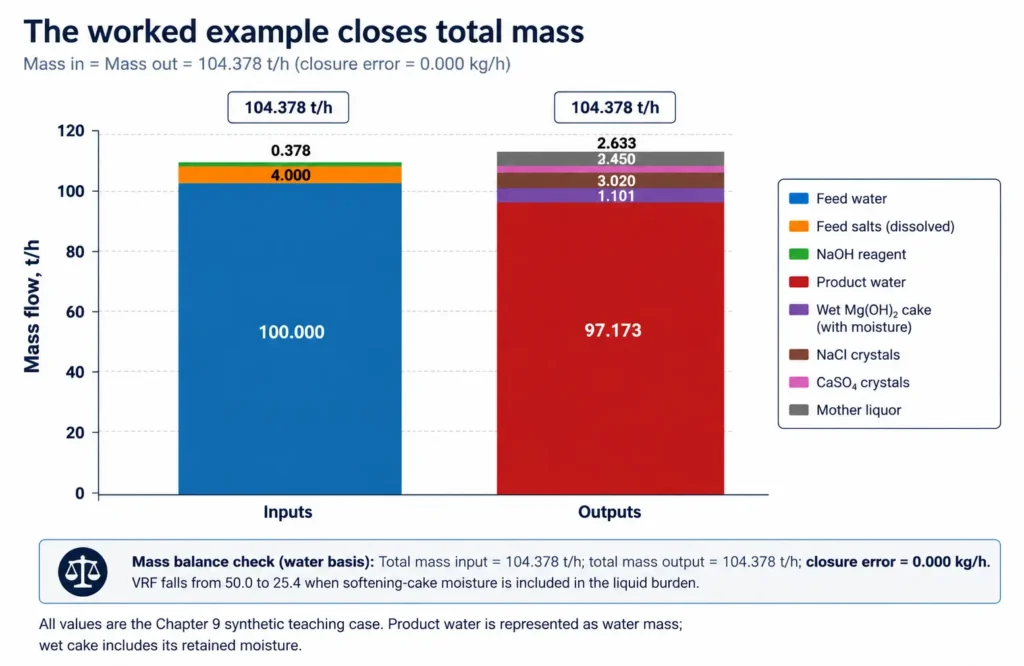
Figure 9.3. Total mass closes at 104.378 t/h on both sides of the worked example.
| Closure / performance item | Input or basis | Output or result | Status |
|---|---|---|---|
| Total mass closure | 104378.1 kg/h input | 104378.1 kg/h output; error 0.000 kg/h | Closed within calculation precision. |
| Water closure | 100,000.0 kg/h feed water | 97173.1 product + 826.9 cake moisture + 2,000.0 mother-liquor water | Closed. |
| NaCl balance | 3000.0 feed + 552.4 reaction product | 3019.6 crystals + 532.9 mother liquor | Closed. |
| CaSO₄ balance | 500.0 kg/h feed | 450.0 crystals + 50.0 mother liquor | Closed. |
| MgCl₂ reaction basis | 500.0 kg/h feed; 90% conversion | 50.0 kg/h residual plus Mg in 275.6 kg/h Mg(OH)₂ | Molar Mg balance controls. |
| Overall gross water recovery | 100.000 m³/h feed water | 97.173 m³/h product water | 97.17% |
Table 9.7. Audit of the worked example.
| What the example deliberately does not proveIt does not prove that MgCl₂, CaSO₄ and NaCl can be selectively recovered at the assumed conversions in a real mixed brine; that complete salt rejection is achievable; that dry crystals meet a product specification; or that the proposed sequence is economic. Those questions require the chemistry, technology, pilot, product and market evidence developed in later parts of the booklet. |
9.8 Batch, recycle and inventory balances
Steady-state equations are insufficient for batch crystallizers, cyclic membranes, regeneration systems, mother-liquor recycle and tanks that fill or empty. The balance period must cover a complete representative cycle, or accumulation must be stated explicitly. A recycle stream is not new production and should not inflate feed, recovery or product totals.
For a mother-liquor loop, each impurity has an accumulation equation: inventory at the end of the period equals initial inventory plus incoming load and reaction additions minus product incorporation, purge, entrainment, degradation and other removals. A “closed loop” with no purge is credible only if every non-product impurity has another quantified removal mechanism.
| Situation | Required calculation | Reporting basis | Failure prevented |
|---|---|---|---|
| Batch or campaign | Initial inventory + additions = final inventory + withdrawals + losses. | Per complete batch and annualized with batch frequency. | Mixing batch totals with hourly rates. |
| Internal recycle | Separate gross circulating flow from net external feed and purge. | Both circulation duty and net boundary flow. | Inflated recovery, pump or treatment-capacity claims. |
| Mother-liquor recycle | Component-by-component accumulation with crystal incorporation and purge. | Per cycle and at long-run periodic steady state. | Hidden impurity buildup and declining product purity. |
| Cleaning / regeneration | Event volume and composition added to annual and design-peak balances. | Per event, per cycle and time-weighted annual basis. | Average balance that misses storage and peak residual duty. |
| Tank storage | dM/dt from measured start/end levels and composition. | Named start/end time and uncertainty. | Treating a changing inventory as unexplained closure error. |
Table 9.8. Dynamic and recycle situations that require more than a steady-state flow split.
9.9 Calculation acceptance gate
A process train can enter technology comparison, economics or environmental assessment only when the water, total mass and controlling constituents close within an agreed tolerance; every reagent and carrier water is included; dry and wet solids are distinguished; product purity and yield have stated bases; recycles and purges are explicit; normal, design and upset cases are separate; and unresolved closure appears as uncertainty rather than hidden adjustment.
Minimum calculation packageProvide the numbered flow diagram, stream table, equations, assumptions, unit conversions, density basis, reaction stoichiometry, stage and overall recoveries, product and residual definitions, closure errors and an editable calculation file. Every number in the narrative should be traceable to that package. |
|---|
9.10 Handover to strategy selection
Parts I and II have now defined the industrial problem, objective, whole-site balance, wastewater composition, variability, failure mechanisms and calculation language. Part III begins by asking which management action should be taken first: avoidance, reduction, segregation, direct reuse, selective removal, concentration, recovery or final disposal.
The handover to Chapter 10 is not a preferred equipment train. It is a closed baseline showing how much water and each constituent enter, where they can leave, what residual burden remains and which metric the project is trying to improve.
9.11 Chapter conclusion
Every process train must close. Feed, product and concentrate flows establish the water balance; constituent loads establish salt and contaminant balances; reagent stoichiometry establishes chemical incorporation; and dry-solids plus moisture accounting establishes the actual residual burden.
Stage recovery, overall recovery, net recovery, concentration factor, volume reduction factor, salt recovery, product yield and purity are not synonyms. Each needs a stated boundary and denominator. A high recovery does not prove low residual burden, and a high solids yield does not prove a qualified product.
The worked example demonstrates the discipline: visible assumptions, a complete stream ledger, reaction accounting, wet-cake moisture, product and mother-liquor streams, and a zero total-mass closure error within calculation precision. Chapter 10 uses this closed baseline to place treatment within the broader saline-wastewater management hierarchy.
Chapter 9 in one sentenceEvery process train must close: water, salts, reagents, products, solids, moisture, purge and accumulation must reconcile across a named boundary. |
|---|