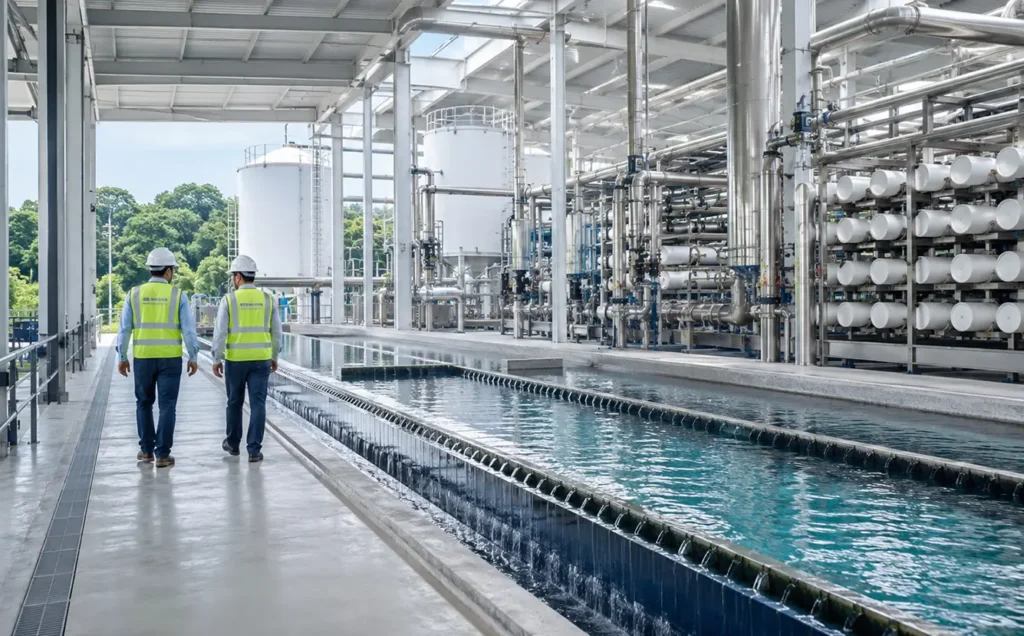
Brine Consulting supports clients in developing water reuse, Minimum Liquid Discharge, and Zero Liquid Discharge systems for industrial, municipal, and infrastructure applications. Our focus is on creating treatment strategies that are technically robust, economically sensible, and aligned with the client’s operational capacity and water security objectives.
Water reuse and ZLD projects require more than a treatment plant. They require a correct understanding of feedwater variability, target water quality, recovery limits, scaling chemistry, pretreatment needs, membrane performance, residuals, sludge, energy, chemical use, and long-term operations. We help clients evaluate these factors early, before project decisions become expensive to reverse.
We work across applications including industrial wastewater reuse, boiler feedwater recovery, cooling tower blowdown, municipal reuse, landfill leachate, food and beverage wastewater, mining water, produced water, high-salinity effluents, and desalination brines. Depending on the case, we help define whether reuse, MLD, full ZLD, partial recovery, or a hybrid approach offers the best balance between cost, compliance, resilience, and environmental benefit.
Typical outputs include reuse strategy, process concept development, recovery optimization, MLD/ZLD flowsheets, technology screening, pre-FEED support, vendor review, cost range assessment, and operational risk analysis.
Who This Is For
Industrial sites where water has become a constraint: abstraction limits or drought restrictions, rising water and levy costs, tightening discharge permits, or a site expansion that needs more water than the permit allows. We work with plant and site managers, process and utilities engineers, and sustainability leads.
What a Water Reuse Feasibility Study Answers
- Which streams are worth reusing, and for which uses on site
- What quality each use needs, and the treatment that gets there
- How much water can be recovered before scaling, fouling or salinity sets the limit
- Where the concentrate goes, and what that route costs
- What the scheme costs to build and run, and how it pays back against water purchase, abstraction charges and the Dutch wastewater levy
What You Receive
- A whole-site water balance that closes, with metering gaps identified
- A review of your water analyses, with missing data and sampling needs
- A reuse options matrix: source reduction, segregation, direct reuse and treatment for reuse, including MLD and ZLD where relevant
- Recovery limits from scaling and concentration screening
- A concentrate and brine management route for each option
- CAPEX and OPEX ranges with their accuracy stated, and a payback view
- A vendor-neutral recommendation with clear next steps
How It Works
- First conversation. Your question, flows, water analyses and permit.
- Data review and balance. We close the water and salt balance and list any data still missing.
- Options screening. We test the options against recovery limits, endpoints and permit constraints.
- Cost ranges and business case. CAPEX and OPEX ranges with their accuracy stated, and the payback logic.
- Specification and vendor evaluation. If you go ahead, we specify the solution and compare supplier proposals on equal terms.
Once representative flow and water quality data are available, a focused feasibility study takes weeks rather than months.
Typical Reuse Applications
- Cooling tower blowdown (see cooling tower water treatment)
- RO concentrate and reject water
- Process rinse water and CIP water
- Steam condensate
- Treated effluent reused for utilities, as in a closed loop water recycling system
Why Independent Advice Matters
We sell no treatment equipment, so the options we put in front of you are not tied to a supplier’s product range. That matters most when deciding how far to push recovery, because an oversized reuse or thermal system is expensive to undo.
What Clients Say
“Christos is not only highly knowledgeable in the field of desalination and brine management but he is also very passionate about his craft. He is a great communicator and it is a pleasure to work with him. He would be a great asset to any team requiring expertise in this field.”
Stan Lueck, President at RODI Systems Corp.
Want to know what a study for your site would involve? Request a consultation: we explain what it would cover before anything is agreed.
Start With the Free Tools
- Industrial Whole-Site Water Balance: close your inflows and outflows
- Industrial Wastewater Scaling & Concentration Tool: screen recovery limits
- MLD vs ZLD Decision Screener: test which endpoint deserves evaluation
- Dutch wastewater levy calculator: estimate what your discharge costs today
For how we design reuse and minimum liquid discharge systems in practice, see industrial water reuse systems in the Netherlands.
Frequently Asked Questions
How much water can an industrial site reuse?
It depends on the streams and the quality each use needs. The practical limit is usually set by scaling compounds, salinity and the cost of handling the concentrate, which is why we screen recovery limits before recommending a scheme.
Do we need zero liquid discharge to reuse water?
No. Most reuse schemes recover water from selected streams and keep a smaller liquid discharge. Minimum liquid discharge often captures most of the benefit at lower cost; ZLD is justified only where no liquid route remains.
What data do you need to start?
Approximate flows, recent water analyses, your discharge permit and your objective. If the data is incomplete, we define a short characterisation step first.
Do you supply or install equipment?
No. We are an independent advisory practice and sell no equipment. We help you specify the system and compare supplier proposals on equal terms.