
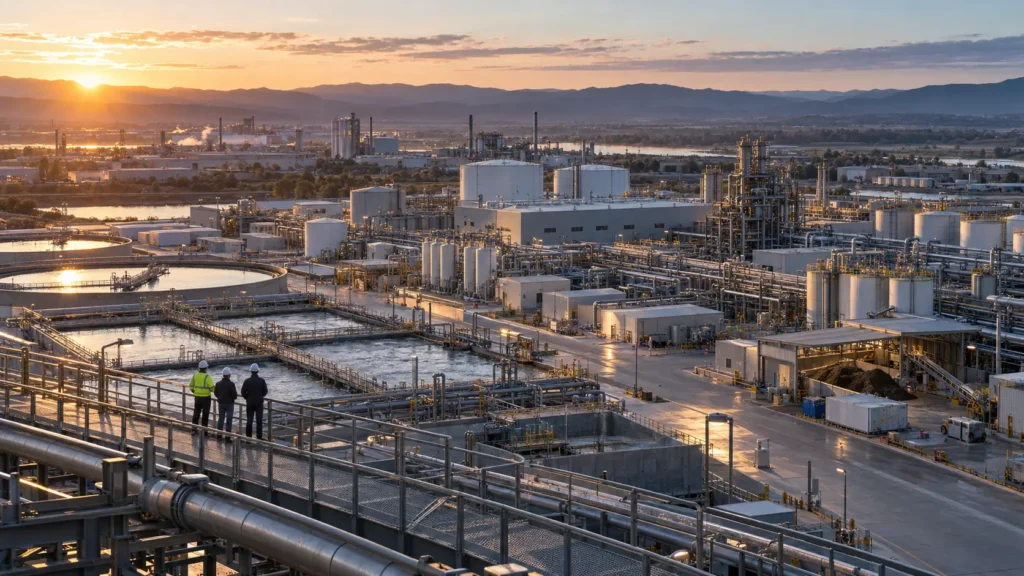
The durable decision discipline that remains useful when technologies, vendors and markets change.
| Purpose | Chapter promise | Controlling anchor |
|---|---|---|
| Compress the whole guide into a durable decision checklist. | Enable an owner, engineer or reviewer to test any MLD, ZLD or valorization concept against ten evidence gates before technology enthusiasm becomes project commitment. | End with a decision discipline, not a sales message. |
Controlled principleA high-salinity wastewater project is defensible only when its decisions can be traced from the real site problem, through the complete water and residual boundary, representative chemistry and variability, source segregation, the chosen endpoint, recovery logic, product qualification, integrated evidence and operability. If one link is missing, the correct action is to stop, simplify or recycle the decision—not to add another unit operation. |
|---|
The guide ends with rules because technologies change faster than decision logic
The preceding chapters deliberately avoided one universal MLD, ZLD or valorization flowsheet. The red-thread cases reached different endpoints because their binding constraints were different: concentrate disposal, mine-water integration, fit-for-purpose reuse, and source segregation. That is the final lesson. High-salinity wastewater projects should be governed by a repeatable decision sequence, not by whichever technology currently has the strongest technical or commercial momentum.
The U.S. Bureau of Reclamation’s concentrate-management work makes the same planning point from another direction: owners face many treatment, minimization and disposal options, and suitability must be assessed against the factors controlling the specific site. Reclamation also cautions that a result judged successful at small scale may still be impractical for a utility-scale application.
| Rule | Non-negotiable question | Minimum evidence | Stop / recycle signal |
|---|---|---|---|
| 1. Problem before technology | What operational, water-security, disposal, regulatory or value problem must be solved? | One-sentence objective; system boundary; cost and risk of doing nothing. | A preferred technology exists before the owner’s problem is quantified. |
| 2. Whole-site mapping | Where do water, salts, pollutants and valuable materials originate and where do they go? | Stream inventory; process origins; flows and variability; reuse and loss map. | The final brine plant is sized from a blended average with no source map. |
| 3. Chemistry beyond TDS | Which species and operating states control the next separation step? | Full ionic and contaminant chemistry; density; temperature; additives; variability; QA/QC. | TDS alone is used as the treatability or technology-selection basis. |
| 4. Segregate before blending | Which streams should remain separate because they are cleaner, valuable, incompatible or easier to treat? | Source identity; hold/release logic; compatibility; dedicated recovery/pretreatment routes. | Blending destroys recovery value or dilutes a difficult stream before treatment. |
| 5. Explicit ZLD boundary | What exactly is meant by ‘zero liquid discharge’ at this site? | Physical/accounting boundary; routine and non-routine liquids; solids, sludge, purge and cleaning routes. | A ZLD claim ignores a liquid purge, wet cake, cleaning waste or off-spec inventory. |
| 6. MLD before automatic ZLD | Does the final increment of recovery solve a real constraint strongly enough to justify its burden? | MLD and ZLD compared against the same endpoint, water-value, lifecycle-cost and risk boundary. | ZLD is selected as a percentage target before the residual endpoint is defined. |
| 7. Every separation creates another stream | Where does every kilogram of water, salt, reagent and impurity go? | Closed water/salt balances; sludge, mother liquor, washes, regenerants, purge and off-spec routes. | A residual disappears from the flowsheet when a separation is added. |
| 8. Buyer/specification before valorization | What qualified use accepts the actual recovered material, in this form and quantity? | Specification; on-spec yield; legal route; internal user/buyer; logistics; rejection and fallback. | Commodity price or elemental presence is treated as bankable product revenue. |
| 9. Integrated pilot evidence | Has the complete train been tested across representative chemistry and operating states? | Pre-agreed success criteria; pretreatment, recycle, solids, cleaning, product and upset evidence. | A short unit-operation test on synthetic or best-case feed is treated as scale-up proof. |
| 10. Operability, downtime and residual disposal | Can the site run, fail, clean, restart and dispose of residuals without breaking the service? | Availability; storage; redundancy; staffing; maintenance; corrosion; spares; fallback and residual capacity. | Steady-state design works only if nothing fouls, fails, goes off-spec or loses its receiver. |
Table 42.1. The ten rules are evidence gates. They are not a technology ranking, weighted score or substitute for project-specific engineering.
Rule 1 — define the problem before selecting technology
A project should begin with the reason to act: water shortage, disposal cost, production constraint, permit exposure, expansion, internal reuse, raw-material loss or another named obligation. The problem statement should be specific enough that the team can define what success means without naming an equipment train. The ‘do nothing’ or current-baseline case must also be visible because avoided water, disposal and production risk often determine the real value of treatment.
Evidence gate — the owner can state the objective, boundary, receiving duty and counterfactual in one coherent basis. If the only objective is ‘achieve ZLD’ or ‘recover minerals’, the framing is not finished.
Rule 2 — map the whole site before designing the final brine plant
Whole-site mapping prevents the most expensive wastewater from being manufactured by the collection system itself. The inventory should identify process origins, clean and contaminated waters, intermittent campaigns, product-rich losses, reusable streams, existing treatment, drains, cleaning events and final receivers. The European chemical-sector BAT framework explicitly requires an inventory of wastewater streams with flow, variability, salts and relevant pollutants, and then prioritizes water reduction, reuse and source recovery before final treatment.
Evidence gate — the final high-salinity boundary is the remainder after source reduction, reuse and source recovery have been screened—not the automatic sum of every drain on the site.
Rule 3 — characterize chemistry beyond TDS
TDS is an inventory descriptor, not a flowsheet. Scaling ions, alkalinity, sulfate, silica, metals, organics, oil, sulfides, nutrients, solvents, process additives, pH, temperature and density can change the feasible sequence even when two streams have similar salinity. The design basis must also represent variability: normal, design and upset states should be supported by representative sampling rather than a single favorable grab sample.
Evidence gate — each major treatment block has a named limiting species or operating condition, and the data set is adequate to mass-balance that species across the proposed train.
Rule 4 — segregate before blending
Segregation preserves options. A relatively clean saline stream may be reusable; a concentrated product or solvent loss may justify recovery; an inhibitory batch may require source pretreatment; and a scaling-rich fraction may be the only stream that needs intensive salt management. EU BAT likewise prioritizes segregation of uncontaminated waters, risk-based buffer storage for abnormal events, and source pretreatment close to the point of generation where dilution would make control harder.
Evidence gate — the project can explain why each material is blended. ‘Common sewer available’ is not a sufficient technical reason when blending destroys source value, compatibility or controllability.
Rule 5 — define the ZLD boundary explicitly
Zero Liquid Discharge is a system endpoint, not a synonym for an evaporator or crystallizer. The boundary must state whether routine liquid wastewater leaves the defined system and must still account for solids, sludges, gases, wet product, purge, cleaning waste, start-up and shutdown inventories and any managed non-routine stream. A ZLD claim that moves an untracked liquid outside the drawing is an accounting failure, not higher recovery.
| Boundary item | Required project statement | Failure mode |
|---|---|---|
| Routine liquid residual | Quantified destination or explicit elimination inside the boundary. | A small purge is omitted because it is operationally inconvenient. |
| Sludge / cake / crystals | Mass, moisture, handling and final route. | Wet solids are treated as if all retained water disappeared. |
| Mother liquor / purge | Recycle limit, impurity accumulation and controlled purge logic. | Closed-loop accumulation is ignored. |
| Cleaning / regeneration | CIP, rinse, regenerant and neutralization route. | Maintenance waste sits outside the advertised ZLD claim. |
| Upset / off-spec inventory | Storage, bypass/fallback and legal endpoint. | The boundary works only at ideal steady state. |
Table 42.2. A ZLD claim is only meaningful when the physical and accounting boundary includes the streams created during real operation.
Rule 6 — test MLD before automatic ZLD
Minimum Liquid Discharge is a purposeful optimum: it minimizes the volume and/or burden of liquid residuals without requiring their complete elimination. The decision to move from a stable MLD endpoint to final thermal finishing should therefore be incremental. Additional recovered-water value and avoided residual burden must be compared with the added energy, chemicals, solids, capital, maintenance, corrosion exposure, downtime and fallback obligation created by the final step. No universal recovery percentage can make that decision for the site.
Evidence gate — the project contains at least one defensible MLD alternative and one more aggressive recovery case on the same lifecycle and residual boundary. The preferred endpoint is the one that solves the actual site constraint at the lowest total burden.
Rule 7 — track the new stream created by every separation
Membranes create permeate and concentrate; softening creates treated water and solids; crystallization creates crystals and mother liquor; ion exchange creates treated water and regenerant; washing creates a cleaner product and a contaminated wash. The flowsheet must therefore grow a residual ledger every time it gains a separation block. Water recovery without salt and impurity accounting is incomplete. [BC]
| Separation action | New stream that must remain visible | Minimum accounting |
|---|---|---|
| Membrane concentration | Concentrate plus cleaning waste | Water, salt, target impurity, CIP volume and endpoint. |
| Precipitation / softening | Sludge/cake plus filtrate | Reagent addition, dry solids, moisture, filtrate chemistry and disposal/reuse. |
| Evaporation / crystallization | Condensate, crystals, mother liquor, purge | Volatile carryover, crystal yield/purity, retained liquor and purge. |
| Product polishing / washing | Wash liquor, fines, off-spec product | Yield loss, recycle, specification and fallback. |
| Regeneration / adsorption | Regenerant, rinse, spent media | Target transfer, chemical use and final waste route. |
Table 42.3. The residual ledger prevents apparent recovery gains from being created by moving water, salt or impurities outside the drawing.
Rule 8 — define the buyer and specification before designing a valorization train
A constituent becomes a product only after the project proves a defined form, specification, consistent quality, lawful route and a real internal user or qualified external buyer. The bankable quantity is the reliable on-spec output after yield, rejection, downtime and storage losses—not the contained elemental inventory. Economics should use internal avoided purchase or delivered netback after purification, qualification, packaging, transport and off-spec handling, with a no-product-revenue case retained.
Evidence gate — the product train can be removed from the commercial case without making the water and residual obligation impossible to operate. If external sales are essential for basic compliance, the project has concentrated market risk inside the treatment plant.
Rule 9 — pilot the integrated system, not the favorite unit operation
Pilot work should close the evidence gap that matters to the project. That normally means representative feed variability, pretreatment, recycle, solids separation, membrane or thermal concentration, cleaning, materials exposure, product quality, mother-liquor or purge behavior, start-up/shutdown and the analytical mass balance are tested together at a scale and duration appropriate to the risk. Reclamation’s concentrate-management programme explicitly distinguishes research success from suitability for implementation and notes that smaller-scale success may not translate directly to large-scale practice.
The success criteria should be written before testing begins: required service, stable operating envelope, fouling/scaling response, cleaning recovery, residual quality, product specification where relevant, data closure and the failure conditions that would trigger redesign. Pilot data are evidence for a decision—not a ceremonial milestone before procurement.
Evidence gate — the pilot reproduces the interactions that can fail in the full train. A single unit operation tested on synthetic, freshly prepared or best-case feed does not prove the integrated system.
Rule 10 — design for operability, downtime and residual disposal
A technically elegant plant that cannot be staffed, cleaned, maintained, restarted or supplied is not a bankable plant. The design basis must include availability, redundancy, buffer and emergency storage, bypass or fallback, operator and laboratory tasks, automation, materials and corrosion inspection, consumables, strategic spares, specialist support, cleaning duration, off-spec management and residual capacity during outages. [BC]
EPA’s current water-reuse research similarly frames treatment around fit-for-purpose quality and operational implementation rather than treatment intensity alone. For high-salinity projects, the same discipline means that recovered water, product and residual routes are all tied to real receiving requirements and operating states.
Evidence gate — the project remains compliant and controllable during cleaning, a unit outage, a feed upset and loss of a product receiver. If the answer is ‘the plant will simply keep running’, the operating case is not finished.
Use the ten rules as a gate sequence, not a weighted score
The rules are deliberately non-compensatory. Excellent product economics cannot repair an undefined residual route; a mature evaporator cannot repair missing feed chemistry; a strong pilot cannot make an unqualified buyer contractual; and high water recovery cannot compensate for an operator model the site cannot sustain. The project should recycle to the earliest failed rule rather than average strengths and weaknesses into one score.
| Project stage | Rules that should be substantially closed | Decision output |
|---|---|---|
| Initial screening | 1–6 | Reason to act, site boundary, chemistry basis, source map and credible endpoint shortlist. |
| Concept selection | 1–8 | Selected MLD/ZLD architecture, complete residual ledger and conservative value case. |
| Laboratory / pilot planning | 3–10 | Explicit evidence gaps, success criteria, representative feed states and integrated test plan. |
| Pre-FEED | 1–10 | Closed balances, operating envelope, pilot evidence, residual routes, downside economics and risk register. |
| FEED / procurement | 9–10 plus all unresolved conditions | Measurable guarantees, interfaces, owner obligations, spares, acceptance tests and fallback capacity. |
| Operations | All ten, continuously | Updated data, controlled change, product/reuse qualification, maintenance and residual compliance. |
Table 42.4. The ten-rule sequence follows project maturity; a later-stage strength cannot erase an earlier-stage fatal gap.
Figure 42.1 — one-page ten-rule poster
| # | Rule | Project discipline |
|---|---|---|
| 1 | Problem before technology | Define the service and counterfactual before naming equipment. |
| 2 | Map the whole site | Find sources, losses, reuse and avoidable loads before sizing the brine plant. |
| 3 | Chemistry beyond TDS | Design to limiting species, contaminants and variability. |
| 4 | Segregate before blending | Keep clean, valuable and incompatible streams separate when it preserves options. |
| 5 | Make the ZLD boundary explicit | Track every routine and non-routine liquid, solid and purge. |
| 6 | MLD before automatic ZLD | Pay for the final recovery increment only when it solves a real constraint. |
| 7 | Every separation creates another stream | Close water, salt, reagent, sludge, wash and mother-liquor balances. |
| 8 | Buyer/specification before valorization | Qualify the actual product, volume, legal route, logistics and fallback. |
| 9 | Pilot the integrated train | Test interactions, recycle, fouling, cleaning, solids and product quality on representative feed. |
| 10 | Design for the bad day | Include downtime, storage, maintenance, staffing, spares and residual disposal. |
Figure 42.1. Ten rules for high-salinity wastewater projects. The poster is a decision discipline, not a universal flowsheet.
Final acceptance gate — when does a high-salinity concept deserve to advance?
| Rule family | Proceed | Conditional / recycle | Stop |
|---|---|---|---|
| Problem + boundary | Objective, system boundary and counterfactual are explicit. | One boundary or value assumption remains bounded and assigned. | Project is a technology demonstration without a defined owner problem. |
| Site + chemistry | Whole-site inventory and representative design/upset chemistry are controlled. | A specific data gap has an approved sampling/test plan. | TDS or one grab sample is the principal design basis. |
| Endpoint + recovery | Residual receiver and MLD/ZLD comparison close on one boundary. | Endpoint depends on a permit, receiver or pilot milestone with a fallback. | Maximum recovery is the objective and the final residual route is undefined. |
| Residual accounting | Every liquid, solid, purge, wash and cleaning stream has mass and destination. | One low-volume stream remains under quantified closure work. | A residual vanishes from the flowsheet or is assumed to have zero burden. |
| Valorization | Specification, reliable volume, user/buyer, legal route, logistics and downside are credible. | Qualification or contract is pending and no-sales case survives. | Economics depend on gross commodity price or 100% merchant sale. |
| Evidence | Integrated test evidence covers representative feed and major failure modes. | Defined evidence programme remains before commitment. | Scale-up depends on short, isolated or non-representative testing. |
| Operations | Availability, maintenance, storage, staffing, spares and fallback are executable. | Owner capability gap has a funded close-out plan. | Compliance depends on uninterrupted ideal steady-state operation. |
| Economics + risk | Case survives higher-cost, lower-availability and no-product-revenue downside tests. | One decision-critical uncertainty awaits evidence. | Project works only in the optimistic base case. |
Table 42.5. Final acceptance gate. Fatal gaps are recycled to the relevant rule; they are not averaged away by strengths elsewhere.
The numbered guide ends here; the appendices turn the rules into working tools
Chapter 42 is the final numbered chapter. The public-booklet appendices that follow are implementation tools rather than new arguments: the data-request sheet turns Rules 1–4 into an intake basis; the analytical programme supports Rule 3 and integrated evidence; the technology screening matrix applies Rules 5–7 without ranking vendors; and the calculation guide makes recovery, balances, product yield, chemical dose, solids generation and treatment cost reproducible.
Chapter conclusion
High-salinity wastewater projects rarely fail because the industry lacks unit operations. They fail when the flowsheet outruns the evidence: a recovery target is selected before the endpoint; a blended TDS hides the chemistry; a valuable or incompatible stream is diluted; a ZLD boundary excludes inconvenient liquids; residuals disappear from the mass balance; product revenue arrives before a product specification; pilot work proves only a preferred device; or the operating model assumes that nothing ever fouls, fails, goes off-spec or loses its receiver.
The ten rules are designed to keep those failures visible. They force the project to start at source, define the real receiving duty, track chemistry and mass, compare MLD with ZLD on the same boundary, qualify value before counting it, test the integrated train and preserve a workable residual and operating fallback. They do not select the same technology for every sector—and that is precisely why they are useful.
The strongest project is therefore not the one with the most equipment, the highest theoretical recovery or the largest headline product revenue. It is the one that can explain, with auditable evidence, why every major block exists, what constraint it removes, what new stream it creates, how the site will operate it, and what happens when the optimistic assumption is removed.
Chapter 42 in one sentenceA bankable high-salinity wastewater project is a chain of evidence from source to endpoint: solve the right problem, preserve the right streams, understand the chemistry, close every residual, prove the integrated system and design for the day when something does not go to plan. |
|---|