
Convert a qualified product into a defensible delivered netback without allowing market assumptions to control the water project.
Controlled principleA qualified product earns project value only at the volume and price actually accessible under a defined grade, delivery basis, receiver capacity, contract structure and fallback route. Global market existence and a published benchmark price are context—not revenue. |
|---|
A market exists only when the actual delivered product can be absorbed
Chapter 25 handed forward a controlled specification, reliable on-spec volume, receiver status, delivered form, acceptance rules and a zero-sales fallback. Chapter 26 begins with that exact package. It does not reopen the case using theoretical contained inventory, the best laboratory batch or a commodity name that hides grade and form.
Official datasets are useful for establishing that a commodity and industrial sector exist. USGS reports industry structure, trends and multi-year statistics for mineral commodities; Eurostat Prodcom reports manufactured production sold by product; Eurostat Comext and UN Comtrade provide detailed trade flows. These sources support market context and triangulation, but their product classifications, reporting units and geographic aggregation do not identify the buyers that can accept a waste-derived material from one plant.
| Evidence state | What it establishes | What it does not establish | Permitted treatment in the project model |
|---|---|---|---|
| Commodity category exists | The material has recognized industrial uses and measurable production or trade. | The recovered grade, location or quantity is saleable. | No revenue; use for market-screening context only. |
| Regional production and trade are quantified | Approximate scale, direction of trade and supply structure are visible. | Accessible demand or local buyer capacity. | No revenue; identify relevant grades, importers and users. |
| Addressable application is defined | A specific grade/form/use and geographic radius have been selected. | A receiver has qualified the actual material. | Conditional demand range, with exclusions visible. |
| Named receivers are mapped | Potential users, annual consumption, delivery form and qualification route are known. | Commitment to buy or accept plant variability. | No contracted revenue; use receiver-specific scenarios. |
| Samples or trials are approved | The actual product has passed a defined technical acceptance milestone. | Volume, price, duration, credit or rejection rights. | Provisional value only if qualification conditions are explicit. |
| Internal commitment or executed offtake exists | A defined volume, term, price basis and acceptance route are committed. | Long-term credit, force-majeure and renewal risk disappear. | Use contracted or approved volume; retain downside and fallback cases. |
Table 26.1. Market evidence must advance from commodity context to a receiver-specific commitment before revenue is recognized.
Global market size must be converted into addressable demand
A global market estimate is normally several filters away from the plant. The relevant denominator is the demand that can accept the product’s exact grade, physical form, package, legal status, delivery frequency and location. Even an accurate global statistic can overstate opportunity when the market is concentrated in distant regions, uses a different hydrate or purity, purchases in lots larger than the plant can supply, or is already served under long-term contracts.
Visible screening equationAddressable demand = reported production or consumption filtered by product classification, grade and form, application, geography, receiver capability, qualification status, delivery window and realistic substitution share. The filters must be evidenced separately; do not apply an unsupported percentage to a global market total. |
|---|
| Demand filter | Minimum evidence | Failure signal | Model response |
| Product classification | HS/CN/Prodcom or commodity category reconciled to the actual product form. | The statistical code combines grades or materials that are not interchangeable. | Use statistics only as an upper boundary; collect buyer-level data. |
| Grade and application | Named specification and use, including purity, phase, moisture and physical form. | Market data describe premium or food/pharma grade while the project makes industrial grade. | Remove incompatible segments and use the matching incumbent product. |
| Geography | Receiver map, transport radius, ports and import/export route. | Demand is global but no user is reachable at a positive delivered netback. | Calculate location-specific demand and delivered cost. |
| Receiver capacity | Actual purchase or consumption by named users and operating schedule. | One plant output exceeds the realistic intake of nearby users. | Cap base-case sales and identify secondary outlets. |
| Qualification and substitution | Approved application, trial protocol and credible replacement ratio. | The buyer will test only a small campaign or requires years of performance data. | Stage volumes by qualification milestone. |
| Timing and growth | Current demand, shutdowns, seasonality, expansion and incumbent contract terms. | A future growth narrative is used to support current revenue. | Separate existing, committed and speculative demand. |
Table 26.2. Addressable demand is a filtered, receiver-specific quantity rather than a share of a global market.
Commercial volume is narrower than process output
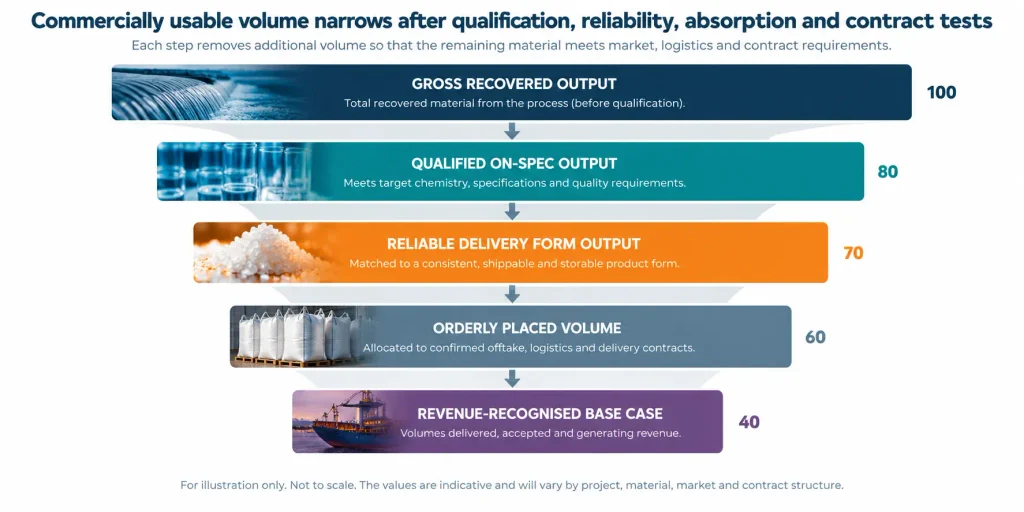
The process mass balance produces a gross recovered quantity. Chapter 25 reduces that to qualified on-spec output. Commercial analysis must narrow it again for availability, storage loss, receiver demand, logistics capacity and contractual commitment. The bankable base case should use the smallest defensible volume across those constraints.
Visible volume ruleCredibly placed volume = the minimum of reliable on-spec production, qualified receiver demand, logistics throughput, stable storage capacity and committed or defensible merchant volume. Any excess remains inventory, a lower-grade outlet or a residual-management obligation. |
|---|
| Volume state | Required basis | Typical overstatement | Economic treatment |
| Gross recovered output | Mass balance after separation recovery and conversion. | All captured mass is treated as product. | No sales credit. |
| Qualified on-spec output | First-pass yield, rework, rejection and representative lot evidence. | Best-batch yield is applied every operating hour. | Maximum technical candidate for placement. |
| Reliable available output | Availability, ramp-up, maintenance, storage degradation and campaign variability. | Nameplate production is multiplied by 8,760 h without evidence. | Use operating cases and annual delivery profile. |
| Credibly placed volume | Receiver capacity, qualification stage, logistics and buyer concentration. | Total market demand is assigned to one new supplier. | Cap at receiver-specific absorption. |
| Revenue-recognized base case | Executed internal commitment/offtake or conservative merchant evidence. | All uncontracted volume receives the same price. | Separate base, upside and zero-sales cases. |
Table 26.3. The commercially defensible volume narrows at every evidence and delivery gate.
Internal use and merchant sale have different value mechanisms
Internal use can be more bankable because the user, incumbent specification, consumption history and avoided purchase are inside the project boundary. The value is not automatically the full invoice price of the incumbent material. It must reflect the actual substitution ratio, avoided inbound logistics and handling, any lost supplier services, additional quality control, storage changes and the operating consequence of product interruption.
External sales may access a larger market but introduce buyer qualification, sales margin, packaging, freight, working capital, credit and rejection risk. The project should compare the two routes on a consistent delivered basis and reserve merchant upside until the receiver and contract evidence justify it.
| Commercial field | Internal-use route | External-sale route | Downside question |
|---|---|---|---|
| Value basis | Avoided delivered purchase, disposal or production constraint attributable to the qualified substitution. | Delivered netback for the actual grade, quantity and contract. | What value remains if substitution or sales stop? |
| Receiver | Named site process owner and approved duty. | Named legal entity with technical and credit approval. | Can the water plant operate during receiver outage? |
| Volume | Actual site consumption and substitution ceiling. | Committed and merchant absorption by delivery period. | Where does excess production go? |
| Logistics | Usually on-site transfer, storage and dosing interface. | Packaging, loading, transport, import/export, unloading and claims. | Which step is capacity-limiting? |
| Price risk | Incumbent purchase contract, index and avoided-cost escalation. | Market/index formula, floor/cap, currency and credit terms. | Does value survive lower price and delayed payment? |
| Failure route | Return to purchased material and residual handling. | Alternate buyer, inventory, downgrade, return or disposal. | Is fallback capacity permitted and funded? |
Table 26.4. Internal use and external sale should be valued on different but equally complete commercial boundaries.
Price must match grade, form, location and delivery terms
Published commodity series are reference points, not invoices. The World Bank publishes dated monthly price series and forecasts for selected global commodities, while USGS provides commodity-specific market and price-trend context. A brine-derived product may differ from those benchmarks in grade, moisture, particle form, lot size, location, certification and contract volume.
The project should therefore build price from the named transaction. Start with the closest defensible comparator and adjust visibly for quality, form, volume, delivery basis, payment, duties, sales cost and expected rejection. Do not use the highest observed spot price or a specialty-grade quotation when the project produces a bulk industrial material.
Netback equationDelivered netback per saleable tonne = contracted or defensible reference price − grade/form discount − volume/contract discount − packaging and loading − freight and delivery − commissions, duties and finance − expected rejection, claims and return cost. Project contribution then subtracts the incremental product-train CAPEX/OPEX allocated to that route. |
|---|
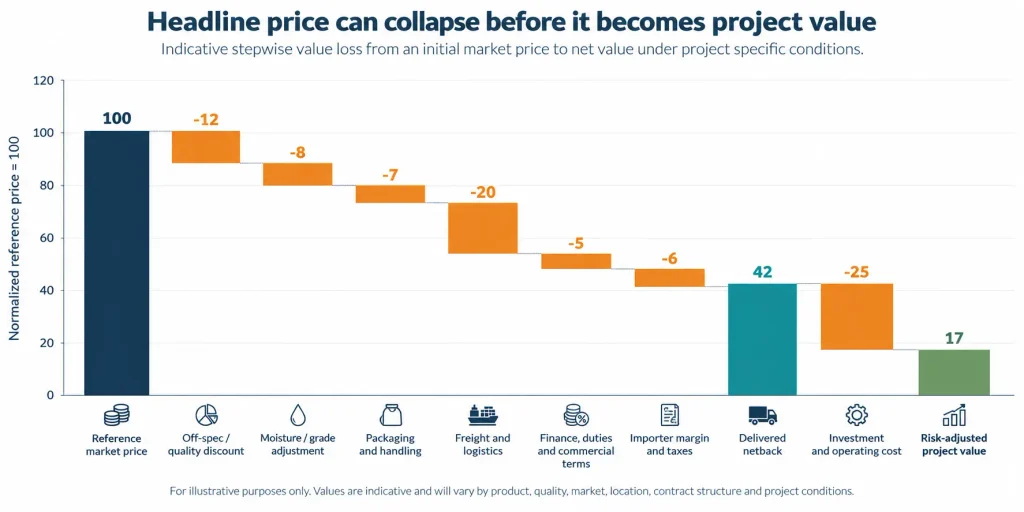
Figure 26.2. Scenario-only gross-price-to-project-value waterfall. Indexed deductions demonstrate the accounting sequence, not typical margins.
| Price field | Required definition | Evidence | Failure signal |
|---|---|---|---|
| Comparator | Exact commodity, grade, basis, unit, location and date. | Contract, buyer quotation, incumbent invoice or traceable benchmark. | A premium spot price is copied from another grade or country. |
| Delivery basis | Named plant gate or destination, transport mode, risk transfer and included services. | Sales term and logistics quotation aligned to the same point. | Ex-works price is combined with seller-paid delivery costs. |
| Volume and term | Lot size, annual quantity, minimum/maximum, contract duration and renewal. | Term sheet or executed agreement. | Small-lot quotation is applied to continuous bulk output. |
| Quality adjustment | Grade, moisture, particle form, contamination, certification and consistency. | Buyer-approved discount/premium formula. | A chemical formula is assumed to be fungible with incumbent material. |
| Payment and credit | Currency, invoicing, payment days, security, bad-debt and working capital. | Credit review and contract terms. | Revenue is booked at shipment with no collection risk. |
| Claims and rejection | Inspection point, decision rule, returns, replacement and liability. | Historical/contractual rejection allowance and route. | Rejected tonnes disappear from the mass balance. |
No headline-price revenue assumptionsDo not multiply gross recovered mass by a public commodity price. Revenue may enter the base case only for qualified, reliably produced and credibly placed volume under a stated delivery and price basis. Uncontracted or unqualified output remains upside or zero-value residual in the downside case. |
|---|
Price volatility belongs in scenarios and contract design
Commodity and freight markets can move materially during project development and operation. The World Bank’s April 2026 outlook and monthly Pink Sheet demonstrate that prices and forecasts are dated and shock-sensitive; UNCTAD reports that freight-rate volatility and route disruption have become persistent features of maritime trade. These sources justify sensitivity analysis, not a universal volatility allowance. [5,9]
The commercial model should distinguish contracted price mechanics from merchant exposure. A fixed price can protect the seller but create inflation or cost mismatch; an index can preserve market linkage but may not track the project’s actual product; a floor/cap or parent guarantee can reduce downside but has a cost and counterparty dependency. Internal avoided cost is also volatile when the incumbent chemical, energy or freight contract resets.
| Price structure | Strength | Risk to test | Required model case |
|---|---|---|---|
| Fixed price | Predictable nominal revenue during the fixed term. | Cost inflation, currency and market divergence. | Contract case plus renewal/repricing downside. |
| Index-linked formula | Transparent linkage to a named market series. | Basis risk between index and actual grade/location; publication lag. | Index history, basis adjustment and floor case. |
| Floor / cap / collar | Limits extremes for one or both parties. | Counterparty strength, option cost and trigger definition. | Stress price beyond floor/cap and default scenario. |
| Cost-plus or avoided-cost formula | Can suit internal substitution or bespoke product. | Disagreement over allowable cost and efficiency incentives. | Auditable cost boundary and incumbent fallback. |
| Merchant / spot exposure | Captures upside and flexible placement. | Price, volume, timing and credit all move together. | No-offtake base/downside; merchant upside separated. |
Table 26.6. Price volatility should be allocated through contract mechanics and explicit downside cases.
Offtake evidence has levels of commercial strength
Expressions of interest are useful for discovery but weak evidence of cash flow. U.S. Department of Energy loan guidance notes that project-finance repayment depends heavily on customer-payment certainty and that signed offtake contracts or committed letters of intent are preferred for a significant share of output. U.S. EXIM guidance similarly emphasizes long-term agreements, creditworthy offtakers, predictable cash flow and concentration risk. These are finance-screening principles rather than universal contract requirements for every brine project.
| Evidence level | What has happened | Remaining uncertainty | Permitted revenue treatment |
|---|---|---|---|
| Market conversation | A potential user confirms general interest. | Grade, sample, volume, price, authority and timing. | Zero. |
| NDA / data exchange | Technical and commercial information is being reviewed. | No acceptance or commitment. | Zero. |
| Sample request / trial | Receiver is willing to test actual material. | Result, scale, repeatability and commercial terms. | Zero; qualification cost only. |
| Approved sample | A stated sample or lot passed the buyer protocol. | Future consistency, volume, price and contract. | Conditional upside; no bankable base revenue. |
| LOI / MOU / term sheet | Parties describe intended volume, price basis and conditions. | Binding status, conditions precedent, credit and remedies. | Probability/scenario treatment only if terms are specific. |
| Conditional offtake | Binding agreement subject to milestones such as qualification or finance close. | Milestone failure, start date and termination rights. | Contracted case with conditions and zero-sales downside. |
| Executed unconditional offtake / approved internal commitment | Defined volume, term, price, quality, delivery and remedies are effective. | Counterparty, force majeure, renewal and residual risk. | Use committed volume subject to credit and performance sensitivities. |
Table 26.7. Offtake strength should be classified by what is committed, not by the enthusiasm of the conversation.
The offtake agreement must allocate quality, volume and interruption risk
A product sale contract does more than state price. It defines the specification, annual and shipment quantities, delivery point, title and risk, inspection, rejection, credit, force majeure, change control and remedies. ICC Incoterms® 2020 can clarify selected delivery tasks, costs and risks between buyer and seller, but they do not replace the full sales contract, product specification, payment terms or legal obligations.
| Contract field | Minimum definition | Seller risk if weak | Buyer risk if weak |
|---|---|---|---|
| Product and specification | Revision-controlled grade, test methods, sampling, decision rule and change control. | Subjective rejection or repeated requalification. | Inconsistent or unsuitable deliveries. |
| Quantity and profile | Annual, monthly/lot minimum and maximum, nominations, ramp-up and tolerance. | Unsold volume and storage burden. | Supply shortfall and process interruption. |
| Take / pay mechanics | Obligation, flexibility, make-up rights and exceptions. | Buyer can stop taking without compensation. | Pays for unavailable or rejected product. |
| Price formula | Base, index, quality adjustment, currency, escalation, floor/cap and review. | Margin erosion or basis mismatch. | Uncontrolled price escalation. |
| Delivery and risk | Named place, loading/unloading, title/risk transfer, freight, insurance and documentation. | Unpriced logistics and loss liability. | Unclear delivery performance. |
| Acceptance and claims | Inspection point, certificate, retest, rejection, return, replacement and claim period. | Open-ended claims and disposal cost. | No remedy for non-conforming supply. |
| Credit support | Payment timing, security, parent/sovereign guarantee, set-off and default. | Bad debt and working-capital exposure. | Excessive security cost or supply termination. |
| Term and termination | Start, duration, renewal, conditions precedent, convenience/default rights and transition. | Stranded product train after early exit. | Locked-in under poor performance. |
| Force majeure and outage | Events, notice, mitigation, allocation during shortage and restart. | Revenue interruption with ongoing plant cost. | No access to substitute supply. |
| Off-spec and zero-offtake fallback | Storage, rework, alternative outlet, return and residual route with capacity. | Water plant depends on continuous sales. | Rejected material accumulates at receiver. |
Table 26.8. An offtake agreement is a risk-allocation instrument, not only a price commitment.
Buyer concentration can become a single-point failure
A nearby buyer can create an excellent netback and still create a fragile water project. If one receiver absorbs most output, its shutdown, credit event, specification change or contract termination can fill product storage and force the upstream treatment train to reduce production. EXIM’s project-finance guidance explicitly treats offtaker credit and concentration as material risks and generally prefers diversification where feasible. [7]
Concentration indicatorLargest-buyer share = annual volume assigned to the largest receiver ÷ total credibly placed volume. Report the ratio and the outage consequence; do not apply a universal pass/fail threshold without product- and project-specific evidence. |
|---|
| Concentration risk | Evidence required | Mitigation | Residual question |
| Single technical qualifier | Only one user accepts the grade or form. | Qualify secondary applications or adjust product form. | Can the material be downgraded without new legal risk? |
| Single volume buyer | One receiver absorbs most or all output. | Multiple buyers, internal use, modular production or full residual capacity. | How long can storage bridge an outage? |
| Single logistics route | One carrier, road, port, pipeline or loading system. | Backup carrier/route, spare loading equipment and emergency storage. | Does rerouting preserve netback and permits? |
| Single credit exposure | Revenue depends on one buyer’s payment. | Credit support, limits, insurance, prepayment or diversified sales. | Who funds inventory and claims during default? |
| Single specification | Product is optimized for one buyer’s proprietary process. | Broader grade window or reversible finishing step. | What is the value after contract termination? |
Table 26.9. Receiver concentration must be tested as an operating and residual-management risk, not only a sales risk.
Logistics is a continuous operating system
Logistics begins before the product leaves the process. Release testing, quarantine, storage, loading, transport, documentation, unloading and rejected-product handling must operate at the plant’s production rhythm. A low annual freight estimate is insufficient if trucks or vessels arrive in campaigns, the loading station is undersized, the buyer closes seasonally, or laboratory release delays fill the silo.
UNCTAD’s 2025 review describes elevated and volatile freight rates, route changes and port disruption. The project should therefore use route-specific quotations and disruption cases rather than a static global freight allowance.
| Logistics step | Required evidence | Capacity / timing question | Failure consequence |
|---|---|---|---|
| Product release | Lot definition, laboratory turnaround, quarantine and certificate process. | Can production continue while results are pending? | Storage fills before product can ship. |
| On-site storage | Usable capacity, segregation, moisture/temperature control and inventory system. | How many hours/days of normal and outage production can be held? | Plant curtailment or cross-contamination. |
| Loading interface | Truck/rail/ship/pipeline rate, queue, dust/spill control and metering. | Does peak loading match carrier slots? | Demurrage, overtime or missed shipment. |
| Inland transport | Payload, axle limits, route, carrier availability, dangerous-goods/waste status and permits. | What is the round-trip fleet requirement? | Freight cost or legal route destroys netback. |
| Port / export / border | Terminal acceptance, storage, customs, documentation and shipment frequency. | Can small or irregular volumes use the terminal? | Delay, rehandling and inventory accumulation. |
| Receiver unloading | Compatible connection, silo/tank capacity, hours, sampling and acceptance point. | Can the receiver take the nominated lot when it arrives? | Rejected or waiting loads and claims. |
| Returns and backup route | Responsibility, reverse logistics, rework/downgrade and permitted residual endpoint. | Can every rejected tonne leave both sites? | Unfunded accumulation and plant shutdown. |
Table 26.10. The logistics chain must close capacity, timing, documentation and rejected-product movement.
Packaging, storage and transport are product requirements
The delivered form can change the commercial outcome. Dry salt may cake or absorb moisture; filter cake may carry free liquid and low payload; a slurry may avoid drying but transport water; acids, alkalis and bromine require compatible containment, safety systems and trained carriers; recovered water may need a pipeline or continuous local consumer. These choices belong in the product specification and netback, not in a post-design logistics note.
Where the material is classified as dangerous goods, the applicable transport regime controls classification, packaging, tanks, marking, documentation and participant obligations. UNECE ADR 2025 governs international road transport in its contracting parties, and the UN Model Regulations provide the basis for many modal and national systems. If the material remains waste, a different legal and documentary route may apply; Regulation (EU) 2024/1157 establishes procedures and controls for waste shipments within, into, out of and through the EU.
| Delivered form | Commercial advantage | Controlling logistics risk | Evidence before selection |
|---|---|---|---|
| Dry crystal / powder | Higher payload and compatibility with bulk solids markets. | Dust, caking, hygroscopicity, contamination and silo discharge. | Storage trial, bulk density, package/silo compatibility and loading test. |
| Wet cake | Avoids some drying energy and equipment. | Low payload, free liquid, drainage, instability and buyer handling. | Moisture distribution, transport containment and receiver dewatering/use test. |
| Slurry / solution | Can preserve chemistry and avoid solids finishing. | Transporting water, corrosion, freezing/precipitation and tank return. | Concentration stability, materials, payload and unloading compatibility. |
| Acid / alkali | Strong internal substitution value and established chemical handling practices. | Dangerous-goods classification, corrosion, concentration drift and emergency response. | Classification, compliant tanks, SDS/documentation and site HSE acceptance. |
| Volatile / toxic specialty chemical | Potential high value at concentrated source. | Containment, off-gas, dangerous goods, specialist carrier and liability. | Full HSE, packaging, emergency and receiver infrastructure review. |
| Recovered water | Continuous local use can eliminate packaging. | Pipeline distance, storage, biological stability and user reliability. | Hydraulic profile, water-quality acceptance and outage route. |
Table 26.11. Product form should be selected together with storage, payload, safety and receiver infrastructure.
Seasonality and inventory can break the production–demand match
High-salinity wastewater treatment may run continuously while product demand follows seasons, maintenance shutdowns, construction cycles or batch campaigns. Annual totals can therefore appear balanced while storage repeatedly overflows. The design must compare daily and weekly production with nominations, shipment windows, laboratory release and receiver outages.
Buffer sizing principleRequired usable buffer is governed by the production rate during the longest credible mismatch between release and removal, plus transport and testing uncertainty, subject to product stability and segregation. The period must be scenario-specific; a generic number of storage days is not defensible. |
|---|
| Mismatch | Evidence | Design response | Downside case |
| Continuous production / seasonal demand | Monthly demand and plant production profile. | Seasonal storage, campaign finishing or alternate outlet. | Demand season is shorter or delayed. |
| Receiver maintenance outage | Planned and unplanned shutdown duration and notice. | Buffer inventory, production curtailment or secondary receiver. | Outage coincides with site upset or storage loss. |
| Irregular transport | Carrier/port schedule, weather and route reliability. | Larger shipment lots, redundant carriers and emergency storage. | Multiple missed shipments. |
| Quality-release delay | Sampling frequency, laboratory turnaround and retest time. | Quarantine capacity and priority analysis. | Repeated borderline lots and retesting. |
| Product degradation | Shelf life, caking, precipitation, corrosion or microbial change. | Conditioned storage, first-in/first-out and limited campaign size. | Inventory expires before placement. |
Table 26.12. Storage must bridge the real timing mismatch without assuming unlimited shelf life or receiver flexibility.
Substitution risk and incumbent displacement must be priced
A recovered product does not enter an empty market. It competes with an incumbent material, supplier relationship, process recipe and risk allocation. The receiver may demand a discount because the new material has shorter operating history, narrower supply security, different physical form, higher testing burden or waste-derived perception. A discount is not necessarily evidence of poor product quality; it may be the price of switching and risk transfer.
The project should compare delivered performance, not chemical assay alone. Internal use must account for the amount of incumbent actually displaced and any productivity or maintenance effect. External sale must account for qualification campaigns, dual sourcing, supplier onboarding and the buyer’s right to revert to the incumbent.
| Substitution field | Question | Evidence | Commercial consequence |
|---|---|---|---|
| Functional equivalence | Does the material perform the same duty at the same or a defined dose? | Receiver trial, process KPI and substitution ratio. | Value is based on useful function, not tonne-for-tonne mass. |
| Supply reliability | Can the project meet volume and delivery through outages and feed changes? | Availability, storage, backup route and supply plan. | Buyer retains dual source or limits share. |
| Switching cost | What testing, equipment, cleaning, permitting or training is required? | Buyer implementation plan and cost owner. | One-time payment, discount or delayed ramp-up. |
| Quality risk | Which impurity or form deviation could damage the buyer process? | Specification, decision rule, liability and insurance review. | Wider discount, tighter rejection or capped volume. |
| Incumbent contract | When can the buyer reduce existing purchases and under what penalties? | Contract expiry, minimum purchase and notice terms. | Addressable demand starts later or is smaller. |
| Perception / waste-derived status | Does policy, customer approval or certification restrict use? | Legal route, buyer policy and customer-chain acceptance. | Segregated application, documentation burden or no route. |
Table 26.13. The commercial comparison should reflect functional substitution, switching cost and incumbent constraints.
Market, offtake and logistics acceptance gate
A product advances only when market absorption, price basis, offtake and logistics are specific enough to enter the project model. Weighted scoring cannot compensate for a fatal missing receiver, impossible transport route or zero-sales fallback that would stop the water plant.
| Gate field | Proceed | Conditional / recycle | Stop | Required record |
|---|---|---|---|---|
| Addressable market | Named grade/use, geography and receiver capacity exceed the base-case placed volume. | Demand exists but buyer-level capacity or timing needs confirmation. | Only a global market statistic or incompatible grade. | Market map and demand register. |
| Price / netback | Comparator, delivery basis and all deductions are evidenced; downside remains viable. | Term sheet or quotations exist but basis/volatility is unresolved. | Headline price or premium-grade quote is the only support. | Netback model and quotations. |
| Placed volume | Reliable on-spec volume matches qualified demand and logistics capacity. | Storage or secondary outlets may bridge variability. | Gross output exceeds credible absorption with no fallback. | Volume bridge and delivery profile. |
| Offtake / internal commitment | Binding or formally approved volume, term, quality and remedies are defined. | Qualification, finance or start-up conditions remain. | Informal interest is treated as committed revenue. | Contract/approval and conditions register. |
| Buyer and credit concentration | Counterparties and routes are resilient or downside capacity is funded. | Concentration is high but storage, guarantees or secondary outlets are developing. | One buyer or route outage stops the water plant. | Credit/concentration and outage analysis. |
| Logistics / storage | Packaging, handling, transport, documentation and rejected returns are operable. | One interface needs trial or permit closure. | No lawful/compatible route or product degrades before delivery. | Logistics mass-flow and capacity ledger. |
| Zero-sales fallback | Permitted, sized and costed residual or alternate-use route exists. | Temporary capacity exists while permanent route is developed. | Project requires uninterrupted sales to remain operable. | Fallback design and cost case. |
Table 26.14. Acceptance gate before product value enters the project economics and centralized-hub analysis.
Handover to Chapter 27 — centralized valorization hubs
Chapter 27 examines whether shared specialist infrastructure, multiple compatible sources and access to ports or industrial users can improve scale, product consistency and market reach. It should receive only candidates whose site-level commercial constraints are explicit. Centralization is not a rescue for an unqualified product or an absent market.
The handover must show the quantity and form moved between source and hub. Transporting dilute brine can destroy the economics and environmental case; source segregation or pre-concentration may be required before a hub is credible. The comparison must therefore include water mass transported, source-site residuals, hub losses, product netback and the contract allocation between brine suppliers, hub operator and offtakers.
| Handover field | Required basis for Chapter 27 | Hub question | Failure if missing |
|---|---|---|---|
| Qualified product / intermediate | Controlled form, impurity envelope and required finishing. | Can multiple sources be blended or processed without losing qualification? | Hub combines incompatible materials and makes an unqualified mixture. |
| Source volumes and variability | Normal/design/upset flow, contained mass, availability and campaigns. | Does aggregation create meaningful, reliable scale? | Annual averages hide incompatible timing or chemistry. |
| Transported form | Brine, concentrate, cake, slurry or product; water and payload explicit. | Should the source pre-concentrate or dewater before transport? | Transporting water consumes the netback. |
| Market and offtake | Receiver locations, placed volumes, price basis and contract strength. | Does the hub improve buyer diversification or only move the same risk? | No additional absorption or contracted demand. |
| Shared infrastructure | Energy, port, storage, laboratory, HSE and specialist operations. | Which shared assets create measurable value? | Hub complexity and fees exceed scale benefit. |
| Residual allocation | Source and hub sludges, mother liquor, purge, off-spec and returns. | Who owns, permits and pays for every residual? | Waste liability is displaced but not solved. |
| Commercial structure | Tolling, purchase/sale, take-or-pay, capacity reservation and quality responsibility. | How are feed risk, yield, product price and downtime allocated? | No party accepts variability or market risk. |
Table 26.15. Chapter 27 needs the source-to-hub mass, market and risk boundary—not a claim that scale alone creates value.
Chapter conclusion
A qualified product is not yet a bankable revenue stream. The commercial case must identify the addressable grade and geography, reliable saleable volume, receiver capacity, delivered price basis, contract strength, buyer credit and concentration, storage and logistics chain, substitution risk and the route for every unsold or rejected tonne.
Global production, trade statistics and public price series are valuable for context and screening, but they remain several steps away from the plant transaction. The correct economic input is the volume that can be credibly placed under a stated delivery and acceptance basis, multiplied by the delivered netback—not gross recovered mass multiplied by a headline commodity price.
The water project must remain operable under a no-offtake case. Where site scale, specialist infrastructure or buyer access are inadequate, Chapter 27 can test a centralized hub—but only with the transported water mass, product qualification, contracts and residual ownership visible.
Chapter 26 in one sentenceProduct value enters the project only when qualified volume, addressable demand, delivered netback, offtake, logistics and the zero-sales fallback are all defensible on the same system boundary. |
|---|