
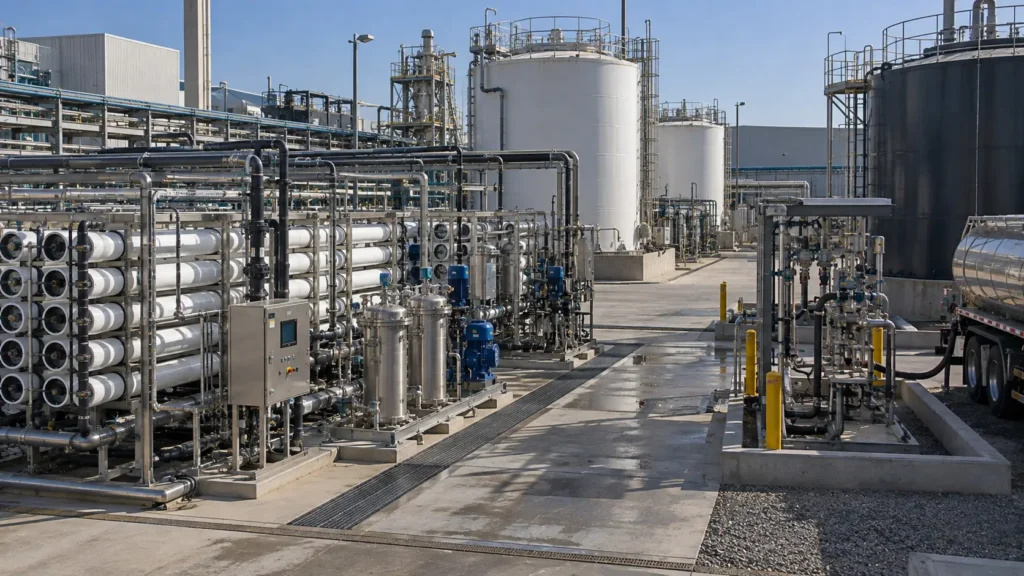
Show why a quantified liquid residual can be the rational technical, economic and operational optimum.
Controlled principleMinimum Liquid Discharge is a site-specific strategy that minimizes the volume and/or burden of liquid residuals without necessarily eliminating them. It is not a fixed recovery percentage and it is not a failed ZLD project. The selected stopping point must be tied to a qualified endpoint, visible marginal economics, complete residual accounting and an operable fallback. |
|---|
12.1 MLD is an optimum, not a percentage
Chapter 11 established the destination, capacity, chemistry envelope, availability, lifecycle liability and full cost of each residual route. Chapter 12 uses that endpoint register to determine how much treatment is actually justified. The objective is not to recover the largest possible fraction of water. It is to reach the point at which the remaining liquid is manageable and the next recovery increment no longer creates sufficient water, compliance, production or risk value to offset its additional energy, chemicals, solids, capital and operational fragility.
The 2025 brine-management review in Nature Reviews Clean Technology distinguishes MLD from ZLD on precisely this systems basis: MLD reduces brine volume and recovers part of the water while retaining a disposal requirement, whereas ZLD proceeds to complete liquid elimination through concentration and crystallization. The review treats technology selection as a constrained optimization problem determined by location, regulation, chemistry and economics rather than by a universal recovery target.
A project may therefore be MLD at 60%, 85% or another recovery only within its stated boundary and residual route. The same numerical recovery can be rational at one site and indefensible at another. What matters is the value captured, burden avoided, residual produced and risk retained.
| MLD preference condition | Question | Evidence | Reason to stop before ZLD | Failure / escalation trigger |
|---|---|---|---|---|
| Manageable liquid route | Can a named endpoint accept the residual under normal, design and upset conditions? | Permit/contract, receiver test, capacity and contingency. | Liquid elimination is not required to close the residual balance. | No credible route, unacceptable liability or route failure. |
| Volume-dependent disposal cost | How does total endpoint cost change as residual volume falls? | Comparable tariff/quote, transport, conditioning and closure basis. | Reducing volume can capture most value before the final liquid disappears. | A fixed minimum charge, capacity step or rejection threshold changes the curve. |
| Valuable recovered water | Which internal use or supply risk is displaced by each recovery block? | Fit-for-purpose specification, demand profile and alternative-supply cost. | Stop when incremental recovered water has lower value than incremental system burden. | High strategic water value or production dependence supports further recovery. |
| Residual brine reuse | Can the concentrated liquid serve a defined internal or external process? | Receiver specification, compatibility test, seasonal demand and legal route. | A usable liquid may have greater system value than an unqualified mixed solid. | Receiver loss, variable chemistry or unacceptable accumulation. |
| Energy / carbon burden | What electrical, thermal, chemical and logistics burden is added by the last block? | Block SEC/duty, energy source, operating hours and emissions factors. | The final thermal or crystallization block may dominate marginal burden. | Useful waste heat or low-carbon energy materially changes the case. |
| Unusable mixed salts | Will deeper concentration create a qualified product or a disposal solid? | Phase path, impurity rejection, washing, product specification and buyer tests. | Avoid converting a manageable liquid into larger quantities of low-value mixed solids. | Selective separation yields a qualified product with credible net value. |
| Reliability and risk reduction | Does MLD provide most compliance and disposal resilience with a simpler train? | Availability model, storage, bypass/fallback, cleaning and operator capability. | A shorter train may deliver higher effective annual recovery and easier contingency. | Endpoint outages or production-critical closure require complete liquid elimination. |
Table 12.1. Conditions that can make MLD the rational site-specific optimum.
12.2 The endpoint defines the minimum treatment target
The starting calculation is the residual route’s accepted flow and chemistry, not the maximum recovery claimed by a technology. The owner should convert the endpoint register into a treatment target: maximum annual and peak volume, pH and temperature envelope, suspended-solids and oil limits, constituent-load limits, batch restrictions, storage requirement, acceptance window and contingency capacity.
Bureau of Reclamation concentrate-management work frames further dewatering as a way to reduce the volume requiring management and recover additional water where it is cost-effective. That framing is important: concentrate minimization serves a residual-management objective; it does not imply that every remaining litre must be evaporated.
| Endpoint field | Required value | Treatment calculation | Decision implication |
|---|---|---|---|
| Accepted routine flow | Average and annual volume reserved by the receiver. | Required overall and net recovery after recycle/CIP losses. | Sets the nominal MLD target. |
| Peak and batch capacity | Maximum transfer rate, batch window and event limit. | Equalization, storage, batch segregation and peak treatment. | Averages cannot hide endpoint bottlenecks. |
| Chemistry envelope | pH, temperature, salinity, solids, oil, organics and named constituents. | Selective treatment and blending needed to reach acceptance. | The endpoint may be chemistry-limited before volume-limited. |
| Availability | Planned/unplanned outage and seasonal access. | Storage days, alternate route and production response. | A low-cost route without continuity may not support MLD. |
| Lifecycle cost | Conditioning, transfer, fees, monitoring, liability and closure. | Comparable annualized baseline and sensitivities. | Use full cost, not only the receiver tariff. |
| Change trigger | Permit, capacity, production, fee or receiver-status threshold. | Future recovery stage or modular expansion. | MLD can be designed as a staged strategy rather than a permanent ceiling. |
Table 12.2. Convert the endpoint register into a quantified MLD treatment target.
12.3 The final recovery increment must justify itself
Recovery should be evaluated in blocks. For each additional block, calculate the incremental water produced, the residual volume avoided, the new constituent concentrations, the treatment and solids burden, the effect on availability and the value of the water or capacity unlocked. The correct question is not whether the cumulative recovery remains attractive; it is whether the next block remains attractive.
Research on OARO, LSRRO, counterflow RO and ED shows why membrane–thermal hybrids are actively developed: membrane or electrochemical concentration can reduce the volume sent to thermal finishing where chemistry and pressure permit. These studies also show that performance and cost depend on feed salinity, staging, area, pressure, current density, recycles and product-water requirements. A promising membrane bridge does not remove the need to test the marginal final step.
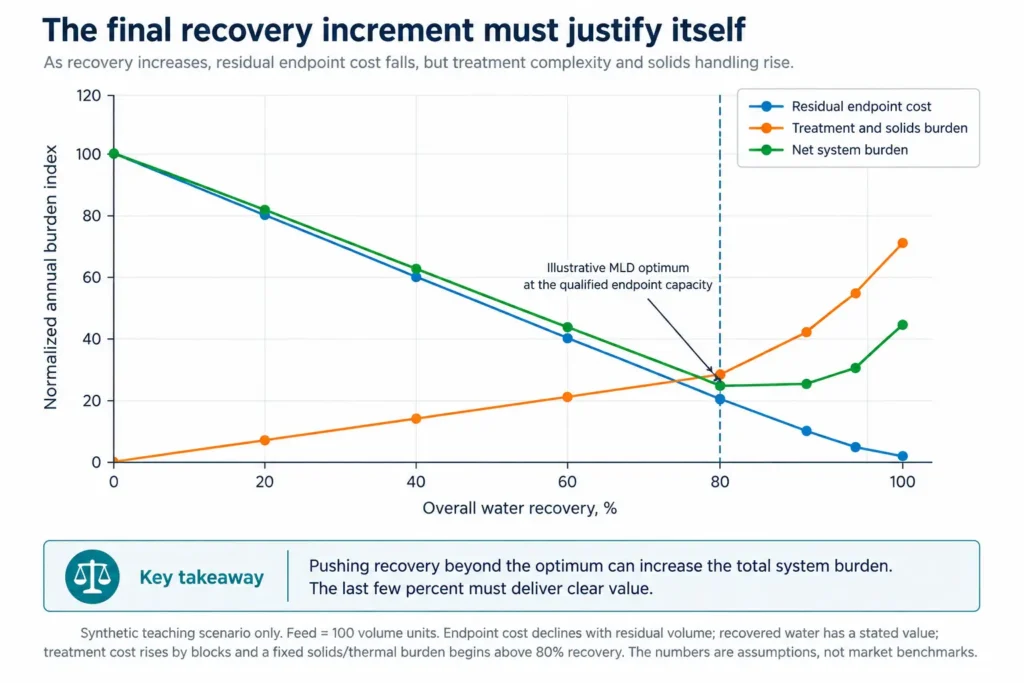
Figure 12.1. Recovery–cost curve for a transparent synthetic scenario. It is not a generic industry benchmark.
| Recovery | Residual volume | Endpoint cost | Treatment burden | Recovered-water value | Net burden |
|---|---|---|---|---|---|
| 0% | 100 | 100.0 | 0.0 | 0.0 | 100.0 |
| 20% | 80 | 80.0 | 7.0 | 6.0 | 81.0 |
| 40% | 60 | 60.0 | 14.0 | 12.0 | 62.0 |
| 60% | 40 | 40.0 | 21.0 | 18.0 | 43.0 |
| 80% | 20 | 20.0 | 28.0 | 24.0 | 24.0 |
| 90% | 10 | 10.0 | 42.0 | 27.0 | 25.0 |
| 95% | 5 | 5.0 | 54.5 | 28.5 | 31.0 |
| 98% | 2 | 2.0 | 71.0 | 29.4 | 43.6 |
Table 12.3. Visible inputs and results for Figure 12.1. All values are normalized scenario assumptions.
Marginal decision ruleAdvance to the next recovery block only when its incremental value—water, capacity, compliance, avoided disposal and risk reduction—exceeds its incremental treatment, energy, chemicals, solids, downtime and retained-liability burden under the downside case. |
|---|
12.4 Volume-dependent disposal cost can favour partial concentration
Where hauling, sewer, injection, pond or centralized treatment charges rise with volume, reducing the liquid residual can lower cost and release capacity. The curve is rarely perfectly linear. It may include minimum monthly charges, vehicle or batch steps, reserved-capacity payments, distance bands, storage, analytical acceptance, rejected-load costs and contingency premiums.
The MLD optimum can occur at an operational threshold rather than a mathematical minimum: the recovery at which one fewer truck is required, a contracted flow tier is reached, a pond balance closes in the dry year, an injection-well pressure envelope is maintained or a sewer allocation is no longer exceeded. These thresholds must be stated as site assumptions or current contractual evidence.
| Cost element | Volume relationship | Data source | Potential discontinuity | MLD implication |
|---|---|---|---|---|
| Receiver tariff / disposal fee | Per-volume, per-mass, minimum charge or blended. | Current quote, contract or tariff. | Tier, minimum invoice or surcharge. | Target the tier or accepted load, not arbitrary maximum recovery. |
| Transport | Vehicle trips, distance, loading and waiting. | Route and logistics study. | Whole-truck increments and route disruption. | A modest volume reduction may eliminate a full trip. |
| Conditioning | Chemical/solids burden may scale with flow or contaminant mass. | Bench test and reagent/sludge balance. | New precipitation threshold or sludge class. | The endpoint chemistry can set the optimum before volume. |
| Storage and contingency | Tank/pond inventory and outage duration. | Availability and emergency plan. | Discrete tank train or production curtailment. | Higher recovery may reduce required contingency storage. |
| Monitoring and liability | May be fixed, volume-based or risk-based. | Permit, contract and governance review. | Reclassification or changed post-closure duty. | Do not assume lower volume proportionally reduces liability. |
Table 12.4. Disposal costs must be modelled as the actual commercial and operational function.
12.5 Residual brine reuse can be better than converting it into mixed solids
A liquid residual can be a deliberate output when its salinity, constituent content or physical condition serves a defined receiver. The strongest case is internal: the brine replaces purchased water, salt solution, process make-up or another input under a controlled specification. An external industrial receiver requires the same discipline as any recovered product: specification, variability, legal route, logistics, acceptance tests, demand profile and off-spec fallback.
Residual reuse should not be used as a label for dilution or burden transfer. The receiver’s complete water and salt balance must remain closed, including accumulation, purge, contaminants and the consequence of interrupted demand. The MLD system must retain a fallback endpoint for periods when the reuse outlet is unavailable.
| Reuse gate | Evidence required | Value basis | Failure mode | Required fallback |
|---|---|---|---|---|
| Named receiver and use | Process location, function and operating demand. | Avoided internal purchase or verified service value. | Use is conceptual or demand is too small. | Qualified endpoint for unused volume. |
| Fit-for-purpose chemistry | Specification, compatibility and pilot/receiver test. | Avoided treatment or reagent purchase. | Scaling, corrosion, product contamination or accumulation. | Segregation, conditioning or diversion. |
| Variability and timing | Normal/design/upset envelope and demand calendar. | Reliable displacement of an existing input. | Seasonal mismatch, shutdown or batch incompatibility. | Storage and alternate route. |
| Legal and contractual route | Classification, permit, ownership and acceptance agreement. | Risk-adjusted transfer value. | Brine remains a waste or receiver changes status. | Owner retains compliant management route. |
| Off-spec management | Rejection criteria, quarantine and rework/disposal. | Value after rejection probability. | Contaminated inventory or forced production stop. | Dedicated tank and named disposal route. |
Table 12.5. Residual-brine reuse requires a receiver, specification, timing match and fallback.
12.6 Excessive thermal energy and carbon burden can move the optimum earlier
The final concentration and crystallization blocks usually operate on the smallest liquid flow but the most difficult chemistry. Osmotic pressure, boiling-point elevation, viscosity, scaling, corrosion, foaming and impurity accumulation are highest there. The resulting burden must be reported as separate electrical and thermal energy, with the denominator stated per feed, recovered water, distillate or brine eliminated.
Published comparisons of advanced membrane processes with mechanical vapour compression consistently motivate membrane-based preconcentration because thermal finishing remains energy-intensive. The 2025 review concludes that current MLD/ZLD systems still rely heavily on mechanical vapour compression and thermal crystallizers, while emerging membrane systems must demonstrate practical competitiveness and reliability.
Carbon is site-specific. Electricity mix, steam source, useful waste heat, boiler efficiency, refrigerants, chemicals, residual transport and solids disposal all affect the result. A low-carbon waste-heat source can justify deeper recovery; an inefficient fossil-steam system can make the same recovery block environmentally and commercially unattractive.
| Burden | Required basis | Why it rises near the endpoint | Potential MLD advantage | Condition supporting deeper recovery |
|---|---|---|---|---|
| Electrical energy | kWh by block and denominator; pumps, compressors, recycles and auxiliaries. | Higher pressure, recirculation, viscosity and smaller driving force. | Avoids the least efficient concentration block. | Efficient membrane/electrochemical bridge with proven availability. |
| Thermal energy | Steam/heat duty, temperature level, COP/economy and source. | Boiling-point elevation, heat-transfer loss and crystallization duty. | Stops before evaporator/crystallizer duty dominates. | Useful waste heat or efficient MVC/MVR integration. |
| Chemicals | Dose, purity, excess, neutralization, cleaning and antifoam. | More severe scaling/fouling and product-purity control. | Lower reagent and cleaning-waste generation. | Selective removal produces stable feed and usable solids. |
| Carbon / environmental burden | Electricity and fuel factors, chemicals, logistics, residuals and replacement. | Energy- and materials-intensive final block. | Captures water/disposal benefit at lower total burden. | Low-carbon energy and avoided high-impact endpoint. |
| Infrastructure | Installed duty, redundancy, storage, materials and replacement. | Specialized metallurgy, vapour systems and solids equipment. | Smaller, simpler plant and easier contingency. | Production-critical closure and strong operator capability. |
Table 12.6. Energy and carbon screening for the final recovery increment.
12.7 Unusable mixed salts are a burden, not a valorization credit
Complete liquid elimination converts dissolved inventory into dry or wet solids, but it does not guarantee a usable product. Mixed industrial brines can co-crystallize salts, entrap mother liquor, incorporate trace contaminants and produce variable cakes that require washing, drying, purification or disposal. The relevant comparison is therefore not liquid waste versus saleable salt; it is the actual MLD residual versus the actual ZLD solids and purge package.
Recent crystallization research demonstrates that high-purity separation from mixed salts requires phase-specific process design, controlled sequencing or selective transport. A 2025 Na2SO4/NaCl study used freeze crystallization and staged evaporation to obtain separate products, while a Nature Water study used diffusion-controlled selective crystallization to suppress mixed-ion transfer. These results demonstrate possibility under defined conditions, not generic productability of an industrial mixed-salt cake.
| Solids question | Evidence | MLD implication | ZLD escalation condition | No-credit rule |
|---|---|---|---|---|
| What phases form? | Phase diagram/model, crystallization tests and mineralogy. | Retain liquid if the solid path is uncontrolled or unstable. | Defined sequence produces manageable solids. | Do not label total TDS as recoverable salt. |
| What purity and consistency result? | Campaign samples, washing/drying tests and specification comparison. | Avoid creating variable mixed cake without a user. | Qualified internal user or buyer accepts the product envelope. | No revenue before qualification. |
| What remains in mother liquor? | Impurity accumulation, recycle and purge model. | A controlled liquid purge may be the rational endpoint. | Purge has a named route or further selective treatment. | Closed loop cannot hide accumulation. |
| What is the physical form? | Moisture, particle size, handling, dusting and storage tests. | Liquid residual may be easier and safer to transfer. | Solid form materially reduces liability and has a route. | Dry mass alone is not the residual burden. |
| What is the legal status? | Waste/by-product/product assessment for the jurisdiction. | Do not create a harder-to-place solid solely to claim ZLD. | Solid has a durable legal and contractual pathway. | Technical purity does not establish market status. |
Table 12.7. Mixed-salt production must be evaluated as a solids-management system.
12.8 Risk reduction without absolute liquid elimination
MLD can deliver most of the project’s risk reduction by bringing the residual within a permitted route, reducing dependence on transport, creating storage headroom, recovering water during drought, removing the constituent that drives rejection or limiting the volume exposed to a high-liability endpoint. The resulting system may have fewer unit operations, lower minimum turndown, simpler restart and more credible contingency than full ZLD.
The relevant measure is effective annual performance. A nominal ZLD train with lower availability can recover less usable water over the year than a stable MLD train, while producing more cleaning waste and off-spec inventory. Availability, maintenance duration, start-up losses, minimum operating load, standby strategy, operator skill and spare-parts supply should therefore enter the comparison.
| Risk dimension | MLD control | Residual risk retained | Downside test | Trigger for ZLD review |
|---|---|---|---|---|
| Compliance | Condition residual to a qualified permitted route. | Permit/receiver dependence remains. | Tighter limit or route suspension. | No practical compliant liquid route. |
| Water security | Recover the economically valuable water block. | Some water remains in residual. | Dry-year source cost and production curtailment. | Strategic water value exceeds final-block burden. |
| Endpoint capacity | Reduce volume to reserved capacity and storage. | Capacity/availability risk remains. | Receiver outage and peak event. | Capacity cannot be secured for project life. |
| Operations | Use a shorter, more maintainable train with fallback. | Routine liquid handling continues. | Lower availability, long cleaning and operator shortage. | Expansion or safety requires loop closure. |
| Residual liability | Reduce volume and remove controlling constituents. | Long-term liquid-route liability remains. | Reclassification, receiver insolvency or future closure. | Liquid liability is unacceptable relative to solids route. |
| Commercial / product | Avoid relying on unqualified mixed-salt revenue. | No solids-product upside. | No-product-revenue and high-disposal case. | Qualified product materially improves downside-surviving economics. |
Table 12.8. MLD risk reduction and the conditions that reopen the ZLD question.
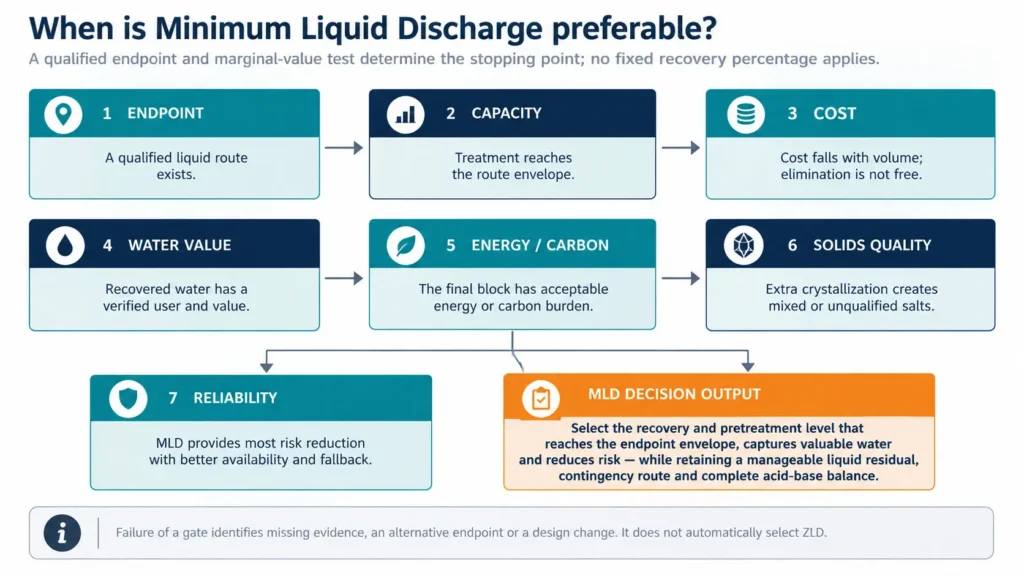
Figure 12.2. MLD preference test. The endpoint is a controlled output, not an unreported failure to reach ZLD.
12.9 Compare MLD options as integrated systems
MLD is not one flowsheet. The shortlist can include source reduction plus disposal, direct reuse plus purge, selective precipitation plus membrane concentration, membrane–electrochemical hybrids, membrane concentration plus a small thermal finisher, or other site-specific combinations. Each option must be compared at the same boundary and endpoint.
| Option | Water output | Liquid residual | Solids / new wastes | Primary value | Critical uncertainty |
|---|---|---|---|---|---|
| Source/segregation + endpoint | Only directly reusable streams. | Largest but simplest compatible residual. | Minimal new treatment waste. | Low complexity and high availability. | Endpoint capacity and future limits. |
| Selective treatment + endpoint | Fit-for-purpose water or reusable brine where applicable. | Reduced burden or targeted chemistry. | Specific sludge/media/cleaning waste. | Remove only the constituent that constrains the route. | Reaction yield, carryover and sludge route. |
| Membrane MLD | Permeate from one or more concentration stages. | Smaller high-salinity concentrate. | Pretreatment sludge, cleaning waste and spent components. | Water recovery and disposal-volume reduction. | Scaling/fouling, pressure, SEC and availability. |
| Electrochemical / hybrid MLD | Dilute stream or water after polishing. | Concentrate and stack purge. | Cleaning, electrode/membrane replacement and pretreatment wastes. | Selective or deeper concentration under defined chemistry. | Current efficiency, organics, stack cost and product quality. |
| Membrane + limited thermal | Permeate plus distillate. | Small mother liquor / purge. | Crystals/sludge, antifoam and cleaning waste. | Use membranes to minimize thermal duty while retaining a liquid endpoint. | Foaming, carryover, corrosion and purge acceptance. |
Table 12.9. MLD alternatives must be compared at the same endpoint, availability and residual boundary.
12.10 MLD decision package and acceptance gate
The prefeasibility output should state the selected residual flow and composition, why the endpoint can accept it, which recovery blocks were tested, where marginal value turns negative, what water and solids are produced, how annual availability changes the result and what trigger would justify a later ZLD stage.
| Decision package item | Minimum content | Acceptance question | Output |
|---|---|---|---|
| Endpoint baseline | Named route, accepted flow/chemistry, capacity, availability, liability and full cost. | Is the route technically and legally credible for the project life? | Qualified residual target. |
| Recovery blocks | Water, concentration factor, constituent loads, energy, chemicals, solids and availability by block. | Does each increment add more value than burden? | Selected stopping point and rejected blocks. |
| Water value | Internal user, specification, demand, alternative supply and interruption value. | Is recovered water actually used and valued? | Risk-adjusted water benefit. |
| Residual reuse | Receiver, specification, timing, legal route, contract and fallback. | Is the liquid output a controlled service or burden transfer? | Qualified reuse plus contingency. |
| Energy / carbon | Electrical/thermal duty, source, denominator, chemicals and logistics. | Does the last block dominate total system burden? | Block-level energy and emissions case. |
| Solids and products | Dry/wet mass, phases, purity, washing, mother liquor, legal status and route. | Are additional solids usable or simply a new waste? | No-credit, internal-use or qualified-product case. |
| Reliability and downside | Availability, turndown, storage, cleaning, operator/spares, no-product and endpoint-outage cases. | Does the option remain operable and financially defensible? | Preferred MLD train and escalation triggers. |
Table 12.10. Minimum MLD decision package before the project advances.
MLD acceptance gateSelect MLD only when the remaining liquid has a named, qualified and resilient route; the chosen recovery reaches that route’s capacity and chemistry envelope; the marginal curve has been shown; water and residual reuse are tied to real users; energy, carbon and solids are fully counted; and the downside case remains operable. The unresolved final recovery increment becomes the explicit question for Chapter 13. |
|---|
12.11 Handover to when ZLD is justified
Chapter 12 identifies the point at which a manageable liquid residual can be the rational optimum. Chapter 13 tests the opposite case: whether the liquid route is unavailable or intolerable, strategic water value or production closure warrants the final block, useful heat and stable chemistry support it, and the site can manage the resulting solids, mother liquor, outages and operator burden.
The handover is the rejected final recovery block: its incremental water, cost, energy, carbon, solids, availability and liability compared with the MLD baseline. ZLD is justified only when that block survives separate technical, operational and downside scrutiny.
12.12 Chapter conclusion
MLD is preferable when a named liquid route remains technically compatible, legally credible and operationally resilient, and when partial concentration captures most of the available water, disposal and risk value. Volume-dependent disposal cost can make reduction worthwhile without making elimination rational. A reusable liquid residual can be more valuable than an unqualified mixed-salt cake. Excessive thermal energy, carbon, chemical and specialized-infrastructure burdens can move the optimum earlier.
The decision must be marginal and site-specific. Each recovery block should be compared against the same endpoint, water value, availability and downside assumptions. Mixed salts receive no product credit without phase control, purity, legal status and a user. Nominal recovery is not a substitute for effective annual performance.
The final recovery increment must justify itself. Where it does not, MLD is a purposeful optimum. Where no credible liquid route exists or the strategic and liability case is stronger than the final-block burden, Chapter 13 tests whether ZLD is justified.
Chapter 12 in one sentenceMLD is the rational optimum when a qualified liquid residual captures most project value and the final recovery increment adds more energy, solids, cost and fragility than it removes. |
|---|