
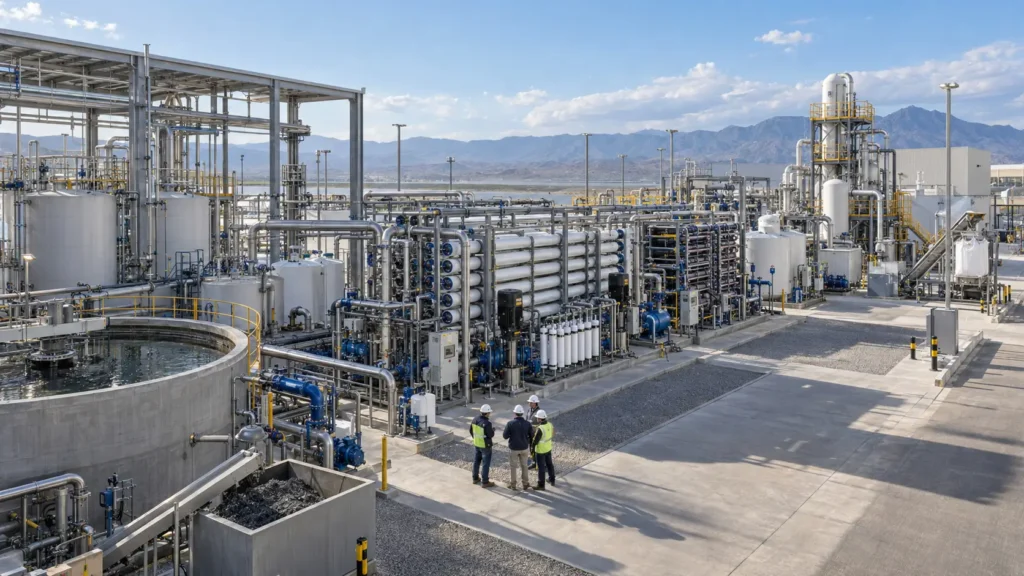
Combine unit operations only when each block removes the next limiting constraint and improves the complete system.
Controlled principleA hybrid train is justified only when the outlet of one block is a demonstrably better feed for the next. Each added unit must remove a named constraint, reduce total lifecycle burden or create a qualified product. Complexity that merely shifts the same residual downstream is not integration. |
|---|
21.1 Hybridization is sequential constraint removal
The earlier chapters intentionally separated characterization, pretreatment, conventional membranes, advanced membranes, thermal concentration, crystallization and solids management. A real project reconnects those blocks—but not by stacking every available technology. The train should advance one constraint at a time: remove the species or operating condition that stops the next lower-burden separation, recalculate the chemistry, then decide whether another block is still justified.
The 2025 Nature Reviews Clean Technology synthesis treats MLD and ZLD technology selection as a constrained optimization problem governed by feed, location, regulation, technical limits and economics. It also emphasizes that reverse-osmosis-based brine volume reduction should be maximized where credible before energy-intensive thermal finishing. The Bureau of Reclamation’s concentrate-management toolbox similarly frames technology selection as application-specific and recommends project-specific desktop and pilot work after planning-level screening.
Hybridization therefore has three valid reasons: extend the stable operating window, reduce the hydraulic or contaminant duty passed to a more expensive downstream block, or isolate a useful component at a point where selectivity and purity are still achievable. It is not valid merely because two technologies can be connected.
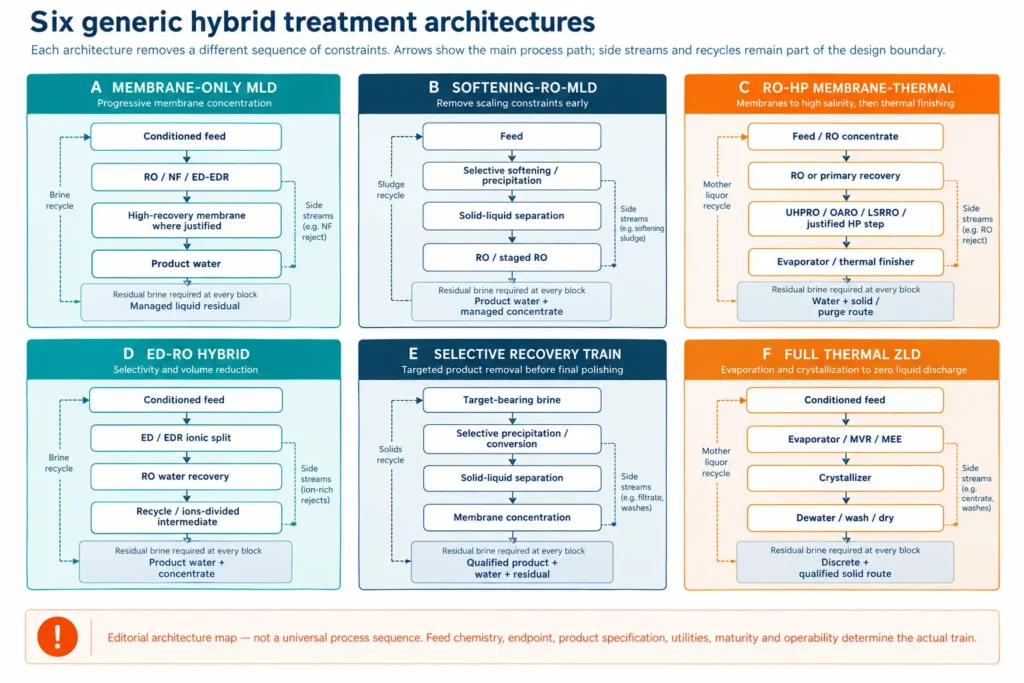
Figure 21.1. Six generic hybrid architectures required by the master brief. They are decision templates, not universal flowsheets.
21.2 Architecture comparison at a glance
The table below deliberately uses qualitative recovery and cost/complexity language. A numeric recovery or cost attached to an architecture without a defined feed, endpoint, product quality, utility basis and residual route would violate the calculation discipline of this guide. “Relative burden” compares the six generic architectures conceptually; it is not a benchmark database.
| Architecture | Feed window / trigger | Recovery role | Dominant technical risk | Main residuals | Industries / contexts | Relative cost | Relative complexity |
|---|---|---|---|---|---|---|---|
| Membrane-only MLD | Stable, membrane-treatable feed with a legal and manageable liquid endpoint. | Partial to high water recovery while preserving a liquid residual. | Osmotic pressure, scaling/fouling, concentrate endpoint and membrane life. | Concentrate, CIP/flush, spent membranes, pretreatment residuals. | Inland desalination, reuse, some industrial and mining waters. | Lower to moderate | Lower to moderate |
| Softening–RO–MLD | Hardness / scale-forming chemistry limits RO before osmotic pressure becomes dominant. | Remove the limiter, then recover more water by RO without pursuing dry-out. | Softening selectivity, sludge handling, residual scale former and recycle accumulation. | Softening sludge, filtrate/backwash, RO concentrate and CIP. | Brackish desalination, power/cooling, mining and process reuse. | Moderate | Moderate |
| RO–HP membrane–thermal | RO concentrate can be further concentrated by a validated high-salinity membrane before thermal finishing. | Maximize lower-energy water removal before the final thermal block. | Advanced-membrane maturity, pressure/osmotic driving force, temperature, scaling and recycle. | Permeates, interstage brines, CIP, final thermal concentrate / solids. | Desalination brines, high-value water recovery, selected industrial ZLD. | High | High |
| ED–RO hybrid | Ion-transfer and water-transfer duties can be split more efficiently or selectively than by one process alone. | Shift salt and water separately; improve recovery or ion distribution. | Membrane resistance/selectivity, current efficiency, scaling, electrode streams and integration. | Concentrate/diluate, electrode rinse, RO concentrate, cleaning wastes. | Brackish/seawater desalination, ionic fractionation and selected brine concentration. | Moderate to high | High |
| Selective precipitation–membrane–product | A target scale-former or valuable phase can be selectively removed before further water recovery. | Convert a constraint into a separated solid, then re-open the membrane window. | Product purity, precipitation kinetics, inhibitor chemistry, fine-solids carryover and market route. | Recovered/failed precipitate, wash, filtrate, membrane concentrate and off-spec product. | Inland brines, process salts, mining, chemical and resource-recovery projects. | Moderate to high | High |
| Full evaporator–crystallizer ZLD | No credible routine liquid endpoint and the full thermal/solid route is justified. | Final liquid elimination within a defined system boundary. | Thermal energy, BPE, scale/foam/corrosion, mother liquor, solids route and availability. | Crystals/mixed salts, purge, condensate contaminants, CIP, dust and off-spec solids. | Power, chemicals, mining, semiconductor and sites with stringent discharge constraints. | Very high | Very high |
Table 21.1. Qualitative comparison of the six generic hybrid architectures. Relative cost and complexity are editorial screening categories only.
21.3 Architecture A — membrane-only MLD
Membrane-only MLD is the simplest architecture when the feed remains within a stable membrane operating envelope and a manageable residual liquid route exists. The train can include conventional RO/NF, staged or cyclic RO, ED/EDR, or a justified high-salinity membrane block, but it stops before thermal dry-out. The endpoint is intentional: recover economically valuable water and minimize the residual to the point at which disposal, reuse or another receiver remains credible.
This architecture is attractive because every avoided thermal unit removes heat-transfer area, vapour handling, crystallization and solids-management obligations. It is also easy to overstate. The final concentrate still carries salts, antiscalant, organics, cleaning chemicals and trace contaminants, and its receiver capacity can become the controlling project constraint. The Reclamation toolbox treats concentrate minimization, concentrate treatment and disposal as connected planning choices rather than assuming that higher recovery is always the best solution.
The acceptance test is therefore endpoint-led. The architecture passes only if the residual flow and composition remain within the routine and backup route under design and upset conditions, and if membrane availability survives the required concentration factor.
21.4 Architecture B — softening–RO–MLD
Softening–RO–MLD is appropriate when mineral scaling, rather than osmotic pressure alone, prevents additional membrane recovery. A selective precipitation or softening step removes the controlling calcium, magnesium or related scale-forming load; solid–liquid separation protects the RO; and the membrane then recovers additional water until the new limiting condition or the selected residual endpoint is reached.
The important design variable is not “maximum hardness removal” but the residual composition that allows the downstream RO to operate. Amusat and co-workers showed in a 2024 end-to-end high-recovery RO optimization that pH-control chemistry changes the required pretreatment and overall process economics; in their seawater case, sulfuric acid increased the calcium-removal requirement because of gypsum risk. The result is not a universal acid-selection rule—it demonstrates that pretreatment and recovery must be optimized as one train.
This architecture succeeds only if the sludge burden is fully priced and the filtrate/recycle does not return the limiting ion. The softening unit is therefore part of the water, salt, reagent and residual balances, not a generic front-end box.
21.5 Architecture C — RO → high-pressure membrane → thermal finishing
This architecture reserves thermal treatment for the fraction that lower-energy pressure-driven or osmotically assisted processes cannot credibly recover. Conventional RO performs bulk water recovery first. A second high-salinity membrane stage—such as UHPRO, OARO, LSRRO or another demonstrated configuration—then reduces the flow sent to an evaporator or crystallizer. The exact technology is conditional on pressure, osmotic driving force, salinity, temperature, scaling, membrane chemistry and maturity.
A 2026 pilot study on real SWRO brine integrated conventional RO pre-concentration with OARO after nanofiltration pretreatment and demonstrated that advanced membrane concentration can materially reduce the residual volume before the next step. The study also identified an operating optimum rather than “maximum possible concentration,” and membrane temperature imposed a practical constraint. Those pilot results are bounded to the tested real brine and equipment; the general lesson is that the advanced membrane block must be optimized as an intermediate duty, not judged by peak salinity alone.
The Nature Reviews synthesis reaches the same systems conclusion: emerging concentration technologies have not displaced mechanical vapour compression and thermal crystallizers, so maximizing credible RO-based brine-volume reduction is a central lever for lowering the thermal burden.
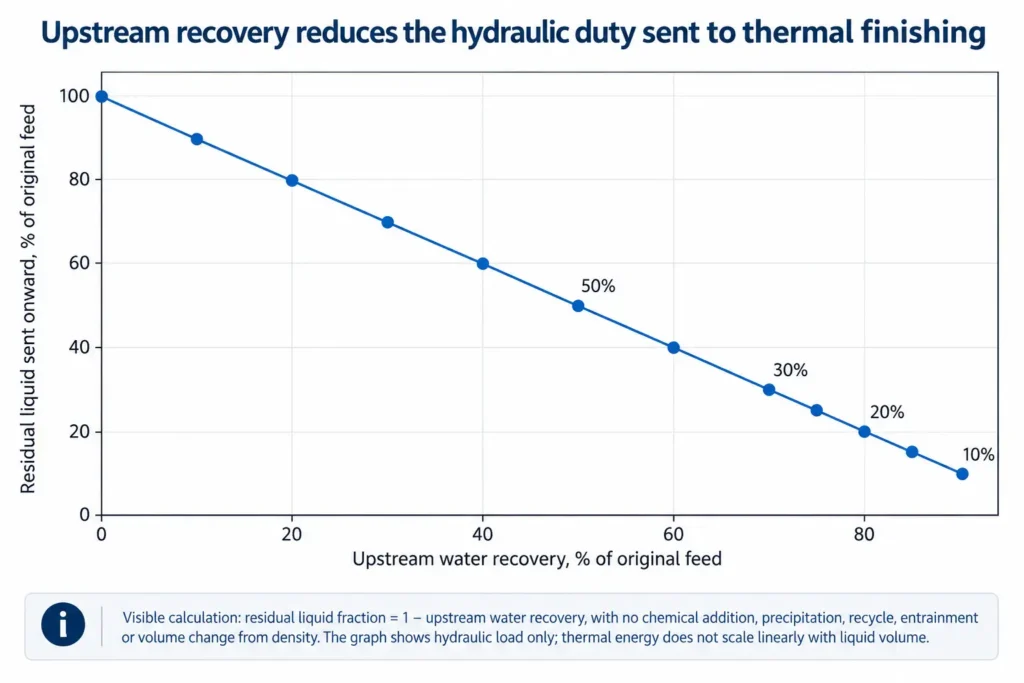
Figure 21.2. Upstream recovery reduces the hydraulic duty passed to thermal finishing. It does not imply proportional thermal-energy reduction.
21.6 Architecture D — ED–RO hybrid
ED and RO separate by different driving forces. RO primarily moves water against osmotic pressure, while ED moves ions through ion-exchange membranes under an electrical potential. Hybridization can therefore assign salt transfer and water recovery to different blocks, use ED/EDR to shift ionic composition before RO, or use RO and ED together to avoid inefficient operation of either process at the wrong end of its concentration window.
Pilot work reported in Desalination in 2022 integrated ED/RED-type electromembrane stages with RO on real seawater and demonstrated multiple ED–RO configurations at pilot scale. Earlier high-salinity modelling likewise showed why an ED–RO combination can extend concentration beyond RO alone while avoiding operation of ED with a very low-conductivity diluate. These are architecture demonstrations, not evidence that ED should be placed upstream or downstream in every project.
The hybrid gate must therefore close current efficiency, membrane resistance, co-ion leakage, water transport, electrode-rinse streams, scaling, cleaning and RO pressure as one system. The electrical block does not remove the need for a residual endpoint; it changes where ions and water leave the boundary.
21.7 Architecture E — selective precipitation → membrane concentration → product recovery
Selective recovery trains intentionally remove a constituent because it is both the next technical constraint and a potentially useful output. The separation may be precipitation, ion exchange, adsorption or another selective conversion, followed by solid–liquid separation and membrane concentration of the revised brine. Product recovery is placed where selectivity is strongest—not automatically at the end of the train.
Kum, Tang and Liu demonstrated this logic in a 2024 inland-brackish-brine study: phosphonate antiscalant was first degraded, scale-forming minerals were then precipitated, microfiltration separated the solids, and a secondary RO recovered additional water. The tested train recovered mineral solids and improved subsequent RO operation, but its performance values are specific to that real brackish brine and laboratory/pilot configuration.
A separate 2024 study used staged precipitation and carbonation on real RO concentrate to remove calcium first and then residual calcium/magnesium, producing different precipitate fractions. Together, these studies support the sequence logic: remove the species that constrains the next step, preserve phase identity, and do not call the precipitate a product until purity, consistency, legal status and a user or buyer are proven.
21.8 Architecture F — full evaporator–crystallizer ZLD
The full thermal architecture accepts that routine liquid discharge will not leave the defined system boundary. A concentrator or multi-effect/MVR evaporator removes most remaining water; a crystallizer drives the mother liquor through controlled supersaturation; dewatering, washing and drying produce the final solid form; and Chapter 20’s residual route closes the solids and side streams.
This is the highest-burden architecture and should be selected because the endpoint requires it—not because ZLD is a stronger label. Chen and co-workers analysed an integrated multi-effect-distillation and evaporative-crystallization ZLD system for desalination brine and showed that the thermal block dominates the system’s energy and economics. Their numerical results belong to the analysed 70 g/kg desalination-brine case, but the architecture illustrates the coupling between final water recovery and thermal/solid handling.
The architecture is incomplete without condensate qualification, vent/non-condensable handling, mother-liquor purge logic, crystal dewatering and an accepted route for mixed or off-spec solids. Those duties remain even when the water balance itself reaches the ZLD endpoint.
21.9 A train is selected by the first unsolved constraint
The six architectures can be viewed as increasing commitments, but they are not a ladder that every project climbs. A project can stop at membrane-only MLD if the residual route is stable. Another may require softening before the same endpoint. A third may justify an advanced membrane block because thermal finishing is unavoidable. A product-recovery train can add selective precipitation while still stopping short of ZLD. The correct architecture is the shortest chain that satisfies the endpoint and business case.
| Observed constraint | First block to test | What must improve | Evidence before adding the next block | Stop condition | Residual created now |
|---|---|---|---|---|---|
| RO recovery limited by a scale former | Selective softening / precipitation | Saturation path and stable membrane recovery | Representative precipitation/solid-separation and membrane testing | Residual endpoint is already manageable after RO | Sludge, filtrate, wash and RO concentrate |
| Conventional RO reaches pressure/osmotic limit before endpoint | Validated high-salinity membrane or ED block | Residual flow and thermal feed duty | Module/pilot data at actual chemistry and temperature | Additional block adds more cost/risk than avoided thermal duty | Interstage brine, permeate/diluate, CIP and auxiliary streams |
| Thermal finishing is unavoidable | Evaporator / MVR / MEE | Water removal with stable heat transfer and qualified condensate | Property model, fouling/CIP and utility integration | Managed liquid residual is preferable under Chapter 12 logic | Concentrate/slurry, condensate, vents and CIP |
| Final mother liquor has no liquid route | Crystallizer + solids route | Convert remaining water/liquid burden into managed solids | Crystallization, dewatering, wash/dry and receiver qualification | Solid route or lifecycle economics fail | Crystals/mixed salts, purge, dust and off-spec lots |
| A target constituent both constrains treatment and has credible use | Selective recovery block | Constraint reduction plus qualified output | Yield/purity, off-spec, market/user and full residual balance | Output fails specification or no credible user/buyer | Product candidate, reject solid/liquid and wash |
Table 21.2. Constraint-first architecture selection: add the next unit only after the preceding block creates a better feed or a qualified output.
21.10 Recycles, inventories and off-spec modes determine whether the hybrid is operable
Steady-state block diagrams hide the operating modes that often decide whether a hybrid train works. Every recycle carries mass back into an earlier block; every batch precipitation, crystallizer wash or membrane CIP temporarily changes flow and chemistry; every downstream outage requires storage or turndown. The integrated model must therefore include start-up, shutdown, cleaning, equipment unavailability, off-spec product, receiver interruption and restart.
The most dangerous recycle is one that returns the exact impurity being removed. Softener filtrate can return calcium or magnesium; membrane concentrate recycle can increase antiscalant and organics; mother-liquor return can accumulate non-crystallizing ions; wash liquor can reduce purity or dilute thermal feed. Recycle is not disposal and must reach a true steady state with an explicit purge.
| Interface | Normal operating question | Upset question | Required buffer / control | Failure if omitted |
|---|---|---|---|---|
| Pretreatment → membrane | Does the feed stay within solids, oil, pH, redox and scale-former limits? | What happens during chemical-dose or separator failure? | Feed diversion, guard filtration, alarms and off-spec tank | Downstream irreversible fouling or scale event |
| Membrane → advanced membrane / ED | Are pressure, temperature, salinity and chemistry inside the demonstrated window? | Can concentrate quality drift beyond the next block before detection? | Intermediate tank, quality interlock and bypass | Cascade failure across multiple membrane blocks |
| Membrane → thermal | Is thermal feed flow/composition stable enough for BPE, scaling and foam control? | Where does feed go during evaporator outage? | Concentrate storage, membrane turndown and alternate endpoint | Forced shutdown or uncontrolled brine inventory |
| Crystallizer → solids line | Can dewatering match crystal production and purity duty? | Where does slurry go during centrifuge/dryer outage? | Slurry/solid buffer, alternate dewatering and purge control | Crystallizer forced off line or product contamination |
| Product / waste → receiver | Can routine shipments match production? | What if a load is rejected or the receiver closes? | Quarantine, backup receiver and operating inventory | Site becomes the unintended final disposal facility |
Table 21.3. The interfaces between blocks require operating modes, storage and fallback—not only steady-state arrows.
21.11 Hybrid acceptance gate
The hybrid gate is passed when the complete train performs better against the project objective than the simpler alternative. “Better” may mean lower lifecycle cost, a manageable residual, more reliable water supply, lower thermal duty, a qualified product or reduced liability. It cannot be established from one unit’s recovery or energy number.
| Gate field | Minimum evidence | Proceed condition | Conditional / recycle trigger | Owner / record |
|---|---|---|---|---|
| Context and endpoint | Whole-site boundary, driver, liquid/solid endpoints and no-action baseline. | Architecture is tied to a real site problem and receiver. | Train exists only because a technology is available. | Project lead; decision register |
| Sequential constraint logic | For every block: inlet constraint, outlet target and next-unit requirement. | Each added unit demonstrably re-opens the next operating window or creates qualified value. | Block removes no controlling constraint or duplicates another duty. | Process lead; constraint register |
| Integrated mass/energy balance | Normal/design/upset water, ions, reagents, energy, recycles, purges and closure error. | All blocks and side streams close on consistent bases. | Unclosed recycle, hidden dilution or mixed energy denominator. | Process/energy leads |
| Maturity and performance | Representative module/pilot/full-scale evidence matched to each unit. | Evidence maturity is proportionate to project commitment. | Laboratory result is carrying a guarantee or bankability claim. | Technology and independent review |
| Operability and availability | Control philosophy, tankage, turndown, bypass, CIP, redundancy and restart. | The train survives credible outages without losing the endpoint. | One block outage strands upstream/downstream inventory. | Operations/control lead |
| Residual and product routes | Chapter 20 ledger plus product specification, rejection and backup route. | Every residual and product has routine and downside handling. | Off-spec material or mother liquor has no destination. | Residual/commercial leads |
| Economics and risk | Installed CAPEX, OPEX, replacements, energy, chemicals, disposal, availability and downside cases. | Hybrid beats the simpler comparator under conservative cases. | Value depends on maximum recovery, zero rejection or unqualified product revenue. | Business-case owner |
Table 21.4. Hybrid treatment-train acceptance gate.
Simplest credible architecture winsThe preferred train is not the one with the most blocks or highest theoretical recovery. It is the least-complex architecture that meets the site endpoint, protects operability, closes every residual, and survives downside economics. A block that does not improve that complete result should be removed. |
|---|
21.12 Handover to Part V — brine valorization without hype
Chapter 22 asks what makes a brine product genuinely recoverable. The handover from this chapter must therefore separate process outputs from commercial products. A hybrid train may create a calcium-rich precipitate, magnesium-rich fraction, NaCl-rich concentrate, crystal salt, acid/base stream or other enriched intermediate; none becomes a product merely because it has been separated.
For each candidate output, the handover should state recoverable inventory, yield, phase or chemical form, impurity profile, lot variability, product specification, internal use or qualified buyer, legal status, packaging/logistics, off-spec fraction and the residual route if the market case disappears. Part V then tests whether the enriched stream has sufficient concentration, selectivity, purity, reliable volume and net value to justify a product train.
21.13 Chapter conclusion
Hybrid treatment trains are the final expression of the sequential constraint-removal logic developed through Part IV. Membrane-only MLD, softening–RO–MLD, membrane–thermal hybrids, ED–RO combinations, selective recovery trains and full thermal ZLD can all be technically legitimate. None is a default architecture.
The architecture must start with the feed and endpoint. Each block should remove the next limiting constraint or create a qualified output, and the chemistry must be recalculated after that intervention. Upstream membrane or electrochemical recovery can reduce the hydraulic duty sent to thermal treatment, but it also creates interstage brines, recycles, cleaning wastes and maturity risks. Selective precipitation can unlock recovery and product opportunities, but it creates solids and off-spec routes. Full thermal ZLD closes routine liquid discharge only if the crystallizer, mother liquor and solid route also close.
The preferred train is therefore the shortest credible chain that survives normal, design and upset operation and remains defensible under conservative economics. Part V now tests whether any separated constituent deserves to become a product rather than simply another managed residual.
Chapter 21 in one sentenceNo architecture is selected without feed and endpoint context: hybridization is justified only when each added block removes the next constraint and improves the complete system. |
|---|