
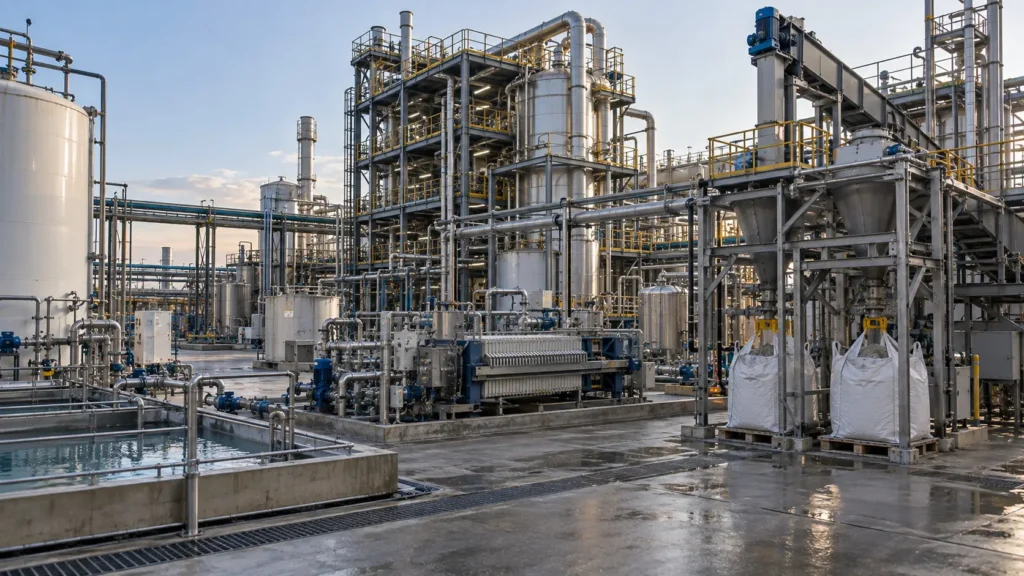
Define the conditions under which complete routine liquid elimination is a defensible system commitment.
Controlled principleZLD is justified only when the project can defend both sides of the decision: why routine liquid discharge is unavailable or unacceptable, and why the complete water, energy, chemical, solids, reliability and operating burden of the final block is preferable to the MLD baseline. Eliminating a liquid stream transfers matter; it does not eliminate residuals. |
|---|
13.1 ZLD is an endpoint and an operating commitment
Zero Liquid Discharge describes a defined system endpoint in which no routine liquid wastewater leaves the stated boundary. It is not the name of one evaporator, crystallizer or proprietary package. The endpoint normally combines source control, segregation, pretreatment, water recovery, final concentration, crystallization or another solids-forming step, solid–liquid separation, recovered-water reuse, controlled storage and a route for every solid and non-routine residual.
This chapter tests the opposite case from Chapter 12. MLD was preferred where a qualified liquid residual captured most of the project value and the final recovery block added more burden than it removed. ZLD becomes a candidate when no practical routine liquid route exists or when water, production or liability value is strong enough to justify the final block. Even then, the project must separately prove the final concentration step, the crystallization and dewatering step, the solids route and the operating system.
Recent technical reviews reach the same broad distinction: ZLD maximizes recovery and avoids routine brine disposal but remains expensive and energy-intensive, while MLD can be more practical where a managed residual route remains. Conventional and emerging trains still have to manage scaling, organics, mixed salts, energy and operational stability.
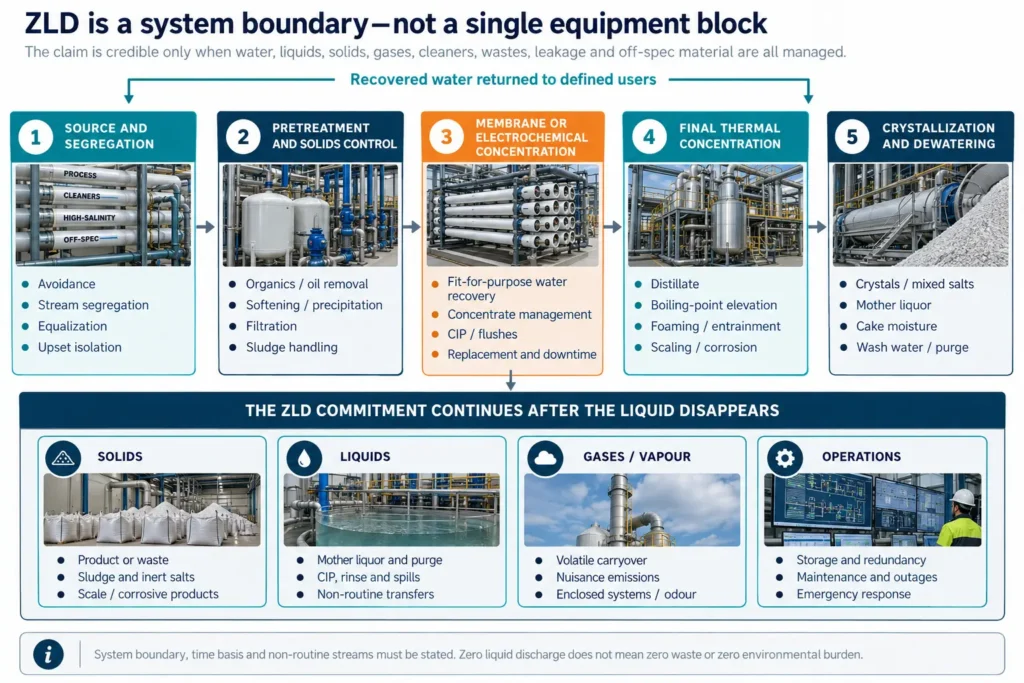
Figure 13.1. ZLD is a system boundary and a continuing commitment to residual and solids management.
13.2 No practical routine liquid-discharge route
The strongest ZLD driver is the absence of a credible routine liquid endpoint. Chapter 11 screened surface, sewer and marine discharge; injection; ponds; hauling; tailings integration; landfill-related routes; beneficial industrial use; and centralized hubs. ZLD should not be declared because one preferred route is inconvenient. The endpoint register should show that the credible alternatives are technically incompatible, legally unavailable, capacity-limited, physically absent, operationally fragile or burdened by unacceptable long-term liability.
A route can fail on quantity, chemistry, location, time or contingency. A sewer may accept the average flow but not the salt load or cleaning events. An injection formation may exist but lack injectivity, integrity evidence or permitting. Hauling may work for pilot volumes but fail under continuous production or road interruption. An evaporation pond can be positive in an annual climate balance yet fail during wet seasons or at closure. The final decision must be based on the full operating envelope and project life.
| Candidate liquid route | Failure mode that can support ZLD | Evidence required | Temporary workaround is not proof | Decision output |
|---|---|---|---|---|
| Surface / sewer / marine discharge | No legal route, no receiving capacity, incompatible load, unacceptable ecological or social risk, or prohibitive contingency conditions. | Current permit pathway, receiver limits, mixing/dilution assessment, monitoring, compliance date and non-routine controls. | A historical permit, generic sector practice or assumed dilution. | Rejected, conditional or retained with quantified capacity. |
| Deep-well injection | No suitable formation, injectivity or containment; integrity or induced-risk concerns; permitting or closure liability unacceptable. | Site geology, injectivity test, compatibility, well integrity, monitoring, closure and financial assurance. | A nearby injection well or regional geology without site confirmation. | Qualified long-life route or explicit rejection. |
| Evaporation pond | Land or climate unavailable; water balance fails; seepage, wildlife, storm, salt inventory or closure route unacceptable. | Monthly water balance, lining/leak system, geotechnical basis, salt inventory, storm storage and closure plan. | A positive annual evaporation average. | Seasonal capacity and closure-qualified route or rejection. |
| Hauling / off-site treatment | Continuous volume, route reliability, acceptance chemistry, contractor dependence, price or custody liability is unacceptable. | Qualified facility, contract, acceptance envelope, transport study, emergency storage and chain of custody. | A spot quote or pilot-scale acceptance. | Routine, contingency-only or rejected route. |
| Tailings / shared industrial route | No compatible receiver, shared infrastructure, legal classification or long-term capacity. | Mass and water balance, geochemistry, geotechnical review, owner agreement and closure responsibility. | Physical proximity or a non-binding expression of interest. | Integrated endpoint, conditional option or rejection. |
Table 13.1. A no-route conclusion must be based on the full endpoint register, not the rejection of one convenient option.
13.3 Regulatory requirement and extreme liability
A legally enforceable no-discharge condition for a named wastestream can justify the endpoint, but the requirement must remain jurisdiction-, facility-, boundary- and date-specific. The U.S. steam-electric rules are a bounded example: the 2024 final rule strengthened requirements for specified coal-power wastestreams, while subsequent deadline changes and a 2026 proposal show that compliance pathways and dates remain current-sensitive. A statement that a whole sector ‘requires ZLD’ is not a design basis.
Extreme liability can also support ZLD where a permitted route remains legally possible but exposes the owner to unacceptable long-term environmental, closure, chain-of-custody or business-continuity risk. The liability case must be more than reputational language. It should identify the event, probability range, consequence, duration, responsible party and how the ZLD system actually reduces—not merely relocates—the exposure.
| Liability driver | What must be quantified | How ZLD can reduce it | What ZLD does not remove |
|---|---|---|---|
| No-discharge permit condition | Exact wastestream, boundary, compliance date, monitoring and non-routine provisions. | Eliminates the routine liquid pathway within the defined boundary. | Solids, gases, cleaning wastes, outage storage and unrelated facility discharges. |
| Receiver or basin vulnerability | Pollutant load, hydrology, ecology, cumulative impact, public sensitivity and incident consequence. | Removes the routine brine load from the receiver. | Upstream energy, chemicals, solids transport and disposal impacts. |
| Route closure / capacity risk | Probability, notice period, replacement route, production consequence and emergency storage. | Reduces dependence on the vulnerable route. | Dependence on electricity, heat, spare parts, solids contractors and operators. |
| Chain-of-custody exposure | Hauler and receiver controls, waste classification, manifests, financial assurance and long-term responsibility. | Can reduce liquid transfers and consolidate residuals. | Responsibility for mixed salts, hazardous constituents or off-spec material. |
| Corporate or financing covenant | Named commitment, metric, baseline, assurance method, breach consequence and lender/customer requirement. | May produce a verifiable no-routine-liquid outcome. | False claims where the boundary excludes material liquid or solid streams. |
Table 13.2. Liability must be mapped to a mechanism, consequence and residual transfer.
13.4 Strategic water value and expansion dependent on loop closure
Water value can justify ZLD where recovered water is not simply a low-cost utility substitute but a production-enabling strategic resource. The correct baseline is the marginal secure-water alternative and the consequence of interruption, not the average tariff. The recovered-water stream must also meet a named use, including seasonal and upset quality, storage and blending requirements.
Production expansion can create a stronger case when the site cannot obtain new water or discharge allocation and the only feasible route to additional output is to close the loop. The project should receive only the incremental contribution margin that it demonstrably unlocks. Gross revenue, corporate growth targets and theoretical nameplate capacity are not attributable project value.
| Value source | Minimum evidence | Credible benefit | Double-counting risk | Downside case |
|---|---|---|---|---|
| Avoided secure-water supply | Alternative source, delivered quality, reliability, treatment, storage and capacity. | Avoided marginal secure-water cost. | Counting both tariff savings and the same avoided supply CAPEX twice. | Dry-year availability, source-quality deterioration and tariff escalation. |
| Avoided interruption | Frequency, duration, production response, inventory and recovery time. | Probability-weighted contribution loss avoided. | Using a full plant outage value where water is not the sole cause. | Longer outage or lower demand. |
| Enabled expansion | Incremental production, contribution margin, ramp-up, water/discharge bottleneck and other constraints. | Contribution from capacity uniquely unlocked by loop closure. | Attributing market growth or unrelated debottlenecking. | Lower price, slower ramp or reduced operating availability. |
| Internal process quality | Receiving use specification, contaminant tolerance, blending and monitoring. | Avoided purchase and improved process resilience. | Valuing distillate at potable-water cost when the real use is lower grade. | Off-spec periods and polishing demand. |
| Strategic / contractual commitment | Named contract, target, assurance method and consequence. | Avoided breach, financing or customer risk where demonstrable. | Adding an unpriced reputational premium to every case. | No recognition or changed target boundary. |
Table 13.3. Strategic water and expansion value must be attributable, non-duplicative and downside-tested.
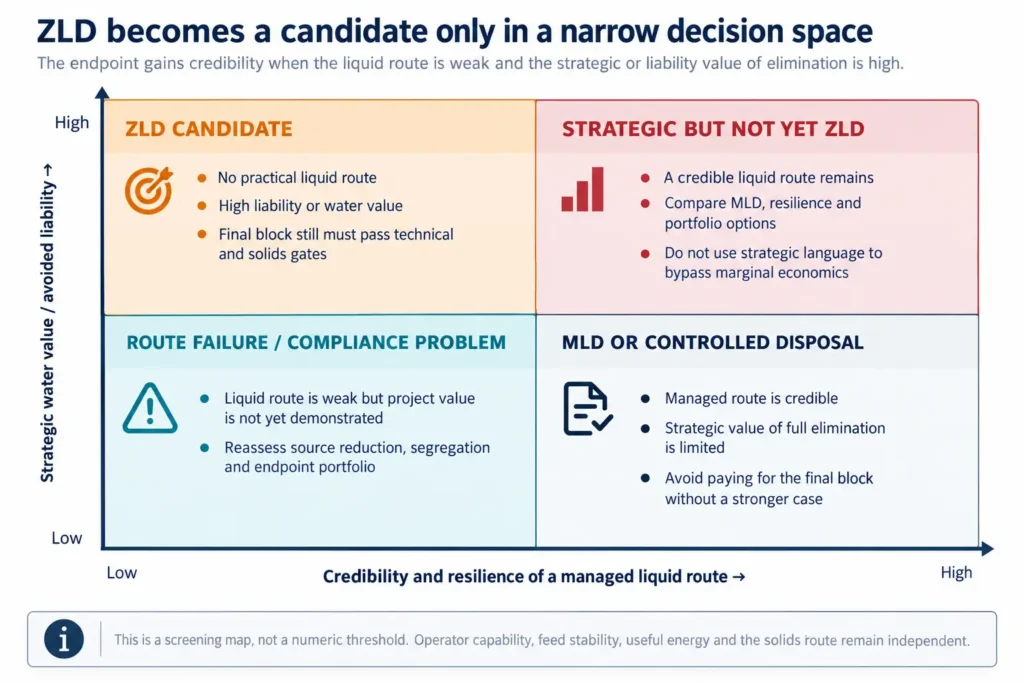
13.5 Useful waste heat can change the final-block economics
Thermal concentration and crystallization are commonly the most energy-intensive ZLD blocks. Useful waste heat, low-value steam, heat integration or a favourable electricity system can materially change the comparison, but only when the source is available at the required temperature, duty, timing and reliability. Heat that is already allocated, seasonally absent or available only during production shutdown cannot be assigned full credit.
The U.S. Department of Energy’s 2026 project selections include a pre-FEED study for waste-heat-powered thermal evaporation of flue-gas-desulfurization wastewater. This is a current bounded example of the engineering opportunity: waste heat can support ZLD integration, but the project still requires pre-FEED evaluation of the heat source, water recovery, by-products and overall plant integration.
| Energy question | Required data | Credit allowed | Failure mode | Design response |
|---|---|---|---|---|
| Is heat genuinely useful? | Temperature, phase, duty, pressure, contaminants and recoverable profile. | Only the technically recoverable duty at the ZLD operating condition. | Low-grade heat cannot meet the required temperature lift. | Heat pump/MVR integration, preheating or no credit. |
| Is it coincident? | Hourly/seasonal production and ZLD demand profile. | Coincident available energy after other users. | Heat disappears during shutdown or low production. | Storage, auxiliary energy or reduced availability. |
| Is it reliable? | Outage, maintenance, turndown and contractual priority. | Availability-adjusted duty. | ZLD depends on a host unit that trips first. | Redundancy, backup fuel/power and emergency liquid storage. |
| What is the carbon basis? | Electricity/steam source, marginal factor, export displacement and time basis. | Avoided incremental emissions on a stated basis. | Calling waste heat zero-carbon without allocation. | Report electrical and thermal energy separately. |
| What infrastructure is required? | Heat exchangers, piping, compression, cooling, water quality and control integration. | Net benefit after integration CAPEX/OPEX. | Free heat but expensive or corrosive transfer system. | Integrated cost, materials and operability review. |
Table 13.4. Waste heat receives credit only after quality, coincidence, reliability and integration are proven.
13.6 Stable feed and controllable chemistry
A stable feed does not mean one unchanging concentration. It means the normal, design, turndown, cleaning and worst-credible states are known; the wastewater can be segregated or equalized; the controlling constituents can be conditioned; and the final blocks can remain within a verified operating envelope. A highly variable mixed sump can make ZLD technically possible but operationally fragile.
The feed-stability test must extend through recycle. Non-crystallizing impurities, organics, antiscalants, corrosion products and trace constituents can accumulate in mother liquor and return streams. The system needs a controlled purge or a demonstrated route for those constituents. ‘Closed loop’ is not a substitute for an impurity balance.
| Feed-stability field | Evidence | Acceptable condition | Warning sign | Response |
|---|---|---|---|---|
| Hydraulic envelope | Continuous and batch flows, duration, campaigns, CIP and storage. | Peaks are isolated, equalized or included in design. | Averaged batch peaks disappear from the design basis. | Segregate, store, campaign or resize. |
| Major-ion chemistry | Normal/design/worst cases with charge and mass closure. | Limiting phases and chemical doses are predictable. | Incompatible maxima combined or key ions missing. | Additional sampling, state-specific trains or conservative envelope. |
| Organics / oil / biology | TOC/COD/oil, named compounds, biology and additive history. | Pretreatment and carryover are controlled. | Foaming, wetting, volatile carryover or refractory accumulation. | Source removal, dedicated treatment, purge or route redesign. |
| Cleaning and regeneration | Chemical, strength, volume, frequency and routing. | Events are segregated or explicitly processed. | CIP is assumed to disappear in monthly average. | Dedicated tankage, neutralization and endpoint. |
| Recycle and mother liquor | Accumulation model, residence time, phase behaviour and purge. | Steady or bounded impurity inventory. | Unbounded chloride, organics, trace metals or non-crystallizers. | Controlled purge, selective removal or separate disposal. |
| Materials / corrosion products | Temperature, halides, pH, redox, deposits and inspection history. | Material envelope and cleaning are credible. | Corrosion products become uncontrolled solids/foulants. | Materials review, deposit control and monitoring. |
Table 13.5. Feed stability means a controllable operating envelope, not a single representative sample.
13.7 A credible solids route is mandatory
ZLD converts the routine liquid residual into solids, sludges, wet cakes, mother liquor and non-routine liquids. The solids route is therefore part of the process design and the business case. A crystallizer does not automatically produce a marketable product. Mixed salts receive no revenue credit unless phase control, purity, consistency, legal status, user or buyer, packaging, logistics and off-spec disposal are demonstrated.
A current vendor case for flue-gas-desulfurization wastewater illustrates the bounded requirement: the ZLD train concentrates and crystallizes dissolved solids, then dewaters them in a centrifuge for transport to an on-site landfill while recovered water is reused. The value of the example is the explicit solids route—not a universal claim that landfill is always suitable.
| Residual | Minimum characterization | Qualified route | Commercial treatment | Fallback |
|---|---|---|---|---|
| Pretreatment sludge | Dry solids, moisture, leachability, organics/metals, variability and dewatering. | Permitted landfill, beneficial use or dedicated treatment. | No product credit without specification and user. | Storage, alternative landfill and filtrate return. |
| Crystals / salts | Phase, purity, size, moisture, trace contaminants and consistency. | Internal use, qualified buyer or disposal. | Risk-adjusted netback after washing, drying, packaging and rejection. | Off-spec disposal and product quarantine. |
| Mixed-salt cake | Full composition, moisture, handling, leachability and classification. | Qualified disposal or demonstrated use. | Normally zero revenue in the base case. | Contracted landfill or stabilization. |
| Mother liquor / purge | Flow, density, ion/organic inventory, radioactivity/persistent contaminants where relevant. | Recycle with bounded purge, off-site route or further treatment. | Not hidden inside the word ‘recycle’. | Emergency storage and managed liquid transfer. |
| Cleaning / rinse waste | Chemicals, pH, organics, metals and volume by event. | Dedicated treatment, controlled return or off-site route. | Included in effective annual recovery and OPEX. | Segregated tank and contractor route. |
| Off-gas / condensate contaminants | Volatiles, entrainment, non-condensables and product-water quality. | Air permit/control and polishing or diversion. | No water-value credit for off-spec condensate. | Quarantine, recycle, vent treatment and monitoring. |
Table 13.6. ZLD is not justified until every solid and non-routine liquid has a qualified route.
Product does not equal projectA technically recoverable salt can still be a disposal solid. The ZLD decision must survive with no merchant-product revenue unless an internal user or qualified buyer, specification, legal route, scale, logistics, rejection allowance and netback are evidenced. |
|---|
13.8 Operator capability, redundancy and outage management
A ZLD plant is a continuous residual-management utility tied to production. It requires operators who can interpret chemistry and normalized performance, manage solids, maintain rotating and thermal equipment, respond to foaming and scaling, control cleaning and protect product-water quality. Automated control does not remove the need for technical ownership.
The system must also manage its own downtime. A historic power-plant case used mobile treatment to bridge reduced evaporator capacity during a planned outage, demonstrating the practical point: when production continues, the wastewater has to go somewhere while the ZLD block is unavailable. The specific temporary train is not a universal solution; the general requirement is contingency capacity and an executable response.
| Operating capability | Minimum evidence | Design implication | Failure consequence | Required safeguard |
|---|---|---|---|---|
| Staffing and competency | Roles, shifts, training, chemistry/solids capability and vendor support. | Realistic labour, supervision and response time. | Slow diagnosis, chemical overdose, poor solids control and product contamination. | Competency matrix, procedures, drills and escalation. |
| Analytical capability | Online instruments, laboratory methods, turnaround, QA/QC and action limits. | Control of saturation, carryover, purity and corrosion. | Operating blind between external laboratory results. | Critical online measurements and rapid internal tests. |
| Redundancy and turndown | Critical equipment availability, N+1 philosophy, train isolation and minimum stable load. | Installed capacity and maintenance windows. | One failure stops the site or forces illegal discharge. | Parallel duty, spares, bypass within boundary and storage. |
| Storage and surge | Normal, upset, maintenance and extreme-event inventories. | Tankage and production-curtailment logic. | Overflow or emergency hauling without qualification. | Defined hours/days by scenario and independent containment. |
| Maintenance and materials | Inspection, cleaning, spares, lead time, corrosion/scale history and access. | Availability-adjusted production and lifecycle cost. | Nominal recovery collapses through downtime. | Planned outages, critical spares and accessible design. |
| Emergency route | Trigger, receiver/contract, transport, permits, communications and reporting. | A lawful non-routine response. | A claimed ZLD site has no response to loss of the final block. | Qualified contingency route or controlled production shutdown. |
Table 13.7. Operator capability and outage management are design criteria, not post-award details.
13.9 Final concentration and crystallization require separate scrutiny
The final concentrator and the crystallizer should not be assessed as one undifferentiated thermal box. Their feeds, phase behaviour, energy intensity, scaling, foaming, materials, hydraulics, solids control and failure modes differ. Thermodynamic analysis shows that the crystallization stage is commonly the most energy-intensive part of a ZLD train; the engineering question is therefore not only whether the system can reach solids, but how the final stages operate at the required availability and product or disposal quality.
Membrane and electrochemical preconcentration can reduce the volume sent to thermal treatment where chemistry and pressure allow. Current manufacturer developments explicitly target reduction of downstream thermal volume in MLD/ZLD service. Such product claims are feed- and design-specific and should be verified through modelling, laboratory work and pilot evidence; they are not universal salinity limits.
| Assessment field | Final concentrator | Crystallizer / solids former | Evidence gate | Fallback |
|---|---|---|---|---|
| Feed definition | Preconcentrated brine, suspended solids, organics, gases and antiscalants. | Near-saturation brine, mixed phases, seed inventory and mother liquor. | Separate stream tables and operating envelopes. | Lower upstream recovery or intermediate treatment. |
| Energy basis | Electrical/thermal duty per stated feed and recovered-water basis. | Incremental duty per crystallizer feed, water removed and dry/wet solid basis. | Block SEC with heat recovery and availability. | Retain managed liquid residual or alternative solids route. |
| Phase behaviour | Onset of precipitation, boiling-point elevation and viscosity. | Phase sequence, hydrate/double-salt formation, impurity rejection and purge. | Thermodynamic model plus bench/pilot crystallization. | Mixed-salt disposal design with no product credit. |
| Scaling / fouling / foaming | Heat-transfer surface, vapour disengagement and concentrate circulation. | Crystal suspension, tube velocity, nucleation, deposition and entrainment. | Long-duration test, autopsy and cleaning recovery. | Reduced concentration, seed/solids strategy or redesign. |
| Materials | Hot brine, vapour, condensate and cleaning exposure. | High-solids slurry, mother liquor, erosion and localized corrosion. | Materials review at hottest/local conditions. | Lining/alloy change, lower temperature or alternate process. |
| Solid–liquid separation | Intermediate precipitates and carryover control. | Centrifuge/filter duty, wash, moisture, purity and filtrate recycle. | Representative slurry test and cake/filtrate balance. | Additional washing/drying, stabilization or landfill route. |
| Availability | Compressor/pump/heat-exchanger redundancy and turndown. | Forced circulation, solids withdrawal, separator reliability and cleaning. | Availability model and maintenance plan. | Storage, parallel train, emergency route or production curtailment. |
Table 13.8. Final concentration and crystallization are separate technical and commercial gates.
13.10 The ZLD justification checklist
The checklist below converts the chapter into a gate review. A ‘conditional’ answer is not approval: it identifies the test, contract, permit, design action or operational control required before the endpoint can advance. Any failed liquid-route, solids, feed, energy or operations gate returns the project to MLD, endpoint redesign or further evidence development.
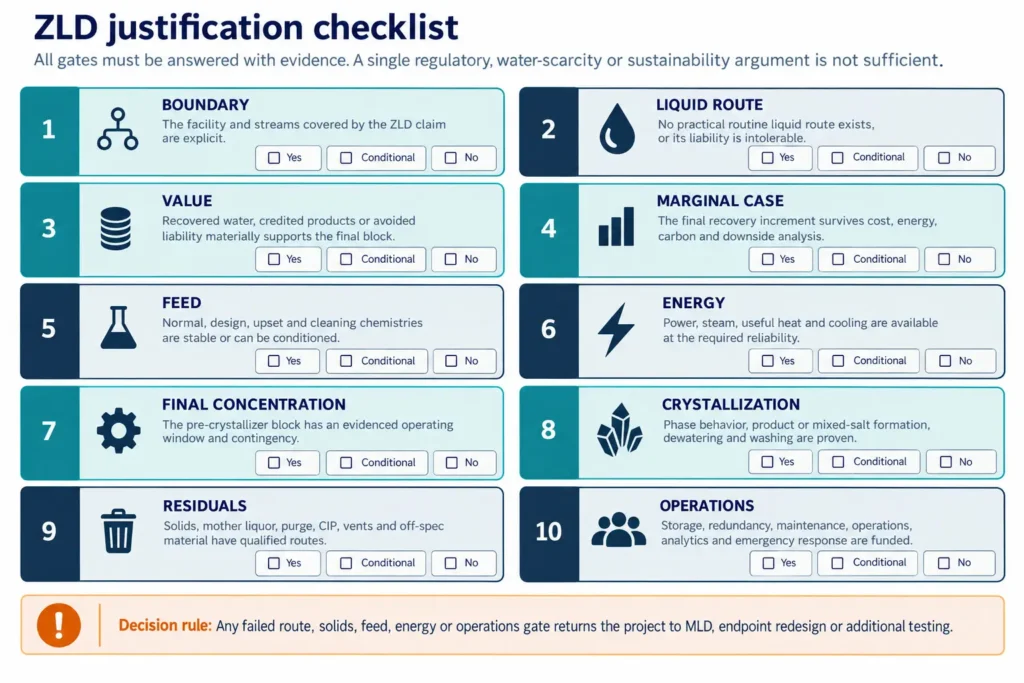
Figure 13.3. Required ZLD justification checklist. Each gate must be supported by project-specific evidence.
| Gate | Pass criterion | Minimum evidence | Conditional action | Fail response |
|---|---|---|---|---|
| 1. Boundary | All routine and non-routine facility streams inside/outside the claim are stated. | Marked PFD, stream register, operating modes and reporting boundary. | Clarify exclusions and shared utilities. | No ZLD claim. |
| 2. Liquid route | No credible routine liquid endpoint remains, or liability is demonstrably intolerable. | Chapter 11 endpoint register with permits, capacity, chemistry and lifecycle. | Complete route tests or contracts. | Retain MLD/managed route. |
| 3. Project value | Water, production, compliance or liability value is attributable and material. | Marginal secure-water, contribution margin, compliance or risk model. | Resolve attribution and double counting. | Final block has no economic driver. |
| 4. Marginal case | Incremental benefit exceeds full incremental burden under downside cases. | CAPEX/OPEX, energy, carbon, availability, solids, replacement and residual route. | Pilot, quotes or sensitivity work. | Stop at MLD optimum. |
| 5. Feed | Normal/design/upset/cleaning states are known and controllable. | Sampling plan, state-specific chemistry, additive ledger and recycle model. | Segregate/equalize/test. | Redesign source and pretreatment. |
| 6. Energy | Power/steam/heat/cooling are available, reliable and costed. | Energy integration, coincidence, backup and carbon basis. | Pre-FEED heat/power study. | No credible final-block utility. |
| 7. Final concentration | Pre-crystallizer block operates within evidenced scaling, fouling, materials and availability limits. | Model, laboratory/pilot, vendor design basis and contingency. | Longer test or alternative concentrator. | Return to lower recovery. |
| 8. Crystallization | Phase behaviour, solids withdrawal, washing, dewatering and purge are proven. | Crystallization test, phase/purity data, wet-cake and mother-liquor balance. | Pilot or disposal-grade mixed-salt design. | No solids-forming endpoint. |
| 9. Residuals | All solids, sludges, mother liquor, CIP, vents and off-spec materials have qualified routes. | Permits/contracts, classification, storage, buyer/user or landfill acceptance. | Secure fallback and liability allocation. | ZLD relocates an unresolved waste. |
| 10. Operations | Operators, analytics, redundancy, storage, maintenance and emergency response are funded and executable. | O&M plan, staffing, spares, availability model and emergency procedures. | Develop owner capability and contingency. | Endpoint is not operable. |
Decision ruleZLD is justified when no credible routine liquid route remains or its liability is unacceptable; the recovered-water, production or compliance value supports the final block; feed, energy and final-stage performance are evidenced; solids and non-routine liquids have qualified routes; operator capability and contingency are funded; and the integrated downside case remains operable. |
|---|
13.11 Define and verify the ZLD boundary
The claim must state what is inside the boundary and the time basis over which performance is measured. A treatment plant may eliminate its own routine brine blowdown while the wider facility still sends cleaning wastes, stormwater, sanitary water or off-spec batches elsewhere. That may be a valid stream-specific ZLD project, but it is not a plant-wide claim.
Verification should report annual and operating-period water recovery, effective liquid transfers, solids and sludge moisture, non-routine events, product-water use in cleaning and washing, purge, off-spec periods and storage change. A year with no routine discharge can still contain emergency transfers; they should be named rather than hidden.
| Boundary element | Must be declared | Verification metric | Misleading claim prevented |
|---|---|---|---|
| Physical boundary | Facility, treatment plant, unit or named wastestream. | Marked PFD and included/excluded streams. | Calling one-stream ZLD a site-wide result. |
| Routine versus non-routine | Normal discharge, maintenance, emergency, storm, sanitary and third-party transfers. | Event log, volume, chemistry, destination and cause. | ‘Zero’ achieved by relabelling routine waste as emergency. |
| Time basis | Operating hours, annual period, availability, start-up and shutdown. | Annualized effective recovery and residual quantities. | Using short commissioning runs as full-year performance. |
| Water used by the system | CIP, dilution, crystal wash, seal/cooling water and blowdown. | Net recovered-water balance. | Reporting gross distillate as net water recovery. |
| Solids moisture | Dry solids, wet cake and retained mother liquor. | Dry and wet mass; moisture and filtrate balance. | Claiming liquid elimination while exporting unquantified free liquid in cake. |
| Storage change | Tank, pond, slurry and product inventories at period start/end. | Inventory reconciliation. | Temporary accumulation reported as treatment. |
| Product and off-spec | Qualified product, downgrade, rejection and disposal. | Yield, purity, rejection rate and route. | Counting all crystals as saleable product. |
Table 13.10. Minimum boundary and verification statement for a credible ZLD claim.
13.12 Chapter conclusion
ZLD is justified when the site has no practical routine liquid route or faces an extreme and evidenced liability; strategic water or production value materially supports loop closure; useful energy and infrastructure are credible; the feed is stable or controllable; the final concentration and crystallization blocks are separately proven; every solid and non-routine liquid has a qualified route; and the owner can operate the system through maintenance, upset and downside conditions.
The endpoint is not justified merely because water is scarce, a regulation is described as strict, a vendor can crystallize the feed, or the brine contains potentially valuable salts. Those statements initiate evidence requests. They do not replace the marginal business case, the solids route, the system boundary or the operational commitment.
ZLD is a system and a commitment to solids management. When that commitment cannot be made credibly, the project should return to the MLD optimum, redesign the source and endpoint portfolio, or develop the missing evidence before selecting equipment.
Chapter 13 in one sentenceZLD is justified only when full liquid elimination is more defensible than the MLD baseline and the site can reliably own every water, solid, purge, outage and operating consequence inside the stated boundary. |
|---|