
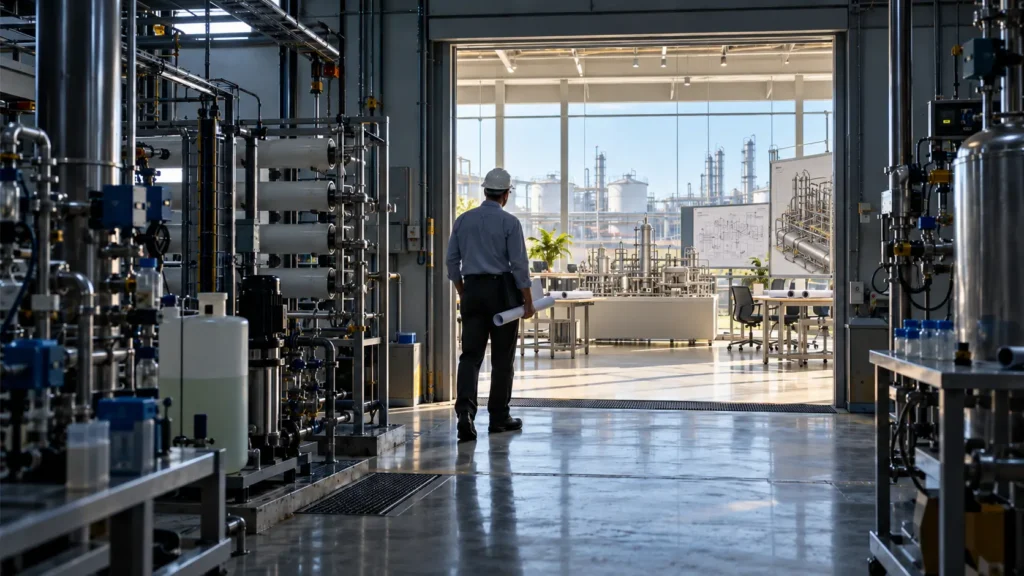
Decision maturity must match evidence maturity.
Controlled principleA project stage is a permission boundary, not a certificate that the entire project is proven. Each gate authorizes only the next commitment that the available evidence can support. Unresolved claims must remain assumptions, tests, allowances, conditions, risks or stop decisions—not be promoted silently into design facts. |
|---|
A stage authorizes a decision—it does not prove the whole project
Project life-cycle names differ among owners, contractors, lenders and jurisdictions. ISO 21502 is deliberately applicable across predictive, iterative, adaptive and hybrid delivery approaches rather than prescribing one universal sequence. DOE capital-project practice uses formal critical decisions, while NASA systems engineering uses life-cycle reviews with entrance and success criteria. The transferable principle is not the label: it is the explicit link between evidence, review and authority to proceed.
For high-salinity wastewater projects, this distinction is essential. A concept study can show that a treatment route deserves testing; it cannot establish continuous operability. A pilot can demonstrate integrated behaviour on representative feed; it cannot by itself establish the total installed project cost, final permit conditions or contractual availability. FEED can specify the plant and interfaces; it cannot substitute for construction quality, commissioning or an agreed performance test. Each stage should therefore state the decision it supports and the claims it still forbids.
| Stage | Minimum evidence | Legitimate decision | Cannot legitimately conclude |
|---|---|---|---|
| Opportunity screening | Named driver; initial boundary; available flow/chemistry; current water and residual route; fatal constraints. | Fund or reject data validation and option screening. | Final technology, product revenue, guaranteed recovery or definitive cost. |
| Data validation | Representative flow history; sampling plan; methods; charge/density checks; additives; normal/design/upset cases. | Approve a controlled design basis and a gap-closing plan. | Treatability, scale-up, final waste classification or long-term performance. |
| Concept | Credible endpoints; first-pass water/salt balances; site utilities and residual routes; candidate architectures. | Shortlist concepts and define the next tests. | Vendor award, frozen train, investment sanction or performance guarantee. |
| Laboratory testing | Representative real matrix; defined hypotheses; analytical methods; repeatability; products and all residuals. | Reject mechanisms, refine chemistry and define pilot conditions. | Continuous uptime, full recycle stability, equipment reliability or site integration. |
| Preliminary techno-economics | Visible mass/energy model; rough equipment duties; site factors; avoided-cost and no-revenue cases. | Rank concepts and identify economic switching variables. | Bankable NPV, final CAPEX, contracted netback or affordability assurance. |
| Pre-feasibility | Option-comparable balances; preliminary equipment and plot; utilities; permits/logistics; estimate basis; risk register. | Select a preferred concept and authorize pilot/feasibility work. | Performance baseline, final procurement strategy or construction approval. |
| Pilot | Integrated real-stream operation; representative duration and upsets; cleaning; recycle/purge; product/residual quality. | Establish scale-up rules, operability limits and evidence for design. | Full-scale availability, all seasonal conditions or guaranteed lifetime. |
| Feasibility | Selected design; pilot basis; equipment sizing; site integration; implementation plan; risk-adjusted economics. | Decide whether the project merits pre-FEED/FEED and commercial development. | Issue-for-construction design, fixed price or final acceptance criteria. |
| Pre-FEED | PFDs and balances; equipment list; plot and utilities; control/operability philosophy; HAZID; execution strategy. | Freeze the basis sufficiently to sanction FEED and align contracting. | As-built configuration, final vendor data or demonstrated performance. |
| FEED | P&IDs; datasheets; specifications; control and safeguarding; interfaces; layout; cost/schedule and test philosophy. | Tender, procure and authorize construction subject to governance. | Construction quality, mechanical completion or accepted plant performance. |
| Procurement | Bid compliance; vendor data; exclusions; guarantees; spares; quality plans; interface and schedule alignment. | Award packages and manage commercial/technical interfaces. | Assume omitted scope is included or that vendor claims close system risk. |
| Construction | IFC information; QA/QC; inspection; material traceability; change and configuration control. | Declare systems mechanically complete and ready for turnover. | Process readiness, stable operation or guarantee compliance. |
| Commissioning | System completion; utilities; procedures; trained operators; punch-list control; safe start-up sequence. | Introduce feed and transition from construction to operation. | Contractual acceptance before the agreed performance protocol is passed. |
| Performance testing | Approved protocol; calibrated measurements; specified feed and duty; stable test window; product and residual criteria. | Accept, conditionally accept or require remedy against defined obligations. | Performance outside the tested envelope or long-term reliability without evidence. |
| Long-term optimization | Actual operating, maintenance, quality, energy, chemical, residual and market data. | Optimize set-points, maintenance, contracts and future debottlenecking. | Rewrite the original evidence record or generalize one site as a universal benchmark. |
Table 32.1. Every stage has a legitimate decision and a corresponding limit on what may be claimed.
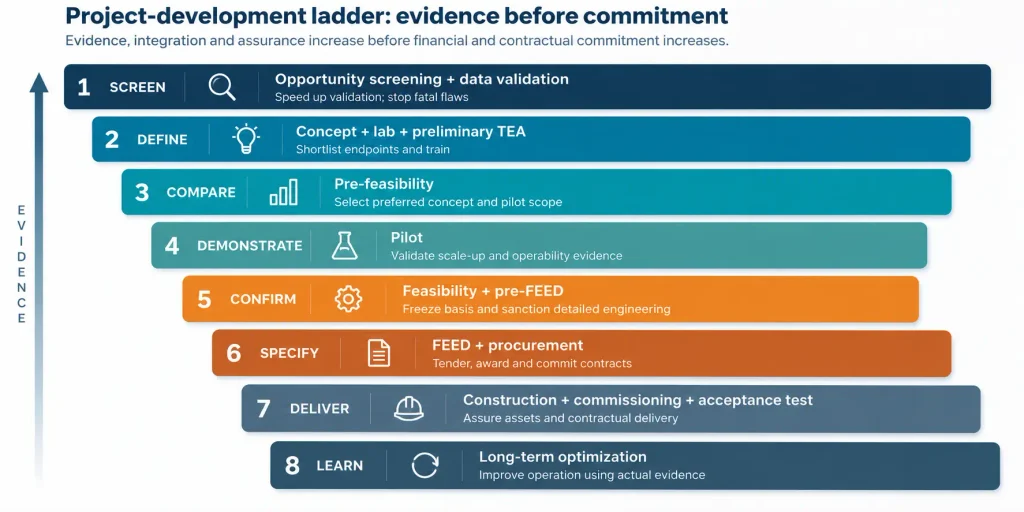
Figure 32.1. Project-development ladder. Stage names may vary, but evidence must mature before technical, financial and contractual commitment increases.
Maintain one controlled evidence and decision system across all stages
The project should not restart its logic at every handover. The same source-to-endpoint boundary, design cases, product/residual definitions, assumptions and decisions should mature through controlled registers. This continuity is what allows new tests and quotations to replace assumptions without changing the question being answered. Project Routemap guidance similarly emphasizes early capability, governance and delivery set-up for complex projects rather than treating front-end work as a narrow engineering exercise. DOE front-end planning guidance uses project-definition maturity before establishment of a performance baseline.
| Controlled register | Minimum content | Failure prevented |
|---|---|---|
| Objective and success criteria | Driver, required service, owner constraints and measurable success/failure thresholds. | The team optimizes a technology instead of the owner’s problem. |
| Basis of design | Normal/design/upset feed, flow, availability, product water, residual and product requirements. | Different disciplines and bidders design different projects. |
| Assumption/evidence register | Claim, value, unit, source, status, owner, expiry and next evidence. | Provisional values become invisible facts. |
| Decision and change register | Decision, authority, date, rationale, alternatives rejected and reopening trigger. | The project repeatedly revisits closed issues or cannot explain changes. |
| Interface matrix | Owner/vendor/site/package boundaries, utilities, controls, drains, storage and data. | Scope gaps emerge during procurement and construction. |
| Risk and opportunity register | Cause, event, consequence, mitigation, cost/schedule effect, owner and trigger. | Risk is described but not treated or funded. |
| Permit and stakeholder route | Jurisdiction, approvals, studies, regulators, receptors, consultations and schedule. | A technically mature design has no lawful route. |
| Product/offtake register | Specification, qualification, buyer/user, volume, logistics, contract status and fallback. | Unqualified revenue controls the water project. |
| Cost and schedule basis | WBS, estimate class/purpose, price date, exclusions, contingency, schedule logic and range. | Numbers from different maturity levels are compared as equivalents. |
| Verification and acceptance plan | Lab/pilot/inspection/commissioning/performance criteria and records. | No one can state what evidence closes each claim. |
Table 32.2. A continuous controlled record converts assumptions into evidence without losing the project boundary.
Opportunity screening and data validation should kill fatal assumptions early
Opportunity screening is directional. It defines the reason to act, the counterfactual and the first fatal-flaw questions: Is the flow material and sufficiently reliable? Is there a lawful residual route? Are the required utilities and space plausible? Does the chemistry contain a known barrier? Is a product or hub case being credited without a real receiver? The output is a decision to validate, pause or stop—not a preferred vendor.
Data validation then establishes whether the available information can support concept work. Flow and chemistry should be separated into normal, design and upset cases; analytical methods, preservation and charge balance should be reviewed; process additives and cleaning events should be identified; and missing information should become a dated sampling or testing plan. Averages are not silently converted into design maxima, and one sample is not promoted into a continuous feed specification.
| Screening field | Required input | Permitted output | Red flag |
|---|---|---|---|
| Hydraulic basis | Flow history by production mode, batch/cleaning events, uptime and peak duration. | Size range and equalization need. | Short records, unexplained meter gaps or nameplate flow used as actual flow. |
| Chemical basis | Representative major ions, density, pH, alkalinity, organics/oil, solids, trace hazards and additives. | Normal/design/upset envelopes and first constraints. | Charge imbalance, detection-limit substitution or absent additive history. |
| Existing system | Water sources/uses, treatment, recycle, disposal, sludge, storage and operating bottlenecks. | Counterfactual and integration boundary. | A proposed brine plant duplicates or destabilizes existing assets. |
| Site and endpoint | Land, power/heat, chemicals, waste routes, transport, permits, operators and outage windows. | Fatal-flaw screen and site data request. | No feasible endpoint, utility or operating capability. |
| Commercial context | Avoided cost, expansion value, internal use, buyer/logistics evidence and fallback. | Whether further commercial work is justified. | Headline price or unsigned interest treated as revenue. |
| Uncertainty | Known unknowns, range basis, owner and next evidence. | Validation budget and schedule. | False precision or unsupported “typical” values. |
Table 32.3. Screening is successful when it identifies the next evidence or a defensible reason to stop.
Concept, laboratory work and preliminary techno-economics develop hypotheses—not guarantees
Concept development should compare endpoints before locking a train: controlled discharge, source reduction and reuse, MLD, ZLD, selective valorization and any on-site, centralized or hybrid architecture. Each concept needs a closed first-pass water and salt balance, named residuals, preliminary utility duties and a credible operating philosophy. The purpose is to expose the first limiting constraint and define which claim requires laboratory evidence.
Laboratory work should be hypothesis-driven. It may establish precipitation windows, co-precipitation, membrane passage, extraction selectivity, crystal phases, dewaterability, corrosivity, cleaning response or product purity. Tests should use representative matrix and report every output stream. They do not establish equipment availability, hydraulic scale-up, long recycle accumulation or site operability. GAO technology-readiness guidance reinforces that maturity assessments must examine how readiness has actually been demonstrated and how a technology will be integrated, rather than relying on a label alone.
| Development item | Minimum discipline | Failure prevented |
|---|---|---|
| Concept mass balance | Close water, target salts, reagent additions, products, purge, sludge and cleaning losses. | A flowsheet whose hidden residual is larger than the stated problem. |
| Constraint hypothesis | Name the mechanism that limits the next step and the measurement that will confirm it. | Broad “test the technology” programmes without a decision purpose. |
| Real-matrix protocol | Representative feed, controls, repeats, analytics, acceptance limits and mass-balance closure. | Synthetic-water success presented as site evidence. |
| Preliminary energy model | Electrical and thermal duties by block, efficiency/COP basis and operating case. | A single vendor SEC applied to an integrated plant. |
| Preliminary cost model | Equipment duty, installed/site allowances, OPEX drivers, residual cost and no-product case. | Equipment price treated as total project cost. |
| Next-stage decision | Reject, revise, advance to pre-feasibility, or require targeted additional testing. | Laboratory success used to authorize procurement. |
Table 32.4. Concept and laboratory work mature the problem definition and remove weak mechanisms before scale-up.
Pre-feasibility compares complete options and defines the pilot decision
Pre-feasibility is the first stage at which the owner should be able to compare complete options on a common basis. It should integrate representative chemistry, process modelling, preliminary equipment duties, site interfaces, residual endpoints, product qualification status, implementation constraints and risk-adjusted economics. The estimate is still a range for a defined purpose; the project should state which deliverables support it and which packages remain factored or analogous.
A preferred concept advances because it best meets the owner’s objectives under downside cases—not because it has the highest recovery or the most impressive laboratory result. The pre-feasibility decision should define the pilot hypotheses, scale, duration, feed campaigns, success criteria, sample plan, failure limits and data needed for feasibility and pre-FEED.
| Pre-feasibility output | Minimum content |
|---|---|
| Option definition | Same feed, boundary, endpoint and service; lower-complexity and no-product alternatives retained. |
| Process basis | Normal/design/upset balances; constraint-removal logic; recycle/purge; preliminary equipment duty. |
| Site integration | Utilities, storage, plot, tie-ins, outage needs, operator capability, transport and shared assets. |
| Environmental/legal | Permit route, residual classification questions, receptor/hazard tests and environmental scenarios. |
| Commercial | Water value, disposal baseline, product qualification/offtake evidence, logistics and fallback capacity. |
| Economics | Total-project scope, OPEX/replacement, schedule, range, sensitivity and mandatory downsides. |
| Pilot basis | Hypotheses, representative conditions, duration, success criteria, analytics, operability and scale-up outputs. |
| Decision | Preferred concept, conditional issues, next-stage budget/schedule and explicit stop conditions. |
Table 32.5. Pre-feasibility must compare complete options and leave a decision-specific pilot programme.
A pilot must test the integrated duty that creates scale-up risk
Pilot scale is not defined by skid size alone. It is defined by whether the test reproduces the controlling chemistry, hydraulic regime, residence time, recycle and purge, solids handling, materials exposure, automation and upset behaviour needed for the scale-up decision. A short demonstration at stable feed may support proof of mechanism; it does not prove cleaning interval, seasonal variability, impurity accumulation or availability.
The pilot should be designed backwards from the engineering claims that feasibility and pre-FEED need. Critical technologies and integration points should be identified before testing; readiness evidence should be independent enough to challenge vendor claims; and failed criteria should trigger redesign rather than selective reporting. Chapter 33 develops the laboratory and pilot programme in detail.
| Pilot evidence field | Required basis | Failure prevented |
|---|---|---|
| Representativeness | Feed campaigns cover normal, design-relevant and credible upset chemistry; pretreatment and additives match the intended system. | Results apply only to an easy or unrepresentative feed. |
| Integration | All material streams, recycle, purge, cleaning, sludge/product finishing and control interactions are included or explicitly bounded. | A successful unit operation fails in the full train. |
| Duration and cycles | Enough operating/cleaning cycles to observe drift, fouling, scaling, corrosion indicators and recovery after upset. | Transient start-up performance is called stable operation. |
| Measurement | Calibrated flow/energy/chemical data; complete water/salt balances; product and residual analyses; uncertainty stated. | Performance cannot be reconciled or scaled. |
| Operability | Start-up/shutdown, turndown, alarms, manual interventions, storage, maintenance and operator feedback. | Design assumes continuous ideal operation. |
| Scale-up model | Dimensionless/empirical basis, equipment-specific rules, safety factors and unresolved scale effects. | Linear multiplication of bench or pilot results. |
| Decision package | Passed/failed criteria, deviations, revised design basis, guarantees requiring further proof and residual risks. | Pilot report becomes promotional evidence instead of an engineering input. |
Table 32.6. Pilot evidence is useful only when it closes the integrated scale-up claims needed by the next gate.
Feasibility and pre-FEED convert demonstration into a controlled project basis
Feasibility should reconcile pilot evidence with a selected process design, implementation plan, permit/commercial route and risk-adjusted business case. It should identify technology and integration risks that remain immature, define maturation actions and show whether the selected concept still outperforms the counterfactual and lower-complexity alternative. A feasible project can still be rejected for affordability, delivery capability, permit schedule, market dependence or owner risk appetite.
Pre-FEED then increases definition before detailed design expenditure. Process flow diagrams, heat and material balances, equipment lists, plot arrangement, utilities, control and operability philosophy, materials basis, preliminary safeguarding, tie-ins, modularization, execution strategy and contracting boundaries should be sufficiently mature to prevent FEED from becoming another concept study. DOE front-end planning guidance explicitly links project-definition maturity to readiness for establishing a performance baseline.
| Pre-FEED domain | Minimum maturity before FEED |
|---|---|
| Process | Validated design cases; PFDs; balances; equipment duties; recycle/purge; product/residual specifications. |
| Mechanical/materials | Preliminary equipment list, metallurgy/corrosion basis, fouling/cleaning provisions and redundancy philosophy. |
| Controls/operability | Control narrative, safeguarding concept, start-up/shutdown, turndown, storage and operator interventions. |
| Site/infrastructure | Plot, tie-ins, utilities, drainage, buildings, roads, storage, waste/product logistics and construction constraints. |
| Safety/environment | HAZID, chemical handling, emissions, residual/hazard route, permit studies and monitoring requirements. |
| Commercial/execution | Package boundaries, owner/EPC/vendor responsibilities, procurement strategy, long-lead items and contracting risks. |
| Cost/schedule | WBS-based estimate and schedule with maturity, exclusions, contingency, escalation, risk and decision thresholds. |
| Assurance | Independent review, pilot-to-design traceability, open items, closure dates and FEED entry criteria. |
Table 32.7. Pre-FEED should freeze the project basis sufficiently that detailed engineering resolves detail—not the fundamental concept.
FEED, procurement and construction mature specification, interfaces and configuration
FEED translates the controlled basis into coordinated specifications, P&IDs, datasheets, layouts, electrical and control documents, civil/structural requirements, package interfaces, commissioning philosophy and acceptance requirements. Design reviews should have defined entrance information and success criteria; outstanding items should be visible and owned, not closed by schedule pressure. NASA life-cycle review guidance provides a useful general model: reviews should be planned, supported by evidence and judged against explicit entrance and success criteria.
Procurement tests whether vendor offers satisfy the system requirement. Technical alignment must include exclusions, battery limits, utility and feed assumptions, guarantees, liquidated-damages or remedy structure where applicable, spares, consumables, test obligations, data delivery and schedule interfaces. Construction then controls the physical realization through IFC documents, inspection and test plans, material traceability, nonconformance, field change and configuration management. Neither procurement nor construction converts an untested process claim into performance evidence.
| Delivery layer | Required evidence | Decision supported |
|---|---|---|
| Design basis | Single approved feed, capacity, service, product/residual and availability basis. | Bidders optimize different duties and exclusions multiply. |
| Interfaces | Battery limits, utilities, drains, controls, storage, tie-ins, owner supply and package data. | Scope gaps emerge during installation and commissioning. |
| Guarantees and tests | Measured parameters, feed envelope, test duration, corrections, exclusions, remedies and retest. | Acceptance dispute or guarantee that cannot be measured. |
| Configuration | Document hierarchy, vendor data incorporation, revision control and field-change authority. | As-built plant diverges from model, procedures and spares. |
| Quality | Codes, materials, weld/NDE/coating/instrument checks, FAT/SAT and records. | Mechanical completion hides defects that impair performance. |
| Readiness | Construction completion system, turnover packages, preservation, procedures, staffing and training. | Commissioning begins with incomplete or undocumented systems. |
Table 32.8. FEED and delivery stages control specification, interfaces and configuration; they do not replace operational proof.
Commissioning and performance testing separate readiness from contractual acceptance
Commissioning should be planned during design, not improvised after construction. Systemization, mechanical completion, pre-commissioning, utility introduction, control-loop checks, safe start-up, water runs, chemical introduction, feed ramp-up, operator training, punch-list management and turnover records should form a controlled sequence. DOE guidance treats transition and closeout as a distinct project-management responsibility and provides dedicated commissioning guidance for complex facilities.
Performance testing is a defined comparison between demonstrated operation and contractual or owner acceptance criteria. The protocol should state feed composition and variability, capacity, product-water quality, recovery and residual basis, energy and chemical denominators, environmental/product specifications, availability or test duration, measurement uncertainty, permitted interruptions, correction methods and remedies. A successful test proves performance only inside its stated boundary.
| Readiness layer | Minimum evidence | Legitimate decision |
|---|---|---|
| Mechanical completion | Installed, inspected and documented equipment/systems; open items classified. | Turn over systems for pre-commissioning. |
| Pre-commissioning | Cleaning, flushing, pressure/leak tests, calibration, loop checks, rotation and utility readiness. | Authorize controlled energization and start-up. |
| Commissioning | Safe sequence, water/chemical/feed introduction, controls, alarms, trips, operator procedures and stable operation. | Declare operational readiness for the formal test. |
| Performance test | Agreed feed/duty, calibrated data, duration, balance closure, product/residual/energy/chemical criteria and deviations. | Accept, conditionally accept, remedy or retest. |
| Reliability run where required | Defined continuous period, planned interventions, spare use and failure accounting. | Demonstrate short-term reliability within the agreed window. |
| Operations handover | As-builts, manuals, training, spares, maintenance, monitoring, warranties and outstanding obligations. | Transfer accountability without losing project commitments. |
Table 32.9. Mechanical completion, commissioning, performance testing and operations handover are separate evidence gates.
Long-term optimization closes the learning loop
The project does not stop learning at contractual acceptance. Actual feed distributions, operating hours, energy, chemicals, cleaning frequency, membrane/media life, corrosion, solids moisture, off-spec product, disposal, maintenance and operator interventions should be compared with the design and business-case models. Deviations should update operating envelopes, maintenance strategy, spare holdings, procurement contracts and future project assumptions.
Optimization should preserve the required service and hard environmental/legal limits. Higher recovery, lower energy or additional products are changes to the controlled system, not free improvements. Each modification should close a new water/salt balance, check residual and product routes, assess reliability and determine whether requalification, permit change or performance re-test is required.
| Optimization evidence | Management use |
|---|---|
| Actual feed and load | Update design distributions, equalization and campaign logic; identify persistent drift. |
| Reliability and maintenance | Compare planned/actual availability, cleaning, failure modes, spares and labour; revise strategy. |
| Resource intensity | Track electrical/thermal energy, reagents, wash water, consumables and residual disposal on visible denominators. |
| Product/residual performance | Track qualified yield, rejection, storage, buyer use, sludge/solid quality, leachability and fallback. |
| Control and operability | Use alarms, manual interventions, turndown and upset recovery to revise control philosophy and training. |
| Economic/environmental model | Replace assumptions with outturn; rerun downside cases before debottlenecking or expansion. |
| Knowledge transfer | Feed lessons into specifications, pilot criteria, contract clauses and estimate ranges for future projects. |
Table 32.10. Long-term operation converts project assumptions into organizational evidence for optimization and future designs.
Estimate accuracy follows definition and risk—not the stage name
Cost estimates should be classified by the maturity of the defining deliverables and the intended use, not by attaching a confident stage label. AACE Recommended Practice 18R-97 aligns estimate classification with process-industry stage-gate development and states that deliverable maturity—not a nominal percentage—is the primary class determinant. It also warns that accuracy depends on technology familiarity, location, complexity, estimating data, assumptions, market conditions and process-stream definition, and therefore requires risk analysis.
The ranges below are AACE’s typical process-industry ranges at an 80% confidence interval after appropriate contingency for the defined scope. They are not promises, not universal project tolerances and not a substitute for project-specific risk analysis. Water projects with novel chemistry, remote sites, weak vendor data, uncertain residual routes or immature products may fall outside them. A chapter stage and an AACE class should only be linked after reviewing the actual deliverables.
| AACE class | Typical purpose | Maturity indicator | Typical low range | Typical high range |
|---|---|---|---|---|
| Class 5 | Concept screening | 0–2% indicated definition | -20% to -50% | +30% to +100% |
| Class 4 | Study / feasibility | 1–15% indicated definition | -15% to -30% | +20% to +50% |
| Class 3 | Budget authorization / control | 10–40% indicated definition | -10% to -20% | +10% to +30% |
| Class 2 | Control / bid or tender | 30–75% indicated definition | -5% to -15% | +5% to +20% |
| Class 1 | Check estimate / bid or tender | 65–100% indicated definition | -3% to -10% | +3% to +15% |
Table 32.11. AACE process-industry estimate classes and typical accuracy ranges. Deliverable maturity and project-specific risk—not the stage label—control applicability.
Use stage gates to control commitment, not to manufacture certainty
A gate should ask whether the evidence is sufficient for the next irreversible or expensive commitment. It should not demand FEED-level certainty from screening, nor accept screening-level evidence at procurement. The review team should include the disciplines and owners of the next-stage risk: process, operations, maintenance, safety, environmental, commercial, procurement, construction, commissioning and finance as applicable. Independent review should increase as the commitment, novelty and consequence of failure increase.
| Gate field | Proceed / conditional basis | Stop signal |
|---|---|---|
| Objective and boundary | Required service, counterfactual, feed cases and source-to-endpoint boundary are stable enough for the decision. | Objective or boundary changes between options. |
| Evidence maturity | Critical claims are supported at the maturity needed; assumptions are explicit, owned and time-limited. | A label, vendor statement or prior project substitutes for evidence. |
| Integration | Water/salt/energy/cost balances, interfaces, residuals, operability and site constraints reconcile. | Unit operations work separately but the system does not close. |
| Technology readiness | Critical technologies and scale-up/integration risks have evidence and maturation plans. | Technology readiness is inferred from company age or a different application. |
| Commercial/legal route | Permits, residuals, product qualification, logistics, contracts and fallback match the stage. | Revenue or lawful disposal remains an assumption controlling viability. |
| Cost/schedule maturity | Estimate purpose, deliverables, WBS, range, risk, schedule logic and exclusions are visible. | Point estimate or compressed schedule is presented without basis. |
| Delivery capability | Owner team, governance, contracting, operations, commissioning and assurance capability are adequate for the next stage. | The project advances because engineering is ready while the organization is not. |
| Decision and conditions | Proceed, conditional proceed, recycle or stop; conditions have owner, date and closure evidence. | Open issues are recorded but do not constrain authorization. |
Table 32.12. A stage gate is credible only when the next commitment, evidence limits and closure conditions are explicit.
Stop ruleStop, simplify or re-stage when a decision depends on evidence that belongs to a later stage; when the preferred concept cannot survive the no-product or residual-fallback case; when critical technology or integration maturity is asserted rather than demonstrated; or when procurement/construction is being used to discover the fundamental process basis. More engineering effort does not cure a project whose decision logic is still undefined. |
|---|
Handover to Chapter 33 — laboratory and pilot testing
Chapter 33 defines the integrated evidence needed for scale-up. It should receive the preferred concept and the exact claims that laboratory or pilot work must close—not a generic request to “test the technology.” Each claim should identify its present evidence state, decision threshold, representative feed and operating conditions, measurement method, duration or number of cycles, mass-balance requirement, failure condition and owner.
The handover should also identify how successful results will change the process design, equipment sizing, materials, control philosophy, cleaning strategy, product/residual specification, guarantees, cost range and next gate. Tests that cannot change or defend a decision should be removed or clearly labelled as exploratory research.
| Handover field | Required basis for Chapter 33 |
|---|---|
| Decision claim | Exact technical, operability, quality, environmental or commercial statement the test must support. |
| Current evidence state | Source, maturity, uncertainty, conflicts and why existing evidence is insufficient. |
| Representative basis | Feed distributions, pretreatment, additives, temperature, recycle, purge and relevant site conditions. |
| Test scale and configuration | Bench/pilot duty, integration, residence time, hydraulic/thermal regime, materials and control features. |
| Protocol and analytics | Variables, controls, repeats, duration/cycles, sampling, methods, calibration and balance closure. |
| Acceptance / failure criteria | Threshold, confidence/variability treatment, allowable deviation and stop/re-design trigger. |
| Scale-up output | Model parameters, design factors, cleaning/lifetime basis, equipment duty and unresolved scale effects. |
| Project-model impact | Which FEED, cost, schedule, risk, permit, guarantee or product/residual input will be replaced. |
| Ownership and assurance | Test owner, independent review, data rights, version control, deviations and approval authority. |
Table 32.13. Chapter 33 requires decision-linked test claims, representative conditions and defined scale-up outputs.
Chapter conclusion
Project development is a controlled conversion of uncertainty into evidence. Opportunity screening identifies whether a problem deserves work. Data validation establishes the design basis. Concept and laboratory work test mechanisms. Preliminary techno-economics and pre-feasibility compare complete options. Pilot work demonstrates integrated behaviour. Feasibility and pre-FEED convert that evidence into a controlled project basis. FEED, procurement and construction specify and realize the asset. Commissioning and performance testing prove readiness and accepted duty. Long-term operation supplies the evidence needed to optimize and improve future projects.
No stage should claim the maturity of the next one. Estimate class follows the maturity of defining deliverables and project-specific risk. Technology readiness does not prove system integration, and mechanical completion does not prove performance. The quality of the project therefore depends less on using fashionable stage names than on stating what evidence exists, what decision it supports, what remains conditional and what would cause the project to stop.
Chapter 33 now develops the laboratory and pilot programme that converts the highest-risk technical and operability assumptions into scale-up evidence.
Chapter 32 in one sentenceAdvance only when the evidence is mature enough for the next decision—and never use a later commitment to compensate for an earlier unanswered question. |
|---|