Endpoint, residual and value language that must be fixed before a technology train is selected.
Controlled principleMLD, ZLD and valorization answer different questions. MLD defines how far liquid residuals should be minimized. ZLD defines whether routine liquid wastewater leaves a stated system boundary. Valorization defines whether a recovered water, material, energy stream or service has a credible use and net value. |
|---|
3.1 Three objectives—not three equipment lists
Minimum Liquid Discharge (MLD), Zero Liquid Discharge (ZLD) and brine valorization are often presented as if they were competing treatment technologies. They are not. They are project objectives and endpoint claims that may be delivered by many different combinations of source reduction, segregation, pretreatment, membrane concentration, electrochemical separation, evaporation, crystallization and residual management.
The distinction matters because a technology name cannot define the project boundary. A reverse-osmosis system may support controlled discharge, MLD or the first stage of ZLD. An evaporator may reduce a brine for off-site disposal, produce a crystallizer feed or recover process water. A precipitation step may remove a limiting scale-former, produce a disposal sludge or create a material that later qualifies as a product. The same unit operation can therefore serve different objectives, and the same objective can be reached through different trains.
The endpoint language must be fixed before the flowsheet. The owner should first state what routine liquid, solid, gaseous and non-routine streams may leave the defined boundary; what water quality is required for reuse; what residual destinations are available; and whether any recovered material has a qualified use. Only then can technologies be compared on a common basis.
3.2 Minimum Liquid Discharge: optimize the residual
In this guide, Minimum Liquid Discharge is a site-specific strategy that minimizes the volume and/or burden of liquid residuals without necessarily eliminating them. “Minimum” describes an optimized endpoint, not a universal recovery percentage. The remaining liquid stream must be quantified, characterized and assigned to a credible destination.
The published literature often uses the phrase “Minimal Liquid Discharge” and may associate it with a high but incomplete water-recovery target. Those ranges are useful only within the chemistry, process boundary and assumptions of the cited study. They do not define MLD for all sectors. Brine Consulting therefore uses “Minimum Liquid Discharge” to emphasize that the correct target is the lowest total system burden that is technically reliable, economically defensible and operationally manageable—not the highest recovery that can be demonstrated in a model.
An MLD project may stop because the residual has a stable and permitted route, because further concentration would create disproportionate energy or solids-handling demand, because mixed salts have no credible use, or because the final thermal step would add more cost and risk than it removes. This is not a failed ZLD project. It is a deliberate decision that the last increment of recovery does not justify itself.
MLD acceptance testAn MLD claim is complete only when the remaining liquid flow, composition, variability, storage requirement, transport or discharge route, cost and upset contingency are visible. “Near-ZLD” is not a substitute for this information. |
|---|
3.3 Zero Liquid Discharge: define the boundary and close the ledger
Zero Liquid Discharge is a defined system endpoint in which no routine liquid wastewater leaves the stated boundary. Water is recovered for reuse or removed as vapour, while residual matter leaves as solids, sludges, gases or managed non-routine streams. The system boundary may be a process unit, a wastewater plant or an entire industrial site, but it must be stated explicitly.
The word “zero” applies to routine liquid wastewater discharge—not to all wastes and impacts. U.S. EPA guidance on zero-discharge metal-finishing systems makes the same distinction: no wastewater is discharged, yet air emissions and solid wastes remain. Modern ZLD reviews likewise identify energy demand, greenhouse-gas emissions, chemical use and solid-waste generation as material system impacts.
A credible ZLD balance must therefore show the product water, evaporation or vapour route, dry or wet solids, chemical sludges, crystal wash water, mother liquor, controlled purge where applicable, condensate contaminants, cleaning wastes, off-spec material and emergency storage. Non-routine discharges cannot be hidden by choosing a narrow operating snapshot. Start-up, shutdown, cleaning, rainfall where relevant, maintenance and upset handling belong in the operating philosophy even when they are excluded from the routine ZLD claim.
| Claim element | What ZLD requires | What ZLD does not establish |
|---|---|---|
| System boundary | A named physical and accounting boundary. | That the whole industrial site, supply chain or lifecycle is discharge-free. |
| Routine liquid wastewater | No routine liquid wastewater leaves the stated boundary. | Zero water consumption, zero vapour or zero non-routine streams. |
| Recovered water | Quality, destination, internal losses and reliability are defined. | That every recovered stream is immediately suitable for reuse. |
| Solids and sludges | Mass, moisture, composition, handling and final route are stated. | That the solids are products, benign or free of long-term liability. |
| Energy and chemicals | Electrical and thermal energy, reagents and cleaning are accounted for. | That ZLD is automatically the lowest-carbon or lowest-impact option. |
| Operating reality | Availability, storage, cleaning, start-up, shutdown and upset routes are addressed. | Continuous perfect closure with no downtime, purge or off-spec material. |
Table 3.1. ZLD is a bounded liquid-discharge endpoint; it is not a claim of zero waste or zero impact.
3.4 Valorization: a separate value and qualification objective
Brine valorization is the conversion of a saline residual into water, chemicals, minerals, energy or a useful service with a credible technical use and net value. It can be applied within a controlled-discharge, MLD or ZLD strategy. It is therefore an overlay on the residual-management endpoint, not a synonym for ZLD.
The first value route is often internal rather than merchant. Recovered water may displace purchased make-up water. A recovered acid, alkali or salt may replace a material already consumed on site. Reduced hauling, injection, landfill demand or environmental liability may create value even when no product is sold. External product sales are a later and more demanding category because purity, consistency, physical form, regulation, market absorption, packaging, storage, transport and buyer qualification all become project constraints.
Resource recovery is not the same as product manufacture. A constituent can be separated technically and still remain a waste, an off-spec material or a negative-value residual. Under the EU Waste Framework Directive, by-product and end-of-waste status depend on conditions that include certain or specific use, lawful use, a market or demand, compliance with technical and product requirements, and protection of health and the environment. The exact legal route remains jurisdiction-specific, but the engineering lesson is universal: a recovered mass does not become a bankable product merely because it appears in a mass balance.
| Value route | Evidence required | Typical benefit basis | Mandatory fallback |
|---|---|---|---|
| Recovered water used on site | Reuse quality, reliability, storage and process acceptance. | Avoided water purchase, discharge or production constraint. | Alternative water supply and off-spec water route. |
| Internal chemical or salt substitution | Composition, concentration, compatibility and internal demand. | Avoided purchase, transport, storage and handling. | Return to treatment or managed disposal. |
| Avoided disposal / safer residual | Reduced volume, hazard or liability with permitted destination. | Avoided gate fee, transport, injection, pond or long-term liability. | Baseline disposal route remains available. |
| Qualified by-product | Consistent specification, lawful use, user acceptance and delivery terms. | Risk-adjusted netback from a secondary output. | Off-spec handling and no-offtake case. |
| Primary product manufacture | Product-grade purification, finishing, certification, scale and offtake. | Merchant or internal product value after full finishing cost. | Independent disposal or reprocessing route. |
| Multi-product platform | Each product passes the same technical, legal and commercial gates. | Portfolio value and system integration benefits. | The project survives failure of one or more product routes. |
Table 3.2. Valorization routes ranked from internal use and avoided cost to merchant product manufacture.
3.5 The continuum: MLD is not inferior ZLD
MLD and ZLD should be read as points on a management continuum rather than a hierarchy of ambition. Moving toward ZLD generally reduces the routine liquid residual, but it also increases the duty transferred to concentration, energy supply, chemical conditioning, materials selection, solids handling, storage and operations. The correct endpoint is the one that resolves the site problem with the lowest credible total burden.
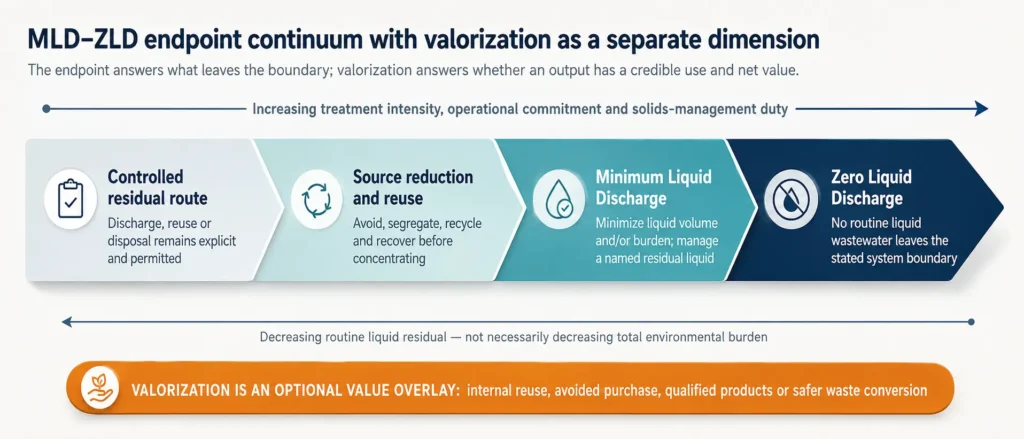
The continuum also prevents a common category error: assuming that a project becomes more circular merely by moving farther to the right. A ZLD plant that produces mixed, wet or contaminated solids for landfill may recover more water but create no product. An MLD system that recovers reusable water, replaces purchased chemicals and sends a small stable residual to a permitted route may create more reliable value. The comparison must therefore include the actual water destination, energy, chemicals, solids, product qualification, residual route and operating risk.
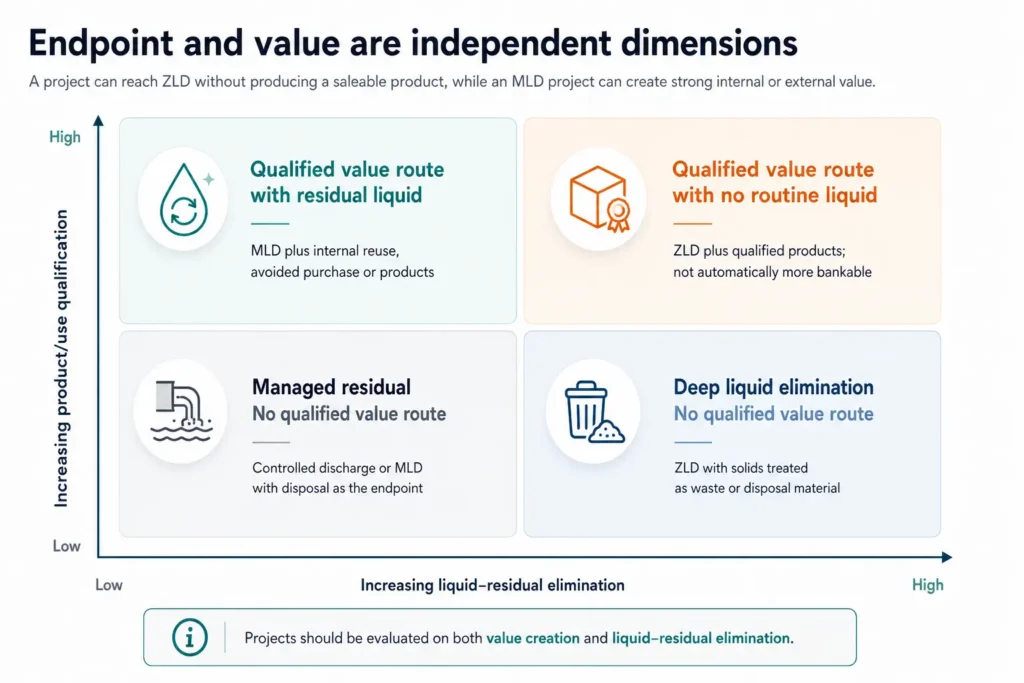
Figure 3.2. Liquid-residual elimination and product qualification are independent project dimensions.
3.6 Every endpoint needs a residual ledger
A project objective is incomplete until every output has a destination. The residual ledger below should be opened at concept stage and retained through pilot testing, feasibility, FEED, procurement and operation. Empty cells are evidence gaps, not opportunities for optimistic assumptions.
| Output / operating stream | MLD statement | ZLD statement | Valorization statement |
|---|---|---|---|
| Product water | Quality, quantity, internal use and losses. | Quality, quantity, internal use and losses. | User specification and avoided-cost basis. |
| Residual liquid | Flow, composition, variability and named destination. | No routine liquid leaves boundary; non-routine streams disclosed. | Any useful liquid has a qualified user; remainder retains a disposal route. |
| Sludge / wet solids | Dry mass, moisture, filtrate and destination. | All chemical and process sludges close the balance. | Purity, washing, dewatering and off-spec route. |
| Crystals / dry solids | If produced, specification or waste route. | Mass, composition, storage and final route. | Product grade, buyer acceptance and no-offtake case. |
| Mother liquor / purge | Recycle accumulation and controlled withdrawal. | Any retained loop and exceptional purge are explicit. | Impurity management protects product quality. |
| Vapour / gases / condensate contaminants | Air and condensate route where present. | Evaporation does not make contaminants disappear. | No value claim without recovery quality and use. |
| CIP, backwash and cleaning waste | Frequency, volume, chemistry and destination. | Included in routine/non-routine boundary logic. | Recovery does not compromise cleaning or product quality. |
| Off-spec and emergency inventory | Storage time, overflow prevention and fallback. | Upset management does not rely on hidden discharge. | Rejected material and lost offtake are costed. |
Table 3.3. Minimum residual ledger for MLD, ZLD and valorization claims.
3.7 State the project objective before naming the technology
A useful objective statement identifies the driver, boundary, water or product destination, residual route and decision criterion. It does not prescribe an equipment train before the chemistry and alternatives have been screened.
| Weak statement | Why it fails | Decision-ready form |
|---|---|---|
| “We need ZLD.” | No boundary, driver, residuals, availability or solids route. | Define the boundary and require no routine liquid wastewater to leave it, while naming water reuse, solids, non-routine streams and downside criteria. |
| “Recover as much water as possible.” | Maximum recovery is not an economic or environmental objective. | Recover water until the next increment no longer reduces total cost, risk and local environmental burden. |
| “Turn the brine into products.” | No specification, user, legal status, scale, logistics or off-spec route. | Screen named products against composition, purification, internal demand or buyer specification, legal route, netback and no-offtake fallback. |
| “Use MLD as a cheaper ZLD.” | Treats MLD as an incomplete copy rather than its own optimum. | Minimize the liquid residual to the point where a stable named route remains and further treatment does not survive sensitivity and operability review. |
| “Install an evaporator/crystallizer.” | Equipment has been selected before the system problem. | Compare source reduction, segregation, reuse, membrane MLD and thermal finishing against the same boundary and residual ledger. |
Table 3.4. Convert labels and equipment requests into decision-ready project objectives.
Decision disciplineFirst define the problem, system boundary and permitted outputs. Then select the endpoint. Only after that should the owner compare treatment trains and valorization routes. |
|---|
3.8 Chapter conclusion
MLD, ZLD and valorization are different objectives within one site-specific strategy. MLD minimizes the volume and/or burden of liquid residuals while retaining a named liquid route. ZLD eliminates routine liquid wastewater discharge from a stated boundary, but still creates solids, sludges, gases, cleaning wastes and operational obligations. Valorization asks whether a recovered output has a credible use and net value; it may accompany MLD, ZLD or a less intensive management strategy.
The endpoint should therefore be selected on the basis of chemistry, water value, disposal constraints, energy, infrastructure, regulation, operability and total residual burden. ZLD is justified only when closure of the routine liquid balance is worth the additional system commitment. Valorization is justified only when specification, use, legal status, logistics, scale and downside economics are credible.
The next chapter turns from definitions to the reasons companies act: regulatory exposure, water security, disposal cost, production constraints, corporate targets and resource-recovery opportunities. Those drivers establish the economic baseline against which MLD, ZLD and valorization must be judged.
Chapter 3 in one sentenceMLD defines the optimized liquid residual, ZLD defines a bounded no-routine-liquid endpoint, and valorization defines whether any recovered output deserves to be treated as value. |
|---|