
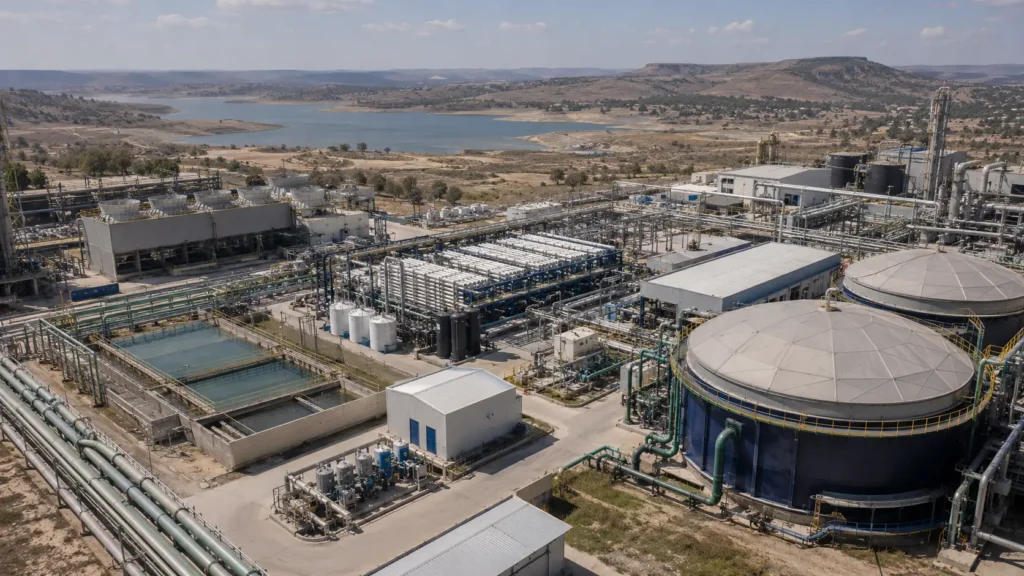
The project driver sets the economic baseline; the endpoint is a response, not the starting assumption.
Research draft | July 2026 | Integrated with Chapters 1–3 and prepared against the Brine Consulting Master Authoring Specification v1.2
| Purpose | Chapter promise | Controlling anchor |
|---|---|---|
| Explain the real technical, regulatory and commercial drivers behind MLD and ZLD projects. | Enable the reader to convert compliance, water-security, disposal, expansion, corporate and resource-recovery pressures into a measurable baseline and a decision-ready project objective. | The driver defines the economic baseline. |
Controlled principleMLD or ZLD is not justified against a zero-cost alternative. The owner must compare the project with the real cost, risk and capacity of the current or credible alternative: compliance, water supply, disposal, lost production, corporate commitments and qualified resource value. Different drivers can support different endpoints. |
|---|
4.1 The driver is the baseline
Companies rarely begin with a neutral request for “better brine management.” They act because a constraint has become material: a permit may no longer be achievable, a water source may be unreliable, a residual route may be expensive or capacity-limited, production growth may be blocked, a corporate commitment may require measurable action, or a recoverable output may have credible internal value. The driver defines what the project must improve and what the owner should compare it against.
This is the economic baseline. A compliance-led project is compared with the cost and risk of maintaining legal operation. A water-security project is compared with the marginal cost and reliability of alternative supply. A disposal-led project is compared with the full cost, capacity and liability of the existing route. An expansion-led project is compared with the contribution from production that cannot proceed without new water or residual capacity. A valorization-led project is compared first with avoided internal purchase and only then with a risk-adjusted merchant netback.
The same wastewater can therefore support different business cases at different sites. Conversely, two sites with similar chemistry may rationally choose different endpoints because their water value, discharge route, infrastructure, regulation and operating capability are different. The driver does not select a technology, but it determines which evidence, denominator and downside case matter.
| Project driver | Economic baseline | Decision objective | Endpoint response to screen | Evidence that must exist |
|---|---|---|---|---|
| Regulatory compliance | Cost and risk of achieving and maintaining the applicable permit or legal condition. | Meet a defined effluent, load, monitoring or no-discharge requirement. | Source control, treatment, controlled discharge, MLD or stream-specific zero discharge. | Exact jurisdiction, permit, wastestream, limit, compliance date and enforcement exposure. |
| Water scarcity and supply security | Marginal secure-water cost plus interruption and curtailment exposure. | Recover fit-for-purpose water and diversify supply. | Reuse with a managed residual; MLD; ZLD only where residual routes and economics justify it. | Source reliability, seasonal availability, required reuse quality, storage and alternative-supply cost. |
| High disposal cost or constrained residual route | Full current route cost, capacity, permitting and long-term liability. | Reduce liquid volume, contaminant burden or logistics. | Segregation, selective treatment, volume reduction, MLD or ZLD. | Flow and chemistry envelope, route capacity, transport, fees, permit limits, solids fallback and upset storage. |
| Production-expansion constraint | Value of incremental production plus avoided water and wastewater infrastructure. | Create hydraulic, pollutant-load or utility headroom. | Source reduction, reuse, debottlenecking, MLD or a bounded ZLD system. | Production campaign, incremental margin, water demand, discharge allocation, treatment headroom and outage consequence. |
| Corporate water or environmental target | Cost and strategic value of delivering a measurable commitment, including financing and reputation effects. | Achieve a defined, basin-relevant reduction or resilience outcome. | Often source reduction and reuse; MLD or ZLD only when they deliver the stated outcome. | Target boundary, baseline year, basin context, governance, assurance method and consequence of non-delivery. |
| Potential resource recovery | Avoided internal purchase or risk-adjusted netback after purification, logistics and off-spec fallback. | Qualify a consistent water, material, chemical, energy stream or service. | Selective recovery integrated with the appropriate residual endpoint. | Inventory, yield, purity, specification, buyer or internal user, legal route, logistics and rejection plan. |
Table 4.1. The project driver determines the economic baseline, the evidence package and the endpoints worth screening.
4.2 Regulatory compliance: meet the legal condition, not a technology slogan
Regulation is often the strongest project trigger, but it is also the driver most likely to be overstated. The legal requirement is normally an effluent limit, pollutant-load allocation, monitoring condition, discharge prohibition, waste classification, water-abstraction condition or site-specific permit obligation. It is not automatically a prescription for a named treatment train.
In the United States, NPDES permits translate technology-based and water-quality-based requirements into facility-specific limits and conditions. Technology-based limits establish the minimum control level, while water-quality-based limits may become more stringent where the receiving water requires greater protection. EPA guidance explicitly allows the discharger to use an available control technique to meet the limit; the permit requirement and the engineering solution are therefore distinct.
Some rules do establish zero-discharge requirements for particular wastestreams. EPA’s steam-electric framework is a useful example: requirements are defined by sector, source category and wastestream, and the 2024 rule strengthened limitations for specified coal-power wastewaters. That does not create a universal legal requirement for plant-wide ZLD, for other sectors, or for other jurisdictions.
The European Union’s Industrial Emissions Directive, as amended in 2024, strengthens integrated pollution prevention, resource efficiency, water efficiency and circular-economy objectives. It still operates through covered activities, permits and best available techniques rather than a universal instruction that every saline industrial stream must reach ZLD.
| Question | Required answer | Why it matters | Unacceptable shortcut |
|---|---|---|---|
| What exactly is regulated? | Name the facility, source category, wastestream, pollutant or property, system boundary and receiving route. | Prevents a stream-specific requirement from being misapplied to the whole site. | “The sector requires ZLD.” |
| What is the enforceable condition? | State the limit, load, prohibition, monitoring condition, compliance date and permit status. | Defines the design criterion and timing. | Citing a policy objective without the permit condition. |
| Is a technology prescribed? | Separate the legal outcome from the technology basis, BAT/BREF or compliance option. | Preserves alternative compliant solutions. | Treating a technology example as the only legal route. |
| What happens under upset or maintenance? | Name storage, bypass prohibition, off-site route, reporting and non-routine controls. | A nominal steady-state flowsheet is not a compliance plan. | Ignoring outages because average performance meets the limit. |
| What is the change trigger? | Identify expansion, permit renewal, revised standard, new source status or receiving-water constraint. | Connects the project to the real decision date. | Assuming a future rule applies before verification. |
Table 4.2. Regulatory screening must identify the exact legal condition before any MLD or ZLD claim is made.
4.3 Water scarcity and supply security
Water scarcity turns wastewater recovery from an environmental option into a production-security question. The relevant baseline is not the average tariff alone. It is the marginal cost and reliability of the next secure cubic metre: abstraction, municipal supply, desalination, transferred water, storage, treatment, drought restrictions and the consequence of interruption.
UN-Water’s water-stress indicator compares freshwater withdrawals with renewable resources after environmental flow requirements. It is useful for basin and policy context, but it is not a plant-level endpoint rule. The project still requires local data on allocation, seasonal reliability, quality, storage, competing users and climate exposure.
The World Bank’s 2025 assessment of municipal and industrial reuse treats fit-for-purpose reuse as a climate-resilient supply option and emphasizes the role of pricing, regulation, planning and bankable delivery models. For an industrial owner, the implication is practical: recovered water should be valued against the credible alternative supply and its reliability, not merely against the current volumetric tariff.
A water-security driver frequently supports source segregation, cascading reuse and MLD before it supports ZLD. If a stable residual route remains available, the additional energy and solids burden of eliminating the final liquid may not improve supply resilience. ZLD becomes relevant when the residual route is unavailable, the recovered-water value is high enough, or the combined compliance and supply case justifies the final concentration step.
4.4 High disposal cost and constrained residual routes
Residual management can dominate the business case even where water is inexpensive. The cost baseline must include more than a disposal fee. It should cover storage, pumping, transport, sewer or injection charges, land, evaporation losses, monitoring, pretreatment, manifesting, permit renewal, contingency capacity, contractor dependence and long-term liability.
The U.S. Bureau of Reclamation identifies concentrate disposal as a significant capital and operating burden for reverse-osmosis facilities and a particular barrier for inland desalination, where an ocean outfall is not available. Its concentrate-management work frames volume reduction as a way to reduce management cost and recover additional water, not as an automatic requirement to eliminate all liquid.
The correct endpoint depends on the route. MLD may be the rational answer when the remaining liquid is stable, permitted and cheaper to manage than the final thermal step. ZLD may be justified when no routine liquid route is available, transport is unreliable, the route has reached capacity, or the retained liability is unacceptable. In either case, the owner must also price the new solids, sludges, purge and cleaning wastes created by the project.
4.5 Production expansion and operating headroom
A plant may consider MLD or ZLD because water and wastewater infrastructure has become the bottleneck to additional production. The constraint may be hydraulic flow, pollutant mass load, cooling or boiler make-up, wastewater-treatment capacity, outfall allocation, storage, solids handling or the ability to operate during seasonal restrictions.
The economic baseline is the value of the capacity that cannot otherwise be used, plus the cost of the alternative infrastructure. That value must be calculated from incremental contribution margin and realistic production availability—not from gross product revenue. The water project should receive only the value that it demonstrably unlocks.
Expansion projects should first test source reduction, campaign segregation, clean-stream reuse, treatment debottlenecking and operational changes. A centralized end-of-pipe ZLD plant can be an expensive way to solve a bottleneck that originates in one avoidable stream. The endpoint follows the bottleneck analysis.
4.6 Corporate targets, disclosure and licence to operate
Corporate water and environmental commitments can accelerate investment before a legal deadline. They may reflect resilience, basin stewardship, investor expectations, customer requirements, social licence, climate adaptation or a company-wide reduction target. The UN Global Compact’s water-resilience guidance explicitly links water action with operational and supply-chain risk, business performance and investor and community expectations.
A target is not a design basis until its boundary is defined. The owner should state the baseline year, facilities and basins included, metric, deadline, governance, assurance method and consequence of non-delivery. A global percentage reduction can be delivered in the wrong basin or by shifting water and waste burdens elsewhere. MLD or ZLD should be selected only if it produces the intended local and corporate outcome.
Reporting and financing frameworks can make water-related risks visible to management and capital providers, particularly where water scarcity is linked to climate or broader sustainability risk. That visibility changes the investment conversation, but it does not turn a voluntary target or disclosure framework into a universal ZLD mandate.
4.7 Potential resource recovery: value must survive qualification
Resource recovery can strengthen a project, but it should rarely be the only reason to construct an MLD or ZLD system. The Department of Energy defines water resource recovery broadly as the production of usable water, energy and materials from wastewater and recognizes both reuse and brine valorization.
The strongest first case is normally internal: recovered water displaces a secure-water purchase; a recovered acid, alkali or salt replaces a qualified chemical; or a separated stream reduces an unavoidable disposal burden. Merchant sales require a consistent product form, specification, legal route, buyer, logistics and off-spec fallback. Headline commodity prices are not project revenue.
The resource-recovery driver should therefore be represented as an overlay on the endpoint decision. It may improve the economics of MLD or ZLD, or it may favour a selective recovery step before the final residual is managed. Product qualification and residual management remain separate gates.
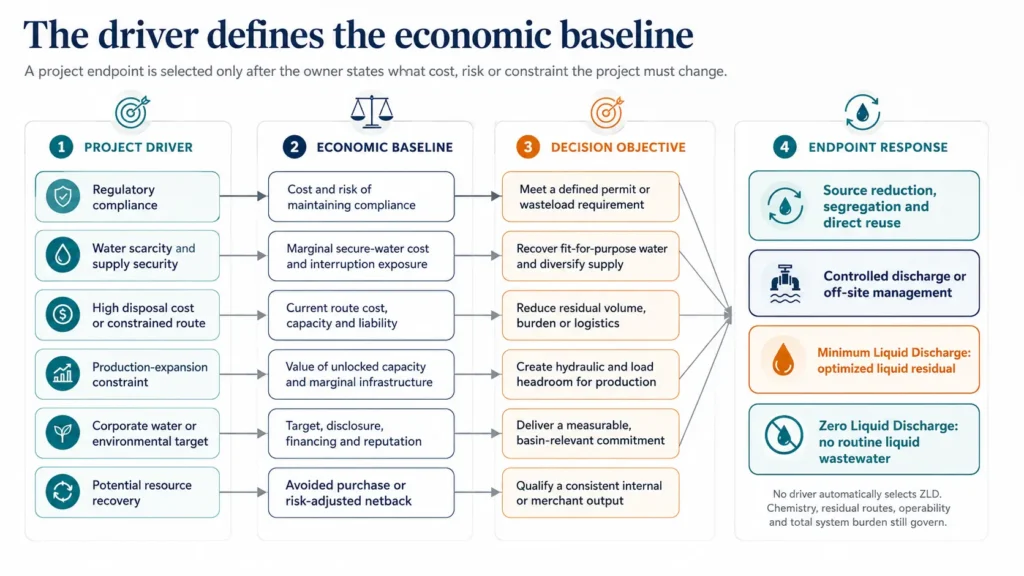
Figure 4.1. Driver-to-objective and driver-to-endpoint map. No project driver automatically selects ZLD.
4.8 Build the economic baseline before comparing trains
A technology comparison is meaningful only when every option is measured against the same baseline, boundary and time basis. The owner should separate avoided burdens, qualified value, full project burden and retained risk. The result is a risk-adjusted net value, not a simple treatment cost.
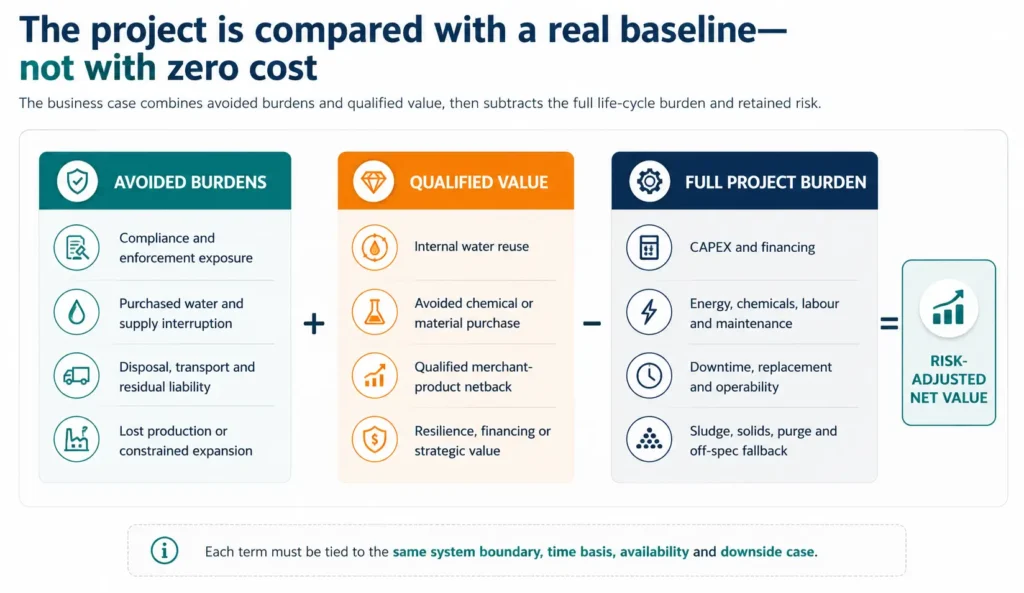
Figure 4.2. Economic baseline ledger for MLD, ZLD and valorization decisions.
| Baseline component | Minimum data | Decision metric | Downside case |
|---|---|---|---|
| Compliance | Applicable limits, exceedance history, monitoring, deadline, outage controls and enforcement consequences. | Annualized compliance cost and probability-weighted exposure. | Lower availability, tighter permit or delayed commissioning. |
| Water supply | Source mix, tariff and fixed charges, quality, reliability, drought restrictions, storage and treatment. | Marginal secure-water cost and interruption cost. | Dry-year allocation, source-quality deterioration or supply outage. |
| Residual management | Flow, chemistry, route capacity, distance, fees, permits, contractor terms and liability. | Full levelized residual-management cost per stated basis. | Route closure, fee escalation, reduced acceptance or emergency storage. |
| Production capacity | Incremental output, contribution margin, campaign schedule, utility and discharge headroom. | Value of demonstrably unlocked production capacity. | Lower demand, ramp-up delay or water-system downtime. |
| Corporate target | Baseline, metric, deadline, basin, governance, assurance and financing relevance. | Cost per verified outcome and strategic value. | Target not recognized, not assured or displaced to another basin. |
| Recovered output | Inventory, yield, purity, consistency, internal demand or buyer, netback, rejection and fallback. | Avoided purchase or net revenue after all qualification and logistics. | No buyer, off-spec production, lower yield or product classified as waste. |
Table 4.3. Minimum baseline ledger before life-cycle comparison of treatment trains.
4.9 Convert the driver into a decision-ready objective
The owner should be able to state the project objective in one paragraph without naming a preferred technology. That statement should identify the driver, system boundary, required water or compliance outcome, acceptable residuals, decision metric and evidence threshold.
| Weak statement | Why it fails | Decision-ready form |
|---|---|---|
| “The regulator requires ZLD.” | The jurisdiction, wastestream, legal condition and system boundary are absent. | “By the permit date, the FGD wastewater stream must meet the specified no-discharge condition within the named plant boundary, including outage and purge controls.” |
| “Water is scarce, so recover as much as possible.” | No reuse quality, alternative supply, reliability or residual route is defined. | “Recover fit-for-purpose cooling make-up to reduce dry-season dependence on the constrained source, while retaining a permitted residual route and stated reliability target.” |
| “Disposal is too expensive.” | The current route cost, capacity and liability are not quantified. | “Reduce routine liquid transport by the amount required to remain within contracted capacity and compare MLD and ZLD against the full delivered disposal cost and contingency route.” |
| “We need ZLD to expand.” | The actual bottleneck and incremental production value are not identified. | “Create the hydraulic and pollutant-load headroom required for the defined production campaign and attribute only the verified incremental contribution margin to the water project.” |
| “The project supports our water-positive target.” | The basin, baseline, metric and assurance method are undefined. | “Deliver the stated reduction in net consumptive use at the named basin and facility, measured against the approved baseline and independently assured.” |
| “The brine contains valuable minerals.” | Presence is not recovery, product qualification or net value. | “Demonstrate the specified product form, yield and purity for the named internal user or buyer, including logistics and off-spec disposal, before assigning revenue.” |
Table 4.4. Replace slogans with objectives that can be tested technically and economically.
4.10 Chapter conclusion
Companies consider MLD or ZLD because a regulatory, water-security, residual-management, production, corporate or resource-recovery constraint has become material. That constraint defines the economic baseline. The project is not evaluated against doing nothing at zero cost; it is evaluated against the real cost, risk and capacity of the current or credible alternative.
Regulation may require a specific discharge outcome, including zero discharge for a defined wastestream, but a policy, sector label or technology example should never be generalized into a universal ZLD mandate. Water scarcity can make recovery valuable without making the final liquid-elimination step rational. High disposal cost can justify MLD where a stable residual route remains. Production and corporate drivers require explicit attribution and measurable boundaries. Resource recovery adds value only after specification, user, legal route, logistics and fallback are established.
The next chapter moves from project drivers to the whole-site water balance. That is where the owner tests whether the apparent end-of-pipe problem can be reduced through source control, segregation, reuse and better accounting before a final brine train is designed.
Chapter 4 in one sentenceThe driver defines the economic baseline; MLD or ZLD is justified only when it improves that baseline within a complete technical, residual and risk boundary. |
|---|