Brine Consulting helps clients evaluate and develop brine management and resource recovery strategies for desalination, industrial wastewater, mining, produced water, and high-salinity effluents. Our work focuses on turning complex saline streams from a disposal burden into a potential source of water, salts, minerals, chemicals, and strategic value.
Brine valorization is not a generic solution. It depends on water chemistry, concentration, flow rate, location, energy cost, market access, product purity, permitting, logistics, and the real cost of disposal. We help clients understand what is technically possible, what is commercially plausible, and what should be avoided.
Our expertise covers brine characterization, salt recovery, magnesium and potassium pathways, sodium chloride production, bromine and specialty mineral opportunities, critical mineral recovery, selective precipitation, membrane concentration, electrodialysis, bipolar membrane electrodialysis, evaporation, crystallization, MLD, ZLD, and integrated circular flowsheets.
We support clients from early screening through pre-feasibility, pilot planning, technology selection, and commercial strategy. The objective is to create realistic pathways that connect process engineering with product markets, environmental value, and long-term infrastructure resilience.
Typical outputs include brine valorization screening, resource recovery roadmaps, mass balance concepts, product opportunity assessment, technology comparisons, market-linked feasibility studies, brine management strategies, and pilot development plans.
Who This Is For
Desalination plants, chemical and mining operations, produced water operators and other industrial sites with high-salinity streams that are hard to discharge, expensive to dispose of, or contain potentially valuable salts and minerals.
What We Assess
- Brine characterisation and how much the stream varies
- The management hierarchy: reduce volume at source, reuse water, recover products, dispose of what remains
- Disposal endpoints and their cost and permit constraints
- Valorisation potential: which products are technically recoverable, at what purity, and whether a buyer exists
Brine Valorisation: What Can Be Recovered
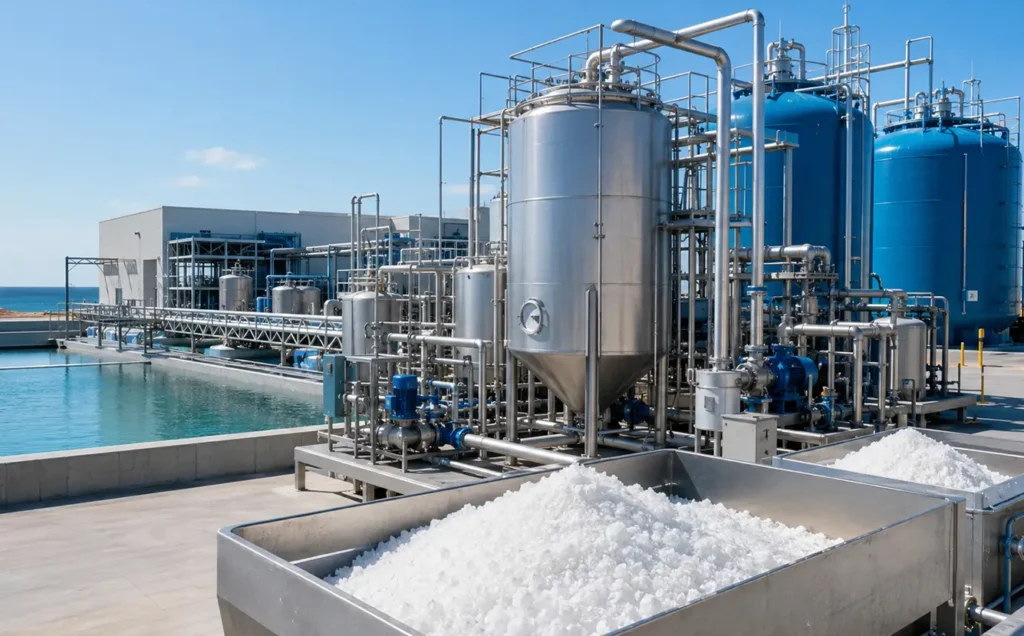
Products recovered from brines include sodium chloride, sodium sulphate, gypsum (calcium sulphate), magnesium compounds and, from certain brines, lithium. Whether recovery makes sense depends on concentration, purity requirements, volumes and a qualified offtaker. Recovered salt rarely pays for a treatment plant on its own, so we count product revenue only when there is a buyer and a specification.
Read more on salt recovery from brine, lithium extraction from brine, and in the ZLD guide chapters on what makes a brine product recoverable, the valorization hierarchy and markets, offtake and logistics.
What You Receive
- A brine characterisation review, with data gaps and sampling needs
- A water and salt mass balance
- Disposal and endpoint options, with their cost and permit implications
- A recoverable product screen, including purity and specification questions
- A market and offtake reality check
- Cost ranges and a business case, with accuracy stated
- An independent recommendation and clear next steps
How It Works
- First conversation. Your question, flows, water analyses and permit.
- Data review and balance. We close the water and salt balance and list any data still missing.
- Options screening. We test the options against recovery limits, endpoints and permit constraints.
- Cost ranges and business case. CAPEX and OPEX ranges with their accuracy stated, and the payback logic.
- Specification and vendor evaluation. If you go ahead, we specify the solution and compare supplier proposals on equal terms.
Who You Work With
Our brine work draws on specialists including Prof. Basel Abusharkh, a specialist in brine valorization, ZLD and high-recovery desalination, and George Iacovou, a salicultural technologist with more than 23 years in crystallization, MVR systems and salt processing. Meet our experts.
What Clients Say
“I had the opportunity to work with Christos on multiple brine valorization projects, and it has always been a pleasure. Beyond his deep expertise in the field, what truly sets him apart is his human touch.”
Guillem Gilabert-Oriol, R&D Leader, Desalination & Membranes, DuPont
“Besides his top-notch technical expertise, ingenuity and holistic approach to water projects (specially those related to brine mining, but not only), Christos has a great business acumen which makes the difference.”
Castor Criado Madrigal, Sr. Director, Global Sales
Want to know what a brine study for your site would involve? Request a consultation: we explain what it would cover before anything is agreed.
Start With the Free Tools
- Brine Mass Balance & Recovery Calculator
- Brine Recovery & Concentration Factor Calculator
- Industrial Wastewater Scaling & Concentration Tool
- MLD vs ZLD Decision Screener
For the brine streams we work with and how a brine engagement runs, see brine management in the Netherlands.
Frequently Asked Questions
Can recovered salt pay for brine treatment?
Rarely on its own. Product revenue depends on purity, volume, logistics and a qualified buyer, so we treat it as an upside to test, not the basis of the business case.
Do we need ZLD to recover products from brine?
Not always. Some products can be recovered from a concentrated stream while a smaller liquid residual remains. The right endpoint depends on your permit and disposal options.
What purity does recovered salt need?
It depends on the use: salt for regeneration, industrial feed or road de-icing each has its own specification. We identify the specification early so the process can be designed to meet it.
What data do you need to start?
A full ion analysis of the brine, flows and how they vary, your current disposal route and its cost, and your objective.