
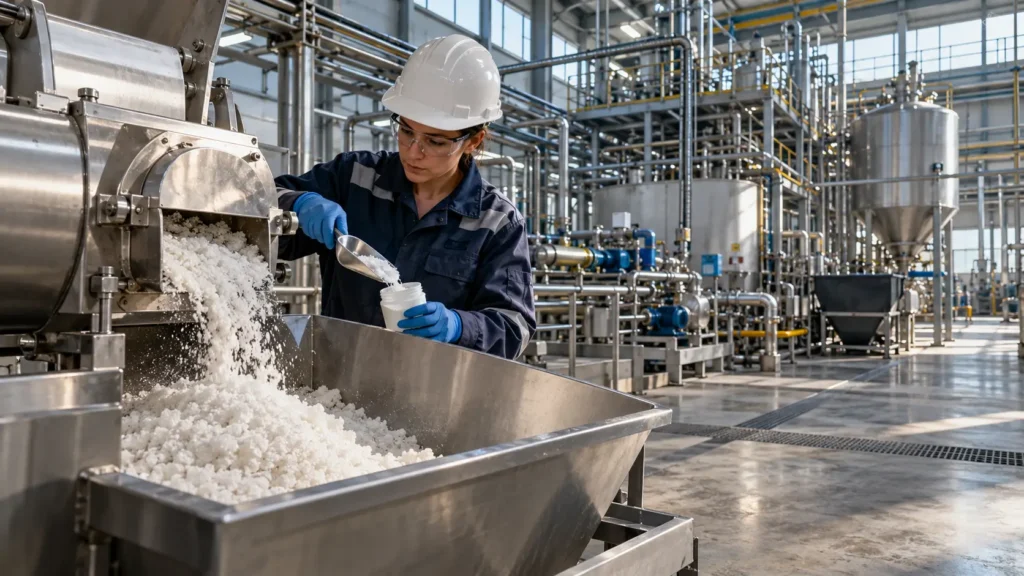
A product exists only when chemistry, scale, specification, demand, logistics and net value line up.
Controlled principleThe presence of an element, ion or salt in a brine establishes inventory only. Recoverability requires sufficient concentration, effective selectivity, achievable purity, reliable volume, a lawful use or qualified buyer within viable logistics, and positive risk-adjusted net value after the complete product train is counted. |
|---|
22.1 Elemental presence is inventory, not recoverability
Chapter 21 deliberately handed Part V enriched process outputs rather than products: calcium-rich precipitates, magnesium-rich fractions, NaCl-rich concentrates, crystal salts, acid/base streams and other intermediates. The handover requires recoverable inventory, yield, form, impurity profile, variability, specification, user or buyer, legal status, logistics, off-spec fraction and the fallback residual route. That distinction is essential because a separation can work technically while the output remains commercially useless.
Current reviews of desalination-brine valorization reach the same broad conclusion. The resource inventory can be large, but scale-up is constrained by separation energy, selectivity, materials durability, product quality, technology maturity and economics. Large-scale brine mining remains concentrated around water and bulk salts, while many multi-resource schemes are still at laboratory or pilot scale. [2–4]
Accordingly, this chapter does not ask whether a brine contains magnesium, lithium, calcium, bromide, sodium chloride or another target. It asks whether that target can move through six sequential gates without the business case collapsing. A failure at any gate is a design result: the material should remain a managed residual, be redirected to an internal use, or the treatment train should be revised.
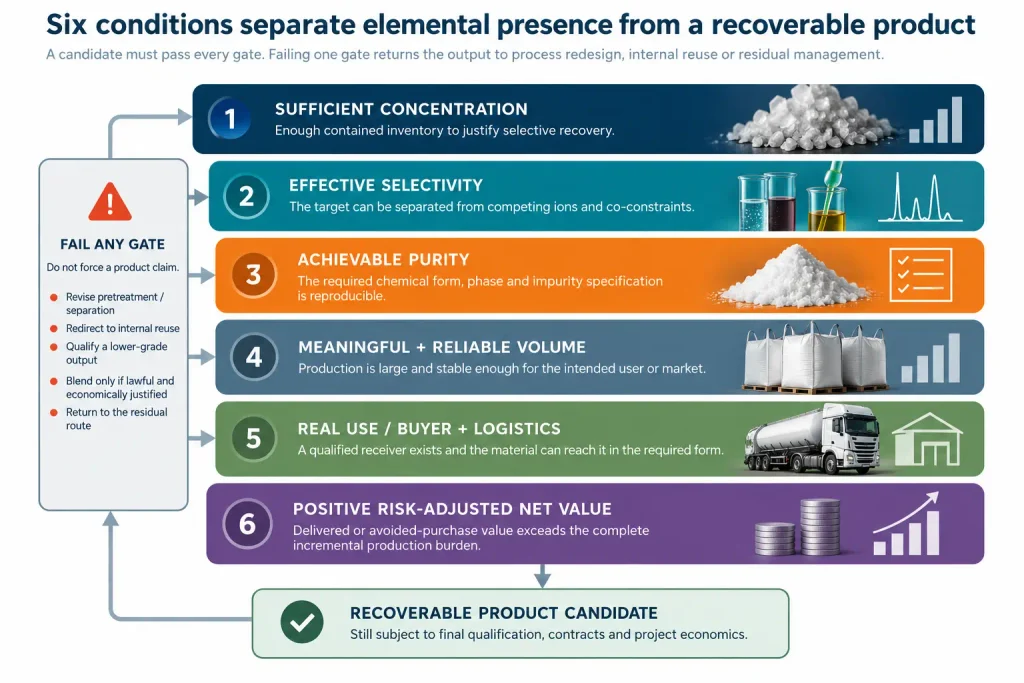
Figure 22.1. Six-condition product-recoverability funnel. All six conditions must be satisfied; the funnel is a decision structure, not a technology ranking.
| Condition | Question | Minimum evidence | Failure signal | Consequence |
|---|---|---|---|---|
| 1. Sufficient concentration | Is enough target present per unit feed and per year to justify a dedicated separation step? | Representative concentration distribution, density, flow, operating hours and target basis. | Attractive assay in isolated samples but low annual contained mass. | Stop detailed product-train design or increase concentration only if the whole system benefits. |
| 2. Effective selectivity | Can the target be separated from chemically similar or much more abundant species? | Separation factor/rejection/distribution/precipitation or crystallization selectivity in the complete matrix. | High recovery of target accompanied by unacceptable co-recovery or reagent burden. | Change chemistry or separation mechanism; do not call enrichment a product. |
| 3. Achievable purity | Can the required phase, form and impurity specification be produced repeatedly? | On-spec product analyses across representative runs, washing/purification basis and off-spec rate. | One high-purity batch, unstable phase or excessive retained mother liquor. | Add purification only if net value survives; otherwise downgrade or reject the route. |
| 4. Meaningful reliable volume | Will the plant produce a stable quantity that matches the use or market? | Normal/design/upset production profile, uptime, seasonality, lot size and storage. | Annual average hides campaign gaps or highly variable composition/volume. | Internal buffer, contract flexibility or different product strategy required. |
| 5. Real use / buyer + logistics | Does a lawful internal use or qualified external receiver exist at feasible distance and form? | Specification, qualification samples, acceptance process, packaging, transport, storage and backup route. | Commodity exists globally but no local receiver accepts the actual product form. | No merchant-sales credit; test internal value or residual route. |
| 6. Positive risk-adjusted net value | Does delivered/avoided value exceed the complete incremental burden? | Netback model including separation, purification, qualification, packaging, storage, transport, replacements, off-spec and residual handling. | Economics require headline commodity price, 100% yield, zero rejection or free disposal. | Product is not bankable; return to lower-risk recovery or residual management. |
Table 22.1. Six conditions and their evidence gates.
22.2 Gate 1 — sufficient concentration means sufficient contained inventory
Concentration is necessary for most mineral-recovery routes because separation equipment, reagents, wash water and downstream purification act on a finite target inventory. But concentration alone is not enough. A high assay in a very small or intermittent stream may contain less annual material than a much weaker but continuous large flow.
For a dissolved target reported as g/L, the first-pass contained mass is straightforward because 1 g/L equals 1 kg/m³. The annual inventory must use a stated operating-time basis and a representative concentration distribution rather than the single maximum assay. The result is an inventory statement only; it does not include separation recovery, conversion into a different compound, on-spec yield, plant availability or buyer acceptance.
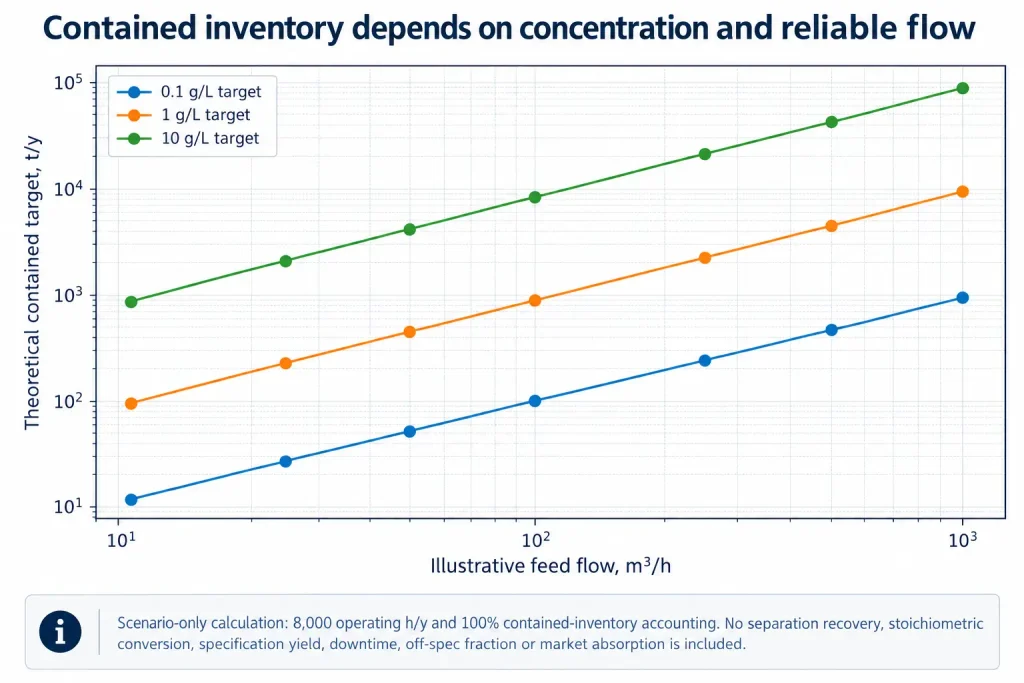
Figure 22.2. Scenario-only contained-inventory calculation. It shows why concentration must be paired with reliable flow and operating time.
Visible calculationContained target, t/y = Ctarget (g/L) × Q (m³/h) × operating hours (h/y) ÷ 1,000. For a compound product made from an elemental or ionic target, keep the chemical basis explicit and apply stoichiometric conversion separately. Saleable output must then apply separation recovery, purification/specification yield and the on-spec fraction. |
|---|
| Inventory input | Required basis | Why it matters | Common error | Output |
|---|---|---|---|---|
| Target concentration | Normal/design/upset distribution, analytical method and chemical basis. | Sets contained mass and separation duty. | Using the highest reported sample as annual feed. | kg/h and t/y of contained target. |
| Flow and availability | Hourly/batch profile, campaigns, downtime and annual operating basis. | Converts concentration into reliable inventory. | Multiplying average assay by nameplate flow for 8,760 h without justification. | Annual contained mass by operating case. |
| Chemical form | Element, ion, salt, hydrate or active ingredient basis. | Controls stoichiometry and product mass. | Comparing Mg concentration directly with Mg(OH)₂ product mass. | Equivalent product mass only after explicit conversion. |
| Separation recovery | Mass of target captured / target entering the defined separation boundary. | Converts inventory to captured target. | Reporting solution volume recovery as target recovery. | Captured target mass and unrecovered residual. |
| Specification yield | Fraction of captured material that reaches required form/purity. | Links technical capture to saleable output. | Assuming every precipitated or crystallized tonne is on-spec. | On-spec, rework and off-spec mass. |
Table 22.2. Minimum inventory calculation basis before discussing product value.
22.3 Gate 2 — selectivity is the core separation question
A brine is not an ore body with one isolated solute. The target normally competes with more abundant ions, chemically similar species, antiscalants, organics and precipitating phases. Effective selectivity means that the chosen mechanism preferentially moves the target into the intended product stream without moving so much impurity, reagent or water that purification destroys the value.
Selectivity must be reported in the metric appropriate to the mechanism: membrane rejection or passage, ion-exchange selectivity, distribution ratio and separation factor for extraction, precipitation yield and co-precipitation, crystal phase selectivity, or another clearly defined mass-based metric. A recovery percentage alone is insufficient because a process can recover most of the target and still make a low-grade mixture.
The 2025 brine-mining reviews emphasize this integration problem: resource potential is real, but economic recovery depends on selective separation and subsequent purification within a workable treatment train.
| Mechanism family | Selectivity basis | Matrix competitors | Evidence required | New residual / burden | Failure signal |
|---|---|---|---|---|---|
| Selective precipitation | Solubility/speciation window and co-precipitation behaviour. | Ca/Mg/metals, carbonate/sulfate/silica, ligands and inhibitors. | pH/reagent path, mineralogy, filtrate chemistry, washing and repeatability. | Sludge/cake, reagent ions, wash liquor and filtrate recycle. | High target removal but contaminated or poorly dewaterable solid. |
| Crystallization | Phase equilibrium, supersaturation control and impurity rejection. | Competing salts, hydrates, double salts and mother-liquor impurities. | Phase map/model, representative batch/pilot, crystal analysis and purge logic. | Mother liquor, wash liquor, fines and off-spec crystals. | Visually good crystals with unacceptable retained liquor or mixed phases. |
| Ion exchange / adsorption | Target affinity relative to background ions and capacity in full matrix. | High ionic strength, competing multivalents, organics and fouling. | Breakthrough curves, regeneration, cyclic capacity and enriched regenerant quality. | Regenerant, rinse, spent media/resin and cleaning waste. | Synthetic-water selectivity disappears in real brine. |
| Membrane / electromembrane | Rejection, passage, permselectivity or transport number on the target basis. | Charge, valence, concentration polarization, water transport and co-ion leakage. | Real-matrix module test, mass balance and cleaning stability. | Dilute/concentrate streams, electrode rinse, cleaning and replacement. | Enrichment factor looks high but target mass yield or purity is poor. |
| Solvent / liquid extraction | Distribution ratio and separation factor plus solvent selectivity. | Co-extracted ions, water, organics and complexing chemistry. | Isotherms, phase disengagement, solvent loss, stripping and impurity profile. | Loaded solvent, strip solution, solvent loss and secondary treatment. | Excellent batch extraction but poor stripping, phase separation or solvent recycle. |
Table 22.3. Selectivity must be tied to the actual separation mechanism and complete brine matrix.
22.4 Gate 3 — purity is a product specification, not a laboratory headline
Product quality starts by naming the required form. The relevant specification may be an ion concentration in a recovered solution, a mineral phase, a chemical grade, a moisture limit, particle-size distribution, trace-metal ceiling, colour, insoluble fraction, activity concentration or another use-specific parameter. “99% recovery” and “99% purity” are different statements and neither is meaningful without the analytical basis.
The product package should show which impurities are in the lattice or chemical structure, which remain as surface or entrapped mother liquor, which originate from reagents, and which arise during storage. Washing, recrystallization, polishing, drying and packaging may improve quality, but each step loses product and creates another residual.
The master specification defines a product as a recovered material with a defined specification, consistent quality, applicable legal compliance and an internal user or qualified buyer. That definition deliberately excludes a one-off high-purity sample.
| Specification field | What to report | Variability question | Qualification evidence | Off-spec route |
|---|---|---|---|---|
| Chemical / phase identity | Target compound, phase, hydration state, assay and analytical method. | Does feed or operating mode change the phase or active content? | Independent or buyer-accepted analysis across representative lots. | Reprocess, dissolve/recrystallize, downgrade or dispose. |
| Impurity profile | Major/minor ions, metals, organics, process additives and insolubles. | Which impurity accumulates in recycle or mother liquor? | Lot-by-lot or campaign distribution against the proposed specification. | Additional wash/polish only if economics remain positive. |
| Physical form | Particle size, morphology, bulk density, viscosity or solution strength. | Does the form remain handleable after storage and transport? | Packaging/storage trial and user process test. | Mill/classify/redry/repackage or downgrade. |
| Moisture / retained liquor | Moisture method, free liquid and mother-liquor composition. | Does humidity or storage time change the result? | Controlled drying/storage study and delivered-product samples. | Redry, segregate wet product or return to residual route. |
| Consistency | Normal/design/upset lots, campaign drift and control limits. | Can the plant repeatedly stay inside specification? | Statistical lot history or suitably long representative demonstration. | Quarantine, rework and explicit rejection allowance. |
Table 22.4. A product-quality package must cover form, impurities, physical properties and consistency.
22.5 Gate 4 — meaningful and reliable volume must fit the receiver
A theoretically large global market does not prove that a particular site can place its output. The plant produces a local stream with a specific annual tonnage, lot size, seasonality, composition and delivery profile. Those characteristics have to fit an internal use or the purchasing pattern of a real external receiver.
Volume can fail in either direction. Too little material may not justify qualification, storage and logistics. Too much can overwhelm a nearby buyer and force the project into a lower-value market or disposal route. The correct question is not “How large is the global market?” but “Who can absorb this quantity, in this form, from this location, with what variability and contract structure?”
| Volume field | Evidence | Buyer / user question | Downside case | Design response |
|---|---|---|---|---|
| Annual on-spec quantity | Contained inventory × recovery × specification yield × on-spec fraction. | Is the quantity meaningful to the receiver but not larger than its credible demand? | Buyer takes only a fraction of output. | Cap production, find multiple outlets or assign residual route to excess. |
| Production profile | Daily/weekly/campaign lots and downtime. | Can the user accept intermittent deliveries or must supply be continuous? | Plant campaign and buyer consumption are misaligned. | Storage, buffer inventory or internal use. |
| Composition variability | Lot distribution, not only average purity. | Can the buyer’s process tolerate variability within the proposed spec? | Off-spec campaign during feed upset. | Quarantine and contractual rejection basis. |
| Scale-up / future expansion | Current and future feed volume and target recovery. | Will future project expansion exceed the market or logistics network? | Successful water project creates a product-surplus problem. | Modular recovery, secondary outlets and downside disposal capacity. |
Table 22.5. Product volume must be matched to actual receiver capacity and production profile.
22.6 Gate 5 — a real use or buyer must survive legal and logistical screening
A market is not a commodity price chart. The receiver must accept the actual chemical form, grade, lot size, packaging and delivery conditions, and the legal route for placing the material on the market must be clear. Internal reuse can be stronger than merchant sales when it displaces a purchased chemical or water stream with a known specification, avoids transport and reduces market risk.
The legal status is jurisdiction-specific. In the European Union, the Waste Framework Directive provides separate conditions for by-product status and for end-of-waste status. By-product status requires, among other conditions, certain further use and lawful direct use within normal industrial practice; end-of-waste requires a specific use, market or demand, compliance with technical/product requirements and no overall adverse environmental or human-health impact. These are regulatory gates, not labels that an engineering report can assign unilaterally.
Logistics can invalidate an otherwise credible product. The design must include storage stability, packaging, loading, transport mode, distance, import/export or waste-shipment requirements where applicable, unloading interface, minimum shipment size and the route for rejected deliveries.
| Commercial / legal field | Minimum evidence | Internal-use case | External-sale case | Failure signal | Required fallback |
|---|---|---|---|---|---|
| Defined use | Process duty and required material specification. | Named consuming unit and avoided purchase/disposal value. | Named application and qualified receiver. | “Could be used for…” without an owner or receiver. | Residual route with no revenue credit. |
| Product / waste status | Jurisdiction, legal pathway and compliance owner. | Site can lawfully reuse within its permits and product/process rules. | By-product/end-of-waste/product rules, registrations and buyer requirements as applicable. | Status depends on calling the material a product. | Keep waste classification and price the compliant route. |
| Qualification | Representative samples and agreed test protocol. | Plant trial or engineering acceptance by the internal user. | Buyer sample approval, specification and rejection protocol. | One informal expression of interest. | Continue qualification or remove sales case. |
| Storage / packaging | Stability, moisture, corrosion, dust, solution concentration and container compatibility. | On-site tank/silo integration. | Package, label, bulk form and shelf life accepted by buyer. | Product degrades or cakes before shipment. | Condition, redry/reprocess or dispose. |
| Transport / geography | Distance, mode, payload, frequency, dangerous-goods/waste rules where relevant. | Often minimal or none. | Delivered-cost model and backup carrier/route. | Transport cost or payload dominates product value. | Local outlet, concentration/form change or no product train. |
| Receiver continuity | Capacity, term, price basis, quality changes and shutdowns. | Internal demand forecast and alternate site use. | Contract/offtake or other credible commitment plus secondary outlet. | Single buyer outage stops water plant. | Storage, backup receiver or full residual capacity. |
Table 22.6. A product requires a lawful use, qualification, logistics and a receiver continuity plan.
22.7 Gate 6 — net value is a delivered netback, not a headline commodity price
The appropriate commercial metric is the incremental value created by the recovered output relative to the best non-product baseline. For an internal use, value may be avoided purchase, avoided water production or avoided disposal. For merchant sales, the relevant price is the delivered netback for the actual grade and contract—not a high-purity spot price copied from a market website.
The product train must then carry all incremental burdens: selective separation, reagents, purification, washing, polishing, drying or concentration, quality assurance, certification, storage, packaging, transport, maintenance and replacement, additional utilities, product loss, off-spec disposal and new residuals. If the water-treatment system is required anyway, only the incremental product-related costs and benefits should be allocated to the product decision; if the product train changes the water plant, those system effects must also be captured.
Recent reviews note that brine valorization can potentially offset part of MLD/ZLD cost, but only when recovery is economically integrated and regulation, product quality and technology maturity are satisfied.
Netback equationRisk-adjusted net product value = delivered sales value or avoided purchase + avoided disposal attributable to the product route − incremental separation − purification/conditioning − qualification/QC − storage/packaging − transport − incremental utilities/maintenance/replacement − off-spec/rejection cost − additional residual handling. Do not give revenue credit to unqualified production. |
|---|
| Value / cost field | Required basis | Base case | Downside test | Do not do |
|---|---|---|---|---|
| Delivered value | Actual grade/form, location, quantity, contract or defensible avoided-purchase basis. | Qualified internal value or buyer netback. | Lower grade/price or no external sale. | Multiply contained mass by headline commodity price. |
| Separation + purification | Incremental CAPEX/OPEX, reagents, membranes/media, energy and labour. | Representative design duty. | Higher reagent/energy use and lower recovery. | Ignore upstream impurity-removal cost needed only for product. |
| Qualification + QC | Sampling, analysis, certifications, trials and ongoing lot release. | Approved test frequency. | More frequent testing or failed qualification. | Treat laboratory analysis as free and instantaneous. |
| Packaging + logistics | Form, payload, distance, storage, loading/unloading and losses. | Normal receiver. | Higher freight, lower payload, receiver outage. | Use ex-works commodity price while paying delivered logistics. |
| Off-spec / residuals | Rejected fraction, rework, disposal, purge and unsold inventory. | Evidence-based on-spec fraction. | No-product-revenue case and higher disposal cost. | Assume 100% of recovered mass is sold. |
Table 22.7. Minimum netback structure for a product-recovery decision.
22.8 Product, by-product, resource recovery and waste must remain distinct
The master terminology intentionally separates resource recovery from product status. Resource recovery means that a constituent has been separated and captured. It does not automatically imply sale, profit or end-of-waste status. A by-product is also a legal concept that must be assessed within the applicable jurisdiction.
This distinction prevents a common circular-economy accounting error: moving mass out of a waste stream and assigning it full product revenue before proving specification, demand, legal status and logistics. The output may still have value as an internal reagent, lower-grade industrial feedstock or avoided-disposal material. Those cases should be valued on their actual function rather than relabelled as a premium commodity.
| Output status | What has been proven | What is still missing | Permitted economic treatment in this guide |
|---|---|---|---|
| Enriched stream | Target concentration has increased. | Selectivity, purity, use, legal route and economics. | No product revenue; value only if an internal process can use it as-is. |
| Recovered constituent | Target has been separated and captured. | Specification consistency, qualification, market/legal/logistics. | Resource-recovery claim only; no merchant-sales assumption. |
| Candidate product | Technical specification appears achievable and receiver/use identified. | Longer-run consistency, legal/commercial qualification and downside economics. | Conditional value with explicit probability/rejection/downside treatment. |
| Qualified product | Defined specification, consistent quality, lawful route and qualified user/buyer. | Project-level contracts and long-term market risk remain. | Use defended netback/avoided-purchase value, not headline commodity price. |
| Managed residual | No credible product route or product case failed. | A compliant routine and backup endpoint. | Cost it honestly; do not hide it as zero-value “salt product”. |
Table 22.8. Controlled progression from enrichment to a qualified product.
22.9 The product-recoverability evidence package
A credible candidate should leave Chapter 22 with a compact evidence package that can be compared across products without pretending that all products use the same separation technology. The package below is the minimum input to the valorization hierarchy in Chapter 23.
| Candidate | Contained inventory | Selectivity / recovery | Product spec + purity | Reliable on-spec volume | User / buyer + legal route | Logistics + off-spec route | Risk-adjusted net value status |
|---|---|---|---|---|---|---|---|
| Candidate A | Concentration × flow × operating basis. | Mass-based separation metric and competing species. | Defined form, impurity limits and analytical method. | t/y or kg/h distribution, not theoretical maximum. | Named internal use or qualified external receiver; jurisdiction stated. | Storage, package, distance, rejection and backup residual route. | Proceed / conditional / stop with no-sales downside. |
| Candidate B | Same fields. | Same fields. | Same fields. | Same fields. | Same fields. | Same fields. | Same fields. |
| Candidate C | Same fields. | Same fields. | Same fields. | Same fields. | Same fields. | Same fields. | Same fields. |
Table 22.9. Product-recoverability register for use before detailed product-train design.
22.10 Acceptance gate — when does a candidate deserve detailed engineering?
The decision to advance should be stricter than a technology-screening decision because product recovery introduces market, quality and legal dependencies into the water-treatment project. Weighted scoring cannot compensate for a fatal failure at one of the six conditions.
| Gate field | Proceed | Conditional / recycle | Stop | Owner / record |
|---|---|---|---|---|
| Concentration + inventory | Representative annual contained mass is sufficient for the intended use and product train. | Inventory is promising but feed variability or operating basis is unresolved. | Only isolated high assays or negligible reliable inventory. | Process lead; analytical and mass-balance register. |
| Selectivity | Real-matrix evidence shows controlled target separation and impurity rejection. | Bench evidence is good but recycle, scale-up or competing-ion effects remain. | Enrichment produces an inseparable or uneconomic mixture. | Separation specialist; test report. |
| Purity / specification | Repeated on-spec output with defined analytical basis. | Purification route exists but yield or consistency is unproven. | Required grade is chemically or operationally unrealistic. | Product/process lead; specification sheet. |
| Volume | On-spec quantity aligns with internal demand or credible market absorption. | Storage/contract flexibility may bridge variability. | Quantity is too small to justify route or too large for realistic outlets. | Commercial + operations; demand and inventory model. |
| Use / buyer / legal / logistics | Named lawful use, qualification path and viable logistics exist. | Buyer interest exists but qualification or legal pathway is incomplete. | No real receiver/use or delivered form is impractical. | Commercial, legal/regulatory and logistics owners. |
| Net value | Risk-adjusted incremental value remains positive under downside cases. | Value is positive only with further evidence or limited revenue credit. | Case depends on headline price, 100% sale, free logistics or zero off-spec. | Business-case owner; netback model. |
Table 22.10. Product-recoverability acceptance gate.
Stop ruleIf a candidate fails concentration, selectivity, purity, reliable volume, real use/buyer/logistics or risk-adjusted net value, do not rescue it with a more elaborate flowsheet by default. First test whether internal reuse, a lower-grade product, a simpler avoided-cost route or ordinary residual management creates the better project. |
|---|
22.11 Handover to Chapter 23 — the valorization hierarchy
Chapter 23 ranks lower-risk value routes before speculative multi-product recovery. The handover from this chapter should therefore contain only candidates that have passed, or are explicitly conditional against, the six recoverability gates.
For each candidate, Chapter 23 needs the contained and recoverable inventory; product form and specification; demonstrated selectivity and purity; reliable on-spec volume; internal use or buyer; legal status; storage and logistics; netback; off-spec fraction; and the no-product fallback. It can then compare internal avoided-cost products, bulk minerals, specialty products and integrated environmental products on a consistent risk basis rather than on theoretical elemental value.
22.12 Chapter conclusion
Elemental presence is not a business case. A brine can contain a valuable element and still be a poor recovery feed because the concentration is too low, competing ions defeat selectivity, the required purity is expensive, the annual quantity is mismatched to demand, the legal or logistics route is weak, or the delivered netback disappears after the full product train is counted.
The correct sequence is therefore six conditions: sufficient concentration, effective selectivity, achievable purity, meaningful and reliable volume, a real lawful use or qualified buyer within viable logistics, and positive risk-adjusted net value. The sequence protects the water project from being distorted by speculative commodity revenue.
A failed product screen is not a failed water project. The recovered constituent may still reduce disposal burden, support internal reuse or justify a simpler lower-grade route. Chapter 23 now ranks those value pathways by risk and bankability.
Chapter 22 in one sentenceA brine constituent becomes a recoverable product only when concentration, selectivity, purity, reliable scale, lawful demand, logistics and risk-adjusted net value are all demonstrated. |
|---|