
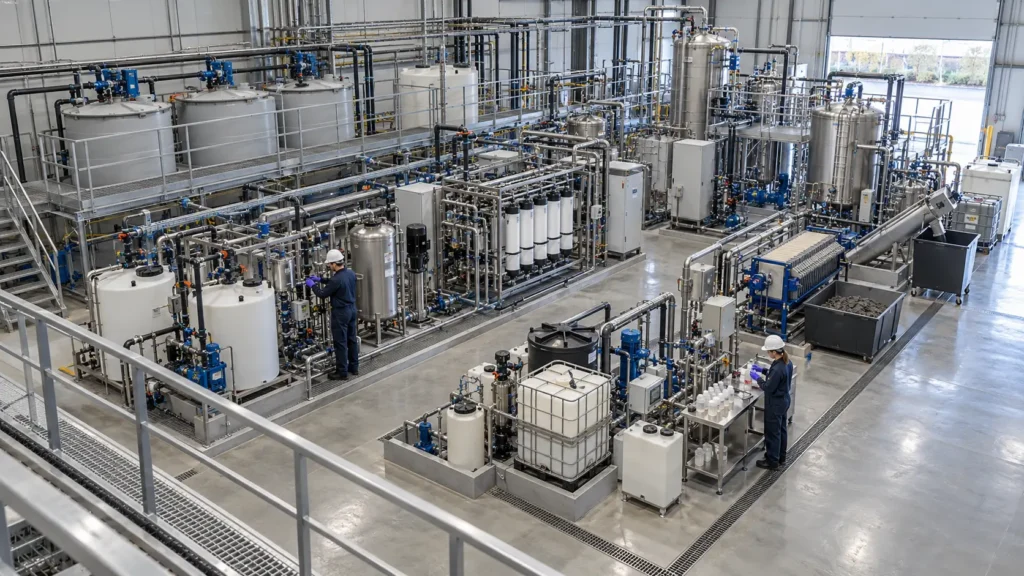
Pilot the integrated process, not isolated hero equipment.
Controlled principleA test is valuable only when it is designed around a named project decision, uses a representative physical and chemical basis, produces auditable data, and changes or defends a design, guarantee, cost, residual or stage-gate conclusion. A successful isolated unit operation is not evidence that the complete MLD, ZLD or valorization train will operate reliably. |
|---|
Test decision claims—not a generic technology
Chapter 32 hands this chapter a preferred concept and a register of exact claims that must be closed. The laboratory or pilot programme should therefore begin with the decision that the owner intends to make: reject a mechanism, select an option, define a scale-up factor, establish a cleaning basis, qualify a product or residual, narrow a cost range, support a guarantee, or authorize the next development stage. “Test the technology” is not a decision claim.
EPA treatability-study guidance uses a tiered laboratory-screening, bench-scale and pilot-scale approach, but also allows unnecessary tiers to be skipped when the data gap and decision do not require them. The transferable lesson is not the CERCLA process itself; it is that test scale follows the evidence needed, not a ceremonial sequence. [6]
| Decision claim | Evidence currently missing | Minimum useful test | Output that changes the project | Failure condition |
|---|---|---|---|---|
| A precipitation step can protect the next concentrator | Kinetics, co-precipitation, dewaterability and filtrate chemistry on real matrix | Controlled jar/bench reactor followed by integrated solids separation | Dose, residence time, cake load, filtrate spec and downstream scaling basis | Required removal is achieved only with unacceptable impurity, reagent or sludge burden |
| A membrane block can sustain the required duty | Element-scale flux, passage, pressure drop, fouling and cleanability under representative recycle | Element or multi-element loop with standardized operating data | Design flux, recovery, staging, cleaning interval and replacement basis | Performance cannot be normalized to a stable condition or cannot be restored by an acceptable cleaning regime |
| A crystallizer can make an acceptable solid | Phase, growth, retained liquor, wash yield, fines and mother-liquor purge | Batch then continuous/semicontinuous crystallization with solids handling | Crystal duty, yield, wash/dry requirements, purge and product/residual route | Mixed phase, unstable product or unmanageable mother-liquor accumulation |
| The integrated train can survive feed and operational variability | Coupled behaviour across pretreatment, concentration, recycle, purge and controls | Representative integrated pilot with defined normal, design and upset cases | Control philosophy, buffers, redundancy, consumables, availability and guarantee basis | Water or residual service fails during a credible case or depends on continuous product sales |
Table 33.1. Every test must close a named decision claim and identify the consequence of failure.
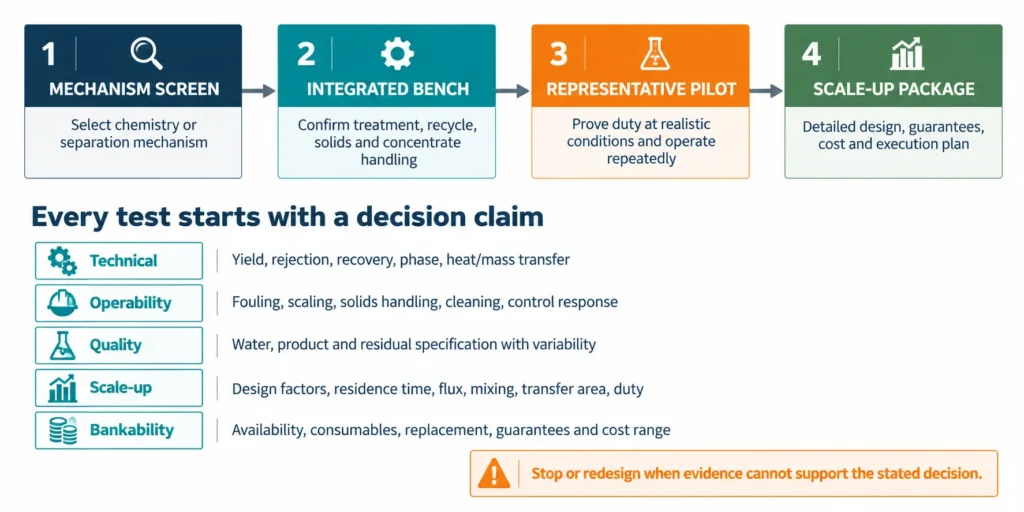
Figure 33.1. Evidence must expand from mechanism screening to integrated, design-actionable scale-up. The ladder is decision-based, not a universal sequence or TRL claim.
Select the lowest test scale that can reproduce the controlling risk
Laboratory screening is efficient for mechanism rejection, parameter windows and analytical development. Bench work adds integration, repeated cycles and better control of residence time, mixing and solids. Pilot work becomes necessary when the decision depends on representative hydraulics, heat and mass transfer, commercial-format components, continuous recycle, operator interventions, cleaning, control logic or the interaction of multiple blocks. Scale should be increased only when the unresolved risk cannot be represented credibly at the smaller scale.
Reclamation describes laboratory projects as small-flow studies used to determine viability, while pilot projects are intended to test practicality at a scale that supports operational requirements and finished-water goals. Its Pitch-to-Pilot programme also requires natural rather than synthetic feed for that specific programme. These are useful programme examples, not universal hydraulic thresholds for industrial pilots.
| Test tier | Primary question | What it can establish | What normally remains unresolved | Advance when |
|---|---|---|---|---|
| Analytical / mechanism screen | Is the proposed reaction, separation or analytical method plausible? | Speciation, equilibrium window, initial selectivity, method detection and sample stability | Hydrodynamics, continuous accumulation, commercial component behaviour and operability | A plausible mechanism exists and the next decision requires controlled process testing |
| Bench batch | What response surface and failure mechanism exist? | Dose, kinetics, phase, equilibrium, sensitivity, repeatability and first solids properties | Steady recycle, long-term deposition, full controls and production-scale interfaces | The preferred operating window and critical variables are defined |
| Bench continuous / cyclic | Can the integrated duty repeat under controlled flow and recycle? | Residence time, cyclic capacity, accumulation, cleaning response and balance closure | Commercial geometry, full-scale transfer coefficients, operator logistics and availability | Scale-dependent risks are identified and the pilot can be designed around them |
| Component / element | Does a commercial-format component behave as required? | Pressure drop, flux/passage, integrity, normalized performance and cleaning response | Complete train interaction, long-duration reliability and plant design | The component duty is stable enough to test in the integrated configuration |
| Integrated pilot | Can the selected process operate as a system on representative conditions? | Control, recycle, purge, solids, cleaning, upset recovery, consumables and scale-up factors | Lifetime beyond the demonstrated envelope and construction/commissioning risks | Acceptance criteria are met and unresolved effects are bounded for feasibility/pre-FEED |
Table 33.2. Test scale should reproduce the controlling decision risk without paying for unnecessary complexity.
Representative feed is a controlled distribution, not one drum
A test feed must represent the process states that control design: normal production, peak load, cleaning or campaign transitions, recycled streams, additive carryover, temperature and the species that accumulate under concentration. A single composite can erase the event that actually causes scaling, foaming, corrosion or product rejection. Conversely, a worst-case synthetic mixture can create combinations that never occur and may reject a viable process for the wrong reason.
ISO 5667-3:2024 covers preservation, handling, transport and storage of water samples, while ISO 5667-14 addresses sampling QA/QC. These controls matter because ageing, temperature change, gas exchange, precipitation, biological activity, adsorption and container interaction can alter the test article before the experiment begins. The programme must record collection time, preservation, storage, homogenization, filtration and any reconstruction or spiking. [2,3]
| Feed control | Required record | Why it matters | Invalid shortcut | Test response |
|---|---|---|---|---|
| Source and operating state | Unit, campaign, load, cleaning state, upstream treatment and sample time | Links the sample to a real process condition | “Representative brine” without production context | Separate normal, design and event feeds or justify blending |
| Ageing and preservation | Container, headspace, temperature, light, time, mixing, filtration and preservative | Prevents the sample from changing unnoticed before testing | Using stored brine as if it were fresh | Validate holding period or report the test as aged-feed evidence |
| Chemistry closure | Major ions, alkalinity/inorganic carbon, density, TDS/conductivity, solids and relevant organics/additives | Detects missing or transformed mass and supports modelling | Accepting a vendor analysis without charge/density checks | Reconcile, reanalyse or explicitly carry the gap |
| Variability design | Frequency distribution, minimum/maximum, event frequency and correlation | Distinguishes a rare event from a persistent design case | Testing only the average and the independent maxima | Create coherent normal, design and upset cases |
| Inventory sufficiency | Volume required for conditioning, repeats, pilot operation, cleaning and retained samples | Avoids changing feed halfway through the programme | Assuming one batch will cover every task | Secure campaign samples, on-site side stream or controlled make-up strategy |
Table 33.3. Representative-feed control must preserve both chemistry and the process context that created it.
Synthetic and real feeds answer different questions
Synthetic feed is useful when the programme needs controlled mechanistic comparisons, a clean mass balance, safe parameter screening or a deliberate challenge concentration. It is weak evidence when trace organics, oils, polymers, colloids, minor ions, biological activity, corrosion products or unknown interactions may govern performance. Real feed is therefore required before claiming representative fouling, scaling, cleaning, product quality or residual behaviour. A hybrid programme may use synthetic feed to map the mechanism and real feed to validate the selected window.
| Use case | Synthetic feed strength | Synthetic feed limitation | Real-feed requirement | Controlled conclusion |
|---|---|---|---|---|
| Reaction or selectivity screen | Independent control of target and competing species | May omit inhibitors, colloids and background ionic-strength effects | Confirm selected window in representative matrix | Mechanism appears viable; no scale-up claim yet |
| Analytical method development | Known additions support recovery and interference checks | Does not prove field sampling or matrix stability | Matrix spike, duplicates and retained real samples | Method is fit for the stated matrix and range |
| Membrane material comparison | Repeatable comparison under one defined solution | Does not reproduce actual foulant layer or additive history | Real-feed element/loop test before design duty | Relative ranking only until real-feed validation |
| Precipitation / crystallization | Clear stoichiometry and phase mapping | May miss nucleation surfaces, inhibitors, mixed solids and entrainment | Real-feed kinetics, mineralogy and dewatering/washing | Candidate operating window and solids route |
| Integrated pilot | Useful only for commissioning, controls or deliberate challenges | Cannot prove representative accumulation or cleaning burden | Normal/design/upset real feed or justified side stream | Project-specific integrated evidence |
Table 33.4. Synthetic feed can isolate mechanisms; real feed is needed to support representative scale-up claims.
Batch tests must not be mistaken for continuous operation
Batch experiments can define reaction windows, equilibrium, phase formation and preliminary kinetics. They do not automatically reproduce steady feed, nucleation history, surface conditioning, recycle accumulation, bleed control, cleaning frequency or the interaction between residence-time distribution and solids inventory. Continuous or cyclic testing is needed when the plant decision depends on these time-dependent effects.
The most important time scale is not the calendar duration by itself. It is the time needed to expose the controlling phenomenon: induction, inventory turnover, membrane or resin cycles, crystal residence, cleaning-and-recovery cycles, feed campaigns, material attack, mother-liquor accumulation or operator response. No universal number of days or cycles is imposed here; the protocol must link duration to the mechanism and decision threshold.
| Time-dependent risk | Batch evidence | Continuous/cyclic evidence needed | Minimum tracked outputs | Failure signal |
|---|---|---|---|---|
| Scaling induction | Supersaturation and initial precipitate | Time to nucleation/deposition under representative surfaces, shear and concentration path | Induction time, deposit location, mass, composition and cleanability | Stable batch liquor but progressive equipment deposition |
| Fouling and conditioning | Initial flux or adsorption | Performance trend through feed changes and cleaning cycles | Normalized flux/passage, pressure drop, foulant mass and cleaning recovery | Short test is stable but baseline does not recover after repeated cycles |
| Recycle accumulation | Single-pass product and residual | Multiple inventory turnovers with controlled purge | Ion/additive/organic inventory, purge composition and balance closure | Impurity or hazard rises without a stable purge endpoint |
| Solids growth and separation | Initial precipitate or crystal | Steady solids inventory, ageing, breakage and classification | Particle size, phase, moisture, filtration/settling and wash yield | Acceptable chemistry but unmanageable fines or retained liquor |
| Control and operability | Manual set point response | Automated transitions, alarms, shutdown/restart and buffer logic | Control deviation, response time, operator action and recovery | Service cannot be maintained during a credible transition |
Table 33.5. Duration and mode must be justified by the time-dependent mechanism that controls scale-up.
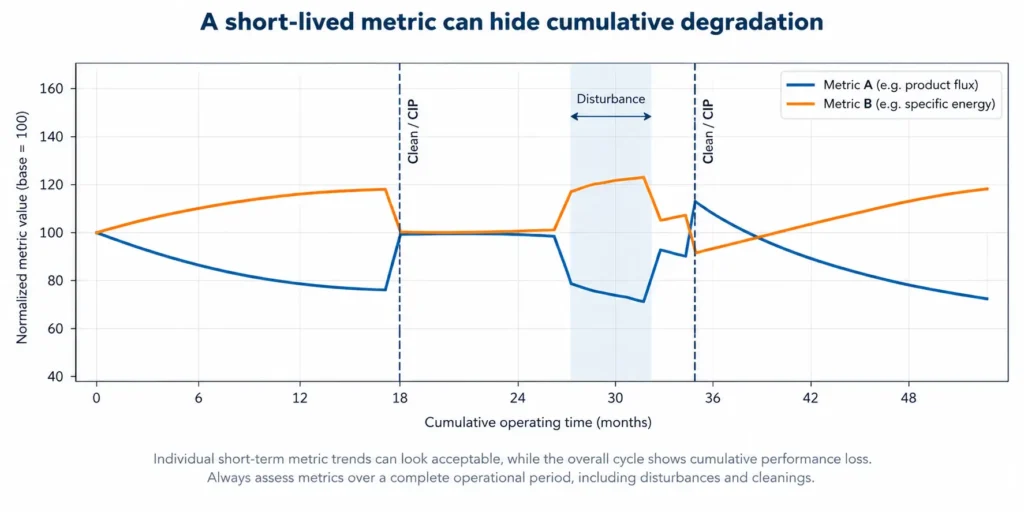
Figure 33.2. Scenario-only teaching trace showing how a short stable window can miss cumulative degradation, feed upset and incomplete cleaning recovery. The values and duration are illustrative, not typical.
Membrane evidence must progress from coupon to commercial geometry
Flat-sheet and small-cell tests are appropriate for material screening, intrinsic selectivity and controlled fouling studies. They do not reproduce feed spacers, channel pressure drop, concentration polarization, element staging, vessel hydraulics or the cleaning distribution of commercial assemblies. ASTM D7601 explicitly describes short-term element or bundle evaluation and states that such testing is not intended for plant design. ASTM D4516 standardizes RO performance because pressure, temperature, conversion and feed concentration alter observed permeate flow and salt passage; it also warns that its applicability to wastewaters is not assured.
| Evidence level | Useful outputs | Scale effects still missing | Normalization / controls | Permitted design use |
|---|---|---|---|---|
| Coupon / flat sheet | Material compatibility, intrinsic passage/rejection, foulant response | Spacer, channel, element manufacturing and pressure drop | Temperature, pressure, concentration, crossflow and area | Material or mechanism screening only |
| Small cell / module | Flux, passage, mass-transfer trend and cleaning chemistry | Commercial element geometry, staging and full hydraulic distribution | Feed analysis, recovery, recirculation, concentration and mass balance | Define element-test window and failure mechanisms |
| Commercial element | Element flux/passage, pressure drop, integrity and cleaning response | Multi-element staging, interstage conditions and plant controls | Standardized performance and stage-specific data where applicable | Preliminary design factor, not complete plant design |
| Multi-element / integrated pilot | Staging, recovery, pressure drop, concentrate quality, cleaning sequence and pretreatment interaction | Full plant redundancy, manifold scale, long-term lifetime and construction variability | Calibrated instruments, normalized performance, membrane history and balance closure | Feasibility/pre-FEED inputs with explicit unresolved lifetime factor |
Table 33.6. Membrane evidence must reproduce commercial geometry and integrated duty before it supports plant design.
Precipitation and crystallization are solids-management tests
Removal percentage is only one output. The programme must also determine reaction kinetics, co-precipitation, phase identity, nucleation behaviour, particle growth, settling or filtration, cake moisture, wash demand, entrained mother liquor, filtrate composition, reagent-derived ions and the destination of every solid and liquid. A precipitation result that protects a membrane but creates an unstable sludge route has not passed the system test.
| Test question | Bench evidence | Pilot / continuous evidence | Scale-up parameter | Downstream consequence |
|---|---|---|---|---|
| Where is the operating window? | pH/reagent path, equilibrium, temperature and competing-ion response | Dose control and response to feed variability | Dose, excess factor, residence and control limits | Residual scaling species and reagent salt load |
| What solid forms? | Mineralogy/phase, impurity and initial morphology | Phase consistency, ageing, attrition and secondary precipitation | Expected phase distribution and off-spec allowance | Product/residual classification and handling |
| Can it be separated? | Settling, filtration, centrifugation and preliminary moisture | Continuous solids loading, blinding, wash and dewatering cycle | Area/flux, cake resistance, wash ratio and equipment duty | Recycle water quality, sludge volume and disposal cost |
| Can crystals meet specification? | Phase, size, assay, moisture and retained liquor | Growth distribution, fines, washing, drying and storage stability | Yield, on-spec fraction, recycle and purge basis | Qualification, packaging and off-spec route |
| Can mother liquor remain controlled? | Composition after a batch or evaporation step | Multiple turnovers, impurity build-up and purge response | Purge rate and maximum impurity inventory | Water recovery, product purity and residual endpoint |
Table 33.7. Precipitation and crystallization testing must close the solids, filtrate, wash and mother-liquor system.
Pilot the recycle, purge and residual network—not only the main equipment
Integrated pilots often fail to represent the streams that determine full-scale stability: membrane concentrate return, softening filtrate, wash water, crystallizer mother liquor, cleaning waste, off-spec product, condensate polishing reject and emergency bypass. Omitting these streams can make the pilot appear stable while the project design has no steady salt, organic or reagent balance.
| Loop / residual | Pilot representation | Key measurements | Required steady or bounded condition | Design output |
|---|---|---|---|---|
| Concentrate recycle | Actual recycle ratio and mixing point | Flow, density, ions, organics/additives, temperature | Inventory reaches a stable or model-consistent trend | Recycle flow, buffer and maximum concentration |
| Filtrate / centrate return | Representative solids carryover and dissolved chemistry | TSS/turbidity, target ions, reagent residual and particle size | No uncontrolled solids or scaling load returns downstream | Clarification/polishing and return location |
| Mother liquor | Repeated return with defined purge | Major/minor ions, phase-formers, organics and water balance | Purity and hazard remain within limits at the selected purge | Purge rate, residual duty and product-yield impact |
| Cleaning waste | Full cleaning sequence and neutralization/segregation route | Volume, pH, COD/TOC, metals/ions and compatibility | Routine and peak waste have a lawful, sized destination | Tankage, treatment and operating-cost allowance |
| Off-spec / unsold product | Representative rejection and rework/bypass route | Mass, moisture, chemistry, storage and reprocessability | Water plant remains operable without product placement | Fallback capacity and no-product operating case |
Table 33.8. The pilot must represent the recycle and residual network that controls full-scale accumulation and fallback.
Cleaning, materials, long-duration and upset tests are part of the core protocol
A stable nominal run is not enough. The programme should deliberately test the operational actions and material exposures that determine availability: start-up, planned shutdown, loss of a dosing system, feed excursion, solids breakthrough, antiscalant or polymer carryover, temperature change, cleaning, drain-down, restart and temporary loss of a product or disposal route. The selected cases should come from the project risk and operability registers rather than an arbitrary “worst case.”
A Reclamation calcium-removal pilot was framed around prevention of calcium-sulfate fouling, extended steady operation and membrane-life implications—illustrating that a pilot question can combine chemistry, operability and lifetime evidence rather than report only initial recovery.
| Test family | Protocol elements | Primary measurements | Acceptance basis | Scale-up / risk output |
|---|---|---|---|---|
| Cleaning and recovery | Defined foul condition, chemistry, sequence, temperature, duration and rinse endpoint | Normalized performance recovery, waste volume/quality and material exposure | Required recovery without unacceptable irreversible loss or waste burden | CIP frequency, tank/dose duty, downtime and disposal |
| Materials and corrosion | Representative wetted materials, joints, elastomers, temperature, oxygen/redox and chemical contact | Mass loss, visual attack, coupons, corrosion indicators, swelling/embrittlement | Compatible for the demonstrated envelope with stated extrapolation limits | Materials selection, corrosion allowance and inspection plan |
| Long-duration operation | Multiple inventory turnovers and repeated cleaning/operating cycles | Trend, drift, variability, consumables, failures and operator interventions | Stable or bounded performance through the decision-specific exposure | Availability, replacement and maintenance basis |
| Upset and recovery | Credible feed, equipment, utility, control, product and residual scenarios | Alarm/control response, service deviation, time to safe state and recovery | No unsafe condition; defined service/fallback performance is restored | Buffers, redundancy, interlocks, bypass and procedures |
| Shutdown / restart | Hot/cold standby, drain/flush, solids suspension and restart sequence | Settling, deposition, microbial/chemical change, time and off-spec production | Restart within required service and residual constraints | Standby philosophy, storage and commissioning sequence |
Table 33.9. Reliability evidence must include cleaning, material exposure, long-duration drift and recovery from credible upsets.
The protocol must make the data reproducible and auditable
EPA’s 2025 QAPP guidance treats the project plan as the specification for how environmental information will be generated and controlled. ISO/IEC 17025 provides the laboratory competence framework for valid testing and calibration, and ISO 5725 distinguishes trueness from precision. Applied to an MLD/ZLD pilot, these principles require a controlled protocol, calibrated instruments, defined analytical methods, quality-control samples, deviations, versioned data, measurement uncertainty and an explicit decision rule.
| Protocol field | Minimum requirement | Typical control | Why it matters | Stop / qualify result when |
|---|---|---|---|---|
| Objectives and hypotheses | Named decision claim, threshold and failure condition | Approved test matrix and change control | Prevents data collection without a decision use | Objective changes after results are seen |
| Instrumentation | Range, accuracy, calibration, location, frequency and data acquisition | Calibration checks, redundancy for critical variables and raw-data retention | Separates process variability from measurement error | Sensor range/accuracy cannot resolve the threshold |
| Sampling and analysis | Location, timing, preservation, method, detection limit and chain of custody | Blanks, duplicates, spikes/standards and retained samples as relevant | Protects representativeness and comparability | Holding time, contamination or interference is uncontrolled |
| Replicates and controls | Number and rationale; baseline/reference where meaningful | Randomization/blocking or repeated cycles suited to mechanism | Supports precision and separates treatment effect from drift | One result is used where variability controls the decision |
| Mass and charge balance | Water, major salt/ion, reagent, solids/product and purge boundaries | Independent flow/analytical checks and reconciliation log | Detects hidden inventory, sampling or calculation errors | Closure error is material and unexplained |
| Data governance | Raw, processed and excluded data; formulas; versions; deviations; owner | Read-only raw archive, calculation review and audit trail | Allows independent reproduction and model update | Only summarized vendor charts are available |
Table 33.10. Test quality is part of the evidence; a credible result must be reproducible from the protocol, raw data and balance.
Define success before operation starts
Success criteria should combine service, operability, quality, residual, safety/environmental and scale-up requirements. Averages alone are insufficient: the protocol should state allowable variability, event-specific limits, minimum exposure or cycles, how missing data are treated, and whether a failed hard criterion can be repeated after a documented cause and corrective action. Weighted scoring must not override a failed safety, lawful-residual, permit or minimum-service condition.
| Success domain | Example criterion structure | Evidence basis | Hard gate? | Action if not met |
|---|---|---|---|---|
| Water service | Net recovered-water quantity and quality within defined normal/design/upset windows | Closed water balance and accepted analytical methods | Yes when required for operations or permit | Redesign duty, pretreatment, controls or endpoint |
| Process performance | Target removal/concentration/yield with defined normalized conditions and variability | Repeated runs/cycles and representative feed | Usually | Change mechanism, operating window or scale-up factor |
| Operability and availability | Start, stop, clean and recover within defined service and staffing constraints | Logged events, downtime, interventions and root causes | Yes where residual/water service depends on it | Add buffer, redundancy, automation or simplify train |
| Product / residual quality | Defined specification, on-spec fraction, off-spec route and fallback capacity | Representative lots/streams and qualification methods | Yes for legal route and claimed revenue | Remove credit, add conditioning or return to residual route |
| Materials and safety | No unacceptable corrosion, incompatibility, exposure or uncontrolled reaction | Coupons/inspection, alarms, events and safety review | Yes | Change materials, chemistry, containment or operating envelope |
| Data quality and balances | Instrument/method uncertainty supports threshold; material balances close to agreed tolerance | QA/QC, calibration, reconciliation and independent review | Yes for load-bearing claims | Repeat, qualify or reject result |
| Scale-up action | Named model/design/guarantee inputs are replaced and residual uncertainty bounded | Approved scale-up report and model update | Yes for next gate | Additional test or conditional/recycle decision |
Table 33.11. Pilot success criteria must be defined before testing and linked to a project action.
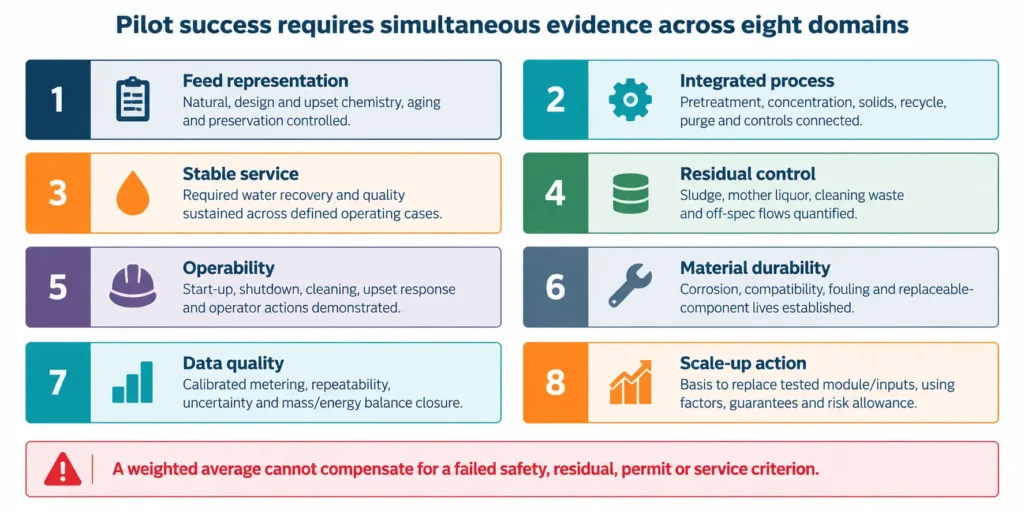
Figure 33.3. Pilot success criteria. All eight domains must be addressed; hard service, safety, legal and residual failures cannot be averaged away.
Convert results into scale-up parameters—without hiding residual uncertainty
A pilot report should not stop at plots and removal percentages. It should translate evidence into the controlled project model: design flows, loads, residence times, fluxes, transfer coefficients, mixing or heat duties, solids separation rates, wash and purge requirements, consumables, cleaning intervals, material limits, control set points, availability allowances and product/residual specifications. Each parameter should identify the demonstrated range, normalization, scale-up method, uncertainty and any factor retained for untested effects.
Short-term element evaluation can be valuable for inspection and performance change, but ASTM D7601 explicitly limits its design use. The same discipline applies more broadly: a result should be used only for the claim and scale it actually supports.
| Pilot result | Translation required | Scale effect / uncertainty | Project register updated | Do not do |
|---|---|---|---|---|
| Performance curve | Normalize to defined feed, temperature, pressure/recovery or thermal basis | Commercial geometry, control range and fouling/scale drift | Process model and equipment datasheet | Copy peak performance as design duty |
| Kinetic / residence data | Fit the mechanism and operating window used for sizing | Mixing, nucleation, surface/volume and RTD differences | Reactor/crystallizer/softener basis | Use one batch time as full-scale residence time |
| Solids separation | Area/flux, cake resistance, moisture, wash and cycle basis | Feed distribution, equipment geometry and solids variability | Solids balance, equipment duty and OPEX | Size only from dry solids mass |
| Cleaning and lifetime | Loss/recovery per cycle, chemical/water use, downtime and residual waste | Longer-term degradation and supplier warranty limitations | Availability, replacement, CIP and risk register | Extrapolate a few cycles directly to asset life |
| Product/residual quality | Distribution, on-spec fraction, rejection and fallback under cases | Scale, storage, transport and buyer/permit qualification | Product/residual specification and commercial/legal register | Credit every recovered kilogram as saleable |
| Upset response | Trigger, safe state, service deviation, recovery time and operator action | Multiple failures, full-plant buffers and utilities | Control philosophy, HAZOP/operability and contingency | Treat successful manual recovery as proof of automatic plant resilience |
Table 33.12. Scale-up is an explicit translation from demonstrated evidence to model, design and risk registers.
Laboratory and pilot acceptance gate
The programme may advance only when the tests are representative enough to support the next decision, the data can be audited, the integrated residual and fallback duties are operable, and every scale-up claim is bounded by the evidence actually generated. A technically impressive result is not sufficient when the protocol, feed, duration, balance, materials or residual route do not represent the project.
| Gate field | Proceed | Conditional / recycle | Stop | Required record |
|---|---|---|---|---|
| Decision linkage | Each test closes a named threshold and changes a project input or decision | Exploratory test is segregated from decision evidence | Testing has no defined decision use | Claim-to-test register |
| Representative basis | Feed, ageing, pretreatment, recycle, temperature and cases match the stated claim | One secondary condition is bounded by sensitivity or follow-up work | Synthetic/aged/partial basis is presented as representative | Feed and condition register |
| Integration and duration | Controlling hydraulics, solids, recycle, cleaning and time-dependent mechanisms are demonstrated | One scale effect remains with justified factor and owner | Isolated short test is used to claim integrated long-term operation | Configuration and exposure matrix |
| Data quality and balance | Methods, calibration, uncertainty, raw data and balances support thresholds | A non-critical gap is documented and does not change the decision | Load-bearing result cannot be reproduced or materially fails closure | QAPP/protocol, QA/QC and reconciliation record |
| Success / failure criteria | Predefined criteria are met across required cases and cycles | A defined repeat or redesign condition is authorized | Criteria are redefined after failure or hard gate is averaged away | Acceptance report and deviation log |
| Scale-up and project impact | Design/model/guarantee/cost inputs are replaced with bounded evidence | Next stage carries explicit conditional factor and test plan | Peak result is copied to design without translation | Scale-up report and updated registers |
| Residual and no-product operation | All routine/upset/off-spec streams have sized, lawful routes and the water system survives without sales | One route awaits confirmation with full temporary capacity | Pilot success depends on absent disposal or uninterrupted buyer | Residual/fallback and no-product case |
Table 33.13. Laboratory and pilot evidence advances only when representation, data quality, integration and scale-up use are auditable.
Stop ruleStop, redesign or re-stage when the programme demonstrates only isolated performance; when feed ageing or synthetic reconstruction controls the result; when a critical time-dependent mechanism has not been exposed; when balances or data quality cannot support the threshold; or when the process cannot operate through off-spec product, cleaning waste or residual fallback. Do not extend a short successful test into an unsupported lifetime or guarantee claim. |
|---|
Handover to Chapter 34 — procurement and technology evaluation
Chapter 34 evaluates technology offers and owner procurement decisions. It should receive the complete evidence package rather than vendor headline performance: approved protocol, representative feed basis, raw and reconciled data, normalized results, demonstrated operating envelope, failure modes, cleaning and materials evidence, residual/fallback duties, scale-up factors, unresolved uncertainty and the exact project-model inputs replaced by testing.
Procurement should distinguish what has been independently demonstrated, what is vendor reference evidence, what remains a guarantee or exclusion, and what the owner must still validate. A bidder should not receive credit for matching the pilot peak while excluding the pretreatment, recycle, solids, product qualification or residual systems that made the result possible.
| Handover field | Required basis for Chapter 34 | Procurement risk if missing |
|---|---|---|
| Tested configuration and boundary | Complete equipment, pretreatment, controls, recycle, purge, residual and utility boundary | Bids exclude the systems that created the demonstrated result |
| Feed and operating envelope | Normal/design/upset distributions, ageing controls, temperature and additives | Guarantee applies only to a cleaner or narrower feed |
| Normalized performance | Raw and normalized water, energy, chemical, solids/product and quality data by case | Vendors compare incomparable peak or short-term values |
| Cleaning, materials and lifetime basis | Demonstrated cycles/exposure, recovery, waste, compatible materials and residual uncertainty | Replacement, availability and warranty risk is hidden |
| Success, deviations and failures | Predefined criteria, results, anomalies, root causes, repeats and unresolved conditions | Only successful runs enter the tender package |
| Scale-up factors and model impact | Parameters replaced, retained factors, equipment duty, cost/risk range and independent review | Bidder or EPC must rediscover the process basis during procurement |
| Data rights and assurance | Owner access to protocol, raw data, calculations, samples, software/version and audit rights | Owner cannot verify, compare or enforce the evidence |
Table 33.14. Chapter 34 requires a procurement-ready evidence package that preserves the tested boundary, limitations and unresolved risks.
Chapter conclusion
Laboratory and pilot work are not smaller versions of the final plant and they are not marketing demonstrations. They are controlled instruments for converting specific uncertainty into evidence. The programme begins with a project decision, selects the lowest scale that reproduces the controlling risk, protects the representative feed, integrates the relevant recycle and residual network, exposes the required duration and cycles, and defines success before operation begins.
The strongest result is not the highest recovery or cleanest graph. It is an auditable package that shows what operated, on which feed and boundary, for which exposure, with what variability and failures, and exactly how the evidence changes the process design, materials, controls, cleaning, product/residual route, guarantees, cost and next gate. Chapter 34 now uses that evidence to compare technologies and procurement offers on a common basis.
Chapter 33 in one sentencePilot the integrated process against predefined decision claims—because isolated performance is not scale-up evidence. |
|---|