
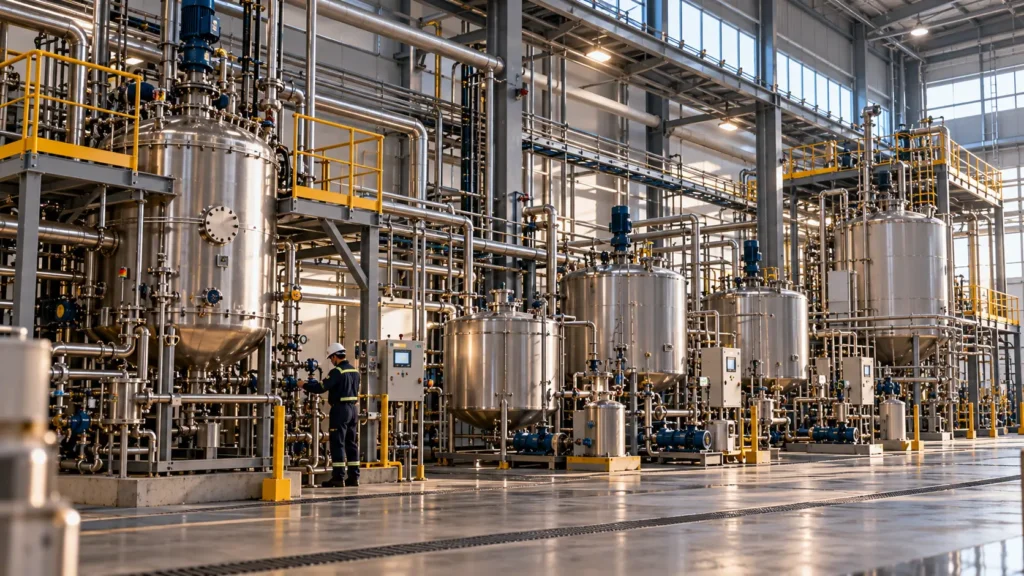
Campaign segregation and product-loss prevention can outperform end-of-pipe complexity.
Controlled principleChemical-industry wastewater should be managed as a set of identifiable process and campaign streams, not as one blended saline effluent. The decision hierarchy is prevention and recovery at source, segregation, dedicated pretreatment where needed, fit-for-purpose internal reuse, and only then common treatment or MLD/ZLD for the fraction whose salt burden still requires it. |
|---|
The plant campaign is part of the wastewater design basis
Chemical and process plants can switch products, grades, catalysts, solvents, recipes, cleaning procedures and production rates while using the same drainage system. The resulting wastewaters may therefore share a pipe but not a treatment problem. EPA’s OCPSF framework explicitly spans both continuous high-volume production and small-volume specialty batch manufacture, illustrating why sector labels do not define one wastewater.
The design basis should preserve the operating state that created each stream: product and grade, batch or campaign identifier, step in the recipe, vessel or unit source, start-up/shutdown state, cleaning stage, solvent or reagent system, flow duration and expected recurrence. A campaign history is more useful than a single annual-average analysis when peak COD, salt, toxicity, solvent, catalyst or pH events control the receiving treatment step.
| Source state | What changes | Why it matters to water treatment | Minimum record |
|---|---|---|---|
| Normal production | Product, conversion, mother-liquor load, salt and solvent system | Sets routine recovery and treatment duty | Campaign ID, batch mass, flow, chemistry distribution |
| Grade / product change | Raw materials, catalysts, wash sequence and off-spec inventory | Can create short, chemically distinct high-load streams | Transition sequence and segregated volumes |
| Cleaning / CIP | Acid/base, solvent, surfactant, oxidant and rinse progression | May be incompatible with biology, membranes or recovery loops | Cleaning recipe, first-rinse and final-rinse identity |
| Start-up / shutdown | Incomplete conversion, purge, flushing and unstable quality | Creates intermittent high-consequence loads | Event frequency, hold/release and fallback route |
| Upset / off-spec | Product, reactant or intermediate loss | Can dominate COD, toxicity or recoverable value | Incident mass balance and recovery/disposal decision |
Table 40.1. Batch and campaign state should remain visible in the wastewater design basis.
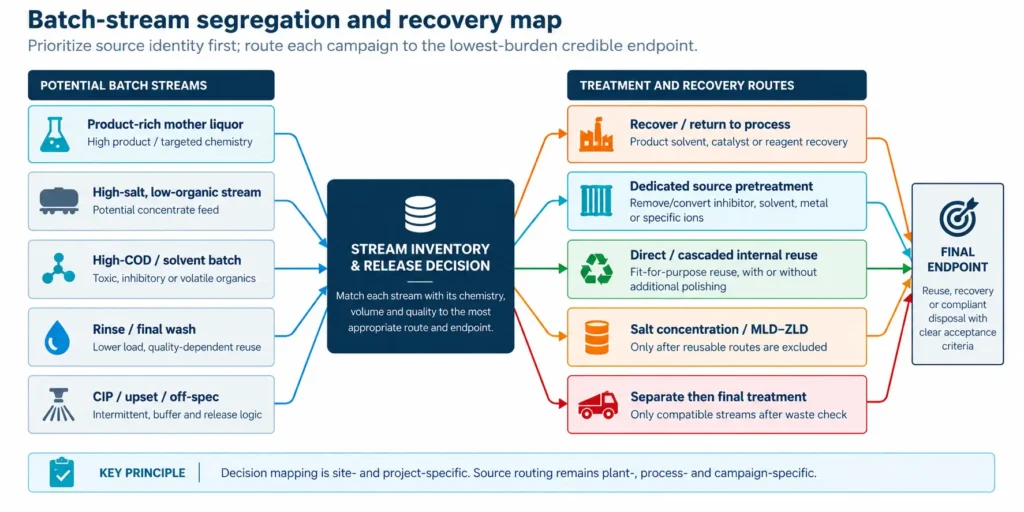
Figure 40.1. Batch-stream segregation and recovery map. The figure is a decision architecture, not a universal chemical-industry treatment train.
Build a wastewater-stream inventory before building a combined plant
The current EU chemical-sector BAT conclusions make stream inventory a formal management requirement: the inventory should connect production processes to emission origins and record average values and variability for flow, pH, temperature, conductivity, relevant pollutants, salts, specific organics and treatability indicators. That logic is particularly important for high-salinity projects because equalization can smooth hydraulic peaks while permanently destroying information about which source created the difficult chemistry.
The inventory should distinguish concentration from load. A small mother-liquor dump may contain more recoverable product or refractory organic mass than hours of weak wash water; conversely, a large low-strength rinse may dominate hydraulic capacity. Both dimensions should be retained until segregation, recovery and common-treatment decisions have been tested.
| Inventory field | Normal basis | Campaign / upset basis | Decision enabled |
|---|---|---|---|
| Flow and duration | Average and scheduled flow | Batch volume, dump rate, frequency | Tankage, equalization and hydraulic capacity |
| Salts / specific ions | Ion distribution and conductivity | Recipe- or neutralization-driven peaks | Scaling, corrosion, membrane/thermal compatibility |
| COD / TOC / biodegradability | Load and biodegradability trend | Solvent/product-loss spikes; inhibition potential | Biology versus source recovery / oxidation / separation |
| Metals / catalysts | Routine trace load | Catalyst dump or cleaning release | Source capture, precipitation, recovery or hazardous residual |
| Volatile / hazardous organics | Routine presence and form | Concentrated solvent or reactive batch | Closed handling, source recovery and air-water interface |
| pH / temperature / reactivity | Normal operating band | Cleaning and neutralization events | Compatibility, safety and neutralization strategy |
Table 40.2. A chemical-sector wastewater inventory should retain both steady-state and campaign-specific information.
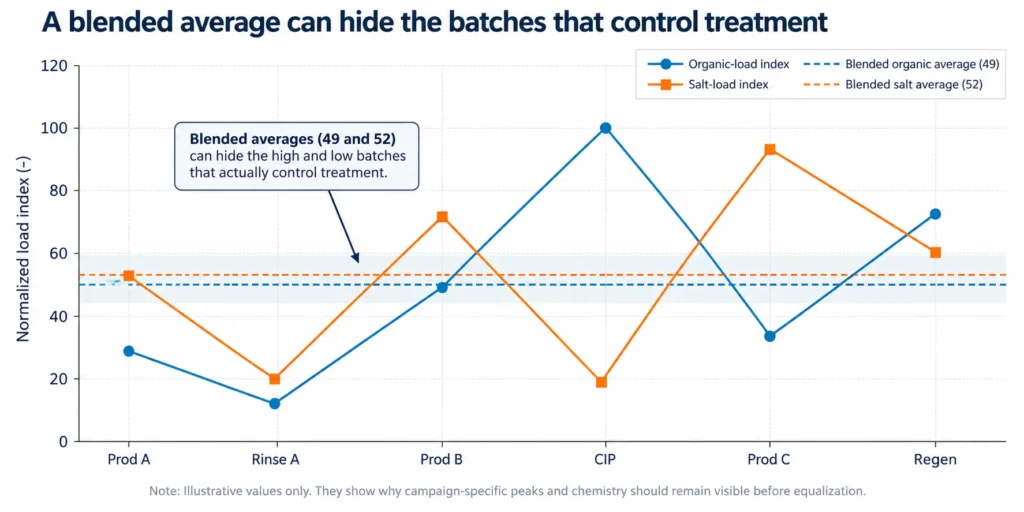
Figure 40.2. Scenario-only batch variability. The normalized values illustrate how blending can hide the batches that control organic or salt treatment duty; they are not plant data or design thresholds.
Product-loss prevention is often the first treatment step
The most valuable contaminant to remove from wastewater may be material that should never have become wastewater. EU BAT gives priority to reducing wastewater volume or pollutant load, reusing water in the process and recovering raw materials; the integrated treatment hierarchy then places process-integrated prevention and recovery at source ahead of pretreatment and final treatment. This makes product-loss prevention a process-engineering action, not merely an environmental initiative.
For a batch plant, the practical questions are simple: can the vessel heel be drained as product or returned to the next compatible batch; can first rinse be recovered separately; can a mother liquor be recycled or sent to a dedicated recovery step; can a solvent be distilled rather than biologically oxidized; can a catalyst-bearing fraction be retained before dilution? Each avoided kilogram reduces both treatment load and the residual mass created by treatment.
| Prevention / recovery action | Value mechanism | Evidence required | Failure mode to avoid |
|---|---|---|---|
| Drain / heel minimization | More saleable product; lower wastewater load | Campaign mass balance and product-quality impact | Sending recoverable product to drain by default |
| First-rinse capture | Concentrated return or recovery feed | Composition, reuse limit and batch compatibility | Blending first rinse into all later rinses |
| Mother-liquor recycle | Raw-material / solvent / salt recovery | Impurity accumulation and purge balance | Closed loop with uncontrolled impurity buildup |
| Solvent recovery | Avoided solvent purchase and COD load | Phase behavior, purity, energy, residual bottoms | Treating recoverable solvent as generic COD |
| Catalyst / metal capture | Avoided loss and lower toxic/metal load | Speciation, selectivity, receiver/reuse specification | Dilution before recovery makes capture impractical |
Table 40.3. Product-loss prevention should be screened before end-of-pipe treatment complexity.
Stream segregation is the principal opportunity – but it must earn its infrastructure
BAT for the chemical sector requires segregation of uncontaminated streams from streams that require treatment and supports source-specific pretreatment close to the source when pollutants would otherwise be diluted or interfere with final treatment. For batch-variable plants, the same principle extends beyond clean versus dirty water: product-rich, solvent-rich, metal-bearing, high-salt/low-organic, high-COD/low-salt, reusable rinse and incompatible cleaning streams may deserve different routing.
Segregation is not free. Dedicated drains, tanks, transfer pumps, analyzers, interlocks and operator procedures add CAPEX and failure modes. The correct test is whether preserved source identity reduces recovery loss, hazardous mixing, treatment size, chemical demand, residual generation or operating risk enough to justify the additional infrastructure.
| Segregation candidate | Keep separate when… | Potential destination | When blending may be acceptable |
|---|---|---|---|
| Product-rich liquor | Recovery or return-to-process value is credible | Dedicated recovery / controlled recycle | Recovery value is disproven and treatment compatibility is established |
| High-salt / low-organic | Organic polishing would otherwise treat unnecessary volume | Salt concentration, selective precipitation, MLD | Common treatment is demonstrably simpler and does not constrain recovery |
| High-COD / solvent | Toxicity, volatility or refractory COD threatens downstream treatment | Recovery, stripping/oxidation or dedicated pretreatment | After contaminant-specific treatment and compatibility checks |
| Metal / catalyst-bearing | Dilution would make capture harder or contaminate sludge | Recovery or precipitation at source | After capture if residual is compatible |
| Final rinse / low load | Quality permits cascade or direct internal reuse | Earlier wash, utility or process reuse | If reuse demand is unavailable and treatment is low burden |
| CIP / upset | Composition is intermittent, extreme or reactive | Buffer, test and controlled release | Only after release criteria confirm compatibility |
Table 40.4. Segregation is a value and risk decision, not a rule to create one tank for every stream.
COD is a load indicator, not a complete description of organics
High COD can arise from saleable product, biodegradable intermediates, refractory organics, solvents, surfactants, chelants, polymers or reducing agents. Those materials can have very different effects on biological treatment, membranes, evaporation, crystallization, air emissions and residual classification. The EU BAT inventory therefore pairs COD/TOC with specific organic compounds and bioeliminability or inhibition information where relevant.
A high-salinity design should also ask whether the organic load changes phase or risk during concentration. Volatile compounds may shift toward off-gas and condensate; non-volatile organics can accumulate in concentrate or mother liquor; surfactants may promote foaming; chelants may change metal precipitation; and polymeric material can impair filtration and crystallization. These are mechanism questions, not arguments for one universal oxidation technology.
| Organic characteristic | Question | Downstream risk | Evidence / response |
|---|---|---|---|
| Biodegradable load | Can biology remove the load at the actual salinity and toxicity? | Oxygen demand, inhibition, biomass upset | Treatability test and salinity-aware operating evidence |
| Refractory organics | What fraction survives final treatment? | Accumulation in reuse water or concentrate | Specific analytics, adsorption/oxidation/separation where justified |
| Volatile solvent | Where does mass partition during collection and treatment? | Air emissions, safety, condensate contamination | Closed capture, recovery/stripping and vapor control |
| Surfactant / polymer | Does it foam, foul or interfere with solids separation? | Membrane fouling, flotation, crystallizer foaming | Real-stream testing and source substitution/reduction |
| Chelant / complexant | Does it keep metals soluble? | Failed precipitation, metal carryover | Speciation and precipitation testing |
| Product/intermediate | Is it more valuable to recover than destroy? | Economic loss disguised as wastewater COD | Mass balance and recovery screen |
Table 40.5. COD/TOC should be resolved into the organic mechanisms that control treatment and recovery.
Specific ions, catalysts and solvents can be stronger gates than salinity
A chemical plant may contain chloride, sulfate, fluoride, phosphate, cyanide-bearing streams, ammonium, sodium salts, acids/bases, catalyst metals or other specific ions because the chemistry is created intentionally by the process. EPA’s chemical-manufacturing regulations are divided into multiple industrial categories and subcategories, reinforcing that pollutant and process origin matter; one generic ‘chemical wastewater’ treatment basis is not defensible.
The design question is therefore which constituent constrains the next operation. A metal catalyst may force source capture before biological treatment; fluoride or sulfate may limit concentration because of precipitation; a solvent may preclude direct membrane exposure; a strong acid/base cleaning stream may need staged neutralization or recovery; and a salt introduced by neutralization may materially increase the later MLD/ZLD duty.
| Specific constituent | Why it can control the train | Primary screening question | Common mistake |
|---|---|---|---|
| Catalyst / metal | Toxicity, sludge contamination, recovery value | Can it be captured before dilution? | Letting final biological sludge become the metal sink |
| Solvent | Volatility, flammability, COD and membrane compatibility | Recover, separate or destroy at source? | Using COD alone to select treatment |
| Sulfate / calcium / hardness | Scaling during concentration | Which species precipitates first and where? | Assuming antiscalant replaces mass balance |
| Fluoride / phosphate | Specific precipitation and residual chemistry | Can selective precipitation create a stable solid? | Ignoring reagent-driven secondary salt load |
| Ammonium / nitrogen species | Biological and discharge burden; pH/speciation effects | Is source recovery or biological removal credible at actual salinity? | Using a generic nitrogen removal step without inhibition testing |
| Acid / alkali / neutralization salts | Corrosion, heat, salt creation | Can process recovery or segregated neutralization reduce total salt? | Neutralizing everything centrally then paying to remove the created salt |
Table 40.6. Specific chemistry should determine the treatment gate; TDS is only one descriptor.
Internal chemical recovery and water reuse should be tested before merchant-product routes
Internal recovery has a structural advantage: the user, specification, logistics and avoided-purchase value may already exist inside the fence. EU BAT explicitly prioritizes raw-material recovery and wastewater reuse within the production process. In chemical plants, this may include solvent return, acid/base recovery, reagent reuse, mother-liquor recycle, counter-current washing, rinse cascade or reuse of polished water in a less demanding step.
The internal route still requires qualification. Recovered material can accumulate impurities, alter reaction selectivity, affect color or product purity, or introduce an uncontrolled contaminant into a regulated product. The correct economic value is avoided purchase and avoided treatment/disposal after the full conditioning burden – not the headline market price of a nominally similar chemical.
| Internal route | Specification owner | Key qualification | Fallback |
|---|---|---|---|
| Solvent return | Production / quality | Water, impurity, inhibitor and distillation-bottoms control | Fresh solvent plus residual treatment |
| Acid / base reuse | Receiving process unit | Strength, contaminant profile and corrosion/materials compatibility | Neutralize / treat as residual |
| Mother-liquor recycle | Process chemistry owner | Impurity accumulation, purge and product quality | Partial recycle plus purge |
| Rinse cascade | Operations / quality | Carryover limit and sequence control | Fresh-water rinse plus treatment |
| Polished-water reuse | Utility / production user | Conductivity, organics, ions, microbiology as relevant | Discharge or lower-grade reuse |
| Recovered catalyst / metal | Process / procurement / quality | Chemical form, purity, activity and legal/product controls | External recovery or compliant disposal |
Table 40.7. Internal recovery is credible only when the receiving process owns a specification and fallback.
Dedicated pretreatment should protect the final plant from incompatible batches
EU BAT 10 and 11 place source recovery and pretreatment ahead of final wastewater treatment and explicitly describe pretreatment for pollutants that are toxic, poorly biodegradable, highly concentrated, volatile, corrosive or otherwise disruptive to the final plant. BAT also notes that source treatment can avoid dilution and that compatible streams may be collected for dedicated combined pretreatment.
For high-salinity process water, dedicated pretreatment can be the difference between a stable hybrid train and a fragile end-of-pipe ZLD system. Examples include solvent recovery or oxidation before membranes, metal removal before biological treatment or salt concentration, hardness/sulfate conditioning before high-recovery desalination, and destruction or removal of organics that would foul thermal equipment. The selected method remains plant-specific.
| Source problem | Pretreatment objective | Candidate function families | Evidence gate before scale-up |
|---|---|---|---|
| Free / dispersed organics | Remove phase and protect downstream | Gravity/coalescence, DAF, adsorption, filtration | Real-stream separation and residual handling |
| Volatile solvent | Recover or prevent transfer to air / condensate | Distillation, stripping with capture, phase separation | Mass partition, safety and off-gas treatment |
| Refractory / inhibitory COD | Protect biology / membranes / evaporation | Recovery, oxidation, adsorption, dedicated treatment | Treatability, by-products and chemical demand |
| Metals / catalyst | Recover or remove before dilution | Selective precipitation, ion exchange, extraction, recovery | Speciation, selectivity, sludge/product quality |
| Hardness / sulfate / silica | Increase concentration envelope | Softening, selective precipitation, filtration | Scaling model plus solids separation testing |
| Extreme pH / reactive cleaning | Make downstream release controllable | Segregation, recovery, staged neutralization | Heat/reaction, salt addition and release criteria |
Table 40.8. Source pretreatment should be selected by the contaminant that the final plant cannot safely absorb.
Salt concentration belongs after the organic and product-recovery decisions
A salt-rich stream is a candidate for membrane, electrochemical or thermal concentration only after the upstream organic, reactive, volatile and solids risks have been bounded. Concentration multiplies whatever is retained: non-volatile organics, catalyst traces, scaling ions, residual reagents and color bodies can all become more important as water is removed.
The correct endpoint may therefore be selective MLD rather than whole-site ZLD. A plant can keep product-rich or high-COD batches out of the concentrator, send a relatively clean saline fraction to high-recovery treatment, and preserve a separate route for incompatible residuals. This can reduce evaporator duty and prevent the crystallizer from becoming the final sink for every process impurity.
| Concentration gate | Proceed when… | Recycle / conditional when… | Stop / redesign when… |
|---|---|---|---|
| Organic control | Retained organics are low or proven manageable | One bounded impurity needs longer-run testing | Foaming, fouling or condensate contamination is uncontrolled |
| Scaling / precipitation | Supersaturation and solids route are controlled | Selective precipitation route needs pilot closure | No stable scale-control or solids-separation route exists |
| Materials | Chloride/pH/temperature/solvent exposure is within justified materials basis | One secondary corrosion mechanism needs coupon/pilot evidence | Required material is unproven or inaccessible |
| Residual endpoint | Concentrate, mother liquor and solids have finite routes | Contingency route is time-limited but controlled | System depends on indefinite storage or assumed product sale |
| Reuse value | Recovered water has a named use and quality target | Blend or seasonal use needs confirmation | No meaningful value or regulatory endpoint for recovered water |
Table 40.9. High-salinity concentration should begin only after retained organics, scale, materials and residual routes are controlled.
Typical chemical-industry MLD and ZLD configurations are conditional architectures
There is no single chemical-sector MLD/ZLD train. The architectures below are decision patterns that preserve source-specific treatment and only combine streams when the resulting chemistry and receiving duty justify it. EPA’s current chemical-manufacturing pages themselves span multiple effluent-guideline categories and highly diverse production modes; the public guide should therefore avoid universal recovery, COD, salinity or cost benchmarks.
| Architecture | Where it fits | Core sequence | Critical proof |
|---|---|---|---|
| Segregation + internal recovery + common WWTP | Salts are secondary and product/COD losses dominate | Source capture -> recovery/pretreatment -> compatible combined treatment | Product recovery and final-treatment inhibition |
| Selective saline-stream MLD | A distinct low-organic saline stream drives disposal burden | Segregate -> hardness/specific-ion control -> membrane/electrochemical concentration -> residual route | Real-matrix concentration and residual capacity |
| Hybrid membrane-thermal | High recovery is justified and pretreatment can protect concentration | Segregate -> source pretreatment -> membrane/electrochemical concentration -> thermal finishing | Closed mass balance, fouling/scaling and energy integration |
| Thermal ZLD for selected stream | Routine liquid discharge from the selected boundary must be eliminated | Segregate -> organics/metals/scale control -> evaporator -> crystallizer/solids -> purge logic | Condensate quality, solids handling and mother-liquor control |
| Campaign / mobile treatment | High-load batches are intermittent or product slate changes | Hold -> characterize -> campaign-specific treatment/recovery -> final route | Tankage, release criteria, turnaround time and changeover |
Table 40.10. Chemical/process MLD and ZLD architectures should be selected by stream identity and endpoint, not by sector label.
Equalization is useful only after incompatible value and risk have been separated
Equalization is a legitimate final-treatment technique and buffer storage is explicitly recognized in EU BAT for non-normal wastewater events. But equalization should not become a reflex that converts recoverable product, a reusable rinse, a concentrated metal stream and a toxic cleaning batch into one average wastewater.
A robust strategy separates first, then equalizes compatible streams to reduce hydraulic or concentration variability. Hold-and-release logic should define what is measured before a batch enters the common system, who owns the release decision, what happens when data are unavailable, and which tank or off-site route receives a rejected batch.
| Buffer / equalization function | Good use | Bad use | Required control |
|---|---|---|---|
| Hydraulic smoothing | Reduces short-term flow peaks after compatibility is proven | Hides batch identity before characterization | Flow history and release criteria |
| Load smoothing | Protects biology or polishing from bounded load swings | Dilutes a toxic/refractory batch into a larger problem | Load-based release and inhibition checks |
| Upset containment | Holds non-normal wastewater pending decision | Uses finite tankage as indefinite disposal | Capacity, maximum hold time and fallback |
| Campaign transition | Separates changeover water until quality stabilizes | Automatically blends first rinse with normal wastewater | Campaign tag and sequence-based routing |
| Reuse buffer | Decouples intermittent supply from internal demand | Stores unstable recovered water without quality controls | Residence-time, stability and user specification |
Table 40.11. Equalization should smooth compatible streams; it should not erase the information needed for recovery and risk control.
Batch plants need operating-state control, not only equipment redundancy
Campaign-driven plants change the treatment feed deliberately. Operators therefore need a controlled matrix linking product schedule and cleaning sequence to tank routing, analyzer checks, chemical programs, membrane or thermal operating limits, laboratory release and residual handling. A treatment system that is stable on Product A but requires undocumented workarounds on Product B is not a robust multi-product design.
Change control is equally important. A new raw material, catalyst, antifoam, chelant, solvent, product grade or cleaning chemical can alter wastewater treatability without changing nameplate flow. The MOC process should trigger water-impact review when a process change can affect COD character, ionic load, precipitation, corrosion, volatility, biodegradability, product recovery or residual classification.
| Operating control | What must be linked | Failure signal | Record |
|---|---|---|---|
| Campaign routing | Product / step -> drain / tank / recovery route | Manual rerouting depends on operator memory | Campaign-water routing matrix |
| Release testing | Tank -> required analyses -> acceptable limits | Batch enters common plant before critical result | Hold/release procedure and audit trail |
| Treatment recipe | Feed state -> chemical / membrane / thermal settings | One generic setpoint for incompatible chemistries | Operating-envelope table |
| Cleaning/changeover | Production cleaning -> wastewater routing and treatment cleaning | Cleaning waste creates unplanned upset or salt load | Integrated cleaning plan |
| MOC | Process recipe / material changes -> water review | New catalyst/solvent appears first as a treatment failure | MOC water-impact checklist |
| Fallback | Rejected batch / treatment outage -> finite route | Production continues with no residual capacity | Emergency tankage / off-site route / production stop rule |
Table 40.12. Batch treatment must be operated as part of the production recipe and management-of-change system.
Recovered chemicals and solids remain products only when specification and legal status are proven
A precipitated catalyst metal, recovered solvent, salt crystal or acid/base stream is not automatically a product. The guide’s earlier product-qualification rules still apply: defined specification, consistent quality, lawful route, real user or buyer, logistics, off-spec handling and risk-adjusted net value. Internal reuse can simplify the commercial chain but not the technical qualification.
Chemical-sector segregation can also create smaller but more concentrated hazardous residuals. Dedicated solvent bottoms, metal-rich sludge, oxidation by-products, spent adsorbent, membrane concentrate and crystallizer mother liquor must be carried through the waste and product boundary explicitly. A ZLD claim does not eliminate these streams; it changes their form.
| Recovered / residual stream | Potential status | Evidence before value credit | No-value fallback |
|---|---|---|---|
| Recovered solvent | Internal raw material or merchant product | Purity, water, inhibitor/by-products, consistent lots and user acceptance | Energy recovery / hazardous treatment / disposal as applicable |
| Recovered acid/base | Internal reagent / candidate product | Strength, impurity profile, materials compatibility and receiving duty | Neutralization and compliant residual treatment |
| Catalyst / metal fraction | Internal return, refiner feed or managed waste | Speciation, assay, contamination, receiver qualification | Hazardous/non-hazardous route as legally determined |
| Salt crystals / precipitate | Candidate bulk product or managed solid | Phase, purity, moisture, contaminants, market/user and legal status | Costed disposal or lower-grade route |
| Mother liquor / purge | Managed liquid residual | Steady-state composition, volume and destination | Finite disposal or further treatment |
| Oxidation / adsorption residual | Managed liquid/solid waste | By-products, toxicity, spent-media characterization | Licensed treatment/disposal |
Table 40.13. Recovery changes material status only when product, legal and residual gates are satisfied.
The business case should count avoided product loss before avoided wastewater volume
For a chemical plant, a cubic metre of wastewater can carry very different economic value depending on what it contains. A product-rich first wash can justify recovery even when its volume is small; a large final rinse may justify direct reuse because its treatment burden is low; a high-salt purge may justify concentration because disposal is expensive. The business case should therefore separate material value, water value and residual cost.
Base-case economics should include product/raw-material loss, water purchase, wastewater treatment, chemicals, energy, maintenance, off-site waste, production interruption and residual liability. Any merchant-product revenue remains incremental and qualification-adjusted. A project that is economic only after assigning full commodity value to every recovered salt should recycle to Chapter 22’s product-recoverability gates.
| Value / cost component | Base-case treatment | Downside test | Do not do |
|---|---|---|---|
| Avoided product / raw material loss | Mass balance times defensible internal value after recovery cost | Lower recovery, more impurity / rework | Treat lost product merely as COD |
| Avoided water purchase | Named reuse volume and displaced water basis | Seasonal or lower reuse demand | Credit all permeate regardless of user |
| Avoided wastewater / disposal | Actual displaced treatment, haulage or discharge burden | Higher disposal price or reduced receiver capacity | Assume residual route is free |
| Segregation infrastructure | Dedicated tanks, drains, analyzers, transfer and controls | More changeover / operator burden | Ignore added operational complexity |
| MLD/ZLD incremental cost | Only the segregated fraction requiring salt removal | Higher energy, lower availability, poorer feed | Normalize cost to whole site without boundary |
| Recovered product revenue | Qualified on-spec volume and delivered/avoided net value | No-sales or off-spec case | Use headline commodity price |
Table 40.14. Chemical-sector economics should value avoided material loss, water and residual burden on separate evidence bases.
Chemical/process sector acceptance gate
A chemical/process MLD or ZLD concept should advance only when the campaign inventory, source routing, prevention/recovery logic, contaminant-specific pretreatment, internal reuse, concentration boundary, residual route and operating controls can be audited against production reality. A blended average and a generic ZLD flow sheet do not constitute a design basis.
| Gate field | Proceed | Conditional / recycle | Stop |
|---|---|---|---|
| Campaign inventory | Normal, changeover, cleaning and upset streams are identified and characterized | One bounded campaign needs additional sampling | Design relies on a single blended composite |
| Product-loss prevention | Major recoverable/product-rich streams have been screened and decisions owned | One recovery route needs qualification | Known product loss is sent to treatment without evaluation |
| Segregation | Dedicated routing has demonstrated whole-system benefit | Infrastructure/automation case needs refinement | Incompatible or high-value streams are mixed by default |
| Pretreatment | Toxic/refractory/volatile/metals/scale gates are controlled at source or before final plant | One mechanism awaits pilot evidence | Final plant is expected to absorb an unproven inhibitory/reactive batch |
| Internal recovery / reuse | Named receiving duties and specifications exist | One reuse case awaits quality validation | Reuse is claimed without a real user/specification |
| MLD/ZLD boundary | Only the fraction requiring salt concentration enters the intensive train | One recycle/purge uncertainty remains | Whole-site ZLD is used to avoid source decisions |
| Residual / product route | Routine, off-spec and upset residuals have finite lawful routes | Contingency route is time-limited but controlled | Water service depends on indefinite storage or assumed sales |
| Operations / MOC | Campaign routing, release, fallback and process-change review are executable | Early-life support closes a defined gap | Treatment relies on undocumented operator workarounds |
| Economics | Case survives no-product-revenue and higher-cost downside cases | One bounded value input awaits evidence | Economics require gross commodity revenue or omitted residual cost |
Table 40.15. Chemical/process concepts advance only when source identity, recovery, treatment, residuals, operations and economics are auditable.
Stop ruleStop, segregate or re-stage when wastewater is represented only by a blended average; when recoverable product or solvent is deliberately diluted before recovery is screened; when one high-COD, metal, solvent or cleaning batch can poison the common plant; when equalization is being used to hide incompatible chemistry; or when whole-site ZLD is proposed without first proving which streams actually need salt concentration. |
|---|
Handover to Chapter 41 – inland desalination and water reuse
Chapter 41 shifts from batch-variable process plants to inland desalination and water-reuse systems, where concentrate disposal is often the binding constraint and recovered water has direct local value. The chemical-sector lesson carried forward is source discipline: do not send every stream to the hardest treatment step simply because a central plant exists.
The handover should translate campaign segregation into source-water and concentrate segregation, product-loss prevention into source reduction, and internal chemical recovery into fit-for-purpose water reuse. Chapter 41 should receive a defined concentrate source, ion distribution, scaling envelope, disposal baseline, water-reuse value, pretreatment/softening logic, residual route and the MLD-versus-ponds/hauling/ZLD comparison required by the master brief.
| Chemical/process expression | Controlled lesson | Inland desalination / reuse translation |
|---|---|---|
| Campaign stream inventory | Preserve source identity before blending | Separate BWRO, reuse-RO and other concentrates by chemistry and endpoint |
| Product-loss prevention | Remove the problem at source before end-of-pipe treatment | Reduce reject generation and improve primary-system recovery only where stable |
| Specific-ion pretreatment | Treat the constituent that constrains the next step | Softening/selective precipitation follows scaling chemistry, not TDS alone |
| Internal receiving duty | Known internal value can be more bankable than merchant sales | Recovered water value is tied to a named municipal/industrial reuse duty |
| Selective MLD boundary | Only difficult fractions should enter intensive concentration | Compare selective high-recovery treatment with ponds, hauling or other disposal |
| Finite residual route | Every separation creates another stream | Concentrate, sludge, purge and final solids remain in the system boundary |
Table 40.16. Chapter 41 inherits source-to-endpoint discipline, not a chemical-industry equipment train.
Chapter conclusion
Chemical and process industries make the case for source-first MLD/ZLD especially clearly. The same site can create product-rich mother liquor, solvent-bearing washes, catalyst or metal streams, strong cleaning solutions, low-load rinses and relatively clean saline purges. Blending them too early can destroy recovery value, magnify treatment volume and make the final plant responsible for chemistry that could have been prevented or handled at source.
The strongest strategy therefore follows the BAT hierarchy and the guide’s broader logic: inventory the streams and their variability; prevent product loss; recover raw material where credible; segregate clean, reusable, high-value and incompatible fractions; pretreat difficult pollutants close to source; reuse water internally where a real duty exists; and concentrate salts only in the fraction whose residual endpoint justifies it. Campaign segregation and product-loss prevention can outperform end-of-pipe complexity.
Chapter 40 in one sentenceIn batch-variable chemical plants, the best MLD/ZLD project often starts by keeping the right streams apart and valuable material out of the drain. |
|---|