
Four fictionalized cases apply one decision framework across inland desalination, mining, produced water and chemical manufacturing.
The four red-thread cases are explicitly fictionalized teaching scenarios. Every numerical flow, recovery and burden index below is an assumption created to make the decision sequence visible. External sources are used only to support sector framing and decision logic; they do not validate the fictional case numbers. This follows the master rule that scenario-specific numbers remain visibly labelled rather than being promoted into generic performance claims. [BC]
RT.1 A common ten-step progression makes the cases comparable
| Step | Question carried through every case | Required output |
|---|---|---|
| 1. Initial data | What does the owner think the problem is? | Stated objective, known source and current endpoint. |
| 2. Missing information | What would make an immediate technology choice premature? | Missing-data list and evidence plan. |
| 3. Characterization | What chemistry and variability actually control treatability? | Normal/design/upset basis, not TDS alone. |
| 4. Management alternatives | Can source reduction, segregation, reuse or a simpler endpoint solve the problem? | Credible baseline plus alternatives. |
| 5. Process screening | Which blocks remove the limiting constraint? | Shortlist tied to chemistry and endpoint. |
| 6. Selected MLD/ZLD train | Where should recovery rationally stop? | Defined train and full residual register. |
| 7. Potential valorization | Is any recovered constituent truly qualified? | Internal use / buyer / spec / no-sales fallback. |
| 8. Economics | Does the option beat the counterfactual under downside cases? | Lifecycle boundary and relative burden. |
| 9. Main risks | What can invalidate the choice? | Risk owners and next evidence step. |
| 10. Recommendation | What should the owner do now? | Proceed / conditional / stop with evidence maturity. |
Table RT.1. All four cases use the same analytical sequence required by the master specification.
Case A — Inland BWRO concentrate: stop where the endpoint is solved
A fictional inland utility operates brackish-water RO to create locally valuable product water. Surface discharge is unavailable. The owner initially asks for ZLD because concentrate hauling is becoming operationally and commercially uncomfortable. The first decision is instead to define the current receiver, limiting scale chemistry and value of additional water. Reclamation’s concentrate-management toolbox is explicitly a planning-level screen and recommends project-specific desktop and pilot work for performance and cost estimation; the case therefore treats technology selection as conditional rather than automatic.
| Design-basis field | Case A — scenario-only assumption |
|---|---|
| Primary RO feed | 100 m³/h. |
| Primary recovery | 70%; 70 m³/h product and 30 m³/h concentrate. |
| Key chemistry | High hardness / sulfate / silica relative to secondary-recovery duty; full ion distribution is still required. |
| Current endpoint | Off-site receiver / hauling route; finite capacity and continuity assumed. |
| Water value | High enough to justify screening additional recovery, but not assumed infinite. |
| Economic index | Current route = 100; selected MLD = 72; aggressive thermal ZLD = 128. |
| Progression | Case A decision |
|---|---|
| Missing information | Longer-term concentrate chemistry distribution, scaling-induction evidence, secondary-RO pilot response, receiver outage history, disposal cost basis and emergency storage. |
| Management alternatives | Optimize stable primary RO; keep current disposal; selective softening + secondary RO; pond/injection only if site-specific evidence supports; thermal ZLD as contingency. |
| Process screening | Use selective softening only if it removes the demonstrated scale constraint on secondary recovery; do not remove chemistry that does not constrain the selected endpoint. |
| Selected train | Primary RO → constraint-specific softening/solids separation → secondary RO → finite 15 m³/h residual receiver. |
| Valorization | No salt revenue in the decision case. Any precipitate remains a managed residual until qualified. |
| Economics | Selected MLD wins in the fictional index because it halves disposal volume without paying for the final thermal increment. |
| Main risks | Receiver interruption; scaling variability; softening sludge dewaterability; secondary membrane cleaning frequency. |
| Recommendation | Pilot the softening + secondary recovery boundary and contract/permit the residual route. Retain ZLD only as a conditional future step. |
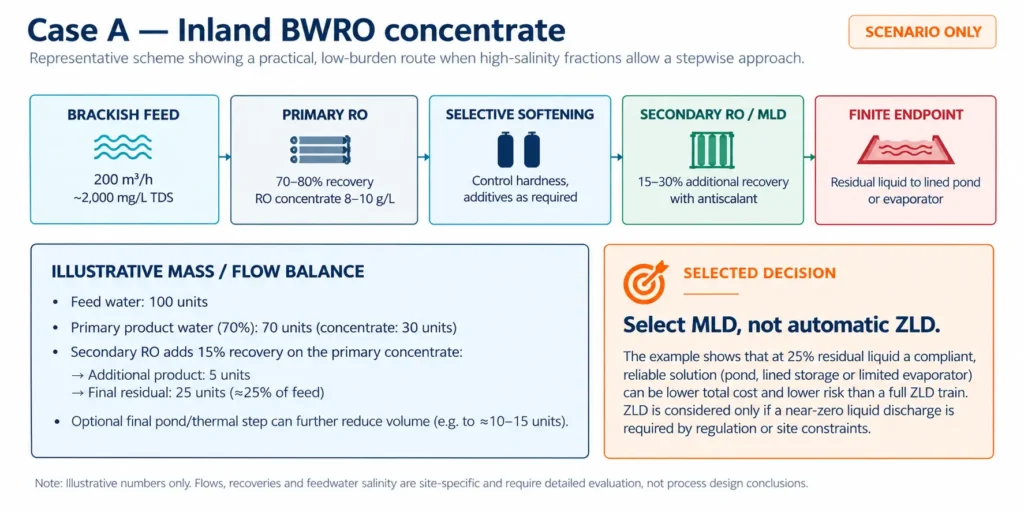
Figure RT.A. Case A fictionalized flowsheet and mass-balance panel. The selected MLD endpoint reduces residual volume without assuming that the final thermal step is automatically justified.
Case B — Mining hypersaline groundwater: remote operability changes the optimum
A fictional remote mine needs additional process water and has access to hypersaline groundwater. The high salinity is only one part of the decision: mine water management, tailings interfaces, production continuity, reagents, spares and operator support are equally important. Australian leading-practice guidance frames mine-water management as a stewardship and risk problem, while tailings guidance emphasizes systematic risk-based integration rather than treating the tailings facility as an undefined sink.
| Design-basis field | Case B — scenario-only assumption |
|---|---|
| Groundwater feed | 25 m³/h. |
| Dissolved-solids context | Hypersaline, NaCl-dominant with divalent scaling species; no generic salinity benchmark claimed. |
| Selected water recovery | 18 m³/h recovered water in the integrated MLD case. |
| Residual interface | 7 m³/h concentrated residual to a specifically approved tailings-water interface. |
| Remote-site constraint | Limited specialist attendance, reagent logistics and maintenance windows. |
| Economic index | Imported-water/disposal baseline = 100; selected integrated MLD = 76; crystallizer/ZLD = 119. |
| Progression | Case B decision |
|---|---|
| Missing information | Hydrogeological variability, tailings geochemistry compatibility, metallurgy/process-water acceptance, thermal integration, materials/corrosion evidence and closure obligations. |
| Management alternatives | Import more water; use groundwater with targeted treatment; tailings-integrated MLD; crystallizer/ZLD if the liquid residual cannot be accepted. |
| Process screening | Remove scale-forming/metals constraints before high-salinity concentration; choose the membrane/thermal transition from real chemistry and pressure/energy limits. |
| Selected train | Groundwater → chemistry-specific pretreatment → thermal concentration → recovered water + controlled tailings residual. |
| Valorization | No mineral revenue in the base/downside model; recovery of salts/metals remains optional upside subject to qualification. |
| Economics | Remote O&M, spare parts and tailings integration outweigh the attraction of the last recovery increment in the fictional case. |
| Main risks | Tailings acceptance changes; corrosion; scaling; energy reliability; long lead-time spares; closure-state mismatch. |
| Recommendation | Advance the integrated MLD case with tailings compatibility testing and long-duration operability evidence before considering crystallization. |
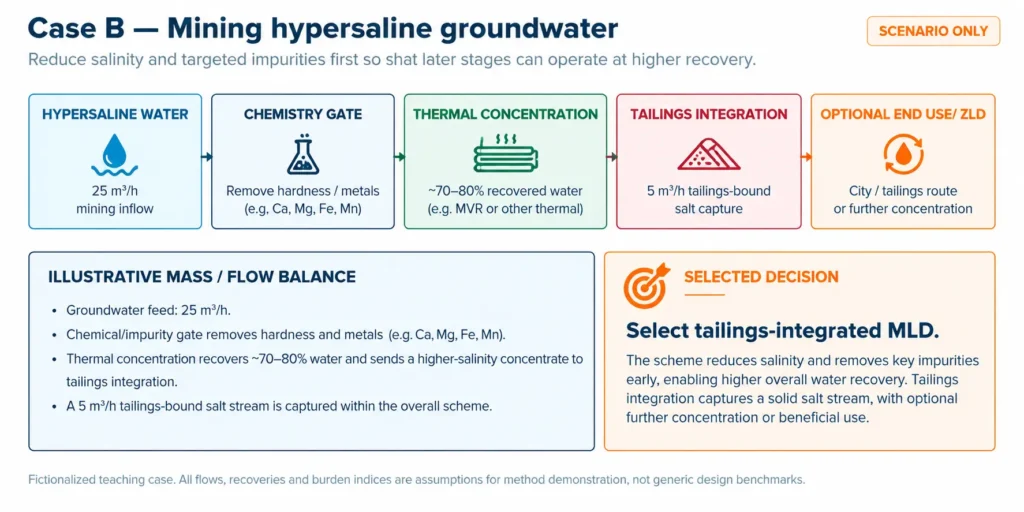
Figure RT.B. Case B fictionalized flowsheet and mass-balance panel. The selected endpoint is a mine-water integration decision, not a maximum-recovery target.
Case C — Produced water: reuse objective before desalination
A fictional oilfield produces a saline, oily and compositionally variable water stream. The owner’s immediate problem is disposal volume and freshwater replacement for internal operations, not external sale of distilled water or minerals. DOE notes that produced-water composition depends on reservoir/geology and can contain dissolved salts, organics and metals; current DOE programs continue to focus on characterization, treatment, recycling and beneficial reuse. The case therefore screens fit-for-purpose internal reuse before bulk desalination.
| Design-basis field | Case C — scenario-only assumption |
|---|---|
| Produced-water flow | 100 m³/h. |
| Primary contaminants | Oil/grease, suspended solids, sulfides, scale-forming ions and variable salinity/organics. |
| Internal reuse target | 85 m³/h after fit-for-purpose pretreatment; bulk salinity removal not required by the fictional receiving duty. |
| Residual route | 15 m³/h outside the reuse envelope to licensed disposal or targeted polishing. |
| Operating variability | Well state / source blend is treated as a design variable. |
| Economic index | Current injection + make-up baseline = 100; reuse-first = 63; deep desalination/ZLD = 151. |
| Progression | Case C decision |
|---|---|
| Missing information | Time-series composition by well/source, reuse specification, oil/solids/sulfide variability, scale tendency, disposal capacity and upset storage. |
| Management alternatives | Continue disposal; segregate and reuse suitable qualities internally; selective polishing for difficult fractions; full desalination only for a defined higher-quality use. |
| Process screening | Deoiling/solids removal and sulfide/scale control are primary gates; desalination is not selected merely because TDS is high. |
| Selected train | Source segregation → oil/solids/sulfide/scale pretreatment → 85 m³/h fit-for-purpose internal reuse → 15 m³/h residual route. |
| Valorization | Critical-mineral or salt recovery receives zero revenue in the decision case until a specific product route is proven. |
| Economics | Avoided freshwater purchase and avoided disposal dominate; deep desalination adds energy, pretreatment and concentrate handling that the internal reuse duty does not require. |
| Main risks | Reuse specification drift; emulsion breakthrough; sulfide safety/corrosion; variable scale-formers; disposal outage. |
| Recommendation | Pilot the pretreatment/reuse envelope across representative well states. Only add desalination if a higher-value receiving duty is explicitly defined. |
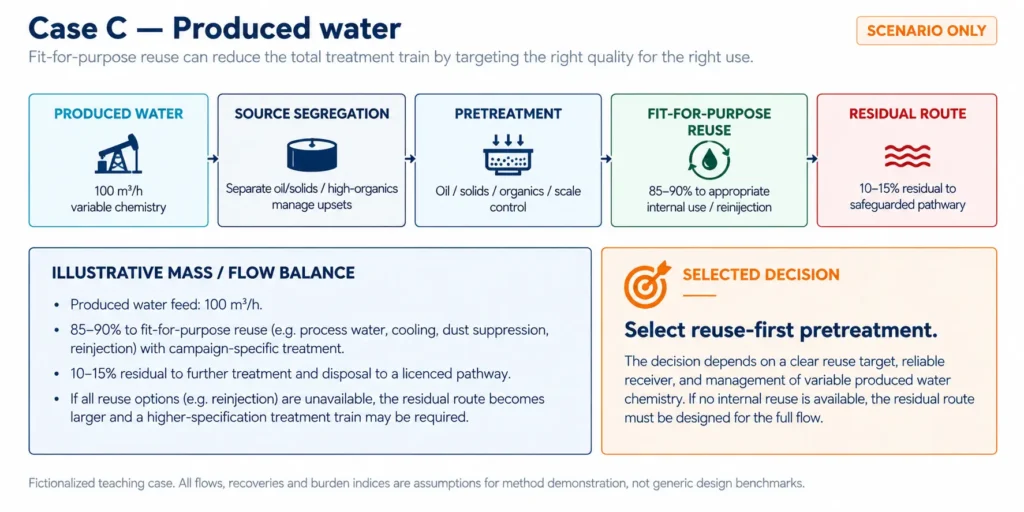
Figure RT.C. Case C fictionalized flowsheet and mass-balance panel. Fit-for-purpose internal reuse is screened before bulk salt removal.
Case D — Chemical-industry wastewater: campaign segregation beats blended complexity
A fictional multiproduct chemical plant initially presents one blended “wastewater” flow. In reality, the water system contains a solvent-rich wash, a low-salt rinse/CIP stream and a high-salt mother liquor. EU chemical-sector BAT conclusions prioritize reducing wastewater generation and pollutant load, reuse and raw-material recovery, stream segregation, source recovery and pretreatment close to source before final treatment. The case applies that hierarchy before any MLD/ZLD train is sized.
| Design-basis field | Case D — scenario-only assumption |
|---|---|
| Blended-equivalent flow | 40 m³/h across three campaign streams. |
| Solvent-rich wash | 5 m³/h; 3.5 m³/h assumed recovered/returned. |
| Low-salt rinse/CIP | 25 m³/h; 20 m³/h assumed reusable after fit-for-purpose treatment. |
| High-salt mother liquor | 10 m³/h; targeted MLD recovers 6 m³/h and leaves 4 m³/h concentrate. |
| Batch-control requirement | Hold/release and campaign identity retained; no average-composition design basis. |
| Economic index | Blended common treatment baseline = 100; segregation + targeted MLD = 57; whole-site ZLD = 165. |
| Progression | Case D decision |
|---|---|
| Missing information | Campaign schedule, solvent/product-loss inventory, COD biodegradability/inhibition, catalyst/metals, cleaning chemistry, storage/hold capacity and product recovery quality. |
| Management alternatives | Prevent product loss; segregate solvent wash; reuse low-salt rinse; isolate mother liquor; targeted MLD; whole-site ZLD only if every stream truly requires it. |
| Process screening | Recover solvent/product before dilution; keep inhibitory/toxic batches away from biological treatment; send only salt-dominated fraction to concentration. |
| Selected train | Source segregation → solvent recovery → rinse reuse / final biological treatment → targeted MLD on 10 m³/h mother liquor. |
| Valorization | Recovered solvent is internal return value in the scenario; no external merchant price is used. |
| Economics | The fictional case wins by shrinking the difficult hydraulic boundary before treatment, not by maximizing recovery from the blended 40 m³/h. |
| Main risks | Campaign misrouting; off-spec solvent return; inhibitory COD slug; incompatible cleaning event; inadequate buffer/hold logic. |
| Recommendation | Implement source inventory, hold/release controls and recovery trials before procuring end-of-pipe high-salinity equipment. |
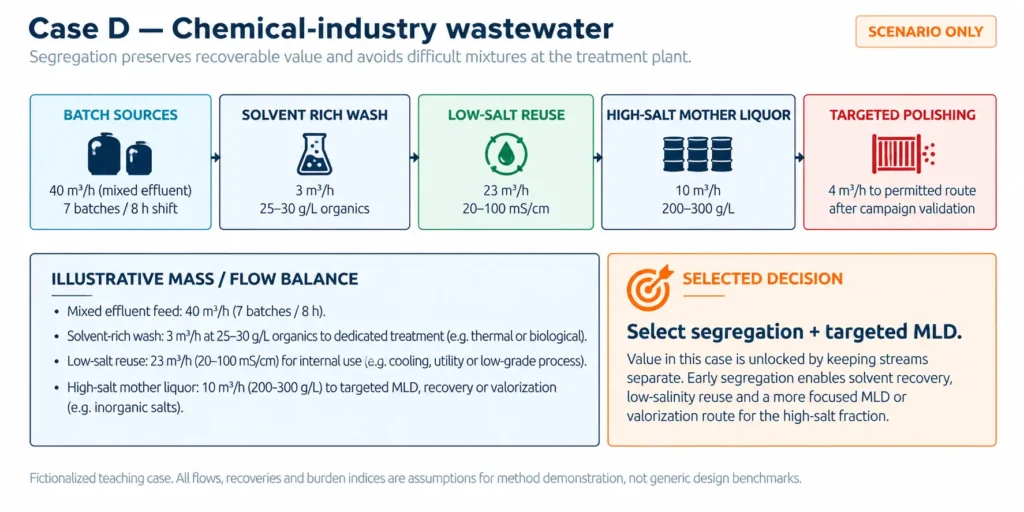
Figure RT.D. Case D fictionalized flowsheet and mass-balance panel. Segregation protects recoverable value and reduces the flow exposed to high-complexity treatment.
RT.6 Cross-case comparison — the same framework produces different endpoints
The cases are intentionally constructed so that the preferred solution is not the same technology in each sector. That is the teaching point. Endpoint, receiving duty, chemistry, source identity and operability determine whether the owner should stop at a stable liquid residual, integrate it with an industrial receiver, reuse water without desalinating it, or reduce the difficult flow before MLD/ZLD. The relative burden indices below are scenario-only and exist solely to show the decision structure.
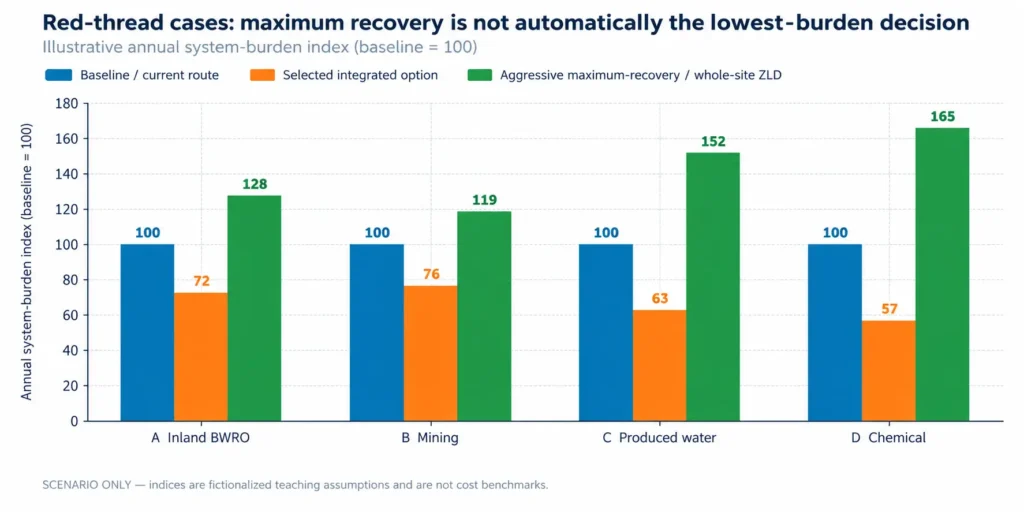
Figure RT.5. Scenario-only cross-case burden index. The selected integrated option is compared with the fictional baseline and an aggressive maximum-recovery / whole-site ZLD alternative; values are not cost benchmarks.
| Case | Binding constraint | Selected endpoint | Why not maximum recovery? | Next evidence step |
|---|---|---|---|---|
| A — Inland BWRO | Finite concentrate receiver + scale chemistry | Selective-softening + secondary-RO MLD | Final thermal increment does not yet change the endpoint enough to justify its burden. | Representative chemistry + softening/secondary-RO pilot + receiver continuity. |
| B — Mining | Remote operability + tailings integration | Tailings-integrated MLD | Approved residual integration is more robust than remote crystallization in the scenario. | Tailings compatibility + corrosion/scaling + long-duration operability. |
| C — Produced water | Internal reuse specification + variable contaminants | Reuse-first pretreatment | Bulk salt removal is not required by the receiving duty. | Time-series feed characterization + reuse pilot across well states. |
| D — Chemical | Campaign identity + product/solvent loss | Segregation + targeted MLD | Whole-site ZLD destroys source value and enlarges the difficult hydraulic boundary. | Stream inventory + hold/release + recovery trials. |
Table RT.2. Four sectors, one decision discipline: solve the receiving duty and source problem before optimizing the final recovery percentage.
RT.7 Handover to Chapter 42 — ten rules for high-salinity wastewater projects
The red-thread cases complete the practical demonstration of the guide. Chapter 42 should now compress the repeated decisions into ten durable rules: problem before technology; whole-site mapping; chemistry beyond TDS; stream segregation; explicit ZLD boundary; MLD before automatic ZLD; every separation creates another stream; buyer/specification before valorization; integrated pilot evidence; and operability, downtime and residual disposal. The cases show why those rules are not slogans: each one changes a real project decision. [BC]
| Rule inherited by Chapter 42 | Evidence from the four cases |
|---|---|
| Problem before technology | A starts from concentrate disposal, B from mine water security, C from internal reuse, D from product loss and campaign segregation. |
| Chemistry beyond TDS | Scale-formers, divalents/metals, oil/sulfides/organics and solvents/COD drive different gates. |
| MLD before automatic ZLD | Cases A and B rationally retain liquid residuals because real receiving routes exist. |
| Every separation creates another stream | Softening sludge, tailings residual, produced-water reject and chemical recovery residues remain explicit. |
| Buyer/specification before valorization | No external product revenue is needed in any selected base case. |
| Integrated pilot + operability | Each recommendation ends with a specific evidence programme rather than a procurement instruction. |
Table RT.3. The red-thread block hands Chapter 42 evidence for a decision-discipline conclusion rather than a sales message.