
A signature gated method for deciding what to stop, what to prove and when technology selection is justified.
Controlled principleThe framework is not a scorecard that allows strong categories to compensate for a fatal weakness. Each gate has a decision question, required evidence, an owner and an explicit outcome: proceed, conditional, recycle or stop. The project advances only when the evidence is appropriate to the next commitment. |
|---|
14.1 Why a gated framework is needed
The preceding chapters established the decision inputs: the industrial problem and economic baseline; the whole-site water balance; representative chemistry and variability; scaling, fouling and corrosion constraints; closed mass balances; the management hierarchy; the qualified residual endpoint; and the separate tests for MLD and ZLD. Chapter 14 does not replace those analyses. It controls the order in which they are admitted into a project decision.
High-salinity projects fail when one attractive result is allowed to bypass the rest of the system. A high laboratory water recovery can bypass the residual route. A precipitate can bypass product specification. A vendor reference can bypass the actual feed chemistry. A strict regulation can bypass the exact permit boundary. A commodity price can bypass purification, logistics and buyer qualification. A gated framework prevents that substitution by asking one bounded question at a time.
The approach is consistent with established systems-engineering practice. NASA separates project phases with Key Decision Points at which a decision authority determines whether the project is ready to progress, may proceed with stated conditions, must correct deficiencies and return, or should stop. NASA’s risk-informed decision guidance also distinguishes direction-setting alternative selection under uncertainty from the later management of implementation risk.
The Brine Consulting framework applies that discipline to industrial saline-water decisions. It is intentionally front-loaded. The cost of revisiting an assumption is low during screening and prefeasibility; it becomes expensive after pilot procurement, FEED, permitting, contracting or equipment commitment. Technology comes after context because context determines what the technology is required to do.
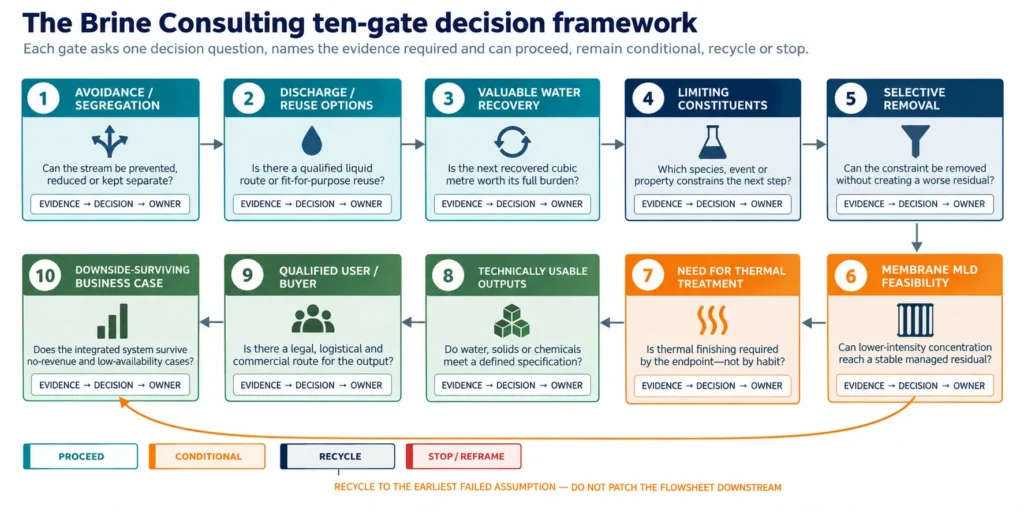
Figure 14.1. The Brine Consulting ten-gate decision framework. Failed gates recycle the project to the earliest invalid assumption.
14.2 How to use the framework
The gates are sequential but iterative. A project should enter Gate 1 with a named facility, stream boundary, project driver and decision date. It should leave Gate 10 with an integrated concept that has a qualified endpoint, admitted technologies, defined evidence gaps, a closed residual ledger and a business case that remains defensible under downside conditions.
Each gate requires four records. First, the decision question must be stated in language that can be answered. Second, the evidence package must be identified and its maturity declared. Third, the decision authority must assign one of four statuses. Fourth, inherited conditions and residual risks must be transferred to the next gate. A gate is not complete because a workshop was held or a consultant produced slides.
The framework should be tailored to project scale, but tailoring cannot delete a material question. A small retrofit may combine several reviews. A novel hypersaline project may require separate laboratory, pilot, pre-FEED and FEED reviews. The correct level of formality depends on the capital at risk, technology novelty, regulatory exposure, feed variability and consequence of failure.
| Gate | Decision question | Minimum admitted evidence | Primary owner | Exit condition |
|---|---|---|---|---|
| 1. Avoidance / segregation | Can the stream be prevented, reduced, kept separate or recovered closer to source? | Whole-site balance, stream register, operating-state map and source-reduction options. | Site operations / process owner | Residual stream is necessary, bounded and measured. |
| 2. Discharge / reuse options | Is there a qualified liquid endpoint or fit-for-purpose use? | Endpoint register, acceptance envelope, capacity, contingency, reuse specification and lifecycle route. | Owner / permitting / water user | Available routes are qualified or explicitly rejected. |
| 3. Economically valuable water recovery | What water recovery is worth paying for? | Marginal secure-water value, recovery curve, availability basis and residual burden. | Owner / commercial lead | Recovery objective is economic and operational, not rhetorical. |
| 4. Limiting constituents | Which constituent, event or property constrains the next step? | Normal/design/upset compositions, speciation, fouling/corrosion analysis and production history. | Process / chemistry lead | First controlling constraints are named with uncertainty. |
| 5. Selective removal | Can the constraint be removed selectively without creating a worse system? | Reaction/separation tests, dose and yield, filtrate/sludge quality, dewatering and residual route. | Process / solids lead | Removal function and all new streams are proven. |
| 6. Membrane MLD feasibility | Can lower-intensity concentration reach a stable managed liquid residual? | Model, bench/pilot evidence, operating envelope, cleaning, materials and qualified residual endpoint. | Process / operations lead | Membrane MLD is feasible, conditional or rejected on evidence. |
| 7. Need for thermal treatment | Does the chosen endpoint require thermal finishing? | Residual flow/composition, boiling and foam behaviour, energy source, materials, condensate and solids plan. | Process / utilities lead | Thermal duty is justified by the endpoint and separately bounded. |
| 8. Technically usable outputs | Do recovered water, chemicals, minerals or solids meet a defined use specification? | Representative samples, impurity profile, consistency, wash/drying needs and off-spec route. | Product / quality lead | Output is technically usable or remains a waste/intermediate. |
| 9. Buyer / internal user | Is there a real legal, logistical and commercial route for the output? | User qualification, volume match, legal status, packaging, transport, storage, contracts and rejection rules. | Commercial / legal lead | Internal use or buyer route is credible and documented. |
| 10. Downside-surviving business case | Does the complete project survive adverse but credible scenarios? | Closed CAPEX/OPEX model, availability, energy, disposal, no-revenue case, sensitivities and risk allocation. | Owner / investment committee | Proceed, pilot, redesign, defer or stop decision is approved. |
Table 14.1. Ten gates, evidence owners and exit conditions.
14.3 Gates 1–3: establish context, endpoint and water value
The first three gates prevent the project from becoming an end-of-pipe technology exercise. Gate 1 asks whether the wastewater should exist in its current form. Gate 2 asks whether a manageable liquid endpoint or reuse opportunity already exists. Gate 3 defines the amount and quality of water that has enough operational or commercial value to justify recovery.
Gate 1 closes only when avoidance, reduction, segregation and direct reuse have been assessed against the operating states that create the stream. Mixing is itself a design decision. Once a low-volume hazardous, oily, silica-rich or product-bearing stream is combined with a large saline flow, the owner may destroy a selective recovery or low-cost treatment route.
Gate 2 requires a complete endpoint register. The Bureau of Reclamation’s concentrate-management toolbox similarly treats option screening as site-specific and recommends that users adjust subjective default assessments to their application, followed by desktop study and pilot testing for the shortlisted technologies. The Brine Consulting framework goes further by making the destination and contingency route a gate before concentration design.
Reuse is accepted only against a named use. EPA describes industrial reuse across cooling, boiler, manufacturing and onsite process applications and organizes resources by end use. This supports the fit-for-purpose principle: the required treatment is set by the receiving use and risk, not by an abstract desire for the highest water quality.
Gate 3 converts water recovery into a marginal decision. The owner values recovered water against the next credible secure supply, treatment required for the use, seasonal reliability, storage, interruption risk and production consequence. A project should not carry an undefined ‘water scarcity premium’ or attribute gross product revenue to every recovered cubic metre.
| Context gate | Evidence package | Fatal gap | Typical recycle action |
|---|---|---|---|
| Gate 1—Avoidance / segregation | Facility balance, source mapping, campaign data, clean/dirty segregation, product-loss review and direct-reuse matches. | The stream boundary is undefined or avoidable flows have been embedded in the design basis. | Return to operations; meter, segregate, change rinse/CIP or recover product closer to source. |
| Gate 2—Discharge / reuse | Receiver specification, permit/legal review, route capacity, distance, contingency, closure liability and internal water-user acceptance. | The project assumes a route exists without written acceptance, or assumes no route without testing credible alternatives. | Rebuild endpoint portfolio; separate routine, batch, mother-liquor and upset routes. |
| Gate 3—Valuable water recovery | Marginal water value, required quality, effective annual recovery, residual burden and supply/downtime scenario. | Water value is represented only by tariff or by an unverified strategic premium. | Define the next secure source, receiving use, availability and the marginal recovery block. |
Table 14.2. Gates 1–3 prevent premature commitment to an end-of-pipe train.
14.4 Gates 4–7: move from chemistry to the minimum necessary process intensity
Gate 4 identifies the first limiting constituents or properties under normal, design and worst-credible operation. The output is not a long list of analytes; it is a ranked set of constraints tied to a process consequence. Examples include sulfate scale before a membrane stage, oil and surfactants before evaporation, silica and metals before deep concentration, chloride and temperature for materials, or batch COD before product crystallization.
Gate 5 tests selective removal. The designer should remove the constituent that constrains the next step rather than remove everything because a generic pretreatment train is familiar. The gate must close the chemical and solids balance: reagent incorporation, reaction yield, residual soluble concentration, carryover, wash water, sludge moisture, dewatering, recycle and final destination.
Gate 6 tests whether membrane or electrochemical concentration can deliver the MLD endpoint established earlier. It does not ask whether a technology can process one laboratory sample. It asks whether the integrated block can operate across the feed envelope, recover fit-for-purpose water, manage cleaning and replacement, and produce a residual liquid that the qualified endpoint can accept.
Gate 7 asks whether thermal treatment is genuinely required. Thermal concentration and crystallization may be unavoidable when no routine liquid route remains, but they should not be inserted automatically. The gate separates the final concentrator, crystallizer, solids separation, mother-liquor purge, condensate management and outage storage. Passing a boiling test does not prove a solids-management system.
| Gate | Required technical evidence | Residuals to close | Proof level before FEED | Reason to stop / recycle |
|---|---|---|---|---|
| 4. Limiting constituents | Representative compositions; chemistry model; physical properties; scaling/fouling/corrosion path; production events. | None created yet, but all likely phase transfers identified. | Constraint ranking stable across normal/design/upset cases. | A single average sample or TDS is carrying the decision. |
| 5. Selective removal | Stoichiometry, kinetic/bench tests, selectivity, separation and dewatering performance, filtrate quality. | Sludge/precipitate, wash water, spent media, chemical residual and off-spec material. | Repeatable removal and solids handling on representative feed. | The new residual is larger, more hazardous or has no route. |
| 6. Membrane MLD | Model and representative bench/pilot run; pressure/osmotic basis; pretreatment; cleaning; materials; availability. | Permeate/product water, concentrate, CIP, flush, replacement media/membranes and upset diversion. | Stable duty and recovery across defined envelope with a qualified concentrate endpoint. | Performance relies on unsupported recovery, hidden recycle or an unqualified residual route. |
| 7. Thermal need | Boiling/evaporation/crystallization behaviour, BPE/viscosity, foam/entrainment, energy source, materials and condensate. | Distillate, vapour/off-gas, scale, mixed crystals, wet cake, mother liquor, purge and cleaning waste. | Separate proof of concentration, crystallization, dewatering, product/residual route and contingency. | Thermal block exists only because the project was labelled ZLD. |
Table 14.3. Gates 4–7 translate chemistry into the minimum process intensity required by the endpoint.
14.5 Gates 8–10: separate technical outputs from bankable products and projects
Gate 8 asks whether an output is technically usable. Recovered water must meet the receiving process specification under representative operation. A mineral or chemical must have a defined form, purity, moisture, particle characteristics, impurity profile, consistency and handling condition. A mixed salt that can be dewatered is not automatically a product.
Gate 9 asks whether that technically usable output has a real internal user or buyer. The user must be able to accept the annual volume, batch size, quality variability, delivery form and legal status. The project must define storage, transport, packaging, quality release, rejection, returns and the off-spec fallback. Internal reuse normally has a stronger first claim because it can be valued as avoided purchase and may require less market development.
Gate 10 integrates the project. Technical feasibility is necessary but insufficient. DOE’s Adoption Readiness Level framework explicitly complements technical readiness with non-technical risks such as value proposition, market acceptance, resource maturity and license to operate. The Brine Consulting gate uses the same broad lesson without importing DOE’s scoring system: a process cannot pass because its equipment works if its user, supply chain, permits, workforce, residuals or economics do not.
The integrated case should compare alternatives on a common boundary and denominator. NETL’s quality guidance emphasizes transparent methods and consistent comparison, with economic assumptions and waste-disposal costs made explicit and evaluated through sensitivities. For saline-water projects, the minimum downside set includes no product revenue, higher energy and chemical cost, lower availability, lower yield or purity, slower qualification, endpoint restriction and off-spec disposal.
| Gate | What passes | What does not pass | Required fallback |
|---|---|---|---|
| 8. Technically usable outputs | Representative output meets a written use/product specification with known variability. | Element presence, theoretical precipitate, one high-purity batch or unwashed wet solids. | Defined retreatment, internal downgrade, recycle or waste route. |
| 9. Qualified user / buyer | Named user accepts form, quality, volume, legal status, delivery and qualification plan. | Generic market size, headline commodity price, letter of interest without specification or logistics. | Off-spec and excess-volume route with zero revenue assumed. |
| 10. Downside-surviving business case | Closed integrated case remains acceptable under owner-approved technical, commercial and availability sensitivities. | Base case depends on maximum recovery, perfect uptime, full product sales or avoided residual costs that are not contractual. | Redesign, staged pilot/deployment, MLD alternative, defer or stop. |
Table 14.4. Gates 8–10 prevent technically interesting outputs from being presented as bankable products or projects.
14.6 Evidence maturity must precede project commitment
A gate is phase-specific. The evidence required to screen an option is not the evidence required to procure it. Early calculations can identify impossible mass balances or obviously weak economics. Laboratory work can establish reactions and separations. Continuous pilot operation can test variability, fouling, controls, cleaning, product quality and residual generation. FEED requires a stable design basis, integrated guarantees, operability, materials, utilities, contingency and contract strategy.
GAO’s Technology Readiness Assessment Guide was developed because immature technologies introduced into larger systems have contributed to delay and cost growth. It emphasizes the maturity of critical technologies and the quality of the evidence demonstrating that maturity before major resource commitments. The Brine Consulting framework applies this principle at block and interface level: a mature membrane does not make an immature pretreatment–membrane–thermal–solids train mature.
Evidence maturity is not identical to a single Technology Readiness Level. A commercially established unit operation can remain high-risk in a new hypersaline composition, temperature, solids regime or product duty. Conversely, a novel selective step may be acceptable inside a pilot if the endpoint, bypass, storage and fallback protect the site. The gate records what has been demonstrated in the relevant environment and what remains conditional.
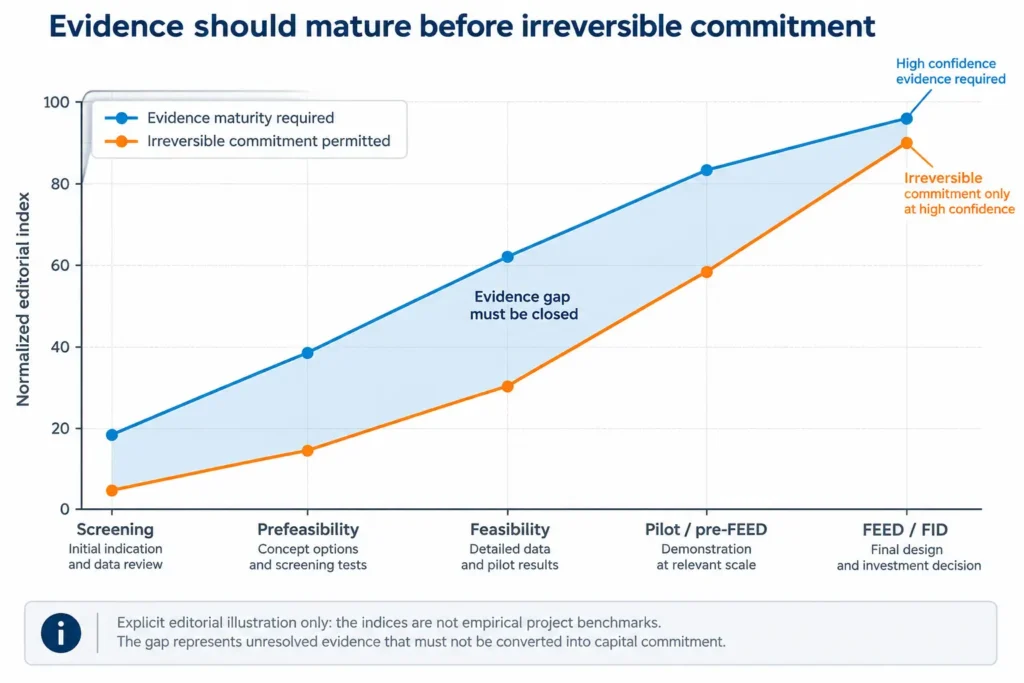
Figure 14.2. Editorial principle: evidence maturity should lead irreversible project commitment. The indices are illustrative, not benchmarks.
| Evidence level | What it can support | What it cannot support | Typical artefact | Gate treatment |
|---|---|---|---|---|
| Hypothesis / source claim | Search terms, first-pass opportunity or risk list. | Design recovery, guarantee, product revenue or scale-up. | Vendor claim, literature mechanism, internal idea. | Open evidence action; no gate closure. |
| Transparent calculation | Mass-balance feasibility, stoichiometry, rough utility and sensitivity screening. | Kinetics, fouling, operability, purity consistency or availability. | Visible spreadsheet/model with assumptions and closure. | May close an early screening sub-question. |
| Representative laboratory test | Reaction pathway, selectivity, phase behaviour, basic product/residual characterization. | Continuous stability, controls, cleaning, long-term materials or full integration. | Test plan, raw data, analytical QA and retained samples. | Conditional pass to integrated/pilot work. |
| Integrated continuous pilot | Variability response, controls, cleaning, residual rates, product consistency and uptime evidence. | Full commercial guarantee without scale-up analysis and reference boundary. | Run log, mass balance, downtime/CIP record, product and residual data. | Can close critical technical gates for pre-FEED. |
| Relevant commercial reference / contractual proof | Mature block duty, supply chain, warranty and operating evidence within a comparable boundary. | Automatic transfer to a different chemistry, scale, site or product specification. | Reference data, guarantee, contract, acceptance test or user qualification. | Supports FEED/FID when differences are explicitly reconciled. |
Table 14.5. Evidence maturity ladder for gate decisions.
14.7 Gate outcomes: proceed, conditional, recycle or stop
A binary pass/fail label is too crude for most project development. The framework uses four controlled outcomes. Proceed means the evidence is sufficient for the next phase and inherited conditions are visible. Conditional means the project may advance only with named actions and without making commitments that depend on the missing proof. Recycle means an earlier assumption or endpoint must be changed. Stop means the option should be closed or the problem reframed.
Conditional status should not become a permanent storage location for uncomfortable risks. Every condition requires an owner, evidence deliverable, due date, decision consequence and next review. A condition that remains open at the point where capital, permits or guarantees depend on it is a failed gate.
One fatal gap can stop the option regardless of an attractive total score. No buyer can invalidate a product-revenue case. No solids route can invalidate ZLD. An incompatible mother liquor can invalidate an otherwise successful crystallizer. An unmanageable CIP stream can invalidate a no-liquid-discharge claim. Weighted averages hide these discontinuities.
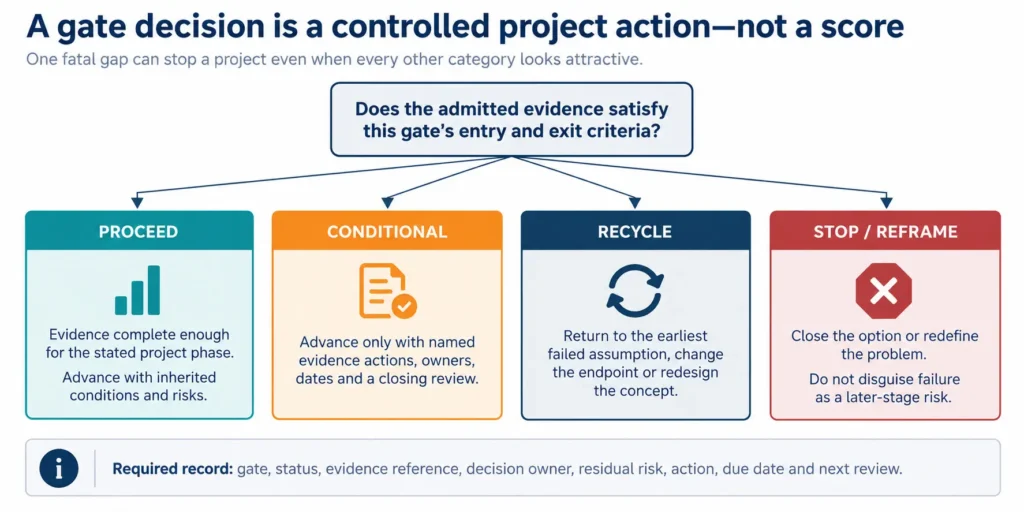
Figure 14.3. Gate outcomes are controlled actions with evidence, owners and consequences.
| Status | Meaning | Permitted commitment | Mandatory record | Failure mode prevented |
|---|---|---|---|---|
| Proceed | Evidence satisfies the phase-specific entry/exit criteria. | Advance to the next gate or phase within stated conditions. | Decision, basis, inherited risks, owner and next review. | Repeated re-litigation of closed assumptions. |
| Conditional | Evidence gap is bounded and can be closed without invalidating the current safe commitment. | Only reversible work that does not depend on the missing evidence. | Action, owner, due date, acceptance criterion and consequence. | Open issues being treated as silently solved. |
| Recycle | An earlier assumption, boundary, endpoint or process architecture is invalid. | No downstream commitment based on the invalid assumption. | Earliest failed gate, revised basis and re-entry criteria. | Patching the flowsheet after the root premise has failed. |
| Stop / reframe | The option is not defensible or the original problem is incorrectly defined. | Close the option or authorize a new problem definition. | Reason, evidence, knowledge retained and conditions for reconsideration. | Sunk-cost escalation and promotional persistence. |
Table 14.6. Controlled gate statuses and permitted commitments.
14.8 The downside-surviving integrated business case
Gate 10 is not a financial model added after the flowsheet. It is the integrated expression of all previous gates. The baseline endpoint, water value, mass balance, energy, chemicals, replacement, labour, waste, product qualification, availability, financing and risk allocation must share one system boundary and operating basis.
The base case should be accompanied by named downside cases rather than one broad contingency. Some risks are correlated. Higher scaling can reduce availability while increasing chemical use, cleaning waste and membrane replacement. Lower product purity can reduce revenue and increase off-spec disposal. Feed variability can lower water recovery while increasing thermal duty. Combined cases reveal whether the project relies on several optimistic assumptions simultaneously.
The decision does not always produce a complete commercial project. It may authorize a targeted laboratory programme, a pilot, an endpoint-permitting study, a user-qualification campaign, a prefeasibility study or a pre-FEED package. The next step should buy the evidence that changes the decision—not merely more detail.
| Downside case | Variables changed | Why it matters | Required response | Gate consequence |
|---|---|---|---|---|
| No product revenue | All merchant revenue set to zero; internal reuse only if qualified. | Tests whether waste treatment has been disguised as a commodity project. | Retain purification, packaging and off-spec costs where still required. | Fail or redesign if project only survives full sales. |
| Lower availability | Downtime, CIP, start-up, upset diversion and maintenance increased. | Reduces annual water/product output and can increase endpoint dependence. | Use effective annual recovery and include contingency transfers/storage. | May trigger pilot, redundancy or MLD endpoint. |
| Higher energy / chemicals | Power, steam, fuel, reagents and disposal prices stressed independently and jointly. | Identifies exposure to the dominant variable and correlated burden. | Show denominator and consumption basis; test waste heat reliability separately. | May shift the membrane–thermal transition or endpoint. |
| Lower yield / purity | Selective removal, crystal yield, wash loss and qualification rejection worsened. | Reduces product value and increases recycle/purge/off-spec waste. | Close component balance and apply buyer rejection rules. | May convert product to intermediate or waste. |
| Endpoint restriction | Capacity reduced, acceptance envelope tightened or route unavailable during outages. | Tests the resilience of MLD and non-routine ZLD residual management. | Use alternative route, storage or reduced production scenario. | Can invalidate the endpoint and recycle to Gate 2. |
| Combined stress | Owner-approved combination of correlated technical and commercial cases. | Prevents a project from passing through isolated sensitivities that cannot occur independently. | Show cash, production, residual and compliance consequences. | Investment committee proceed / pilot / redesign / stop. |
Table 14.7. Minimum downside cases for the integrated decision.
14.9 A concise gate register
The working framework should be maintained as a controlled register, not reconstructed from meeting notes. Each gate entry should identify the current basis, evidence reference, status, decision owner, inherited risks and next action. The register links the technical file, product-qualification file, endpoint file and economic model.
Gate status is applied to the stated project phase. A technology can be acceptable for laboratory testing and unacceptable for FEED. A product can be technically promising and commercially unqualified. A disposal route can be available for pilot volumes and unavailable for routine operation. The register preserves those distinctions.
| Gate | Status | Decision basis | Evidence ref. | Owner | Open action | Due / review | Inherited risk |
|---|---|---|---|---|---|---|---|
| 1–10 | Proceed / Conditional / Recycle / Stop | One-sentence answer to the gate question. | Document, calculation, test, permit, user or contract reference. | Named accountable role. | Evidence needed to close or preserve status. | Date and approval forum. | Risk transferred to the next gate and its control. |
Table 14.8. Minimum gate-register structure.
Framework ruleAdvance the project only to the level justified by admitted evidence. Do not use a mature unit operation to hide an immature interface, a product concept to hide an unqualified buyer, or a high recovery to hide an unresolved residual. The earliest failed gate controls the redesign. |
|---|
14.10 Decision package before treatment-train design
A project that passes the framework does not yet have a final flowsheet. It has a controlled basis for building one. The package should contain the facility and stream boundary, project driver and baseline, water balance, operating-state and chemistry cases, endpoint register, water-value and recovery objective, limiting constituents, selective-removal evidence, MLD and thermal decisions, product and user qualification, closed mass and residual balances, evidence register, downside economics and gate approvals.
This package defines the functions that the treatment train must perform. Chapter 15 begins Part IV by addressing pretreatment and conditioning by function: screening, equalization, oil and solids removal, filtration, biological and oxidative treatment, ion exchange, softening, selective precipitation, silica and metals control, antiscalant destruction and pH conditioning. Each pretreatment choice will be evaluated against the limiting constituent identified at Gate 4, the selective-removal decision at Gate 5 and the new residual it creates.
Technology therefore comes after context—but it does come. Once the gates have established why the stream exists, where the residual can go, how much water is valuable, what constrains recovery, whether thermal treatment is necessary and whether any output has a real use, the owner can compare process blocks on the correct system boundary.
| Decision package item | Minimum content | Used in Part IV for |
|---|---|---|
| Problem and boundary | Facility, stream names, project driver, baseline, decision date and claimed MLD/ZLD boundary. | Functional requirements and battery limits. |
| Water and chemistry basis | Normal/design/upset flows, complete characterization, variability and closure status. | Sizing, materials, control and test requirements. |
| Endpoint and water-value basis | Qualified liquid/solid routes, reuse specification, contingency and marginal water value. | Recovery target and residual duty. |
| Constraint register | Limiting constituents, mechanisms, uncertainty and current evidence maturity. | Pretreatment and sequence selection. |
| Block decisions | Selective removal, membrane MLD, thermal need and product/residual qualification status. | Technology shortlist and interfaces. |
| Commercial and risk basis | User/buyer status, legal/logistics route, integrated costs, sensitivities and risk allocation. | Pilot, guarantee, contract and investment strategy. |
| Gate register | Status, evidence, owner, actions, review dates and inherited conditions. | Project governance and change control. |
Table 14.9. Minimum decision package handed to Part IV.
14.11 Chapter conclusion
The Brine Consulting framework is a gated chain of reasoning. It begins with avoidance and segregation, qualifies discharge and reuse routes, values water recovery, identifies the limiting constituents, tests selective removal, determines whether membrane MLD can reach the endpoint, asks whether thermal treatment is genuinely required, and then separates technically usable outputs from qualified users and a downside-surviving project.
The gates are not a weighted score and they do not guarantee one preferred technology. They expose the earliest assumption that remains unproven. A project may proceed, proceed conditionally, recycle to an earlier gate or stop. The evidence required rises with the commitment being requested.
Technology comes after context. Once context, chemistry, endpoint, products, operations and economics have passed the appropriate gates, the flowsheet becomes the final expression of the decision—not the opening guess.
Chapter 14 in one sentenceTechnology selection begins only after ten gates have shown that the stream, endpoint, water value, constraints, outputs, user and downside business case form one defensible system. |
|---|