
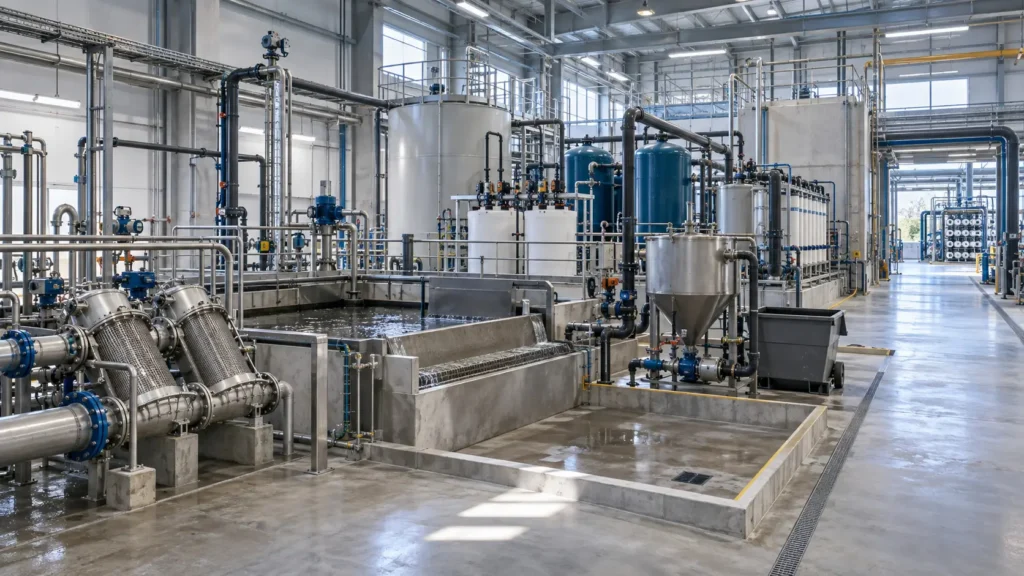
Select pretreatment by the constraint it removes, the downstream duty it protects and the new waste it creates.
Controlled principlePretreatment is justified only when it removes a named constraint to the level required by the next process block. Every option has two outputs: a conditioned feed and a new residual. Both must be closed in the mass balance, tested under the operating envelope and assigned an operable destination. |
|---|
15.1 Pretreatment is the first business-case gate
The decision framework has now established the stream, endpoint, water value, limiting constituents and justified project direction. Pretreatment converts that decision into an operable feed for the selected concentration, thermal or product-recovery block. It is not a decorative front end and it should not be selected from a standard equipment list.
A pretreatment step is a business-case gate because it can determine downstream recovery, membrane or heat-transfer area, cleaning frequency, availability, materials, chemical consumption, sludge production and product purity. An inexpensive downstream technology can become uneconomic when it requires a large and fragile pretreatment train. Conversely, selective removal of one controlling constituent can unlock a much simpler and lower-burden system.
The correct question is therefore not “What pretreatment is normally used?” It is: Which feed property prevents the next unit from meeting its required duty, what removal or conditioning target is necessary, and what new residual and operating obligation will that intervention create?
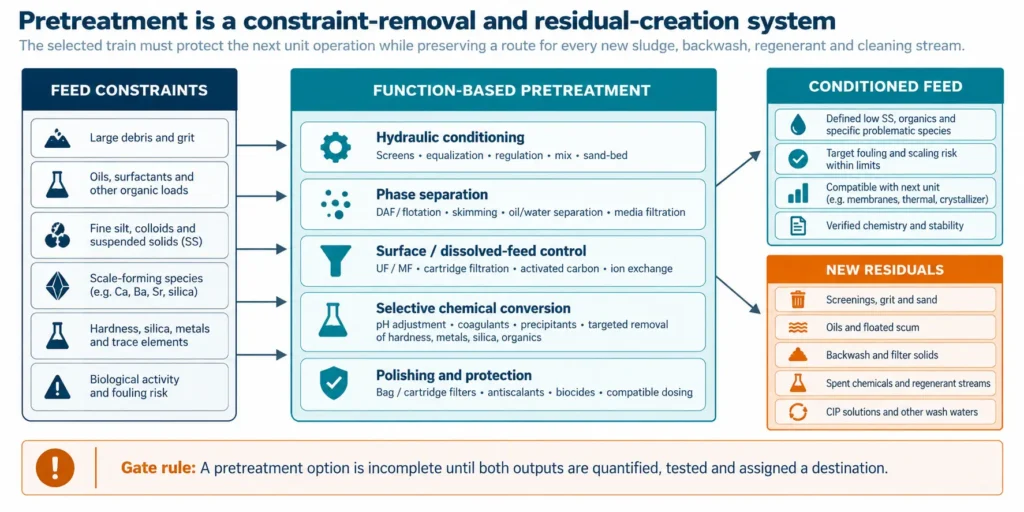
Figure 15.1. Pretreatment is a constraint-removal and residual-creation system.
15.2 Define the downstream protection target first
The same wastewater may require different conditioning for conventional RO, nanofiltration, electrodialysis, a high-salinity membrane process, an evaporator, a crystallizer or a selective product-recovery step. The target is set by the next process and its location in the train—not by a generic pretreatment specification.
For membranes, the controlling variables may be particles, colloids, oil, biological activity, hardness, sulfate, silica, metals, oxidants, reducers, temperature or incompatible polymers. For thermal systems, foaming, entrainment, volatile carryover, heat-transfer deposits, corrosion and condensate quality may dominate. For crystallization and valorization, the most important pretreatment objective may be impurity rejection and phase control rather than maximum removal.
The required target should therefore identify the analyte or property, fraction, operating state, measurement method, location and margin. “Low hardness,” “low organics” and “good SDI” are not design criteria. Neither is complete removal automatically justified.
| Problem / constraint | Removal or conditioning function | Candidate methods | New residual | Common failure mode | Downstream implication |
|---|---|---|---|---|---|
| Large debris, fibres and grit | Protect pumps, valves, channels and downstream separation equipment. | Coarse/fine screening, strainers, grit removal. | Screenings, grit, wash water and compacted wet solids. | Bypass, blinding, poor screenings washing or underestimated peak load. | Mechanical damage, plugging and avoidable maintenance. |
| Flow, temperature or chemistry peaks | Convert variable events into a controllable feed envelope. | Segregation, equalization, storage, mixing, cooling/heating and controlled blending. | Tank bottoms, vapours, cleaning waste and off-spec inventory. | Dead zones, precipitation in storage, gas release or incompatible blending. | Oversized downstream plant, unstable controls or event-driven failure. |
| Free oil and unstable emulsions | Separate a hydrophobic phase before membranes, biology or thermal treatment. | Gravity separation, coalescence, API/CPI-type separation, DAF/IGF and media. | Skim oil, float sludge, oily backwash and spent media. | Stable emulsions, surfactants, small droplets, polymer carryover or gas-control problems. | Membrane wetting/fouling, foaming, condensate contamination and oily sludge. |
| Suspended and colloidal solids | Destabilize, grow and separate particles or retain them on a barrier. | Coagulation/flocculation, clarification, DAF, media filtration, MF/UF and guard filtration. | Chemical sludge, backwash, retentate, spent cartridges and CIP. | Wrong coagulant/pH, shear, short circuiting, membrane fouling or poor backwash. | Pressure drop, flux loss, heat-transfer fouling and downstream solids. |
| Biodegradable organics and nutrients | Convert soluble organics to biomass and stable products before concentration. | Aerobic/anaerobic biology, biofilm or MBR where the matrix and salinity permit. | Waste biomass, off-gas, nutrient chemicals and biological cleaning waste. | Salt/toxin inhibition, shock loading, poor acclimation or nutrient imbalance. | Organic fouling, foaming, colour/odour and unstable product quality. |
| Refractory dissolved organics | Adsorb or oxidize the compounds that constrain the next block. | GAC/PAC, targeted oxidation/AOP and source-specific treatment. | Spent carbon, regeneration loss, oxidant residual, quench salts and by-products. | Competitive adsorption, radical scavenging, incomplete oxidation or harmful by-products. | Persistent fouling, condensate carryover, product impurity or added ionic load. |
| Hardness and multivalent scale formers | Remove or convert the species that constrains recovery. | Ion exchange, lime/soda/caustic softening, carbonation, seeded precipitation and selective membranes. | Spent regenerant, precipitated sludge, wash water, filtrate and seed purge. | Incomplete removal, poor solids separation, resin leakage or chemical overfeed. | Reduced stable recovery, scaling and higher thermal duty. |
| Silica, silicates and metal interactions | Control the matrix-specific silica/metal mechanism before deep concentration. | pH/temperature control, coagulation/adsorption, softening/coprecipitation, seeded precipitation or selective separation. | Silica/metal sludge, spent media, regenerant and unstable recycle. | Treating one silica number as universal or ignoring colloidal and cation-mediated forms. | Irreversible deposits, mixed solids and product contamination. |
| Metals, sulfide and redox-sensitive species | Change oxidation state, precipitate, adsorb or isolate the controlling species. | Aeration/stripping, oxidation/reduction, hydroxide/sulfide precipitation, adsorption or IX. | Metal-rich sludge, off-gas, spent media, regenerant and quench waste. | Redissolution, colloidal carryover, unsafe gas release or hazardous sludge. | Corrosion, catalyst/product contamination and residual-classification risk. |
| Residual antiscalant | Deactivate or remove inhibitor where it prevents deliberate precipitation or recovery. | Ozone, UV/persulfate, adsorption or other validated formulation-specific treatment. | Orthophosphate/oxidation products, sulfate, bromate risk, spent media and quench chemicals. | Assuming all antiscalants react alike or ignoring matrix oxidant demand. | Failed precipitation, impurity mobilisation or added by-product burden. |
| pH, carbonate system and gas incompatibility | Place speciation and gas transfer within the downstream operating window. | Acid/alkali dosing, CO₂ addition or stripping, degassing and staged neutralization. | Added counter-ions, precipitate, off-gas and neutralization sludge. | Poor mixing, local extremes, redissolution or hidden reagent salt load. | Scale/corrosion shift, altered membrane rejection and thermal carryover. |
Table 15.1. Required problem–treatment–new residual map. Candidate methods are screening options, not a universal sequence.
15.3 Headworks, segregation and equalization
Screening and grit removal protect mechanical equipment and prevent large solids from being redistributed into smaller, more difficult particles. EPA describes screening as the first unit operation used to remove debris that can damage or clog downstream equipment. That function is transferable, but aperture, cleaning mode, bypass philosophy and screenings handling remain stream-specific.
Equalization is more than a tank. It is a controlled inventory that must account for batch timing, residence time, mixing energy, gas release, temperature, reaction during storage, sediment accumulation and the possibility that incompatible streams will precipitate or polymerize when blended. Equalization reduces hydraulic and load peaks only when the tank and control system can actually absorb the event.
Segregation should remain available as a pretreatment option. A small high-strength CIP, regenerant, oily or metal-bearing batch may be cheaper to treat separately than to dilute into the entire brine flow. The equalization basis must therefore preserve the source identity and decide deliberately which streams may be blended.
| Function | Design inputs | Control / monitoring | New residual | Failure to test |
|---|---|---|---|---|
| Screening / straining | Peak flow, object size/shape, fibre load, solids wetness and corrosivity. | Differential level/pressure, bypass, wash and screenings inventory. | Wet screenings, wash water and compacted solids. | Plugging, bypass or fragmented debris transferred downstream. |
| Grit / dense solids | Particle density/size, velocity, oil association and batch peaks. | Hydraulics, removal frequency and tank-bottom inspection. | Grit slurry, oily mineral solids and dewatering water. | Abrasion, sediment accumulation and pump damage. |
| Segregation | Source stream, event frequency, chemistry incompatibility and separate route. | Valve logic, labelling, interlocks, tank inventory and operator authority. | Dedicated batch residual or separately recoverable stream. | Loss of a reuse/product opportunity or creation of mixed hazardous waste. |
| Equalization / controlled blending | Time-series flow/load, storage change, reaction kinetics, gas and heat release. | Level, mixing, pH, conductivity, temperature, ORP and event tracking. | Tank bottoms, vapours, cleaning and off-spec inventory. | A tank that stores variability rather than controlling it. |
Table 15.2. Hydraulic conditioning must preserve source identity and close tank inventory.
15.4 Oil, particles and colloids
Free oil should be removed before it becomes a stable emulsion. Gravity separators and coalescers depend on density difference, droplet size, viscosity and residence time. DAF or induced-gas flotation uses gas bubbles to attach to and lift dispersed oil and solids; coagulants or polymers may improve capture but create a chemically conditioned float sludge. Recent oily-wastewater studies confirm that bubble conditions, recycle, chemistry and pretreatment strongly influence performance, so pilot results should remain tied to the tested matrix.
Coagulation and flocculation destabilize colloids and create larger particles for clarification, flotation or filtration. EPA’s ballasted-flocculation fact sheet demonstrates the use of coagulant, polymer and recycled ballast to accelerate settling, while its centralized-waste-treatment development document treats clarification, flotation, media filtration and ultrafiltration as distinct unit operations. The transferable lesson is functional: destabilization, growth and separation are different duties and each creates a solids or backwash stream.
MF and UF are barriers for particles and colloids, not dissolved-salt removal steps. They produce retentate, backwash and chemically enhanced backwash or CIP streams. The feed’s particle size, oil, polymer and precipitate history determines whether the membrane acts as robust protection or merely relocates an uncontrolled solids problem into a concentrated waste.
| Method | Best-suited function | Key feed variables | Primary residual | Typical failure mechanism | Compatibility check |
|---|---|---|---|---|---|
| Gravity / coalescence | Free oil and separable droplets. | Droplet size, density difference, viscosity, surfactant and temperature. | Skim oil, settled solids and wash water. | Stable emulsion, short circuiting or solids/oil rag layer. | Downstream oil target and residual oil route. |
| DAF / IGF | Dispersed oil, light solids and chemically formed floc. | Bubble size, recycle, gas solubility, salinity, pH and polymer/coagulant. | Float sludge, saturator purge and wash water. | Poor bubble attachment, foaming, polymer overdose or weak skimming. | Gas safety, sludge dewatering and polymer carryover. |
| Clarification / settling | Settleable solids and chemical precipitates. | Floc size/density, rise rate, temperature, shear and sludge recycle. | Underflow sludge and overflow wash/flush. | Pin floc, density currents, poor sludge withdrawal or carryover. | Solids-loading envelope and downstream filter duty. |
| Media filtration | Residual particles after clarification or direct filtration. | Particle spectrum, headloss, coagulant carryover and backwash supply. | Backwash, first filtrate and spent media. | Mudballing, breakthrough, channeling or inadequate backwash. | Backwash-water source and return destination. |
| MF / UF | Fine particles, colloids and microorganisms. | Oil, irreversible organics, polymer, particle load, flux and cleaning chemistry. | Retentate, backwash, chemically enhanced backwash and CIP. | Pore blocking, cake compaction, integrity loss or incompatible cleaning. | Retentate route, downstream oxidant limits and membrane warranty. |
| Guard cartridge | Protect downstream equipment from episodic residual solids. | Absolute/nominal rating, dirt load and upstream failure frequency. | Spent cartridges and housing drain. | Using a guard filter as the primary solids process. | Replacement logistics and alarm before breakthrough. |
Table 15.3. Oil and solids separation: function, residual and compatibility requirements.
15.5 Dissolved organics: biology, carbon and oxidation
Biological treatment can remove biodegradable organics before they are concentrated into membrane foulants, evaporator foam or crystal impurities. High salinity, however, changes osmotic stress, microbial community and reaction rates. A 2024 hypersaline industrial-wastewater study demonstrated that adapted biofilm communities could maintain ammonia removal in the tested system while salinity and organic matter still reduced specific activity and gene abundance. This supports acclimation and testing—not a universal salinity threshold or a guarantee that conventional biomass will perform.
Activated carbon is a polishing and selective-adsorption process. EPA’s GAC fact sheet identifies tertiary treatment of soluble organics and certain inorganic compounds, but adsorption capacity depends on compound identity, competing dissolved matter, pore accessibility and contact conditions. Spent carbon, fines, backwash and regeneration losses are part of the residual balance.
Oxidation and advanced oxidation should be assigned a named chemical objective: destroy a specific compound, reduce toxicity, improve biodegradability, decolourize, deactivate an inhibitor or protect a downstream surface. EPA’s advanced-oxidation handbooks emphasize site-specific applicability and process selection. In saline matrices, oxidant demand, radical scavenging, bromide chemistry, gas transfer, pH and quenching can dominate. Oxidation does not remove dissolved salts and may convert one organic compound into more mobile or more ionic products.
| Method | Decision question | New residual / addition | Critical test | Do not assume |
|---|---|---|---|---|
| Biological treatment | Is the controlling organic load biodegradable under the actual salinity, temperature, toxin and event envelope? | Waste biomass, off-gas, nutrient/alkalinity chemicals and cleaning waste. | Acclimation, inhibition, kinetics, settleability/retention and shock recovery. | Municipal design kinetics transfer to a saline industrial feed. |
| GAC / PAC | Can adsorption remove the named compound to the downstream target at realistic competition and loading? | Spent carbon, carbon fines, backwash, regeneration loss and adsorbed contaminant. | Isotherm/column testing, breakthrough and disposal/regeneration qualification. | TOC removal equals removal of every problematic compound. |
| Conventional oxidation | Will the oxidant convert the target without creating an unacceptable by-product or materials problem? | Oxidant residual, reaction products, quench salts, gas and corrosion burden. | Demand, kinetics, speciation, by-products and downstream compatibility. | More oxidant always produces a cleaner feed. |
| AOP | Is radical chemistry needed and effective in the actual high-ionic-strength matrix? | Reagent-derived ions, catalyst/media residual, quench and transformation products. | Matrix scavenging, energy/reagent dose, target removal and toxicity/product tests. | Bench results in pure water scale directly to brine. |
Table 15.4. Dissolved-organic pretreatment must be target-specific and residual-aware.
15.6 Ion exchange and selective adsorption
Ion exchange is valuable when low leakage of a specific ion or ion family unlocks the next step. It can polish residual hardness after bulk precipitation, remove selected metals or oxyanions, or separate a useful fraction. It is not a solids-free process. Regeneration displaces the captured ions into a smaller, often much stronger waste together with unused regenerant and rinse water.
High background salinity can reduce selectivity or working capacity, increase regenerant demand and make the regenerant difficult to reuse or dispose of. Resin form, competing ions, pH, organic fouling, oxidation, temperature and particle carryover must be tested. The project should report the mass captured per cycle, leakage profile, regenerant composition, rinse volume, resin life and the route for spent resin and fines.
Selective adsorbents face the same discipline. Laboratory capacity in a synthetic solution is not a design basis for a real brine. Competition, kinetics, regeneration, attrition and the legal status of the enriched regenerant or spent media determine whether the separation improves the total system.
| IX / adsorption field | Required evidence | Performance output | New residual | Business-case risk |
|---|---|---|---|---|
| Selectivity and competition | Breakthrough in the complete matrix across normal/design/upset cases. | Target leakage and captured mass per cycle. | Enriched regenerant or loaded media. | Synthetic-solution capacity overstates real performance. |
| Regeneration | Chemical type, strength, volume, recovery, rinse and compatibility. | Usable capacity restored and stable cycle length. | Unused regenerant, displaced ions and rinse water. | A small liquid volume with a much larger disposal burden. |
| Fouling and oxidation | Oil/organic/particle pretreatment, oxidant exposure and cleaning response. | Pressure drop, exchange kinetics and retained capacity. | Cleaning waste, resin fines and off-spec regenerant. | Rapid irreversible loss or contaminant release. |
| Product / reuse route | Specification, impurity profile and internal or external receiver. | Qualified concentrated ion stream or avoided chemical purchase. | Reject regenerant, off-spec batch and spent resin. | Calling an enriched waste a product before qualification. |
Table 15.5. Ion exchange and selective adsorption are cyclic separation systems with a regenerant balance.
15.7 Softening, seeded precipitation, silica and metals removal
Chemical softening and precipitation deliberately convert dissolved species into solids. The process may use lime, soda ash, caustic, carbonate, sulfide, phosphate or other reagents depending on the target and product/residual objective. Seed recycle can accelerate growth and improve settleability, but it creates a circulating solids inventory that requires classification, purge and dewatering.
A 2024 study on real reverse-osmosis concentrate used a two-stage precipitation and carbonation sequence to separate calcium and then residual calcium/magnesium under its tested conditions. The result demonstrates selective sequence design; it does not establish a universal dose, removal or product purity. Reclamation’s Yuma pretreatment chain provides a full-scale example of screens, sedimentation, lime/ferric treatment, solids-contact clarification, filtration and pH control used to protect RO. The lesson is integration and sludge handling, not a universal process recipe.
Silica treatment must preserve the distinction between dissolved molecular silica, colloidal silica and mixed silicate or metal-rich deposits. A 2022 RO-concentrate study showed that divalent cations materially changed silica behaviour and challenged a commonly repeated universal concentration limit in the tested matrix. Silica, magnesium, aluminium, iron, pH and residence history should therefore be evaluated together.
Metals removal can produce hydroxide, carbonate, sulfide or mixed solids whose leachability, moisture, hazardous classification and product contamination differ. The chemical equation is only the beginning; nucleation, co-precipitation, solids separation, washing, filtrate recycle and disposal determine the real plant.
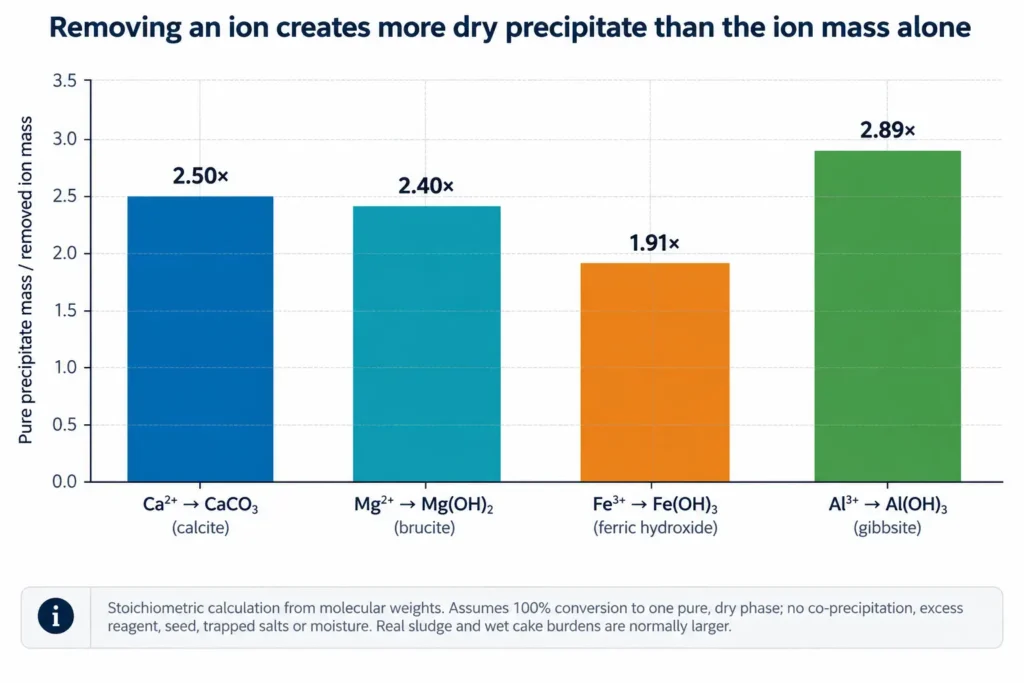
Figure 15.2. Stoichiometric solids amplification: removed-ion mass is not sludge dry mass.
| Precipitation duty | Chemical path to screen | Control variables | Solids required | Filtrate / recycle question | Failure mode |
|---|---|---|---|---|---|
| Carbonate hardness / calcium | Carbonate addition, lime/soda sequence, carbonation or seed growth. | pH, alkalinity/DIC, Ca activity, temperature, mixing and CO₂. | Phase identity, size, settleability, wash and moisture. | Does filtrate meet the next sulfate/carbonate and pH target? | Fine carryover, excess reagent, polymorph/impurity and redissolution. |
| Magnesium / metal hydroxides | Caustic or lime elevation, staged precipitation and selective pH windows. | pH path, kinetics, chelants, carbonate, silica and metal competition. | Gel/flake behaviour, thickening, dewatering and washing. | Are sodium/chemical additions and residual metal closed? | Voluminous sludge, poor filtration, co-precipitation and downstream high pH. |
| Sulfate-forming ions | Remove Ca/Ba/Sr, exchange ions or precipitate a controlled sulfate phase. | Ion activities, common ions, inhibitor, seed and temperature. | Mineralogy, growth, entrainment and purge. | Does recycle reintroduce the limiting ion? | Uncontrolled scale transferred into reactor, filter or pipework. |
| Silica / silicate | Coagulation/adsorption, pH-controlled precipitation, Mg/metal-assisted removal or selective separation. | Silica fraction, pH, temperature, Mg/Ca/Al/Fe, polymer and residence time. | Silica-rich or mixed solid identity and dewaterability. | Will recycle age/polymerize or return cations? | Universal-limit assumption, unstable colloids and mixed deposits. |
| Target metals | Oxidation/reduction plus hydroxide, sulfide, carbonate, adsorption or IX. | Oxidation state, ligand/chelant, pH, sulfide/gas safety and competing ions. | Leachability, hazardous status, purity and moisture. | Can filtrate or wash return without dissolving metals? | Toxic gas, redissolution, colloidal escape or hazardous wet sludge. |
Table 15.6. Precipitation is a solids-production, separation and recycle system.
Solids accounting ruleReport target-ion removal, reagent incorporation, counter-ions, co-precipitated species, seed make-up/purge, dry solids, cake moisture, wash water, filtrate composition and closure error separately. A percentage removal without a sludge balance cannot support CAPEX, disposal or product claims. |
|---|
15.8 pH control and antiscalant destruction
pH control changes speciation, solubility, gas partitioning, membrane charge, corrosion and reaction kinetics. It does not remove mass by itself. Acid adds an anion or gas-derived carbon; caustic commonly adds sodium or another cation; neutralization can precipitate or redissolve solids; and poor mixing can create local conditions far outside the measured bulk pH.
The dose basis should include alkalinity or acid-neutralizing capacity, target pH at the actual temperature and ionic strength, gas transfer, reaction time, reagent purity and the destination of the added counter-ion. A pH value measured after cooling and aeration may not represent the process condition.
Residual antiscalant can prevent the deliberate precipitation required for a second recovery stage. Recent studies show that oxidation response differs by phosphonate structure and matrix. A 2023 Water Research study found slow direct ozone reaction for the tested nitrogen-free phosphonates while radical processes were more promising; a separate 2023 study found that tested nitrogen-containing phosphonates reacted effectively through different pathways. A 2024 brine treatment study combined UV/persulfate antiscalant degradation with chemical demineralization, MF and secondary RO. These results support formulation-specific testing and by-product control—not one universal destruction technology.
| Conditioning action | Primary purpose | Added / transformed load | Verification | New residual or risk |
|---|---|---|---|---|
| Acid addition | Reduce carbonate supersaturation, set membrane/precipitation pH or dissolve selected solids. | Acid anion, dissolved CO₂ and corrosion exposure. | Titration/model, mixing, gas behaviour and material compatibility. | Counter-ion accumulation, off-gas and acidic CIP/flush. |
| Alkali addition | Precipitate hydroxides/carbonates, shift silica/organic chemistry or set downstream pH. | Sodium/other cation and reagent impurities. | Dose-response, local mixing, precipitation and filtrate chemistry. | Sludge, high-pH stream, added salinity and caustic corrosion. |
| CO₂ addition / stripping | Control carbonate system without the same counter-ion addition as mineral acid. | Dissolved/gaseous carbon and mass-transfer duty. | DIC/alkalinity/pH at process temperature and pressure. | Off-gas, incomplete equilibration or downstream pH rebound. |
| Antiscalant oxidation | Remove inhibition before deliberate precipitation or product recovery. | Oxidation products, phosphate, sulfate, bromate potential and oxidant/quench. | Actual formulation, matrix demand, target precipitation and by-product analysis. | New ionic load, toxic by-product, corrosion and incomplete deactivation. |
| Antiscalant adsorption | Remove inhibitor without bulk oxidation where a suitable sorbent exists. | Loaded media and possible regenerant. | Breakthrough, competition, desorption and reuse/disposal. | Spent media or concentrated regenerant with unclear route. |
Table 15.7. pH and antiscalant conditioning must include the added chemical and by-product balance.
15.9 Integrate the train: one pretreatment step changes the next
Pretreatment steps are not independent modules. Coagulant or polymer carryover can foul membranes, contaminate crystals or alter ion-exchange performance. Oxidation can release phosphate from phosphonates, shift metals and change biodegradable carbon. Softening creates fine precipitates that require effective solid–liquid separation. Activated-carbon fines need downstream retention. Biological treatment creates biomass and soluble microbial products. An antiscalant added to protect one membrane stage can inhibit the precipitation planned after it.
The train should therefore be tested as an integrated sequence with real recycles, cleaning returns and start-up conditions. Unit tests that use fresh synthetic feed at every step can hide accumulation, incompatible chemicals and mother-liquor effects.
| Upstream action | Beneficial effect | Possible carryover | Affected downstream block | Integration test |
|---|---|---|---|---|
| Coagulation / flocculation | Colloid and fine-solids removal. | Al/Fe, polymer, pin floc and altered pH. | UF/RO, IX, thermal and crystals. | Carryover under dose/flow extremes; membrane and product compatibility. |
| Softening / precipitation | Removes scale-forming ions. | Fine solids, high pH, sodium/reagent salt and residual seed. | Filters, membranes, evaporator and product train. | Full solids separation, filtrate chemistry and recycle ageing. |
| Oxidation / AOP | Destroys target organic or inhibitor. | Oxidant, phosphate/sulfate, transformation products and changed redox. | Biology, membranes, IX, corrosion and product. | Quench, by-products, materials and downstream performance. |
| GAC / adsorption | Removes target dissolved organics. | Carbon fines, desorbed compounds and regeneration chemistry. | MF/UF, RO, thermal and product. | Breakthrough, fines retention and spent-media route. |
| Biology | Removes biodegradable organics/nutrients. | Biomass, SMP/EPS, nutrients and biocide incompatibility. | Clarifier/UF, RO and thermal. | Shock recovery, solids retention and downstream cleaning. |
| Antiscalant addition | Protects a membrane stage. | Persistent inhibitor in concentrate. | Precipitation, crystallization and product recovery. | Actual residual dose, destruction/removal need and new by-products. |
Table 15.8. Pretreatment compatibility matrix: upstream protection can create downstream constraints.
15.10 Close the pretreatment residual ledger
The conditioned feed is only half of the pretreatment deliverable. The residual ledger must name continuous, intermittent and non-routine wastes; quantify dry and wet mass; identify chemical and contaminant content; and assign storage, treatment, recycle, transport, product or disposal routes.
Residuals should not be hidden by internal recycle. Returning clarifier overflow, filter backwash, UF retentate or dewatering filtrate to the head of the plant can increase hydraulic load and accumulate the very constituent being removed. A recycle is valid only when the steady-state and upset mass balance closes.
| Residual | Flow / batch basis | Composition basis | Physical form | Route and contingency | Cost / risk field |
|---|---|---|---|---|---|
| Screenings and grit | Wet mass by event and annual quantity. | Water, oil, organics, metals and debris. | Drained/compacted screenings or grit slurry. | Container, washing, landfill/reuse and overflow contingency. | Handling, odour, classification and transport. |
| Oil / float sludge | Skim/underflow rate and peak upset inventory. | Oil fractions, solids, water, polymer/coagulant and toxics. | Pumpable emulsion or dewatered oily cake. | Recovery, treatment, hazardous/non-hazardous disposal and spill storage. | Fire/safety, liability, dewatering and receiver limits. |
| Chemical / precipitation sludge | Dry solids plus wet volume and cake moisture. | Target phase, co-precipitates, reagent, seed and contaminants. | Slurry, thickened sludge or filter cake. | Recycle/purge, washing, product qualification or disposal. | Dewatering, leachability, volume and off-spec route. |
| Backwash / retentate | Cycle volume, frequency and solids load. | Particles, oil, biology, chemicals and dissolved salts. | Dilute high-flow wash or concentrated retentate. | Return, separate treatment, equalization and upset diversion. | Hydraulic recirculation and accumulation. |
| Regenerant / spent media | Per cycle, rinse and annual replacement. | Unused regenerant, displaced ions, target contaminant and media/resin. | Concentrated liquid or solid media. | Reuse, recovery, treatment, disposal and supplier take-back. | High-strength waste, classification and replacement. |
| CIP / cleaning waste | Recipe, sequence, volume and frequency. | Acid/alkali, surfactant, chelant, oxidant, dissolved deposit and rinse. | Batch liquid with changing composition. | Segregation, neutralization, recovery or controlled blending. | Peak load, incompatibility, corrosion and permit. |
| Off-spec / start-up inventory | Maximum credible duration and storage. | Full feed and chemical envelope. | Tank inventory or diverted product/residual. | Return, reprocess, external route and emergency overflow. | Business continuity and environmental release. |
Table 15.9. Pretreatment residual ledger required for mass balance, CAPEX, OPEX and liability.
No residual, no approvalA pretreatment train may not pass the gate when a new sludge, retentate, regenerant, backwash, CIP or off-spec stream is merely labelled “to waste.” The destination, capacity, acceptance envelope, contingency and cost must be named at the same maturity as the conditioned-feed claim. |
|---|
15.11 Pretreatment acceptance gate
Pretreatment should advance into the conventional membrane chapter only after it has a measurable removal function, an integrated operating envelope and a complete residual basis. The gate is not passed by one favourable jar test or by a supplier’s generic feed specification.
| Gate field | Minimum evidence | Proceed condition | Conditional / recycle trigger | Owner / record |
|---|---|---|---|---|
| Downstream requirement | Named next unit, duty, feed specification, margin and failure consequence. | Requirement is measurable and tied to normal/design/upset cases. | Generic target, conflicting supplier limits or no upset basis. | Process lead; technology data sheet and basis of design. |
| Removal mechanism | Representative feed tests, model and comparable operating evidence. | Controlling constituent reduced by a repeatable mechanism. | One sample, synthetic feed only or unstable kinetics. | Pretreatment lead; test report and data register. |
| Hydraulics and operability | Flow/event envelope, tankage, mixing, redundancy, cleaning and start-up. | Train remains controllable during peaks, CIP and turndown. | Hidden batch event, insufficient storage or no recovery after upset. | Operations and process controls. |
| Chemical and materials compatibility | Dose range, carryover, redox/pH, corrosion and downstream cleaning limits. | No unresolved incompatibility across the integrated train. | Polymer/oxidant/reagent carryover or materials gap. | Chemistry/materials leads. |
| Residual closure | Dry/wet mass, composition, recycle, storage, route, contingency and acceptance. | Every routine and non-routine residual has a credible route. | Unclosed recycle, no receiver or unqualified product claim. | Residuals/environmental lead. |
| Economics and availability | Installed equipment, chemicals, replacements, labour, disposal, downtime and downside cases. | Pretreatment-enabled train improves the total project baseline. | Downstream saving depends on optimistic sludge, chemical or availability assumptions. | Project controls and business-case owner. |
| Scale-up plan | Test duration, variability/events, success criteria and performance guarantees. | Evidence is proportionate to project commitment. | Laboratory result treated as FEED or guarantee basis. | Project manager and independent reviewer where required. |
Table 15.10. Pretreatment acceptance gate before conventional membrane concentration.
15.12 Handover to Chapter 16
Chapter 16 evaluates conventional membrane concentration—RO, NF and ED/EDR—without assuming that pretreatment has made the feed harmless. The handover is a conditioned-feed specification and residual ledger, not a list of installed equipment.
For each normal, design, turndown and worst-credible case, the handover should state flow, temperature, pH, conductivity/TDS, density, major ions, alkalinity/inorganic carbon, particles, oil, organics, biology, residual oxidant/reductant, antiscalant and every chemical introduced during pretreatment. It should also state which constraints remain intentionally unresolved and how the membrane train will monitor, clean, bypass or stop.
15.13 Chapter conclusion
Pretreatment is the first business-case gate because it determines whether the selected downstream process can operate reliably and whether the total treatment train remains economically defensible. The appropriate method is selected by function: hydraulic conditioning, phase separation, removal of particles or organics, selective ion capture, deliberate precipitation, inhibitor destruction or pH/redox control.
Every method creates a new waste or obligation. Screening creates wet solids; equalization creates inventory and tank bottoms; flotation creates oily sludge; coagulation and softening create chemical solids; filtration and UF create backwash and retentate; carbon creates spent media; biology creates biomass; ion exchange creates regenerant; oxidation creates transformation products and quench; pH control adds counter-ions or gas-transfer duty.
A defensible pretreatment train therefore has two verified outputs: a conditioned feed that meets the next unit’s operating envelope, and a residual portfolio with closed mass, route, contingency and cost. Chapter 16 now evaluates the membrane roles that this conditioned feed may enable.
Chapter 15 in one sentencePretreatment is not an accessory block: it must remove the next constraint at lower total burden than the residuals, chemicals and operating risk it creates. |
|---|