
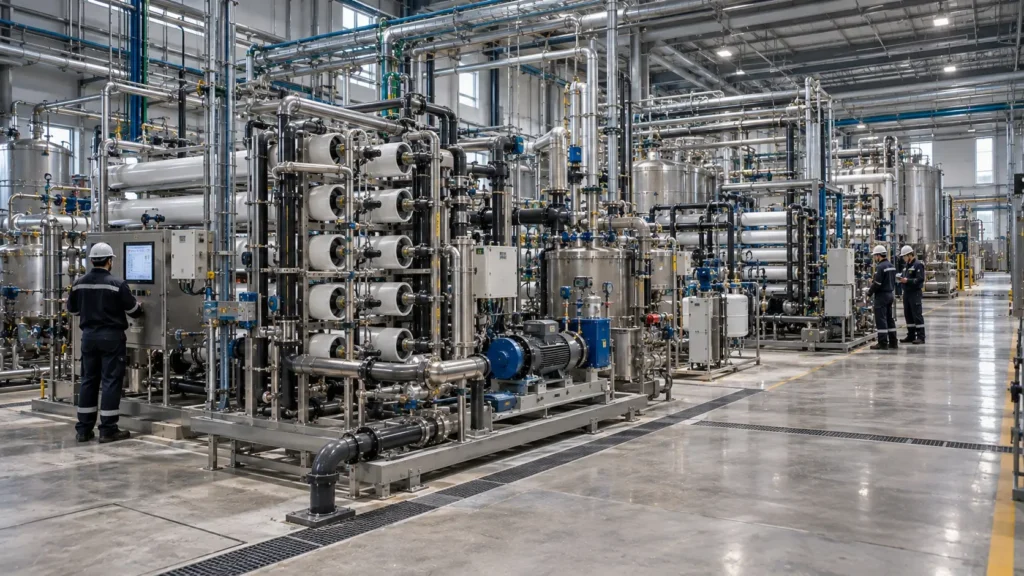
Compare advanced membrane routes by industrial role, evidence maturity and the burden they transfer to recycles, products and the thermal handoff.
Controlled principleAn advanced membrane process is not justified because it reaches a higher salinity in a paper or pilot. It must improve the conventional baseline after realistic module hydraulics, pressure or current, internal polarization, recycle, product quality, pretreatment, cleaning, materials, availability and every residual stream are included. |
|---|
17.1 Beyond the conventional membrane baseline
Chapter 16 established the conventional NF, RO and ED/EDR baseline. Chapter 17 addresses processes that extend that baseline by raising allowable pressure, reducing the local osmotic-pressure difference, allowing controlled salt passage, using a draw solution, transferring water as vapour or using an electric field for selective ionic transport. These are different transport strategies, not one technology family.
The starting question is not which process reports the highest final concentration. It is which process produces the required water or ion split at lower total system burden than conventional membrane concentration followed by the justified thermal or disposal endpoint. A high-salinity membrane can be valuable as the final water-recovery step, an intermediate impurity split, a selective product stage or a preconcentrator that reduces evaporator duty. It does not need to replace thermal treatment to create value.
The handover from Chapter 16 is a conditioned-feed specification and residual ledger for normal, design, turndown and worst-credible cases. Advanced processes must inherit that full chemistry and operating history. They do not reset scaling, fouling, corrosion, volatile carryover or off-spec risk.
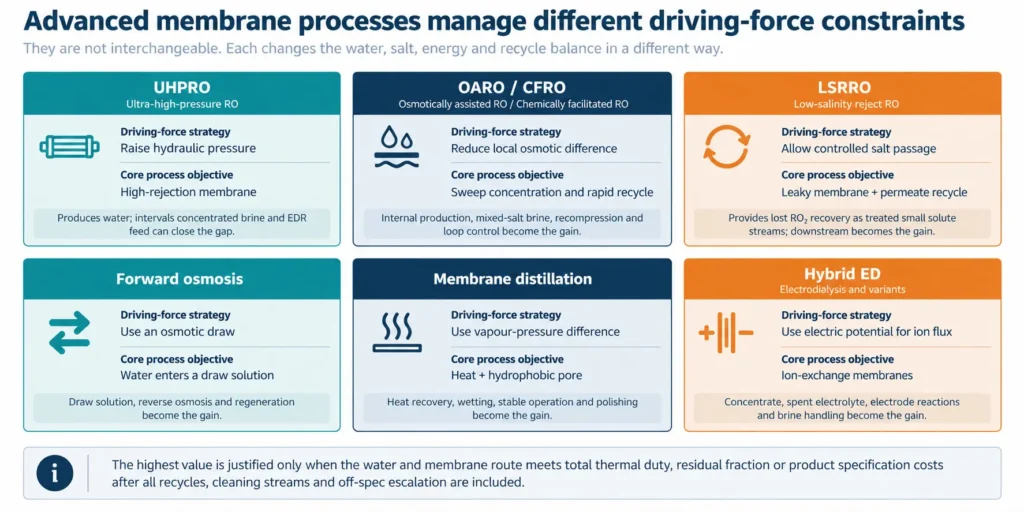
Figure 17.1. Advanced membrane processes manage different driving-force constraints; they are not interchangeable.
17.2 Maturity is part of the design basis
Technology maturity must be stated at the level of the proposed duty. Commercial membrane elements do not automatically make a new process configuration commercially mature. A field pilot does not establish membrane life, availability, cleaning frequency, controls, guarantees or residual acceptance at full scale. A vendor reference does not become independent evidence merely because the equipment is operating.
This chapter uses four evidence categories: commercial components; integrated pilot or field demonstration; early commercial or niche full-scale use; and repeatable commercial reference in a comparable chemistry, flow, duty and boundary. The evidence level should be attached to the exact process configuration, not to the broad name of the membrane family.
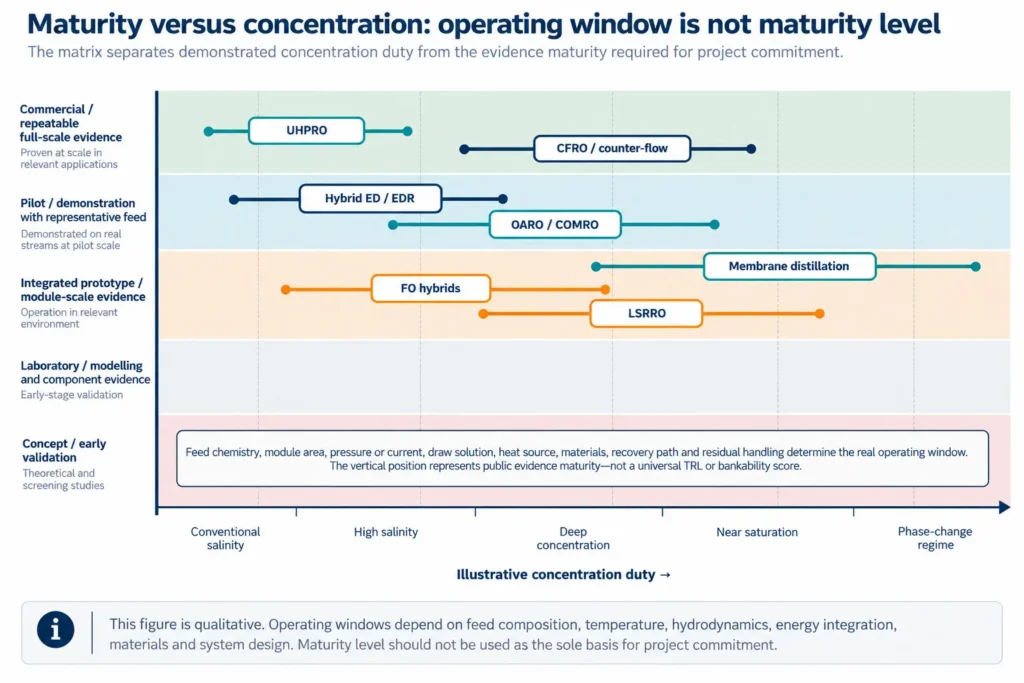
Figure 17.2. Required maturity-versus-concentration matrix. The windows are qualitative and must not be read as universal salinity thresholds.
| Process | Practical feed role | Primary product | Main limitation | Pretreatment emphasis | Evidence maturity | Best hybrid role |
|---|---|---|---|---|---|---|
| UHPRO | Conditioned brine beyond conventional RO where direct hydraulic pressure remains credible. | High-quality permeate and a smaller concentrated brine. | Pressure rating, osmotic approach, element compaction, pump/ERD duty, scaling and materials. | Very low particulate/oil load; selective scale-former control; stable temperature and pH. | Commercial UHP elements; integrated-system references remain chemistry- and vendor-specific. | Last pressure-driven stage before thermal treatment or a product-recovery block. |
| OARO / COMRO / CFRO | High-salinity brine where staged osmotic balancing can reduce local pressure difference. | Diluted product or intermediate stream plus a deeply concentrated brine. | Internal concentration polarization, large area, sweep/recycle recompression, loop control and product quality. | Stable, low-fouling feed; multivalent and silica control; compatible sweep chemistry. | Pilot/field demonstration; some vendor-commercial claims; independent full-scale data limited. | After RO/UHPRO and before evaporation, or where a counterflow loop serves a specific industrial recycle. |
| LSRRO | High-salinity brine where controlled salt passage and permeate recycle are acceptable. | High-quality final permeate after integrated cascade; concentrated brine. | Membrane salt permeability, permeate recycle, stage balancing, ion-specific passage and model uncertainty. | Clean feed and selective limiter removal; control of species that recycle or accumulate. | Pilot-scale demonstration; emerging membrane and modelling base. | RO extension to reduce thermal feed volume while using conventional-style modules. |
| Forward osmosis | Dewatering or osmotic transfer when a compatible draw solution and regeneration sink exist. | Diluted draw solution and concentrated feed; clean water only after draw regeneration. | Draw regeneration, reverse solute flux, internal polarization, fouling and diluted-draw handling. | Feed pretreatment plus draw/feed compatibility and volatile/organic control. | Commercial modules with pilot or niche system deployment; process maturity application-specific. | Preconcentrator coupled to an existing thermal, RO or process draw-regeneration duty. |
| Membrane distillation | High-salinity or near-saturation liquid where low-grade heat and cooling are available. | Distillate and a concentrated hot brine. | Heat loss/recovery, wetting, scaling, fouling, volatile carryover, cooling and module durability. | Solids/oil control, antifoam compatibility, volatile management and thermal materials. | Full-scale niche demonstrations and early commercial systems; broad industrial bankability remains case-specific. | Thermal-membrane bridge between pressure-driven concentration and crystallization. |
| Hybrid ED systems | Selective ionic removal or concentration where ion split has value and water transfer is controlled. | Diluate/concentrate or selectively separated ion streams; sometimes acid/base products. | Electrical resistance, co-ion leakage, water transport, electrode reactions, scaling and product cross-contamination. | Particles/oil removal; polyvalent and electrode scaling control; redox and gas management. | Commercial ED components; hypersaline/selective hybrids at pilot to early deployment. | Selective pretreatment, metathesis, mineral split, or polishing around RO and thermal blocks. |
Table 17.1. Functional comparison of advanced high-salinity membrane processes. No row defines a universal operating limit.
17.3 Ultra-high-pressure reverse osmosis
UHPRO extends the direct-pressure logic of conventional RO. The membrane remains highly rejecting and the applied hydraulic pressure must exceed the effective osmotic-pressure difference plus hydraulic losses. The advantage is conceptual and operational continuity: a familiar RO-type flowsheet can reduce the liquid sent to thermal treatment without a draw-solution or permeate-recycle network.
Current commercial membrane elements now explicitly target ultra-high-pressure industrial brine concentration. DuPont lists UHP elements for operation up to 120 bar and, for one current product family, vendor-stated NaCl reject concentrations up to 250 g/L. These values are product claims under supplier conditions, not universal feed or concentrate limits and not proof that the complete plant can operate at those conditions with a complex industrial brine.
The system gate shifts from the membrane sheet to the complete pressure boundary: pump, energy-recovery device, pressure vessels, connectors, seals, instrumentation, fatigue cycles, temperature, element compaction, concentration polarization and cleaning. Scaling and osmotic approach can remove the theoretical benefit before the nominal pressure limit is reached. The stable endpoint should therefore be set by the first chemical, mechanical or economic constraint, not by the maximum pressure printed on a product sheet.
| UHPRO design field | Required evidence | Why it controls | Residual / operational consequence | No-credit shortcut |
|---|---|---|---|---|
| Pressure and osmotic approach | Non-ideal osmotic model, module pressure drop, local concentration polarization and full pressure profile. | Net driving pressure and component rating determine flux and energy. | High-pressure concentrate, decompression duty, ERD losses and start/stop transients. | Using feed TDS and maximum pump pressure alone. |
| Element and vessel mechanics | Supplier-rated element, vessel, connectors, seals and cyclic pressure basis at temperature. | Compaction, telescoping and fatigue can change transport or integrity. | Replacement frequency, leak risk and pressure-boundary inspection. | Assuming a UHP membrane can be installed in a standard SWRO train. |
| Chemistry and scaling | Normal/design/upset speciation path, inhibitor or selective removal, surface/pilot evidence. | The stable chemical limit can occur below the hydraulic limit. | CIP, flush, intermediate solids and lower effective recovery. | Treating a pure NaCl product claim as a mixed-brine guarantee. |
| Permeate and product quality | Ion-specific rejection over pressure, salinity, temperature, flux and membrane age. | High pressure and high concentration can change passage and required polishing. | Off-spec permeate, recycle and downstream water treatment. | Quoting one standard rejection test as project permeate quality. |
| Energy and availability | Pump/ERD efficiency, turndown, downtime, cleaning, replacements and annual operating hours. | A low theoretical SEC can coexist with poor effective annual recovery. | Electrical peak, spares, bypass and thermal-feed variability. | Comparing ideal pump work with full thermal-plant energy. |
Table 17.2. UHPRO is a complete ultra-high-pressure system, not only a membrane element.
17.4 OARO, COMRO and counterflow systems
Osmotically assisted and counterflow configurations reduce the local osmotic-pressure difference by placing an intermediate saline stream on the permeate side or by arranging staged streams in counterflow. OARO normally uses an asymmetric membrane and an osmotic sweep; COMRO and CFRO describe cascading or counterflow process arrangements that distribute the osmotic burden across stages. The nomenclature is not perfectly uniform across the literature and vendor market, so the project should define the exact flow paths, membrane orientation and recycle loops.
A July 2026 pilot study of real nanofiltration-pretreated SWRO brine reported an integrated RO–OARO system treating 28–59 m³/d, reaching up to 245 g/L final brine and 72–85% overall recovery under its tested conditions. The reported energy basis differed materially depending on whether it was normalized to permeate or concentrated brine. The study also identified membrane temperature as a practical limit. These results are important pilot evidence, not a cross-sector guarantee.
A separate 2026 scale-up study using real industrial 4040 modules reached a more cautious conclusion: when pressure drop, module area, sweep recompression and process complexity were included, HPRO was more robust and less energy-intensive for the studied targets, while an HPRO–OARO hybrid required substantial module area and energy. The disagreement is not a contradiction to be averaged; it shows that OARO performance is highly configuration-, module-, target- and basis-dependent.
CFRO also has field-demonstration and vendor-commercial activity. DOE selected a produced-water field pilot using commercial RO infrastructure in a counterflow arrangement, while Gradiant currently markets a proprietary CFRO platform and named industrial applications. Public vendor claims should be recorded as commercial evidence, but independent feed, availability, cleaning and residual data remain separate verification gates.
| Configuration field | OARO | COMRO / CFRO | What must close | Failure mode | Scale-up evidence |
|---|---|---|---|---|---|
| Osmotic-assistance stream | Sweep solution on the support/permeate side. | Counterflow or cascading process streams; exact vendor configuration varies. | Sweep source, salinity, recompression, dilution and final destination. | Sweep becomes an unclosed internal brine inventory. | Full stream table and transient recycle model. |
| Membrane transport | Water and salt transport plus internal concentration polarization. | High-rejection or selected commercial membranes in staged counterflow. | Module orientation, support resistance, pressure drop and salt leakage. | Bench membrane coefficient used as full-module performance. | Real module test at relevant pressure, temperature and salinity. |
| Product water | Often recovered after downstream RO or split from diluted sweep. | Diluted stream may require downstream polishing or recycle. | Water quality, internal recycle and net recovery. | Gross membrane flux reported as saleable/reusable water. | Integrated product specification and annual net balance. |
| Hydraulics and controls | Multiple pressure levels and sweep circulation. | Multiple countercurrent stages, feed splits or reflux loops. | Start-up, shutdown, inventory, turndown and control authority. | Steady-state model hides transition and off-spec volumes. | Pilot with representative cycles and fault response. |
| Maturity | Pilot-scale real-brine evidence; emerging industrial applications. | Field pilots and vendor-commercial platform claims. | Comparable chemistry, flow, duty and operating duration. | Brand maturity substituted for project maturity. | Independent reference or bounded vendor case with downside tests. |
Table 17.3. OARO and counterflow systems require explicit nomenclature, recycle and scale-up evidence.
17.5 Low-salt-rejection reverse osmosis
LSRRO reduces the transmembrane osmotic-pressure difference by allowing controlled salt passage through progressively more permeable membranes. The permeate from later stages is recycled upstream so that the integrated system can still produce high-quality final permeate. The process therefore trades pressure for salt leakage, staging and recycle complexity.
A 2024 pilot demonstration treated five feeds ranging from 70 g/L NaCl solution to 133 g/L produced water, reported water recoveries above 60%, brines above 200 g/L and operation at 75.8 bar. Select-ion rejection across the integrated experiments was high and final permeate TDS was reported between 31 and 333 mg/L. Those are strong pilot results under the stated feeds, membranes and duration; the study itself notes the need to refine membrane transport properties.
The design challenge is not simply choosing a lower nominal rejection. Salt permeability changes with salinity, flux, ion, temperature and membrane condition. A 2026 modelling study showed that conventional constant-permeability assumptions can be inadequate across high salinity. Stage-by-stage ion transport and permeate-recycle accumulation must therefore be verified, especially for multivalent ions, trace contaminants and any product-recovery objective.
| LSRRO field | Required design basis | Value created | Risk transferred | Acceptance evidence |
|---|---|---|---|---|
| Membrane cascade | Water and ion permeabilities by salinity, flux, temperature and pressure for each membrane class. | Lower hydraulic pressure for deep brine concentration. | Ion-specific salt leakage and membrane-manufacturing consistency. | Pilot membrane lot data and predictive model validated across the operating path. |
| Permeate recycle | Flow, salinity, ion pattern, tank inventory and final product path. | Allows internal recovery of leaked salt while preserving final water quality. | Recycle accumulation, hydraulic load and off-spec transition water. | Closed cyclic/steady-state mass balance and event testing. |
| Feed chemistry | Scaling/fouling limits after selective pretreatment. | Can extend pressure-driven recovery before thermal treatment. | A small uncontrolled multivalent leak can dominate later stages. | Real-feed pilot with surface/deposit evidence and cleaning recovery. |
| Commercial maturity | Module availability, membrane reproducibility, controls and guarantees. | Potential compatibility with conventional spiral-wound architecture. | Pilot results presented as routine commercial performance. | Comparable reference or a project-specific scale-up and guarantee plan. |
Table 17.4. LSRRO exchanges hydraulic pressure for controlled salt passage and recycle discipline.
17.6 Forward osmosis
Forward osmosis moves water from the feed into a higher-osmotic-pressure draw solution. It can dewater a difficult feed at low hydraulic pressure, but it does not produce clean water until the diluted draw is regenerated or directly used. The draw solution is therefore part of the process product and energy balance, not a temporary laboratory reagent.
Current commercial FO modules exist, and a 2026 study used a commercial module to dewater hypersaline sodium-sulfate and sodium-chloride feeds. The authors also noted the limited experimental dataset for commercial modules at hypersaline conditions. CSIRO currently describes its FO–RO platform as mid-stage, TRL 5–7, with large-scale demonstration knowledge and a commercialisation opportunity. These sources support pilot and niche readiness, not broad bankable maturity for high-salinity industrial brines.
FO is strongest when the draw-regeneration burden is already valuable: concentration of a process solution, product dilution, an available thermal regeneration sink, or coupling to RO where the draw chemistry is benign. It is weak when the draw is selected only to create high laboratory flux and the project has no credible path for reverse solute flux, draw loss, regeneration, cleaning and diluted-draw inventory.
17.7 Membrane distillation
Membrane distillation transfers water vapour across a hydrophobic microporous membrane using a vapour-pressure difference, normally created by temperature. It is a thermal separation implemented through a membrane contactor. High salt rejection of non-volatile solutes is possible, but volatile compounds, droplets from wetting or entrainment, and membrane chemistry can affect distillate quality.
A 2025 peer-reviewed study reported operation and control of a full-scale vacuum-assisted air-gap MD unit treating desalination brine for greenhouse production using biomass heat. The work is important full-scale evidence and also documented practical cooling limitations. It should be treated as a niche, application-specific reference—not proof that MD is broadly bankable for industrial ZLD feeds.
MD becomes attractive where low-grade or waste heat has credible availability and temperature, where cooling and heat recovery are designed as part of the plant, and where the feed can be protected from oil, surfactants, particles, scale, foam and volatile carryover. The thermal chapter that follows will compare this distributed membrane contactor with evaporators and brine concentrators on the same heat, condensate and residual basis.
| Process | Driving solution / utility | Product | Primary constraint | New residual / recycle | Best hybrid role |
|---|---|---|---|---|---|
| Forward osmosis | Draw solution with higher osmotic activity; regeneration energy or direct process use. | Diluted draw plus concentrated feed; water only after regeneration. | Draw regeneration, reverse solute flux and internal polarization. | Draw loss, cleaning waste, concentrated feed and off-spec diluted draw. | Dewater difficult feed before RO/thermal, or exploit a process-integrated draw. |
| Membrane distillation | Heat and cooling across a hydrophobic membrane contactor. | Distillate plus hot concentrated brine. | Heat recovery, wetting, scale/fouling, volatile carryover and module durability. | CIP, concentrate, rejected distillate, vent/condensate contaminants and spent modules. | Use low-grade heat to bridge pressure-driven concentration and crystallization. |
Table 17.5. FO and MD can accept high salinity, but their draw and thermal systems remain part of the core process.
17.8 Hybrid electrodialysis systems
Electrodialysis can remain valuable beyond conventional brackish-water desalination when the project objective is ionic separation rather than only bulk water production. Selective membranes, metathesis stacks, bipolar membranes, staged ED–RO systems and ED coupled to precipitation or thermal treatment can split incompatible ions, concentrate a target, produce acid/base or reduce scaling in the next block.
A 2024 analysis of hypersaline ED identified intrinsic conductivity–selectivity and water-transport trade-offs. Using current commercial ion-exchange-membrane properties, the study found competitive energy potential for its modelled feeds below approximately 100,000 ppm TDS, while higher salinity required improved suppression of water transport. This is a model-based boundary, not a universal ED limit.
Hybrid configurations can be more mature than a new membrane because they combine commercial components, but the integrated duty may still be emerging. A 2025 field-scale salt-free electrodialysis-metathesis pilot treated real brackish RO brine and reported high hydraulic recovery and directional calcium/sulfate separation. Those results are relevant to inland RO brine management and do not directly transfer to hypersaline mixed industrial brines.
At high salinity, resistance can decrease while water transport, co-ion leakage, osmosis, electrode reactions, scaling and product cross-contamination become more important. The design must close current efficiency, voltage, stack resistance, hydraulic recovery, salt recovery, electrode rinse, gas, cleaning and both product streams.
| Hybrid ED role | Value proposition | Main transport / chemistry risk | Residuals and products | Evidence gate |
|---|---|---|---|---|
| ED before RO or thermal | Remove or redistribute scale-forming ions and reduce downstream constraint. | Water transport, selectivity loss, concentration polarization and scaling. | Diluate, concentrate, electrode rinse, cleaning and possible precipitate. | Ion-specific pilot and integrated water/salt/charge balance. |
| Electrodialysis metathesis | Separate cation/anion pairs to avoid sparingly soluble combinations. | Membrane selectivity, extra compartments, leakage and product purity. | Multiple salt streams, rinse, cleaning and final residual route. | Field/pilot evidence for the actual ions, salinity and hydraulic recovery. |
| Selective ED for minerals | Concentrate or separate a target ion before product purification. | Donnan selectivity degradation, competing ions and SEC/selectivity trade-off. | Target-rich stream plus depleted/brine streams and off-spec product. | Real multicomponent brine, buyer specification and no-revenue downside case. |
| Bipolar / acid-base integration | Convert salt streams to acid/base where purity and internal use justify it. | Water splitting efficiency, membrane fouling, co-ion leakage and acid/base contamination. | Acid, base, depleted salt, electrode rinse and cleaning waste. | Product qualification, materials, internal demand and long-duration stack data. |
Table 17.6. Hybrid ED systems are selected by the ion split and product boundary, not by TDS alone.
17.9 Laboratory, pilot and commercial evidence are not interchangeable
The maturity question should be answered with a comparable-reference record. The proposed feed, pretreatment, membrane/module, flow, operating pressure or current, temperature, recovery, product quality, residuals, run duration, cleaning cycles, availability and scale-up ratio should be visible. A strong laboratory paper can establish mechanism and a pilot can establish integrated feasibility; neither automatically establishes a commercial guarantee.
Current evidence is mixed by technology. UHPRO has commercially offered elements and pressure ratings. OARO and LSRRO now have credible real-brine pilot evidence. CFRO has field-pilot programmes and vendor-commercial deployment claims. FO has commercial modules and mid-stage integrated platforms. MD has niche full-scale operation. ED is commercially mature as a core technology while hypersaline and selective hybrid duties remain application-specific. The maturity matrix therefore cannot be reduced to one TRL number for each acronym.
| Evidence level | What it proves | What it does not prove | Minimum record | Project use | Decision status |
|---|---|---|---|---|---|
| Bench / coupon | Transport mechanism, material compatibility and first fouling/scale response. | Module hydraulics, controls, cleaning life or annual availability. | Feed chemistry, membrane lot, area, flux, pressure/current, temperature and duration. | Reject or refine concept; define pilot. | Conditional only. |
| Integrated laboratory skid | Multi-stage mass balance, recycle logic and short-duration product quality. | Field variability, maintainability, long cleaning cycles or full-scale pressure drop. | All streams, instrumentation, transients, CIP and closure error. | Pre-feasibility and pilot design. | Conditional. |
| Pilot / field demonstration | Performance on real feed and representative operating states at meaningful module scale. | Commercial reliability unless duration, repetitions and scale-up are adequate. | Flow, module, availability, events, cleaning, residual routes and comparable baseline. | Technology selection and scale-up basis. | Proceed with scale-up conditions. |
| Niche full-scale reference | Integrated operation at commercial flow for a bounded application. | Transferability to different chemistry, product or climate. | Comparable-reference matrix and independent operating data where possible. | FEED and contracting risk allocation. | Proceed if comparable. |
| Repeatable commercial platform | Supply chain, standard design, operation and multiple references. | Project-specific feed suitability or guaranteed bankability. | Reference fleet, warranties, exclusions and downside performance. | Procurement and guarantee negotiation. | Proceed after project gate. |
Table 17.7. Evidence maturity must match the project commitment being requested.
Commercial claim controlRecord vendor operating claims as vendor evidence with the product, date, stated feed, pressure/current, recovery, product and boundary. Do not convert a current product page, webinar or announced installation into industry-wide performance. Independent data and contractual guarantees remain separate gates. |
|---|
17.10 Choose the best hybrid role, not the most advanced acronym
Advanced membranes create the most value when they remove a specific burden from the total train. UHPRO can reduce evaporator feed. OARO/CFRO can manage an osmotic-pressure step that direct RO cannot. LSRRO can use salt leakage and recycle to stay within moderate hydraulic pressure. FO can transfer water into a useful draw. MD can use available low-grade heat. Hybrid ED can separate ions that would otherwise scale or contaminate a product.
The hybrid should be compared with a simpler baseline: additional conventional RO, selective precipitation, MLD with a managed residual, or direct thermal concentration. The comparison must include pretreatment, recycles, auxiliary pumps, heat/cooling, electrode systems, membrane replacement, cleaning, off-spec water and residual treatment. A reduction in thermal feed volume is not a complete business case when the membrane block adds a larger unavailable or unmanageable burden.
| Hybrid objective | Candidate advanced process | Baseline to compare | Required benefit metric | Stop / reframe trigger |
|---|---|---|---|---|
| Reduce thermal feed volume | UHPRO, OARO/CFRO, LSRRO or MD. | Conventional RO plus thermal, or MLD with residual disposal. | Net annual brine eliminated; total electrical/thermal energy; availability and residual cost. | Membrane block adds more energy, area, downtime or residual risk than thermal duty avoided. |
| Protect crystallizer/product purity | Selective ED, FO separation, NF/ED hybrid or targeted membrane split. | Chemical precipitation, purge or direct mixed-salt crystallization. | Impurity rejection, target yield, wash/purge reduction and qualified product value. | Product remains mixed/off-spec or separation creates unmanageable side streams. |
| Use waste heat | MD integrated with process heat and cooling. | Evaporator/MVC or disposal of a concentrated residual. | Recovered water per available heat duty; condensate quality and cooling burden. | Heat is intermittent, cooling unavailable, wetting/volatile carryover unresolved. |
| Treat difficult high-salinity feed | FO or OARO with a compatible process stream. | Source segregation, dedicated organic treatment or direct thermal. | Net product/reuse value after draw/sweep regeneration and losses. | Draw/sweep is selected only for flux and has no closed regeneration route. |
| Selective mineral/chemical recovery | Selective ED/BMED or membrane-ion split. | Precipitation, solvent/adsorption route or no-revenue disposal case. | Purity, yield, internal use/netback and rejection/fallback cost. | No qualified user, poor selectivity in real brine or energy/selectivity trade-off fails. |
Table 17.8. Advanced membranes should be selected for a defined hybrid benefit against a simpler baseline.
17.11 Advanced membrane acceptance gate
An advanced membrane process may advance to FEED only when its transport advantage survives realistic modules, the complete integrated balance and the evidence maturity required by the project. The gate should be failed or recycled when the technology name is more mature than the proposed duty.
| Gate field | Minimum evidence | Proceed condition | Conditional / recycle trigger | Owner / record |
|---|---|---|---|---|
| Defined industrial role | Named constraint, product and exact position in the train. | Advanced block improves a specific baseline duty. | Technology selected before the hybrid objective. | Process lead; decision framework register. |
| Practical feed window | Normal/design/upset composition, temperature, pressure/current/heat and product specification. | Operating path remains inside a tested or supplier-supported envelope. | Only feed TDS or pure NaCl evidence is available. | Chemistry and technology leads. |
| Integrated mass and energy balance | All recycles, draw/sweep, permeate, diluate, concentrate, electrode/thermal and cleaning streams. | Water, salts, chemicals and energy close on consistent denominators. | Gross recovery or membrane flux used instead of net product. | Process modelling lead. |
| Module and equipment scale-up | Real module pressure drop, area, compaction/polarization, controls and materials. | Scale-up factors and component ratings are verified. | Coupon data extrapolated directly to full scale. | Mechanical/membrane lead and supplier. |
| Maturity and reference | Comparable pilot/full-scale record, duration, cleaning, availability and independent evidence. | Evidence level matches commitment and guarantee. | Vendor announcement or short test is the only commercial basis. | Project manager and independent reviewer. |
| Residual and off-spec route | Concentrate, draw/sweep, electrode rinse, CIP, spent modules, rejected product and contingency. | Every routine/non-routine stream has capacity and fallback. | Internal recycle hides accumulation or no route exists. | Residuals/environmental lead. |
| Economics and downside | CAPEX, energy, chemicals, replacements, availability, residual cost and no-performance/no-product sensitivities. | Advanced block improves risk-adjusted total system value. | Business case depends on best published pilot result. | Business-case owner. |
Table 17.9. Acceptance gate before high-salinity membrane technology advances to FEED or contracting.
Bankability ruleLaboratory performance becomes bankable only after the proposed configuration has a comparable feed, module, scale, operating duration, cleaning history, availability, product boundary, residual route and contractual risk allocation. A high final concentration is one result—not a guarantee. |
|---|
17.12 Handover to Chapter 18
Chapter 18 evaluates thermal concentration. The handover from Chapter 17 is the membrane-optimized thermal feed, not a claim that membranes can or should eliminate thermal treatment. For each case, it should state the residual flow, density, temperature, boiling-point elevation basis, major ions, saturation state, oil/organics, antifoam or antiscalant, volatile compounds, particles, corrosion constraints and variability.
The handover must also state recovered-water quality, pressure/electrical/thermal energy, available waste heat, membrane availability, cleaning and flush volumes, concentrate inventory, draw/sweep or electrode streams, and the expected crystallizer or disposal endpoint. This allows Chapter 18 to compare MVC, MVR, MEE and film/forced-circulation systems against the actual duty remaining after justified membrane concentration.
17.13 Chapter conclusion
High-salinity membrane processes extend the conventional baseline through different mechanisms. UHPRO raises direct hydraulic pressure. OARO, COMRO and CFRO distribute the osmotic burden through sweep or counterflow arrangements. LSRRO uses controlled salt passage and permeate recycle. Forward osmosis relies on a draw solution. Membrane distillation uses a thermal vapour-pressure difference. Hybrid ED systems move and separate ions electrically.
Their practical windows cannot be reduced to TDS. Pressure rating, non-ideal osmosis, internal polarization, salt and water transport, temperature, scaling, fouling, wetting, corrosion, product quality, recycles and residuals determine the role. Maturity is equally specific: a commercial element, a pilot process and a repeatable full-scale reference are different evidence states.
The preferred technology is the one that improves the total train under realistic downside conditions. Advanced membranes are most credible as selective hybrid blocks that reduce thermal duty, protect product quality or create a valuable ion split. Chapter 18 now evaluates the thermal systems required when the remaining concentration duty is still justified.
Chapter 17 in one sentenceAdvanced membranes are bankable only when their transport advantage survives real modules, full recycles, product specifications, residual management and a maturity level proportionate to the project commitment. |
|---|