
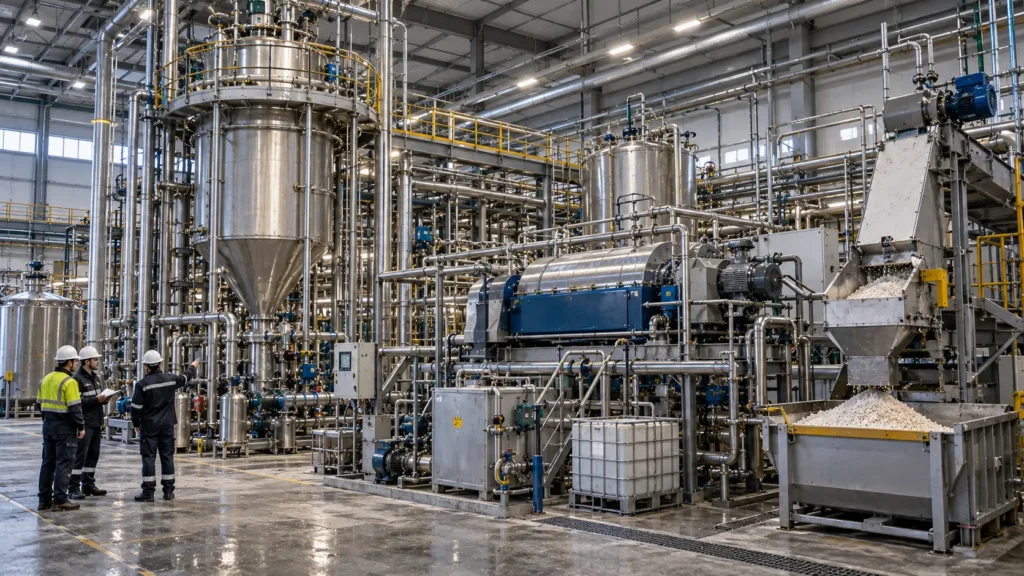
Distinguish controlled crystalline products from mixed salts, wet sludges and dry disposal solids.
Controlled principleCrystallization is a selective phase-separation process only when the phase path, crystal population, liquor separation and impurity purge are controlled. Removing the last water does not automatically create a product; it can just as easily create a variable mixed salt, a wet cake or a dry waste. |
|---|
19.1 Final water removal changes the design objective
Chapter 18 delivered a concentrated liquid or slurry with a defined temperature, saturation state, suspended-solids inventory, vapour history and residual route. Chapter 19 must decide whether the remaining duty should produce a controlled crystal phase, a deliberately mixed disposal salt, a wet sludge or another stable solid. The objective is no longer simply to evaporate water. It is to control phase formation and assign every liquid and solid output.
Solution crystallization creates solids from supersaturation. GEA describes it as a selective solid-liquid separation capable of producing crystalline products and recovering solvent, but the selectivity depends on the actual solubility and phase behaviour. In mixed industrial brines, several salts, hydrates, double salts and amorphous or colloidal solids may compete.
The first gate is therefore the output specification. A product route begins with a named phase, purity, crystal-size distribution, moisture, trace-contaminant limit, packaging form and qualified user. A disposal route begins with waste classification, leachability, stability, receiver acceptance, storage and closure. The crystallizer cannot be selected until that distinction is made.
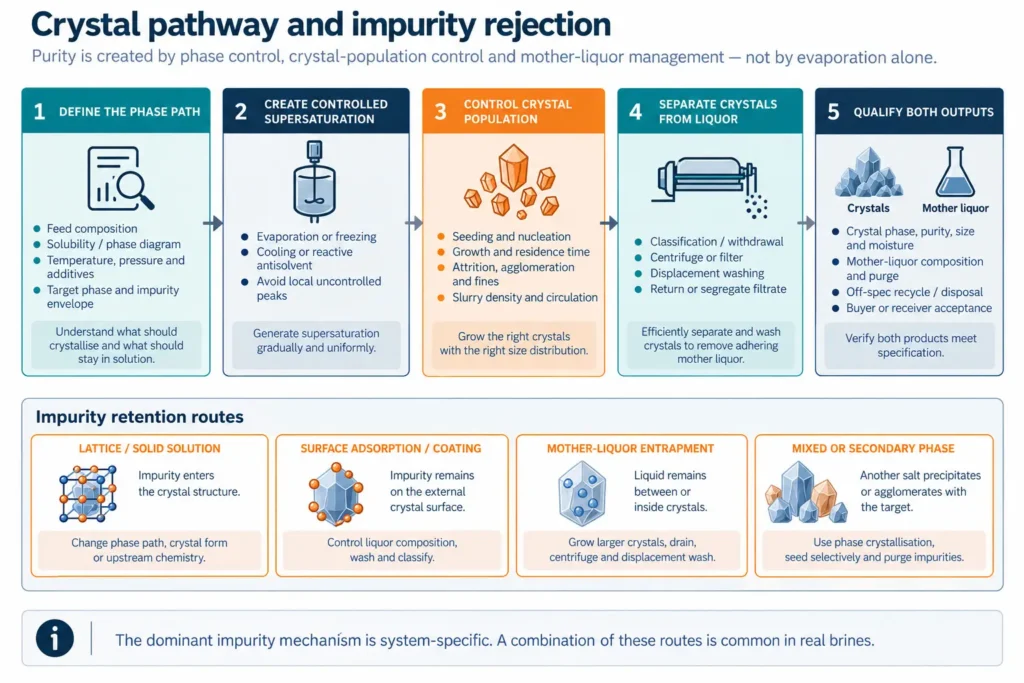
Figure 19.1. Crystal pathway and impurity rejection: purity depends on the entire phase and mother-liquor system.
19.2 Supersaturation, nucleation, growth and crystal population
Supersaturation is the thermodynamic driving force for crystallization, but plant behaviour is determined by how that driving force is created and distributed. Excess local supersaturation can create fines, encrustation or uncontrolled secondary phases. Too little supersaturation can produce low yield, long residence time and excessive recycle. The operating strategy must balance nucleation, growth, attrition, agglomeration and classification.
Seeding provides a known surface and can direct the first precipitation event, but the seed phase, size, dose, surface history and compatibility must be proven. Residence time supports growth only if the crystal remains in the growth zone and is not broken or redissolved. Fines destruction can return small crystals to solution and favour growth of the retained population, while uncontrolled attrition can continually recreate nuclei.
A saturation model is not a population balance. Phase-equilibrium calculations identify what can form under stated assumptions; they do not determine induction time, crystal habit, particle size, filterability, mother-liquor inclusion or product washing. Bench and pilot work must measure the actual solids and their separation behaviour.
| Control field | Design question | Evidence required | Failure mode | Downstream consequence |
|---|---|---|---|---|
| Phase path | Which phase should appear first, and which phases must remain dissolved? | Complete composition, temperature-dependent solubility/phase diagram, activity model and solids analysis. | Unexpected hydrate, double salt, amorphous solid or co-precipitation. | Variable purity, blocked equipment and unclosed salt balance. |
| Supersaturation generation | How is driving force created without local runaway? | Evaporation/cooling/addition rate, mixing, residence distribution and wall conditions. | Wall scale, burst nucleation or low yield. | Cleaning, fines, unstable production and downtime. |
| Seeding / nucleation | Can the target phase be initiated reproducibly? | Seed identity, size, dose, induction time and contamination tests. | Wrong polymorph/phase or spontaneous fines. | Off-spec solid and poor filterability. |
| Growth / residence | Can crystals reach the required size before withdrawal? | Growth kinetics, residence-time distribution, slurry density and classification data. | Short circuiting, redissolution, attrition or agglomeration. | Broad size distribution and high liquor retention. |
| Fines and recycle | Where do fines, dissolved impurities and secondary phases accumulate? | Fines-destruction balance, classifier performance, recycle and purge composition. | Closed-loop impurity accumulation. | Loss of purity and eventual process instability. |
Table 19.1. Crystal-population control links thermodynamic potential to separable, repeatable solids.
19.3 Forced-circulation and DTB crystallizers
Forced-circulation crystallizers are robust slurry systems. GEA positions them for evaporative crystallization of relatively flat or inverse-solubility products, viscous media and scaling-prone service. High circulation through an external heater limits boiling on the heat-transfer surface, but the mechanical energy and attrition encourage secondary nucleation; they are therefore appropriate when robust solids production matters more than coarse, narrowly sized crystals.
Draft-tube-baffle (DTB) crystallizers use gentler internal circulation, a clarified mother-liquor zone and fines withdrawal or destruction to favour growth of coarser crystals with a narrower distribution. GEA identifies DTB units for vacuum cooling or moderate-capacity evaporative crystallization where crystal-size control is valuable. The extra population-control features add design and operating sensitivity; they do not guarantee purity if the phase path and mother liquor are uncontrolled.
The comparison is therefore functional. A forced-circulation unit is not an inferior DTB; it is a different compromise among robustness, slurry handling, encrustation, attrition, product size and capacity. Real-feed crystallization and solids-separation tests should select the architecture.
| Architecture | Best role | Crystal-population behaviour | Feed / slurry tolerance | Main liabilities | Required proof |
|---|---|---|---|---|---|
| Forced circulation | Robust evaporative crystallization, viscous or scaling-prone media, mixed/disposal salts or products not requiring coarse crystals. | MSMPR-like mixed suspension; stronger circulation and more secondary nucleation/attrition. | High slurry circulation and external heat exchanger; suitable for difficult concentrated media. | Pump power, fines, broad size, erosion, surface deposition and liquor entrainment. | Slurry rheology, heat transfer, attrition, PSD, solids withdrawal, CIP and condensate quality. |
| DTB | Controlled growth of coarser crystals with a narrower size distribution where product size and washing matter. | Growth zone plus clarified-liquor/fines-control zone; lower secondary nucleation. | Requires stable population control and well-characterized phase/kinetics. | More complex control, classifier/fines loop sensitivity and possible impurity accumulation. | Kinetics, fines destruction, residence time, classification, product wash and upset recovery. |
| Hybrid / staged | Use different architectures as liquor composition and product objective change. | Population intentionally reset or separated between stages. | Useful when first-stage product and later mixed residual require different handling. | Interstage slurry transfer, seeding contamination and mother-liquor carryover. | Stagewise mass balance, phase identity, wash/recycle and off-spec route. |
Table 19.2. Forced-circulation and DTB crystallizers solve different crystal-population problems.
19.4 Evaporative, cooling and fractional crystallization
Evaporative crystallization removes solvent until one or more salts exceed their solubility. It is effective for salts with relatively flat or inverse temperature-solubility behaviour and integrates naturally with the thermal system described in Chapter 18. Its weakness is that continued water removal can drive several salts into the solid phase, creating mixed crystals or mother-liquor inclusions unless the sequence and purge are controlled.
Cooling crystallization exploits a strong decline in solubility with temperature. A 2024 experimental and techno-economic study of a NaCl-Na2SO4 saline effluent found that cooling or antisolvent crystallization could selectively recover sodium sulfate before evaporative sodium-chloride recovery, whereas stand-alone fractional evaporation promoted co-precipitation in the tested matrix. That result is a bounded example, but it demonstrates why crystallization method follows the phase diagram rather than a generic preference.
Fractional crystallization is a staged separation strategy, not one machine. It can use evaporation, cooling, freezing, reaction, antisolvent addition or combinations to move through different phase regions and remove one controlled phase before another forms. A 2026 solvent-driven study confirms that salt response to organic solvent addition is ion- and salt-specific; high-solubility salts may not crystallize even at high solvent ratios. Solvent recovery, fire and toxicity controls, residual solvent in products and mother liquor, and regulatory acceptance must therefore be part of the base case.
| Route | Driving force | Best use | Main output | Primary limitation | Residuals to close |
|---|---|---|---|---|---|
| Evaporative | Water removal raises concentration and supersaturation. | Flat/inverse solubility, high concentration, thermal integration and final water removal. | Crystals plus vapour/condensate and mother liquor. | Energy, mixed-phase precipitation, scaling, entrainment and impurity concentration. | Condensate, vents, mother liquor, purge, CIP and off-spec solids. |
| Cooling | Temperature reduction lowers target solubility. | Salts with steep temperature-solubility dependence; selective hydrate or phase recovery. | Crystals plus cooled mother liquor. | Refrigeration/cooling duty, hydrate transitions, viscosity and heat exchange. | Warm-up/redissolution risk, refrigerant/utility, wash liquor and purge. |
| Fractional / staged | Sequentially cross selected phase boundaries. | Separate products or remove one impurity before the next stage. | Multiple controlled products and stage liquors. | Phase-diagram complexity, carryover and cumulative yield loss. | Every intermediate liquor, wash, off-spec phase and final purge. |
| Antisolvent / solvent-driven | Solvent addition changes salt solubility. | Selective recovery where a validated solvent creates a useful phase split. | Crystals plus solvent-rich mother liquor. | Solvent recovery, safety, emissions, compatibility and residual solvent. | Recovered solvent, losses, wash, purge and contaminated off-spec product. |
Table 19.3. Crystallization route follows phase behaviour, product objective and residual closure.
19.5 Eutectic freeze crystallization
Eutectic freeze crystallization (EFC) cools a saline solution to form ice and one or more salt phases. Its attraction is that water and salt can be separated at low temperature, potentially avoiding the boiling-point-elevation and hot-surface burdens of evaporation. Its difficulty is that ice and salt crystals must be nucleated, grown and separated from a highly concentrated mother liquor without cross-contamination.
A 2024 review characterizes EFC as promising for saline wastewater but identifies ice scaling and multicomponent-brine complexity as continuing challenges. A 2026 experimental study on RO brine produced ice and hydrated sulfate/chloride salts, illustrating both the recovery opportunity and the need to manage hydrates and multiple phase transitions. These sources support research and pilot investigation, not an assumption of broad commercial maturity.
EFC should be screened where low-temperature utilities, phase behaviour and product form are favourable. The design must include refrigeration, ice washing, salt/ice classification, hydrate stability, melt-water quality, cold mother-liquor recycle and defrost or de-icing wastes.
| EFC field | Required evidence | Potential advantage | Failure mode | Residual / utility burden |
|---|---|---|---|---|
| Phase diagram | Eutectic and hydrate temperatures for the complete matrix. | Potential simultaneous water and salt phase recovery. | Unexpected hydrate/double salt or incomplete phase separation. | Cold mother liquor and off-spec mixed crystals. |
| Ice formation | Nucleation, growth, salt rejection and wash-column performance. | Low-temperature water separation. | Ice scaling, brine inclusions and saline melt water. | Ice wash, melt-water rework and de-icing waste. |
| Salt crystals | Identity, hydrate stability, size, density and classification from ice. | Selective salt phase where thermodynamics permit. | Fine intergrown ice/salt, phase transformation or poor filtration. | Wash liquor, unstable hydrate and final purge. |
| Energy / maturity | Refrigeration COP, heat integration, defrost, pilot duration and scale-up evidence. | Avoids hot boiling surfaces and may use cold integration. | Laboratory energy or yield extrapolated to plant scale. | Refrigerant system, auxiliaries and unavailable-duty contingency. |
Table 19.4. Eutectic freeze crystallization requires simultaneous control of ice, salts and cold mother liquor.
19.6 Spray drying and direct dry-out
Spray drying atomizes a liquid or slurry into a hot gas so that droplets dry before the gas exits and the remaining powder is captured in a downstream particulate-control system. GEA markets spray-drying evaporation as a mature ZLD option for specific industrial effluents, especially where suitable hot flue gas is already available.
The output should usually be treated as a dry powder or mixed solid until phase, purity and use are demonstrated. Rapid droplet drying can lock impurities, unreacted chemicals and fine particles into the powder. It may eliminate a routine liquid stream, but it transfers the project boundary to gas distribution, atomization, wall deposition, dust collection, emissions, ash/salt compatibility, fire/explosion controls and powder handling.
Spray drying is therefore not a substitute for a product crystallizer when a controlled crystal size, washability or phase purity is required. It is strongest as an integrated final dry-out route where the host gas system and solids receiver are already credible.
19.7 Solar and enhanced evaporation
Solar evaporation uses climatic heat and mass transfer rather than purchased thermal duty. It can be a valid final-water-removal or salt-harvesting route where land, net evaporation, liner integrity, wildlife control, storm capacity and long-term salt management are acceptable. It is not a zero-burden technology; it creates large inventories exposed to weather and requires eventual harvesting, closure or continued storage.
The Bureau of Reclamation operates evaporation ponds at the Brackish Groundwater National Desalination Research Facility and makes them available for enhanced-evaporation research. Reclamation has also studied solar-powered circulation intended to increase evaporation and reduce pond area. Those programmes show that enhanced evaporation is site- and climate-specific; they do not establish a universal evaporation factor.
Solar ponds can perform fractional harvesting when the phase sequence is known and the bittern is removed at the correct point. Without controlled pond sequencing, brine transfer, harvesting and mother-liquor purge, the output is more likely to be a variable mixed salt than a qualified product.
| Final-removal route | Strongest context | Product-control potential | Main constraints | Monitoring / contingency | Likely output |
|---|---|---|---|---|---|
| Spray drying | Suitable hot gas or combustion-air integration; pumpable feed and credible dust collection. | Low unless phase and powder specification are separately proven. | Atomization, wall deposition, gas temperature, emissions, ash interaction and dust safety. | Gas/solid balance, outlet humidity/temperature, particulate emissions, wall deposits and bypass route. | Dry mixed powder or disposal solid; controlled product only with qualification. |
| Solar ponds / saltworks | High net evaporation, land availability, liners, manageable storms and harvesting access. | Can be high for established saltworks with staged ponds and controlled bittern. | Weather, land, seepage, wildlife, rainfall, windblown salt and closure inventory. | Water balance, salinity/phase tracking, storm storage, leakage, wildlife and harvesting schedule. | Harvested salt, bittern/mother liquor and long-term pond solids. |
| Enhanced evaporation | Existing pond or dry-surface route where circulation, spraying or photothermal enhancement is justified. | Generally secondary to volume reduction unless harvesting is controlled. | Aerosols, drift, equipment scaling, wind/weather and uncertain field factor. | Meteorology, drift/emissions, deposition, net evaporation and shutdown route. | Concentrated liquor or mixed deposited salt. |
Table 19.5. Spray drying and solar evaporation remove final water through very different site systems.
19.8 Mother liquor and impurity rejection
Mother liquor is the liquid remaining after crystals form. It is enriched in species rejected by the target phase and in impurities added or concentrated through pretreatment, antiscalant destruction, corrosion, cleaning and recycle. Crystal purity is therefore governed as much by how mother liquor is excluded and purged as by which phase crystallizes.
A 2025 review identifies three principal impurity-retention routes: incorporation into the lattice, external retention on the surface and mother-liquor entrapment. These mechanisms require different controls. Washing can remove external liquor but cannot reliably remove an impurity incorporated into the lattice; changing the phase path, crystal form or upstream chemistry may be necessary.
The teaching calculation below isolates only one mechanism. It shows why a modest retained-liquor mass can create a material impurity level even when the crystals themselves are pure. Real products can be worse because the retained liquid also contains target salt, multiple impurities and fine suspended phases.
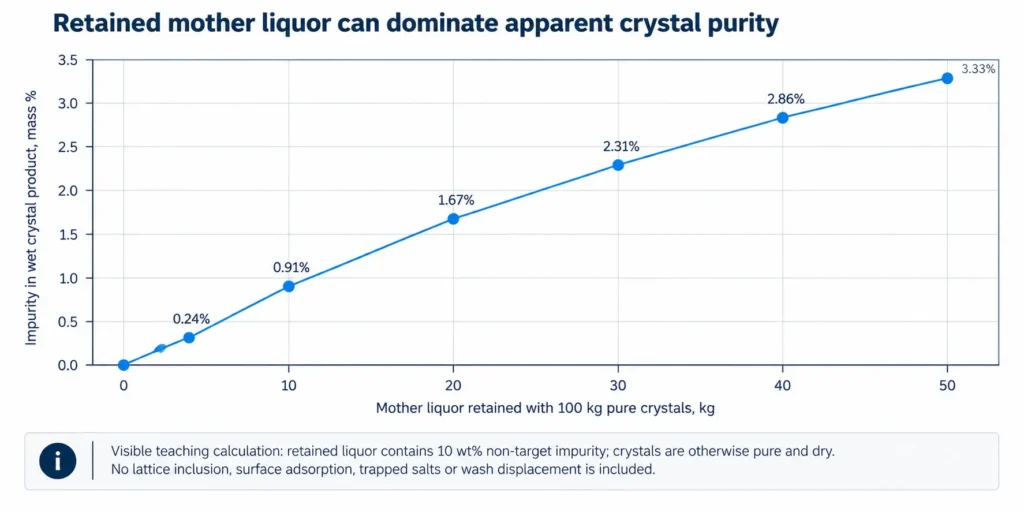
Figure 19.2. Illustrative mother-liquor retention calculation. It is not a product-purity benchmark.
| Impurity route | Diagnostic evidence | Control strategy | What washing can do | Remaining risk |
|---|---|---|---|---|
| Lattice inclusion / solid solution | Phase analysis, dissolution profile, microscopy or composition versus crystal size. | Change phase, temperature path, supersaturation, impurity concentration or upstream removal. | Usually limited; surface washing does not remove lattice impurity. | Recrystallization or product downgrade may be required. |
| Surface adsorption / coating | Surface-sensitive analysis and impurity reduction after controlled wash. | Reduce liquor impurity, change surface chemistry, improve washing and residence. | Can remove accessible surface-bound liquor or coating if chemistry permits. | Re-adsorption, dissolution loss or incomplete displacement. |
| Mother-liquor entrapment | Cake moisture, wash curve, centrifuge/filter drainage and internal inclusions. | Grow/filter larger crystals, control agglomeration, improve separation and displacement wash. | Can displace interstitial liquor and reduce soluble impurities. | Internal inclusions and capillary retention remain. |
| Mixed / secondary phase | XRD/mineralogy, microscopy, thermal analysis and stagewise mass balance. | Stage crystallization, selective seeding, impurity purge or upstream conversion. | Cannot selectively wash away an insoluble co-precipitated phase. | Product becomes mixed salt or requires reprocessing. |
Table 19.6. Impurity mechanism determines whether washing, phase control or reprocessing is required.
19.9 Classify the solid honestly
ZLD can produce salt crystals as either a disposal solid or a resource. The 2025 Nature Reviews assessment treats both outcomes as valid system endpoints and emphasizes that current thermal crystallization remains effective but energy intensive. The presence of crystals does not determine which outcome applies.
A controlled commercial crystal meets a specification, remains consistent through normal and upset operation, has a legal route and a qualified user. A mixed disposal salt is a legitimate process output when it is intentionally produced, characterized and accepted by a receiver. Wet sludge or cake must retain its moisture and reagent burden in the mass balance. Stable solid waste requires demonstrated physical and chemical stability, not simply dryness.
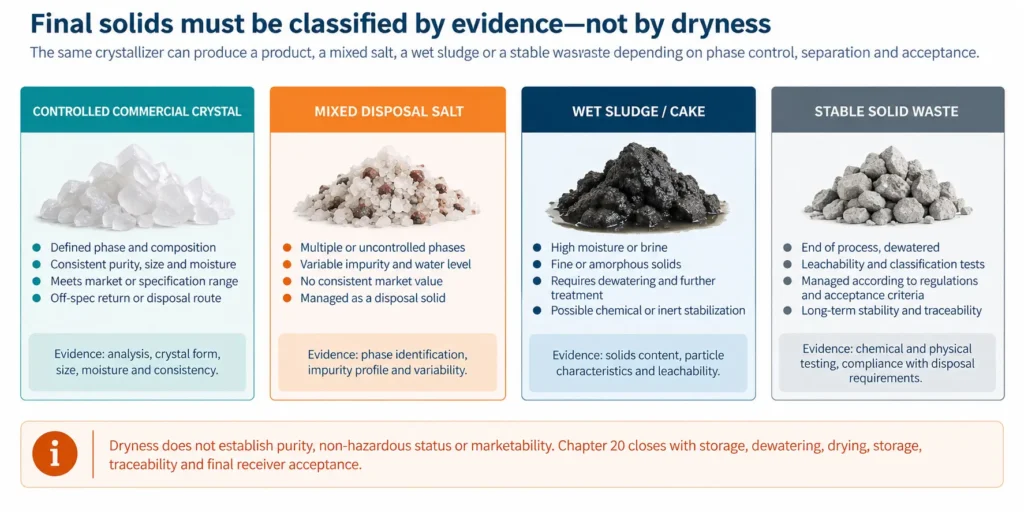
Figure 19.3. Final solids are classified by phase control, moisture, legal status and receiver acceptance.
| Output class | Minimum definition | Required measurements | Commercial / legal evidence | Fallback route | Prohibited claim |
|---|---|---|---|---|---|
| Controlled commercial crystal | Named crystalline phase with a repeatable specification and product form. | Purity, phase, PSD, moisture, trace contaminants, wash loss and stability. | Qualified internal user or buyer, legal status, packaging, logistics and rejection procedure. | Reprocess, downgrade or dispose off-spec material. | Calling a recovered solid a product because the target element is present. |
| Mixed disposal salt | Intentional multi-phase solid managed as waste or non-product residual. | Phase mix, dry/wet mass, moisture, leachability, contaminants and variability. | Waste classification and receiver acceptance. | Alternate landfill, stabilization or continued storage. | Assigning commodity revenue to an unqualified mixture. |
| Wet sludge / cake | Fine or precipitated solids retaining substantial liquid and treatment chemicals. | Dry solids, cake moisture, filtrate chemistry, reagent incorporation and leachability. | Transport/receiver acceptance and dewatering basis. | Further dewatering, stabilization or controlled liquid route. | Reporting only dry solids and hiding retained liquid. |
| Stable solid waste | Solid shown to remain manageable through storage, transport and final placement. | Physical stability, hygroscopicity, leachability, dust, heat/gas generation and compatibility. | Permit/acceptance, packaging and long-term liability. | Repackage, stabilize or move to alternate receiver. | Equating dryness with non-hazardous or permanent stability. |
Table 19.7. Product and waste labels require different but equally complete evidence.
19.10 Close the crystal, water and mother-liquor balance
A crystallizer balance must track water evaporated or frozen, accepted recovered water, crystal water of hydration, free mother liquor, entrained liquor, target phase, secondary phases, dissolved purge, wash water, filtrate return, seed and off-spec recycle. A water balance can close while the product and impurity balances fail.
The calculation should be stagewise. Each product withdrawal removes both crystals and retained liquor; each wash displaces liquor but can dissolve product; each recycle returns target salt and impurities; each purge sacrifices recoverable material to prevent accumulation. The model should show yield, purity and purge as linked outcomes rather than independent targets.
| Balance field | Mandatory inputs | Mandatory outputs | Cross-check | Unclosed term to show explicitly |
|---|---|---|---|---|
| Water | Feed water, evaporation/freezing, wash, melt, condensate, cake moisture and storage change. | Recovered water, residual liquor, hydrate water, wet solids and closure error. | Density/flow, dryer/centrifuge data and condensate/melt measurements. | Entrainment, vapour loss, sampling or inventory change. |
| Target salt / element | Dissolved and suspended feed, seed, reagent contribution and recycle. | Product crystal, secondary phase, mother liquor, purge, deposits and off-spec. | Elemental balance and phase analysis. | Unknown solid phase, scale inventory or analytical closure. |
| Impurities | Complete ion/organic/metal inventory plus added chemicals and corrosion products. | Lattice/surface/entrained product impurity, mother liquor and purge. | Product assay, wash curve, filtrate and mother-liquor trend. | Unmeasured ion, volatile loss or retained equipment inventory. |
| Crystal product | PSD, phase, purity, wet mass, cake moisture, wash and drying. | Dry product, wash loss, off-spec and packaging inventory. | Drying mass loss and product lot reconciliation. | Hygroscopic gain, dust or unrecorded recycle. |
| Mother liquor | Flow, composition, density, temperature and suspended fines by cycle/time. | Recycle, purge, wash return, storage and final destination. | Time-dependent accumulation model. | Closed-loop buildup, episodic dump or crystallizer heel. |
Table 19.8. The crystallization balance must close water, target phase, impurities and mother liquor together.
19.11 Crystallization acceptance gate
A crystallization route should advance only when it produces the intended output under representative normal, design and upset chemistry and when the mother liquor, wash, off-spec and final purge remain manageable. One clean batch is not evidence of stable continuous operation.
| Gate field | Minimum evidence | Proceed condition | Conditional / recycle trigger | Owner / record |
|---|---|---|---|---|
| Output definition | Product or waste specification, legal status, receiver and fallback. | Output class is explicit and accepted. | No buyer/receiver, undefined mixed salt or revenue-only justification. | Product/residual owner and commercial/legal register. |
| Phase and impurity path | Validated phase diagram/model plus representative experiments. | Target phase and impurity rejection repeat across the envelope. | Unexpected hydrate, double salt, co-precipitate or lattice impurity. | Process chemistry lead and phase-test report. |
| Crystallizer architecture | Population kinetics, slurry rheology, heat/mass transfer and control philosophy. | Selected FC/DTB/other system meets size, yield, uptime and cleanability. | Fines, encrustation, unstable PSD or scale-up gap. | Crystallization lead and vendor/test package. |
| Solid-liquid separation | Filter/centrifuge, wash, moisture and product-loss tests. | Required purity and moisture are achieved with closed wash/filtrate balance. | High liquor retention, excessive dissolution or unmanageable fines. | Solids-separation lead. |
| Mother liquor / purge | Time-dependent impurity model, recycle, storage, purge and destination. | No uncontrolled accumulation; purge is accepted and costed. | Closed-loop buildup or no route for concentrated purge. | Process and residuals leads. |
| Final water removal route | Thermal, spray, freeze or solar utilities, emissions and contingency. | Water removal remains justified and integrated with site utilities. | Energy/land/gas dependence or off-spec water/solid lacks fallback. | Utilities/environmental leads. |
| Scale-up and availability | Pilot duration, cycles, cleanings, starts/stops and material inspection. | Evidence maturity matches project commitment and guarantee. | Laboratory purity or yield used as full-scale guarantee basis. | Project manager and independent reviewer. |
Table 19.9. Crystallization acceptance gate before final solids handling and project claims.
Acceptance ruleA crystallizer passes only when the target output, phase path, crystal population, separation, mother-liquor purge, utility system, off-spec route and evidence maturity are all explicit. A technically dry output with no stable receiver or impurity control does not pass. |
|---|
19.12 Handover to Chapter 20
Chapter 20 closes the physical and regulatory route for the solids produced here. The handover must state the dry and wet mass, phase identity, particle-size distribution, cake moisture, hygroscopicity, retained mother liquor, wash and filtrate composition, trace contaminants, leachability needs, dust or gas hazards, storage conditions, packaging, transport and receiver specification.
The crystallization chapter should also identify off-spec lots, seed and fines recycle, purge salt, spray-dryer powder, pond harvest, mixed salt and any residual liquid that remains. Chapter 20 then selects thickening, centrifugation, filtration, washing, drying, stabilization, storage and final acceptance without changing the product or waste classification by wording alone.
19.13 Chapter conclusion
Crystallization is the controlled conversion of supersaturation into a separable solid phase. Forced-circulation crystallizers favour robust slurry handling; DTB crystallizers favour controlled growth of coarser crystals. Evaporative, cooling, staged, solvent-driven and eutectic-freeze routes use different phase paths and create different utilities, products and residuals. Spray drying and solar evaporation can remove final water, but they do not automatically create a controlled crystal product.
Purity is controlled through the mother liquor and impurity path. Lattice inclusion, surface retention, entrapped liquor and secondary phases require different responses. Washing can displace accessible liquor; it cannot repair an incorrect phase path. Every recycle and wash also changes yield and impurity accumulation, so product recovery, purity and purge must be solved together.
The defensible endpoint is explicit: controlled commercial crystal, mixed disposal salt, wet sludge or stable solid waste. Each can be a legitimate output when its mass, composition, moisture, legal status, receiver and downside route are proven. Chapter 20 now closes dewatering, washing, drying, storage, transport and final liability.
Chapter 19 in one sentenceCrystallization creates value only when phase, crystal population, mother liquor, impurities and the final solid route are controlled as one system. |
|---|