
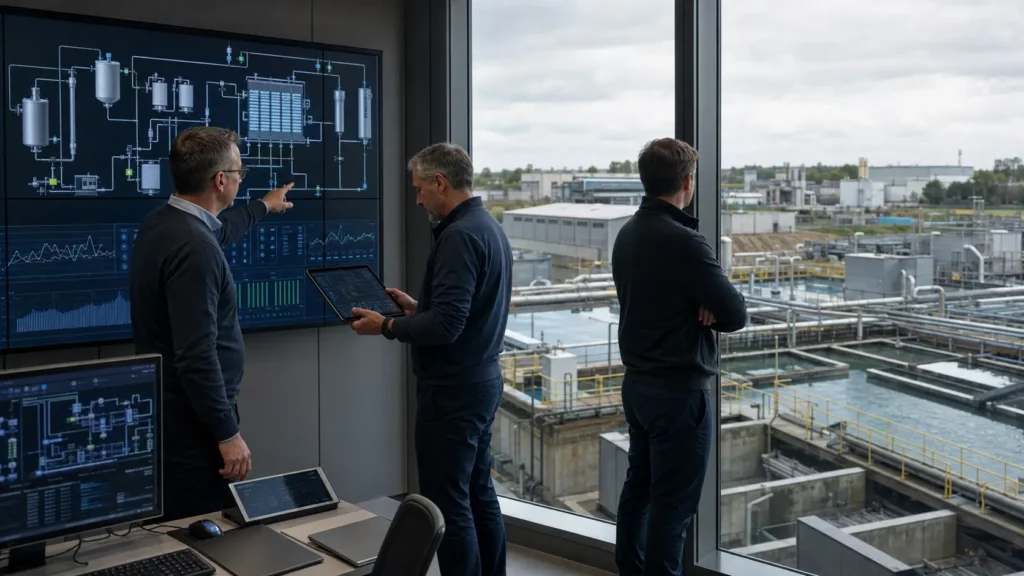
A domain defined by operational constraints and chemistry—not by a single TDS threshold.
Controlled definitionHigh-salinity industrial wastewater is an industrial liquid stream in which dissolved salts materially constrain reuse, treatment, discharge or resource recovery. No single TDS threshold applies across sectors. |
|---|
1.1 A practical domain, not a universal concentration class
The phrase high-salinity industrial wastewater sounds numerical, but the engineering problem is functional. A stream belongs in this domain when its dissolved salts materially change what the owner can do with the water: whether it can be reused, whether a biological or membrane process can operate, whether a discharge route remains permissible, whether evaporation or crystallization becomes necessary, or whether a recoverable constituent can be separated at credible purity and cost. The relevant threshold therefore moves with the sector, the receiving environment, the process objective and the site’s infrastructure.
This distinction matters because salinity classifications were largely developed for natural-water description and water-use suitability. The U.S. Geological Survey, for example, classifies 10–35 g/L as highly saline and notes that seawater is approximately 35 g/L. That scale is useful for orientation, but it is not a treatment boundary. A lower-salinity industrial stream can be difficult because of silica, sulfate, oil, solvents, metals or extreme variability. A cleaner and more stable sodium-chloride brine at a higher TDS may be easier to model, condition and concentrate, even though it imposes a larger osmotic and corrosion burden.
Accordingly, this guide does not define high-salinity industrial wastewater by one cut-off value. The term is used when salinity has become a controlling project variable. The owner should state the number, the analytical method and the operational consequence rather than rely on the adjective alone.
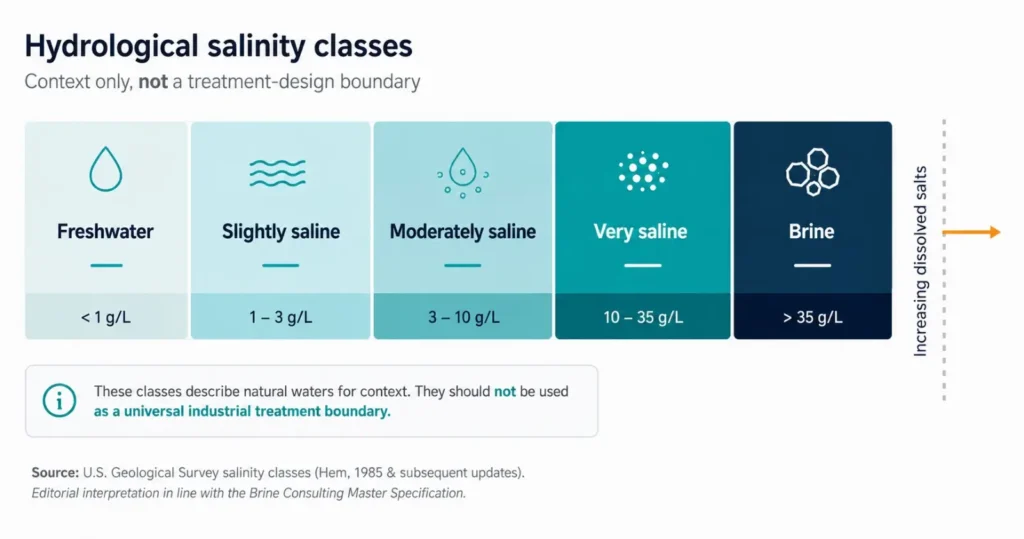
Figure 1.1. A common hydrological salinity classification for context. It should not be used as a universal industrial treatment boundary.
Source: U.S. Geological Survey salinity classes [3]. Editorial interpretation and warning against a universal treatment threshold follow the Brine Consulting master specification [BC].
1.2 TDS is an aggregate measurement, not a treatment diagnosis
Total dissolved solids (TDS) is often the first number requested and the last number challenged. It is useful—but only within its analytical boundary. Gravimetric TDS is the mass of filterable residue remaining after a defined evaporation and drying procedure. Salinity is a related but distinct measure of dissolved salts, while specific conductance is an electrical proxy whose relationship with dissolved mass depends on ion type and water chemistry.
The distinction is not academic. In a 2023 U.S. Geological Survey study of 6,391 surface-water samples, median TDS values differed from speciated-ion salinity by roughly 19–24%, depending on the TDS method. The study also found that conductance-based estimation improved substantially when the major-ion water type was known. These results were obtained for natural waters, not industrial brines, but they show why a single reported number cannot be treated as a complete chemical description.
For concentrated industrial matrices, method limitations can become more important. Highly mineralized residues may be hygroscopic; bicarbonate changes form during drying; excessive residue can entrap water; volatile constituents and gases are not represented in the same way as non-volatile salts; and filtered TDS excludes suspended solids and free oil by definition. A laboratory result therefore needs its method, dilution history, detection limits and quality-control notes.
What TDS can tell you—and what it cannotTDS can indicate the overall dissolved-residue burden and support rough mass balances. It cannot identify the ions present, their speciation, saturation state, osmotic activity, scaling sequence, corrosion risk, organic load, oil, suspended solids, biological activity, process additives or variability. |
|---|
| Descriptor | What it contributes | What it does not resolve |
|---|---|---|
| TDS / filterable residue | Aggregate dried residue after filtration and heating. | Ion identity, speciation, oil/TSS, volatility and saturation sequence. |
| Salinity from speciated ions | Sum of measured dissolved ionic species on a stated mass or volume basis. | Unmeasured ions, neutral species, organics and analytical closure errors. |
| Specific conductance | Rapid indicator of the water’s ability to carry electric current. | A universal TDS conversion; the relationship changes with ion type, temperature and concentration. |
| Density, activity and osmotic pressure | Mass-flow conversion plus thermodynamic and pressure/energy constraints. | Scaling, fouling, corrosion and product purity without full chemistry. |
| Major ions and alkalinity | Charge balance, scale-forming species, monovalent/divalent split and chemical-dose basis. | Organics, oil, colloids, biology or all trace contaminants. |
| Non-salt loads and operating context | TOC/COD, oil, TSS, pH, temperature, redox, additives and the normal/design/upset envelope. | The dissolved-salt burden, ionic selectivity or a complete composition without full analytical data. |
Table 1.1. A design-ready description requires multiple complementary measurements; no single descriptor replaces the others.
1.3 Same TDS, completely different wastewater
A TDS value collapses a composition vector into one scalar. Two streams can therefore report the same dissolved-residue concentration while presenting different limits, different residuals and different product opportunities. The practical questions are not merely “How much salt?” but “Which ions?”, “In what form?”, “What changes during concentration?” and “What else is present that TDS does not capture?”
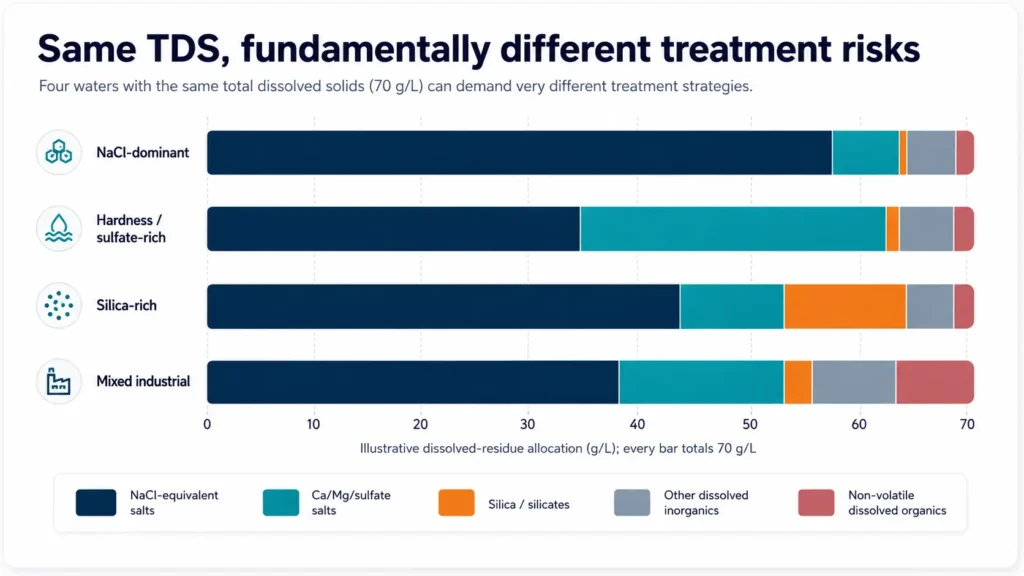
Figure 1.2. Illustrative equal-TDS waters with different compositions. The bars are explicit assumptions for teaching and are not representative design feeds.
Figure basis: four synthetic 70 g/L composition allocations created solely to demonstrate the information loss that occurs when chemistry is reduced to TDS. Oil, suspended solids, temperature, pH and variability are intentionally shown outside the TDS balance.
| Illustrative chemistry | Controlling risk | Likely design consequence | Residuals that must be named |
|---|---|---|---|
| NaCl-dominant brine | Osmotic pressure, chloride corrosion and sodium-chloride product purity. | Pressure-driven concentration where justified; selective divalent removal; thermal finishing near saturation. | Permeate/concentrate, cleaning waste, corrosion products and a controlled mother-liquor purge. |
| Calcium–magnesium–sulfate-rich stream | Carbonate/sulfate precipitation and large chemical-sludge loads. | Selective softening or precipitation before deeper concentration; solids dewatering becomes a core unit operation. | Softening sludge, wash water, filtrate recycle and residual multivalent load. |
| Silica-rich saline stream | Silica/silicate polymerization and deposition, often sensitive to pH, metals and concentration history. | Source segregation, pH/temperature control, targeted removal and conservative recovery limits. | Silica-rich sludge or concentrate, cleaning waste and potentially unstable recycle chemistry. |
| Organic- or oil-bearing saline stream | Membrane fouling, wetting, foaming, volatile carryover and incompatibility with downstream product recovery. | Oil/solids removal, equalization and dedicated organic treatment before salt concentration. | Oily sludge, spent media, concentrate, off-gas/condensate contaminants and cleaning waste. |
Table 1.2. Equal TDS does not imply equal treatability, recovery or residual management.
1.4 The stream name should preserve its origin
“Brine” is a useful descriptive word, but it is too broad to carry a design basis. The stream name should retain the process that created it because origin explains what was rejected, concentrated, displaced, dosed or reacted. The same liquid may be legally and operationally different depending on whether it is a raw process stream, a membrane concentrate, a regeneration waste or a crystallizer purge.
| Controlled term | Required meaning | Why the distinction matters |
|---|---|---|
| Brine | Any saline liquid stream. | Origin, legal status, treatability and economic value remain undefined. |
| Concentrate | The retained, salt-enriched stream from a separation process. | Name the process where clarity matters: RO concentrate, NF concentrate, ED concentrate. |
| RO concentrate | Water and solutes rejected by reverse osmosis, plus any species introduced or transformed by pretreatment and operation. | Feed chemistry, stage recovery, antiscalants, cleaning history and recycle determine the actual composition. Reclamation treats concentrate management as a site-specific systems problem rather than a single disposal choice. |
| Process brine | A saline stream generated directly by manufacturing, extraction, washing, reaction, neutralization or product purification. | It may contain product losses, catalysts, solvents, reducing/oxidizing agents or batch-specific chemistry. |
| Produced water | Water co-produced with oil, gas or geothermal fluids, potentially including formation water, injected water and production chemicals. | Composition varies by basin, formation, well, operating history and time. The USGS national database therefore records physical properties, inorganic chemistry, organic chemistry and isotopes rather than relying on TDS alone. |
| Cooling-tower blowdown | The controlled removal of recirculating water to limit the accumulation of dissolved solids and treatment chemicals. | The chemistry reflects make-up water, cycles of concentration, evaporation, corrosion/scale control and biological treatment. |
| Regeneration waste | Spent regenerant from ion exchange, softening or other cyclic separation processes. | Contains unused regenerant plus displaced ions and impurities; it is not equivalent to a clean NaCl solution. |
| Mother liquor | Liquid remaining after crystallization, enriched in non-crystallizing and rejected impurities. | Requires explicit recycle and purge logic; “closed loop” without impurity control is not a valid mass balance. |
| Purge stream | A deliberately withdrawn fraction used to control accumulation in a recycle loop. | Its flow, composition and destination are part of the process—not an incidental loss. |
Table 1.3. Controlled terminology for the booklet. Definitions follow the Brine Consulting master specification [BC]; external sources add context for selected stream types.
1.5 What makes salinity a project constraint?
A stream enters the high-salinity project domain when dissolved salts materially change one or more decisions. Four tests are useful at the first screening stage.
1. Reuse constraint. The stream cannot be returned to the intended process, cooling system, boiler, irrigation scheme or product-contact use without salt removal or selective conditioning. The relevant limit is set by the use—not by a generic TDS value.
2. Treatment constraint. Osmotic pressure, saturation, ionic activity, viscosity, corrosion, fouling or reaction chemistry changes the feasible treatment window, energy demand, materials or uptime. A technology may be established in one salinity range but unsuitable for the actual composition and residual route.
3. Discharge constraint. The baseline liquid route is unavailable, capacity-limited, environmentally unacceptable, expensive or creates long-term liability. The required response may be source reduction, segregation, MLD, ZLD or a different disposal system—not necessarily maximum recovery.
4. Resource-recovery constraint. A target constituent is present, but competing ions, impurities, product form, market scale, regulation or logistics determine whether it can become a product. Presence is an inventory statement; recoverability and bankability require separate evidence.
Decision disciplineDo not ask “Is this brine?” and jump to a technology. Ask: What is the operational problem? What is the system boundary? Which species controls the next step? What water or product is required? Where will every residual go? |
|---|
1.6 The minimum characterization before technology screening
The first data request should establish a normal, design and upset basis. A single laboratory certificate and an average flow are not enough. At minimum, the owner should provide:
- Average, minimum, design and peak flow, including batch duration, production campaigns, cleaning events and seasonal variability.
- pH, temperature, conductivity, gravimetric TDS or stated salinity method, density, alkalinity/inorganic carbon and a complete major-ion analysis sufficient for charge-balance checking.
- Calcium, magnesium, barium, strontium, sulfate, carbonate/bicarbonate, silica, fluoride, phosphate and other site-specific scale-forming or toxic species.
- TSS, turbidity, particle size where relevant, oil and grease, TOC/COD, volatile or persistent organics, biological activity and dissolved gases where relevant.
- All process additives, treatment chemicals, antiscalants, coagulants, corrosion inhibitors, biocides, solvents, catalysts, neutralization reagents and CIP chemicals.
- Existing treatment and recycle loops, tank residence times, spills/upsets, material-of-construction problems, cleaning frequency and current residual destinations.
- The required product-water quality, internal reuse opportunity, discharge or disposal constraint, and any proposed recovered product specification or buyer requirement.
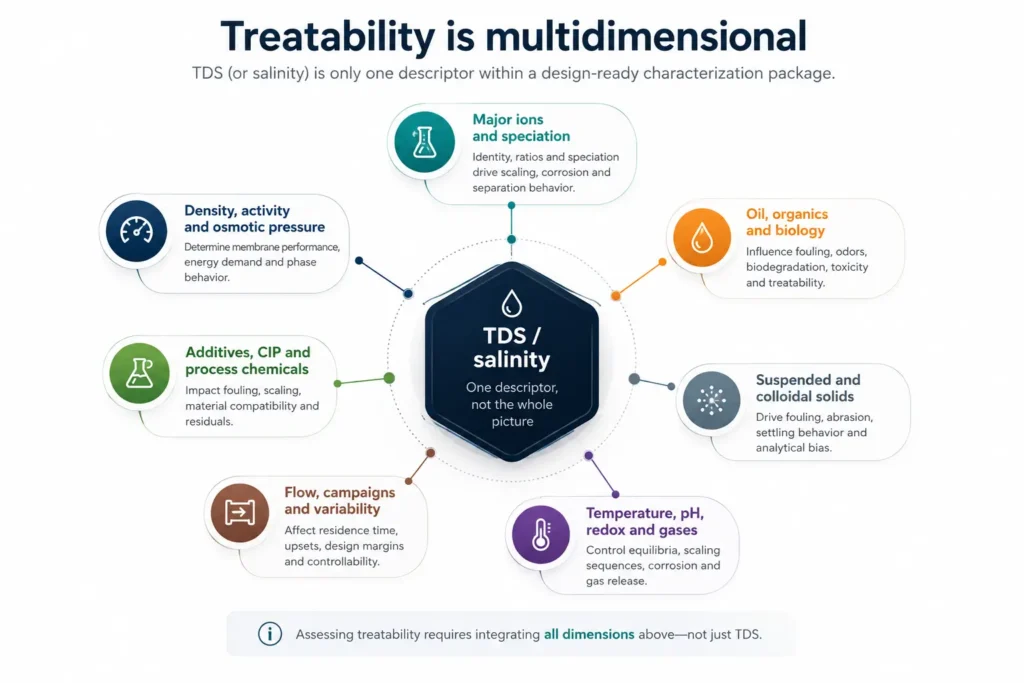
1.7 Chapter conclusion
High-salinity industrial wastewater is best understood as a decision domain. Dissolved salts have become material to the owner’s ability to reuse water, operate treatment, discharge residuals or recover products. That condition can occur below, near or far above seawater salinity, depending on chemistry and context.
TDS remains useful for first-pass inventory and mass balance, but it is not a proxy for treatability. The ion pattern, organics, oil, solids, temperature, pH, additives and variability determine what precipitates, what fouls, what corrodes, what can be separated and what residuals will be created. The stream’s origin must remain visible in its name because origin carries process history and impurity risk.
The practical consequence is simple: characterize before selecting technology. The next chapters therefore begin with the whole-site water balance, representative sampling and design-ready chemistry rather than with an equipment list.
Chapter 1 in one sentenceHigh salinity is not a number alone; it is the point at which dissolved salts become a controlling system constraint. |
|---|