
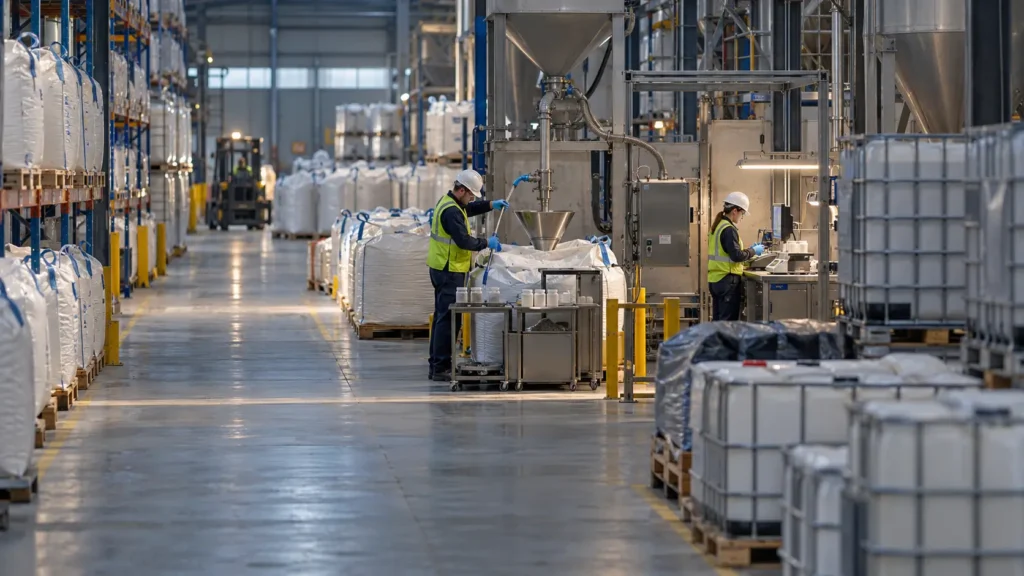
Show the distance between a recovered material and a saleable or internally accepted product.
Controlled principlePurity is not a single number and qualification is not a certificate attached after process design. A recovered material becomes a product only when its identity, composition, physical form, performance, variability, analytical basis, legal route and acceptance criteria are defined for a named use—and representative lots repeatedly meet them. |
|---|
Recovered material, specification and qualification are different states
Chapter 24 handed forward product cards with a source position, impurity burden, proposed form, user or buyer, residual route and maturity basis. Chapter 25 converts that pathway into an auditable acceptance system. The central distinction is between what the process captures, what the specification requires and what the user or buyer has actually accepted.
A recovered precipitate, crystal, solution or water stream may have high target assay while remaining unsuitable for use. It may carry the wrong hydration state, particle morphology, moisture, trace contaminant, salt carryover, microbiological risk, packaging condition or batch variability. Conversely, a lower-purity material can be fully qualified when the intended internal use tolerates the impurity profile and the avoided-purchase case is documented. The specification therefore begins with function, not with the highest achievable purity.
| Material state | What is established | Minimum evidence | What is not yet proven | Permitted project claim |
|---|---|---|---|---|
| Recovered material | A target constituent or useful stream has been separated or concentrated. | Closed mass balance; source stream; chemical basis; recovery and residual route. | Conformity with a use-specific specification, consistency, legal status or acceptance. | Recovered intermediate or treatment output. |
| Draft product candidate | A proposed form, use and preliminary specification have been named. | Product card; target/impurity profile; proposed methods; user or buyer hypothesis. | Representative-lot performance and formal acceptance. | Candidate product subject to qualification. |
| Conforming lot | A defined lot meets stated limits under an agreed decision rule. | Representative sample; controlled method; uncertainty/decision rule; traceable lot record. | Long-term process capability or user performance unless separately demonstrated. | On-spec lot for the stated boundary. |
| Qualified internal material | The site user has approved the material for a named duty. | Application trial; operating limits; substitution ratio; change-control and rejection route. | Merchant saleability or transfer of approval to another user. | Accepted internal reuse / avoided purchase. |
| Qualified external product | The buyer and applicable legal route accept the delivered form. | Buyer protocol; contract specification; legal/product documentation; packaging, transport and off-spec clauses. | Bankable revenue without the Chapter 26 market and netback analysis. | Qualified product candidate for offtake. |
Table 25.1. Purity, conformity and qualification are separate evidence states.
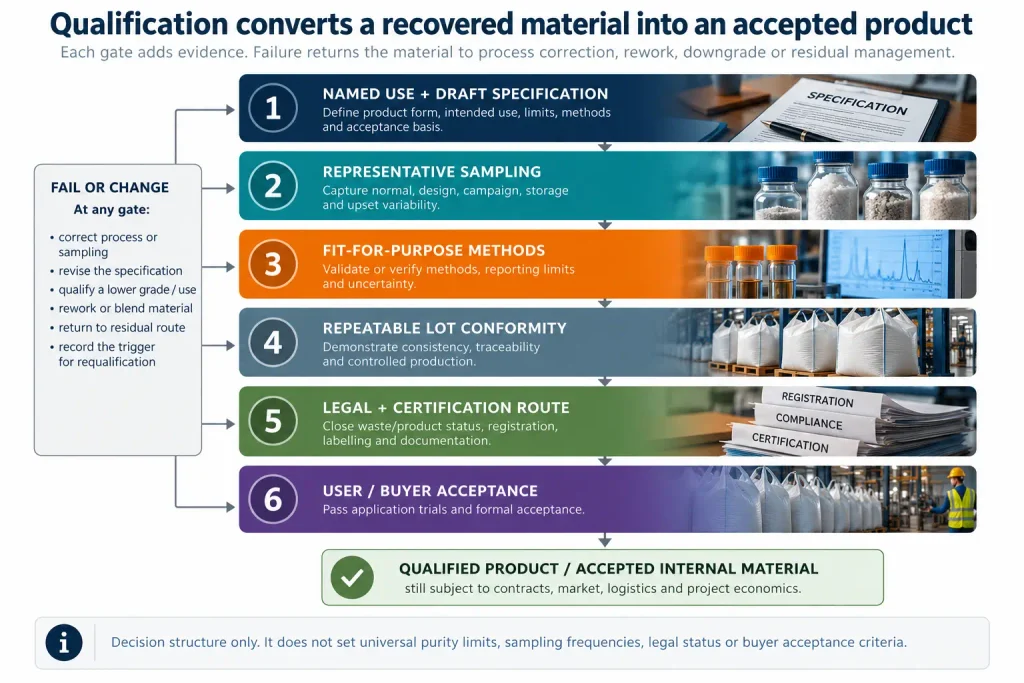
Figure 25.1. Product-qualification funnel. Every gate can return the material to process correction, a lower-grade use or residual management.
Build the specification backward from the named use
A useful specification is an interface between the process and the receiver. It states what must be delivered, how it will be measured, how a lot will be accepted and what happens when the result is uncertain or outside limits. It is not a list of every analyte the laboratory can report. Each limit should protect product identity, process performance, health and environmental requirements, transport or storage stability, or another explicit user need.
The starting question is therefore not “What purity can the plant make?” but “What material does the named use require, and what is the lowest-burden route that can meet it reliably?” This prevents unnecessary polishing while exposing requirements that chemistry-only development often misses: dry basis versus as-received basis, hydrate or polymorph, free liquid, particle-size distribution, solution strength, trace metals, organic residues, microbiology, dissolution behaviour and packaging stability.
| Specification block | Required definition | Typical evidence | Common ambiguity | Design consequence |
|---|---|---|---|---|
| Identity and basis | Compound/phase, ionic or elemental basis, hydration state, solution strength and dry/as-received basis. | Phase/chemical analysis and explicit calculation basis. | “99% product” without naming denominator, phase or moisture basis. | Wrong stoichiometry, product mass or grade claim. |
| Assay / active content | Target concentration or mass fraction and whether a minimum, range or nominal value applies. | Validated/verified method across representative range. | Recovery percentage reported as purity. | Additional wash, conversion, concentration or blending duty. |
| Impurity limits | Major ions, trace metals, organics, insolubles, process additives and use-specific contaminants. | Specification list tied to receiver risk and method reporting limits. | Non-detect treated as zero; total and dissolved basis mixed. | Selective removal, purge, reagent change or downgrade. |
| Physical form | Particle size/morphology, moisture, bulk density, viscosity, colour, free liquid and handling state. | Representative lot and storage/transport tests. | Chemical assay used as proxy for handling performance. | Drying, classification, granulation, packaging or storage controls. |
| Functional performance | Dissolution, reactivity, filtration, strength, scaling/corrosion effect, substitution ratio or reuse suitability. | Application-specific trial against incumbent material or control water. | Assumed equivalence because chemical formula matches. | Process redesign or internal-use limitation. |
| Microbiological / hygiene | Use-specific indicators, pathogens, regrowth control and sampling point where relevant. | Jurisdiction- and application-specific protocol. | Universal microbial limit copied between uses. | Disinfection, storage residence-time and monitoring requirements. |
| Lot and decision rule | Lot definition, sampling plan, analytical uncertainty, rounding and conformity rule. | Written acceptance protocol agreed before testing. | Borderline result judged ad hoc after analysis. | Re-test disputes, hidden rejection and unpriced risk. |
| Delivery and fallback | Packaging, labelling, shelf life, storage, transport, certificate and off-spec route. | Delivered-product trial and contract-ready specification. | Plant-gate sample assumed equal to delivered product. | Re-drying, segregation, quarantine, return or disposal capacity. |
Table 25.2. Minimum architecture of a use-specific product specification.
Specification ownershipThe user or buyer owns the acceptance need; the process designer owns the ability to meet it; the laboratory owns valid measurement within its scope; and the project owner owns the commercial and residual consequences. No single party can close qualification alone. |
|---|
Chemical purity must state identity, basis and trace-contaminant burden
Chemical purity begins by identifying the material actually produced. For salts and mineral products this may require more than elemental analysis: crystal phase, hydration state, double salts, amorphous fraction, retained mother liquor and reagent-derived ions can all change the active content and end use. A sodium-rich crystal cake, for example, cannot be treated as pure NaCl merely because sodium and chloride dominate the assay. Likewise, magnesium measured in a precipitate does not distinguish Mg(OH)2, MgCO3, mixed hydroxide/carbonate phases or occluded brine.
The specification must separate intrinsic impurities from removable surface contamination and process variability. Lattice substitution or co-precipitation may require a different separation route; retained mother liquor may respond to washing and dewatering; reagent contamination may be reduced by a different chemical source; storage pickup may require packaging control. This classification links an out-of-spec result to a corrective action rather than to generic “more purification.”
Trace limits should be selected from the use and legal route, then matched to an analytical method with a suitable working range and reporting limit. A limit below the method’s reliable quantification capability creates false confidence. A result reported as “not detected” means only that the method did not detect the analyte under stated conditions; it does not establish zero concentration. Method validation or verification, matrix effects, recovery, precision, blanks, calibration and sampling must be adequate for the decision being made.
| Quality question | What to distinguish | Evidence / method need | Failure signal | Process response |
|---|---|---|---|---|
| What is the product? | Element, ion, compound, phase, hydrate, solution or mixture. | Identity method appropriate to material; chemical and phase basis aligned. | Elemental balance cannot explain crystal/mineral phase. | Revise conversion, crystallization or product claim. |
| Where is the impurity? | Lattice/structure, co-precipitate, surface liquor, entrainment, reagent or storage pickup. | Mass balance plus washed/unwashed and dry/as-received comparisons. | Purity improves only temporarily or varies with washing. | Target the actual impurity mechanism. |
| Is the limit measurable? | Specification limit versus detection/quantification capability and matrix interference. | Fit-for-purpose method, blanks, spikes/reference material and uncertainty where relevant. | Repeated non-detects near an unrealistic limit. | Change method, limit or product route before qualification. |
| Is purity repeatable? | Normal, start-up, campaign, recycle and upset lots. | Lot distribution, process conditions and traceable sampling. | One showcase batch differs from production distribution. | Extend demonstration; identify control variable and purge logic. |
| Does purification preserve value? | Product loss, water/reagent use, new residuals and downtime. | Incremental mass/energy/residual balance. | Purity achieved only with excessive rework or rejection. | Downgrade use or stop merchant-product route. |
Table 25.3. Chemical purity must be linked to identity, impurity mechanism and measurable limits.
Physical form can control acceptance even when chemistry passes
Many recovered minerals fail as products because their physical form is ignored. Particle-size distribution affects dissolution, reactivity, filtration, dusting, blending and downstream dosing. Morphology influences cake dewatering, wash efficiency, flowability and bulk density. Moisture may dilute assay, retain corrosive mother liquor, promote caking or make freight uneconomic. Colour can indicate contamination or simply differ from an incumbent material; either way the receiver may treat it as a quality parameter.
The test method must fit the product and intended comparison. ISO 13320 provides general guidance for laser-diffraction particle-size measurement in two-phase systems but does not set material-specific product requirements; sample dispersion and optical assumptions remain part of the method. [6] For irregular crystals or agglomerates, image analysis, sieving, microscopy or a receiver-specific method may be more useful. The specification should not mix results from different preparation or measurement methods as if they were directly interchangeable.
| Physical attribute | Why it matters | Minimum reporting basis | Storage / delivery question | Typical corrective action |
|---|---|---|---|---|
| Particle-size distribution | Dissolution rate, reactivity, filtration, dust, dosing and downstream compatibility. | Method, dispersion/preparation, characteristic percentiles or sieve fractions. | Does attrition, agglomeration or humidity change the delivered distribution? | Classification, milling, granulation, crystallizer control or packaging change. |
| Morphology / phase habit | Dewatering, retained liquor, flowability, surface area and user response. | Representative microscopy or image analysis with phase context. | Does handling break crystals or create fines? | Seed/control supersaturation; change washing or drying. |
| Moisture / free liquid | Active content, caking, corrosion, freight and microbial/storage risk. | Method, temperature, dry/as-received basis and mother-liquor composition. | Does moisture rebound during storage? | Improve dewatering/drying, barrier packaging or lower-grade use. |
| Bulk density / flowability | Silo, bag, feeder, truck and dosing capacity. | Loose/tapped basis, conditioning and repeatability. | Can existing receiver equipment unload and meter it? | Granulate, densify, change package or revise delivery rate. |
| Colour / appearance | Contamination signal, customer expectation and application aesthetics. | Defined method or controlled visual standard where justified. | Does oxidation, organics or storage alter appearance? | Remove source contaminant, protect storage or change use. |
| Solution viscosity / strength | Pumpability, metering, heat transfer and chemical substitution. | Temperature, concentration basis, density and viscosity method. | Will crystallization or stratification occur in transit/storage? | Dilute/concentrate, heat-trace, mix or constrain delivery window. |
Table 25.4. Physical-form qualification links the plant product to storage, transport and user equipment.
Dissolution, functional performance and microbiological limits are use-specific
A matching chemical formula does not guarantee matching performance. A recovered CaCO3 may have a different surface area, particle habit, trace-metal profile or moisture content from a purchased filler. Recovered Mg(OH)2 may differ in neutralization rate or filtration behaviour. BPED acid and alkali can meet concentration targets while salt leakage limits their substitution ratio. Recovered water may satisfy salinity requirements but remain unsuitable for a boiler, cooling tower, wash step or process contact because silica, hardness, organics, corrosion potential or microbiology are not controlled.
The qualification plan should therefore include a functional test that represents the intended use. Internal substitution trials are especially valuable because they expose process interactions under controlled risk and can quantify avoided purchase, treatment or transport. The trial must nevertheless define success criteria, monitoring period, upset response and the conditions that trigger requalification.
Microbiological requirements cannot be imported from an unrelated water-reuse or product standard. EPA’s current industrial-reuse resources compile jurisdiction-specific authorizations, water-quality specifications and monitoring requirements, illustrating that the required limits depend on source, exposure and end use rather than on a universal “recycled water” grade. Similar use-specific reasoning applies to recovered salts or chemicals where food, pharmaceutical, agricultural or worker-contact routes introduce separate hygiene and certification burdens.
| Candidate / use | Chemistry-only claim that is insufficient | Functional qualification question | Additional evidence | Stop / downgrade signal |
|---|---|---|---|---|
| Recovered water for cooling | TDS and pH meet target. | Does the water control scaling, corrosion, biofouling, aerosol/exposure and cycles of concentration? | Site water model, materials check, monitored trial and use-specific compliance. | Treatment or monitoring burden exceeds avoided-water value. |
| Recovered water for boiler feed | Conductivity is low. | Are silica, hardness, alkalinity, organics and dissolved gases compatible with pressure and treatment programme? | Boiler-vendor/user specification and controlled trial. | Risk to steam system, product or reliability cannot be bounded. |
| Recovered mineral as reagent | Assay matches purchased chemical. | Does dose-response, dissolution/reactivity and impurity transfer match the process duty? | Side-by-side substitution trial and downstream mass balance. | Higher dose or impurity burden destroys avoided-cost value. |
| Recovered salt for industrial use | Major salt content is high. | Do moisture, insolubles, trace ions, crystal form and dissolution fit the receiver? | Delivered sample, storage test and application run. | Receiver requires extensive reprocessing or rejects variability. |
| Recovered acid / alkali | Nominal concentration is achieved. | Does salt contamination, colour, metals and concentration stability permit substitution? | Compatibility and dosing trial; membrane-leakage control. | Only a small blend fraction is usable or quality drifts. |
Table 25.5. Functional qualification closes the gap between analytical composition and useful performance.
Sampling and analytical methods are part of the product specification
A laboratory result is meaningful only for the sample, method and decision boundary represented. Product qualification therefore starts before the sample reaches the laboratory. The plan must define the lot, sampling point, timing, increment pattern, compositing, preservation, container, storage time, chain of custody and the operating state represented. A grab sample from a stable solution, a composite across a crystallizer campaign and a multi-increment powder sample answer different questions.
Laboratories operating to ISO/IEC 17025 can demonstrate competence and the ability to generate valid results within their accredited scope. Accreditation is not a blanket guarantee for every matrix or method: the project must confirm that the specific test, range and material fall within the laboratory’s capability. Eurachem’s 2025 guidance emphasizes that validation or verification translates the customer problem into required method performance, now explicitly including sampling and sample handling.
The acceptance protocol must also state the decision rule. ILAC G8 addresses decision rules when laboratories issue statements of conformity, while JCGM 106 explains the role of measurement uncertainty in conformity assessment. [3,5] The project does not need to prescribe one universal guard band. It must, however, agree before testing how uncertainty, rounding, replicate results and results near a limit will be treated. Otherwise the same analytical result can be accepted by one party and rejected by another.
Borderline-result ruleDefine the conformity decision before samples are analysed. The protocol should state the specification limit, reported basis, measurement uncertainty treatment, rounding, re-test authority, sample-retention period and who bears the consequence of an inconclusive or failed result. |
|---|
| Evidence field | Required record | Why it matters | Failure mode | Qualification response |
|---|---|---|---|---|
| Lot definition | Production period, mass/volume, source stream, operating mode and segregation rules. | Connects result to material released or used. | Sample passes but released inventory includes a different campaign. | Redefine lots and quarantine boundaries. |
| Sampling plan | Point, time, increments, composite/grab basis, frequency and representativeness rationale. | Captures spatial and temporal variability. | Convenient sample misses fines, surface liquor or start-up drift. | Change sampling and repeat representative demonstration. |
| Sample handling | Container, preservation, homogenization, drying, temperature, hold time and chain of custody. | Prevents alteration before analysis. | Crystallization, oxidation, settling, microbial change or moisture loss. | Validate handling or move testing closer to process. |
| Method suitability | Analyte/form, matrix, range, selectivity, precision, bias/recovery and reporting limit. | Ensures the test can support the specification decision. | Method is outside range or matrix interference dominates. | Verify/validate or select another method/laboratory. |
| Laboratory competence | Accreditation scope where relevant, quality-control records and traceability. | Supports valid and accepted results. | Accreditation cited without confirming the method/matrix. | Scope review, split samples or independent confirmation. |
| Uncertainty / decision rule | Uncertainty where material, acceptance rule, rounding and retest logic. | Makes conformity statements reproducible. | Borderline lots decided after commercial pressure is known. | Agree rule before qualification and contract. |
| Data integrity | Raw data, calculations, corrections, versions, certificates and retention period. | Supports audit, disputes and change control. | Only a summary certificate survives. | Controlled digital record and traceable certificate package. |
Table 25.6. The sampling and analytical package must be designed for the acceptance decision.
Batch consistency matters more than a showcase result
Qualification is a distribution problem, not a best-batch problem. A single lot can meet every chemical and physical limit while the process remains incapable of producing consistent material. Representative demonstration must cover the feed and operating conditions that drive variability: campaigns, recycle accumulation, mother-liquor purge, reagent lots, start-up and shutdown, seasonal temperature, filter or dryer condition, storage residence time and relevant upsets.
Control charts and process-capability methods can help distinguish a stable process from one that is drifting or excessively variable. NIST describes process capability as a comparison between the output of an in-control process and the specification limits; capability indices are not substitutes for establishing control, representative data or the correct distributional assumptions. Acceptance sampling standards provide structured approaches for lot-by-lot decisions by attributes or variables, but the selected plan must fit the product, risk allocation and production context.
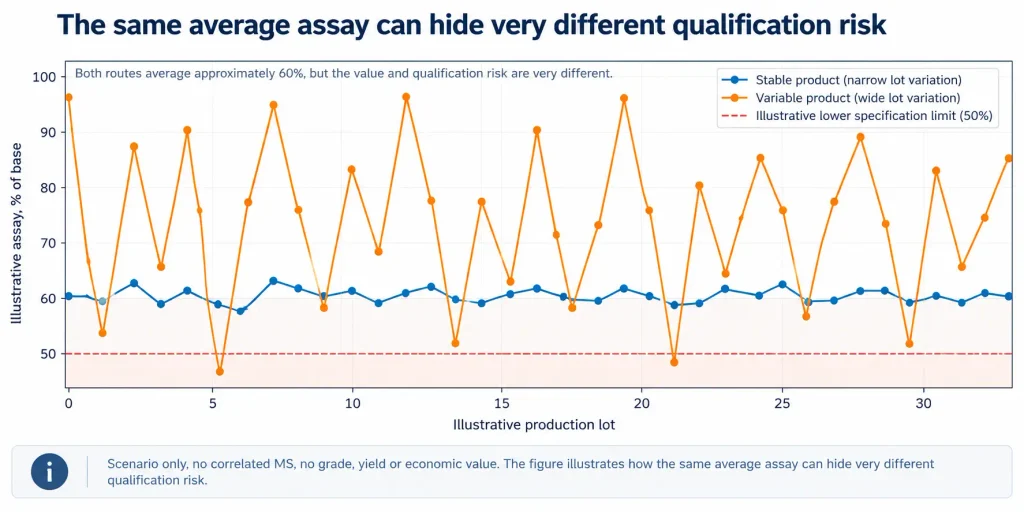
Figure 25.2. Scenario-only lot variability. Equal average assay does not establish equal qualification risk.
| Consistency control | Minimum basis | What it demonstrates | What it cannot hide | Trigger for action |
|---|---|---|---|---|
| Representative lot plan | Number and timing justified by campaign length, feed variability and production mode. | Coverage of expected operating envelope. | Cherry-picked consecutive samples under ideal conditions. | Extend programme when a variability driver is missing. |
| Process-state record | Feed chemistry, dose, pH, temperature, recovery, purge, wash, drying and downtime linked to lot. | Cause-and-effect relationship between process and quality. | Certificate of analysis without process context. | Investigate control variable and update operating window. |
| Trend / control review | Time-ordered data with agreed warning and action limits where appropriate. | Drift, step change, cyclic behaviour and special causes. | Average value that masks instability. | Hold release, correct process and define requalification scope. |
| Capability assessment | Stable process, suitable distribution, sufficient data and clear specification basis. | Whether routine output can fit inside limits. | Capability index calculated from mixed or unstable populations. | Do not claim capability; segregate populations or redesign. |
| Off-spec and rework history | Frequency, mass, cause, disposition, product loss and residual burden. | True on-spec yield and qualification cost. | Reworked tonnes counted as first-pass product. | Include rejection/rework in economics and design capacity. |
Table 25.7. Batch consistency links product quality to the operating envelope and true on-spec yield.
Qualification should progress through controlled stages
Qualification should reduce risk in stages rather than jump from a laboratory sample to a sales assumption. The appropriate sequence depends on the product and receiver, but each stage should have a defined input, acceptance decision and fallback. Early samples may screen feasibility; engineering samples establish process reproducibility; pre-production lots test storage and application; routine release then operates under an agreed certificate and change-control system.
Internal use is often the strongest first route because the user, incumbent material, process data and failure response are inside the site boundary. This does not justify informal acceptance. The internal user should issue or approve a specification, trial protocol, maximum substitution ratio, monitoring plan and rejection route. The evidence can later support an external buyer, but qualification does not automatically transfer between applications or sites.
| Stage | Material and purpose | Required evidence | Decision | Fallback |
|---|---|---|---|---|
| 0. Paper screen | Product card and draft use/specification. | Inventory, impurity mechanism, preliminary methods, user/buyer and residual route. | Worth producing samples? | Stop, redirect to internal use or remain residual. |
| 1. Bench sample | Demonstrate identity and likely impurity/purification route. | Mass balance, analytical method suitability, basic physical form and residuals. | Can a representative route be developed? | Revise chemistry or product form. |
| 2. Engineering sample | Show repeatability on representative feed and equipment. | Multiple lots, process-state data, washing/drying/storage and preliminary functional test. | Advance to user qualification? | Correct process; restrict operating window. |
| 3. User / buyer trial | Test delivered material in the named application. | Approved protocol, incumbent comparison, performance, HSE and off-spec response. | Conditional or full acceptance? | Lower substitution, lower grade or no-credit route. |
| 4. Pre-production campaign | Confirm reliable quantity, delivered form and release controls. | Campaign lots, packaging/logistics trial, certificate format, legal route and rejection handling. | Contract / routine internal approval? | Additional campaign or redesign. |
| 5. Routine release | Operate under controlled specification and change management. | Release test, trend review, retained samples, nonconformance and periodic requalification. | Continue, hold or requalify. | Quarantine, rework, downgrade or residual route. |
Table 25.8. Staged qualification avoids treating a one-off sample as a commercial product.
Legal status, registration and certification are separate gates
Engineering cannot assign legal product status by description alone. In the European Union, the Waste Framework Directive sets separate conditions for by-product and end-of-waste status. End-of-waste requires a specific use, market or demand, compliance with technical and product requirements and no overall adverse environmental or human-health impacts; where criteria are not established, decisions may be jurisdiction- and material-specific. Once a material ceases to be waste, applicable chemical and product legislation must still be satisfied before first use or placement on the market.
For substances or mixtures placed on the EU market, REACH and CLP obligations may include substance identity, registration or exemption analysis, classification, labelling, packaging and safety-data documentation depending on the material, tonnage, actor and use. The current consolidated texts should be checked for the project jurisdiction and date. A product certificate, ISO-accredited laboratory report or buyer approval does not itself create end-of-waste status, and an end-of-waste decision does not itself prove product quality.
Outside the EU, the same principle applies even though the legal mechanisms differ. EPA’s beneficial-use methodology is explicitly voluntary and does not replace applicable laws, regulations or beneficial-use determinations. The project should therefore maintain a jurisdiction-specific legal register rather than transferring a status conclusion between countries, products or end uses.
| Gate | Question to close | Evidence owner | What the gate establishes | What it does not establish |
|---|---|---|---|---|
| Waste / by-product / end-of-waste | What is the material’s legal status at each process and transfer point? | Project owner with competent legal/regulatory advice. | Permitted route for management or placement. | Technical conformity, buyer acceptance or profitability. |
| Chemical legislation | Do identity, registration/exemption, classification, SDS, labelling and packaging duties apply? | Manufacturer/importer/supplier with regulatory support. | Chemical-market compliance for the stated actor/use. | End-use performance or offtake. |
| Product / sector standard | Does a mandatory or voluntary standard apply to the intended grade and use? | Product owner and user/buyer. | Required grade, test or certification framework. | Conformity of actual production lots. |
| Laboratory accreditation | Is the laboratory competent for the specific method and matrix? | Laboratory and project QA. | Confidence in valid results within scope. | Legal product status or universal method suitability. |
| Buyer qualification | Has the receiver approved the delivered material and protocol? | Buyer/internal user. | Acceptance for the named application and conditions. | Acceptance by another buyer, site or use. |
| Beneficial-use / environmental claim | Does the use provide function without unacceptable health/environmental burden? | Project owner, regulator and receiver as applicable. | Support for the specific use and counterfactual. | Automatic exemption from waste or product rules. |
Table 25.9. Legal status, analytical conformity, certification and buyer approval must not be collapsed into one claim.
Regulatory boundaryThis chapter provides an engineering and project-development framework, not legal advice. By-product, end-of-waste, chemical-registration, product-standard and beneficial-use decisions must be made under the applicable jurisdiction, material, actor and end use. |
|---|
Internal-user and buyer qualification must name the acceptance protocol
The proposed receiver should be engaged before the specification is frozen. A buyer may reject an analytically pure material because it arrives in the wrong particle form, package, lot size or documentation system. An internal user may accept a technically lower grade because the impurity is benign or useful in the receiving process. Qualification therefore requires a written protocol that connects the delivered material to the receiver’s process and commercial controls.
The protocol should identify who supplies samples, who pays for testing, whether trial material can enter production, what constitutes success, who owns the data, how changes are notified and what happens to rejected material. External qualification may also require supplier audits, quality agreements, insurance, product liability, approved-source lists or periodic recertification. These are project dependencies that belong in the risk register before revenue is credited.
| Protocol field | Internal-use route | External-buyer route | Minimum project record | Failure consequence |
|---|---|---|---|---|
| Specification authority | Named process owner approves limits and substitution conditions. | Buyer specification or negotiated contract specification. | Signed/controlled specification and revision. | No accepted basis for release. |
| Sample and trial | Controlled plant trial with monitored downstream performance. | Qualification sample, laboratory and/or production trial per buyer procedure. | Protocol, sample traceability, results and deviations. | Sample approval cannot be generalized. |
| Acceptance decision | Operational, quality, HSE and cost criteria. | Technical approval plus commercial/vendor approval where required. | Decision owner and formal disposition. | Informal enthusiasm mistaken for qualification. |
| Routine release | Site certificate/monitoring and receiving-process checks. | Certificate of analysis/conformity, retained samples and buyer rights. | Release checklist and batch record. | Shipment/use before conformity is established. |
| Change notification | Feed, process, reagent, equipment, method or specification change. | Contractual supplier-change and requalification rules. | Change-control register. | Approval silently becomes invalid. |
| Rejection / fallback | Quarantine, return to process, alternate internal use or disposal. | Return, replacement, credit, downgrade and legal transport route. | Capacity, cost and responsibility assigned. | Rejected material accumulates without lawful route. |
Table 25.10. Qualification protocol differs for internal use and external sale, but both require formal acceptance and fallback.
Change control defines when qualification no longer applies
Qualification is valid only for the demonstrated material and operating boundary. A change in feed source, upstream antiscalant, precipitation reagent, membrane selectivity, mother-liquor purge, washing, dryer, packaging, analytical method or receiving process can alter the product even when the product name remains unchanged. The quality system must identify which changes require notification, risk review, additional testing or full requalification.
Change control should also address gradual drift. New trace contaminants may appear as feed campaigns change; impurity recycle can accumulate; filter-cloth wear can change solids carryover; storage humidity can alter moisture and caking. Trend review and retained samples allow the owner to distinguish a laboratory anomaly from a process shift and to define the affected lots.
| Change trigger | Potential product effect | Minimum review | Possible requalification scope | Release status |
|---|---|---|---|---|
| Feed source/composition or industrial additive | New impurity, phase, colour, organics, microbiology or variability. | Updated chemistry and hazard/use screen. | Analytical panel plus functional trial. | Hold or conditional release until bounded. |
| Reagent/source or dose | Counter-ion, metal, insoluble or residual-reagent change. | Supplier certificate and comparative lots. | Targeted impurity and performance tests. | Release under approved deviation only if risk is closed. |
| Separation/wash/dry operating window | Purity, retained liquor, moisture, size and yield change. | Process-change mass balance and trial lots. | Representative lots and storage test. | New operating range requires approval. |
| Equipment/material of construction | Metal pickup, oil, wear particles, corrosion or cross-contamination. | Materials/HSE review and baseline comparison. | Trace panel and first-production inspection. | Quarantine first lots as defined. |
| Analytical method/laboratory | Bias, precision, reporting limit or comparability change. | Method equivalence / verification and split samples. | Bridging study. | Do not merge historical trends without evidence. |
| Packaging/storage/logistics | Moisture, contamination, breakage, segregation or shelf-life change. | Delivered-product and handling review. | Storage/transport trial. | Plant-gate conformity alone is insufficient. |
| User process or specification | Different performance or exposure requirement. | New use-case and legal review. | Application qualification. | Previous approval does not transfer. |
Table 25.11. Qualification must be bounded by a formal change-control and requalification system.
Every product route needs an off-spec, rework and rejection pathway
Off-spec material is not an exceptional footnote. It is an expected stream with mass, storage, rework, transport and legal consequences. The design must allocate quarantine capacity, segregation, sampling, reprocessing, blending rules, downgrade outlets and final residual management. The project economics must use first-pass on-spec yield and include product loss, additional utilities, labour, downtime and disposal associated with rework and rejection.
Blending is not a universal correction. It may be prohibited by the product standard, waste rules, buyer agreement or hazardous-property logic; it can also spread a contaminant across a larger mass. Rework should be technically demonstrated and traceable, with a limit on repeated cycles. When no lawful and value-preserving disposition exists, the candidate product route fails even if the normal lot is attractive.
| Disposition | When credible | Required controls | Hidden burden | Stop condition |
|---|---|---|---|---|
| Reprocess / dissolve / recrystallize | The defect is reversible and the process can restore specification. | Traceable batch, defined recipe, yield/residual balance and retest rule. | Energy, water, chemicals, capacity loss and impurity recycle. | Repeated rework or accumulation destabilizes the plant. |
| Rewash / redry / classify | Surface liquor, moisture or size distribution is the controlling defect. | Maximum cycles, contamination control and delivered-form retest. | Product loss, fines, wash liquor and dryer bottleneck. | Corrective step cannot reliably close the limit. |
| Blend | Specification and law permit blending; source lots are compatible. | Approved calculation, homogeneity, traceability and no dilution of hazard/waste status. | Good material consumed to absorb bad material. | Blending masks contamination or has no guaranteed outlet. |
| Downgrade / alternate internal use | A lower grade has a named user and tolerates the actual profile. | Separate specification, value and qualification route. | Lower netback and inventory complexity. | “Lower grade” has no qualified receiver. |
| Return / supplier credit | Contract and transport route permit return. | Responsibility, packaging, classification and cost clauses. | Reverse logistics and liability. | Receiver can reject but owner has no route. |
| Residual management | No product route remains but lawful management is available. | Characterization, storage, transport and disposal/management capacity. | Full cost and long-term liability. | No lawful or reliable endpoint. |
Table 25.12. Off-spec disposition is part of product-train design and risk-adjusted economics.
Qualification acceptance gate
A candidate advances to market, offtake and logistics analysis only when the specification and qualification package are specific enough to price the delivered product and its rejection risk. Weighted scoring cannot compensate for a missing legal route, representative sampling plan, accepted user or off-spec endpoint. Conditional status is permitted when the missing evidence is explicit, funded and linked to a decision date; it is not permission to book revenue.
| Gate field | Proceed | Conditional / recycle | Stop | Required record |
|---|---|---|---|---|
| Named use and specification | Use, form, limits, basis and methods are approved. | Receiver input or one non-critical limit remains to be finalized. | Generic commodity name only; no use-specific requirements. | Controlled draft/final specification. |
| Representative lots | Sampling covers expected feed and operating variability. | Additional campaign/upset data scheduled. | Single showcase batch or untraceable sample. | Lot and sampling plan; chain of custody. |
| Method fitness and decision rule | Methods suit matrix/range; conformity rule agreed. | Targeted verification or bridging study underway. | Limits cannot be measured reliably or acceptance is ad hoc. | Method register, uncertainty/decision rule and lab scope. |
| Chemical and physical conformity | Representative lots meet identity, impurities, form and storage requirements. | One correctable attribute requires process update and repeat lots. | Purity depends on excessive rework or unstable phase/form. | Certificates, raw data and process-state link. |
| Functional / microbiological performance | Named application trial passes with monitoring and use-specific requirements. | Restricted substitution or monitored trial continues. | Material damages process, product, health or environmental performance. | Trial protocol, results and acceptance decision. |
| Consistency and control | Process is stable within the demonstrated operating boundary; off-spec yield is known. | More duration needed but no unresolved failure mode. | High variability, drift or unbounded recycle accumulation. | Trend/capability review and nonconformance history. |
| Legal / certification route | Jurisdiction-specific status and applicable chemical/product duties are closed. | Application/registration/certification has defined owner and schedule. | No lawful route to use or place material. | Legal register, approvals and product documentation. |
| User / buyer acceptance | Formal internal approval or buyer qualification exists for delivered form. | Sample approval is conditional on pre-production campaign. | No qualified receiver; interest is non-binding and unspecific. | Approval/protocol and change-control obligations. |
| Off-spec / rejection route | Capacity, responsibility and cost are defined for every disposition. | Temporary route exists while permanent capacity is developed. | Rejected material has no lawful, reliable or affordable endpoint. | Off-spec mass balance and disposition plan. |
| Economic treatment | Only qualified on-spec volume receives provisional value; downside is explicit. | Revenue remains zero until stated qualification milestone. | Economics require 100% saleable yield or no rejection. | Qualification-adjusted volume and cost inputs for Chapter 26. |
Table 25.13. Qualification acceptance gate before markets, offtake and logistics analysis.
No certificate-only product claimsA certificate of analysis reports results for a sample or lot under stated methods. It does not by itself prove representative production, legal product status, application performance, buyer acceptance, logistics suitability or bankable revenue. Those claims require their own evidence. |
|---|
Handover to Chapter 26 — markets, offtake and logistics
Chapter 26 receives only the product candidates that pass, or remain explicitly conditional against, the qualification gate. The handover is not a gross production estimate. It is the reliable on-spec quantity in the delivered form, adjusted for first-pass yield, rework, rejection, downtime, storage loss and the demonstrated operating envelope.
For each candidate, Chapter 26 should receive the controlled specification and revision; named grade/use; qualified internal user or external buyer status; annual and delivery-profile volume; sample and lot evidence; packaging, storage and shelf-life conditions; legal/product documentation; certificate and decision rule; price basis or avoided-cost comparator; rejection rights; off-spec and backup route; change-control obligations; and the milestone before any product revenue may enter the project model.
| Handover field | Required basis for Chapter 26 | Commercial risk if missing |
|---|---|---|
| Qualified product definition | Form, grade/use, controlled specification and legal route. | Price or market comparison applies to a different material. |
| Reliable on-spec volume | Lot/campaign profile after yield, rejection, rework, downtime and storage loss. | Gross contained inventory is mistaken for saleable tonnes. |
| Receiver status | Internal approval, qualification stage, buyer concentration and remaining conditions. | Non-binding interest is treated as offtake. |
| Delivered form | Packaging, loading, storage, shelf life, transport classification and handling equipment. | Plant-gate product cannot reach or enter receiver process. |
| Acceptance and rejection | Certificate, decision rule, inspection rights, claims, return and replacement route. | Rejection cost and working-capital exposure are hidden. |
| Change control | Notification and requalification triggers for process, feed, method and receiver changes. | Qualification becomes invalid without detection. |
| Downside fallback | Alternate use, residual route, capacity and cost under zero-sales case. | Water project depends on uninterrupted product sales. |
Table 25.14. Qualification-adjusted handover package for Chapter 26.
Chapter conclusion
Purity is one field inside a larger product system. The project must define identity, basis, impurities, physical form, functional performance, microbiology where relevant, sampling, analytical methods, uncertainty and the conformity decision. It must then show that representative lots repeatedly meet the specification under a controlled operating envelope.
Qualification adds the receiver and legal route. An internal user or buyer must approve the actual delivered material for a named application, with change-control, rejection and off-spec provisions. Laboratory accreditation, a high assay, end-of-waste status or a successful one-off trial can each support the case, but none replaces the others.
The bankable quantity is therefore not the theoretical product mass and not the best laboratory result. It is the reliable on-spec volume that can be released, used or delivered under agreed acceptance conditions, with the cost and endpoint of every rejected tonne visible. Chapter 26 now tests whether that qualified product has a market, offtake structure and logistics netback strong enough to enter the project economics.
Chapter 25 in one sentenceA recovered material becomes a qualified product only when a named use, measurable specification, representative lot evidence, legal route, receiver acceptance and off-spec pathway are all established on the same system boundary. |
|---|