

Centralize specialist infrastructure only when aggregation improves the complete source-to-market system.
Controlled principleA centralized hub is credible only when source compatibility, transported form, shared infrastructure, product qualification, residual ownership, contracts and total system burden are superior to the best on-site or hybrid alternative. Scale alone does not create value. |
|---|
Centralization is a system-boundary choice, not a scale shortcut
Chapter 26 handed forward the qualified intermediate or product, source volumes and variability, transported form, site-level market and logistics constraints, shared-infrastructure opportunity, residual ownership and commercial structure. Chapter 27 tests whether those constraints are better solved together. It does not assume that a larger plant is automatically cheaper, cleaner or more bankable.
UNIDO and the World Bank describe eco-industrial parks as managed industrial areas in which firms collaborate through exchanges of materials, energy, water and by-products, supported by shared infrastructure and park-level management. That framework is useful for brine valorization because the hub is not only a treatment plant: it is a receiving, quality-control, storage, utility, product-finishing, residual-management and contracting platform.
A 2025 EU-funded review of 125 industrial parks shows that cooperation models differ widely in ownership, utility integration and stakeholder roles. The design question is therefore project-specific: which functions should remain at the source, which should be shared, and which dependency would make the water operation vulnerable if the hub stopped?
| Configuration | Best fit | Value mechanism | Main weakness | Minimum fallback |
|---|---|---|---|---|
| On-site train | One large, stable source with utilities, operators, residual route and receiver access. | No feed transport; direct control of water and residual system. | Dedicated equipment may be underutilized; specialist products and buyers may be absent. | Site residual route and modular expansion plan. |
| Centralized hub | Several compatible sources near shared utilities, industrial users, storage or port infrastructure. | Aggregated duty, specialist staff, shared finishing/QC and broader market access. | Transport, blending, multi-party contracts and common-mode outage risk. | Source emergency storage and alternate treatment/disposal. |
| Hybrid network | Sources need local pretreatment or water recovery, while only concentrated intermediates require specialist finishing. | Moves less water and keeps source-specific contaminants out of the hub. | Two operating interfaces and split performance guarantees. | Each source can operate safely when hub intake is interrupted. |
Table 27.1. Centralization must be compared with the best on-site and hybrid configurations on the same boundary.
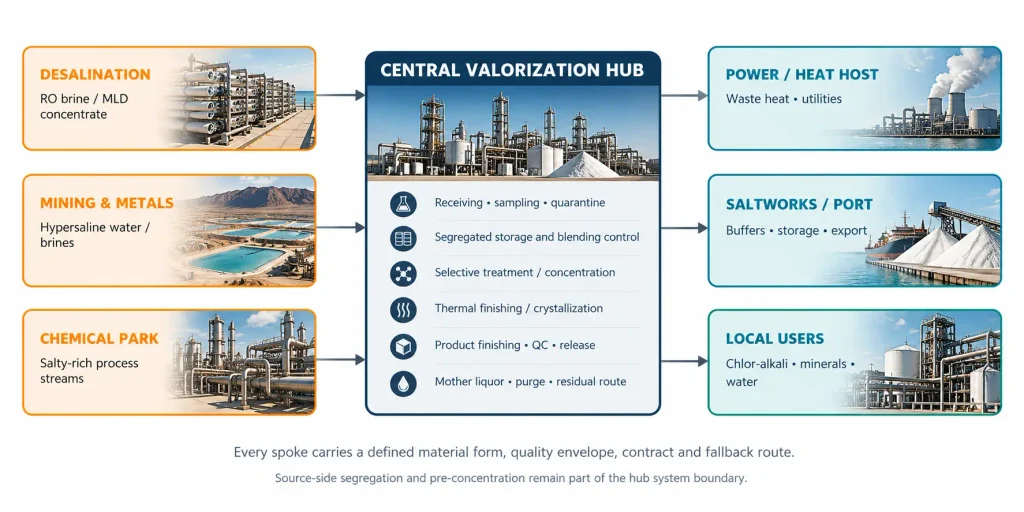
Figure 27.1. Hub-and-spoke architecture. The hub centralizes selected functions; source segregation, pre-concentration and fallback routes remain inside the system boundary.
A hub creates value by sharing constraints—not by pooling every stream
A credible hub shares equipment or capabilities that are expensive, technically specialized or difficult to justify at one site. Typical candidates are analytical laboratories, segregated storage, selective purification, thermal finishing, crystallization, drying, dangerous-goods handling, product qualification, port loading and specialist operations. Common infrastructure is valuable only when its utilization and flexibility outweigh additional interfaces, transport and coordination.
Current brine-valorization literature still places most large-scale activity around water recovery and bulk salts, while multi-resource trains remain much more dependent on feed chemistry, selective separation, materials durability and market integration. A hub can improve utilization and market reach, but it cannot turn an immature separation or unqualified product into a commercial route.
| Shared constraint | Potential hub advantage | Evidence required | Failure signal |
|---|---|---|---|
| Scale / utilization | Aggregate compatible duty across several sources and campaigns. | Hourly and annual source profiles; minimum stable load; expansion case. | Average annual mass appears large but simultaneous compatible feed is small. |
| Specialist operation | Concentrate expertise, maintenance, laboratory and HSE systems. | Staffing model, competency, response time, spares and service coverage. | Remote source or hub outage leaves no qualified operator or fallback. |
| Product consistency | Blend within a controlled envelope and use shared finishing/QC. | Source fingerprinting, blend rules, segregation, lot traceability and release plan. | Blending increases variability or hides the origin of off-spec material. |
| Utilities / waste heat | Use shared power, steam, cooling, water, waste heat and emergency systems. | Temperature, availability, pressure, quality, contract and outage profile. | “Waste heat available” is stated without a usable duty or continuity basis. |
| Market / logistics | Locate near users, chemical infrastructure, port, storage and carriers. | Receiver map, delivered form, shipment size, route and backup outlet. | Hub produces more material than the local or export chain can absorb. |
| Residual management | Centralize permitted treatment, mother-liquor control and final solids routes. | Residual mass balance, classification, acceptance capacity and liability owner. | Products leave the hub but purge and rejected material have no endpoint. |
Table 27.2. The hub must solve a named constraint with evidence; shared scale is not a value mechanism by itself.
Compatibility must be proven before aggregation
The first technical gate is not total tonnage but compatibility. Two streams with similar TDS may have different calcium, magnesium, sulfate, silica, organics, oil, metals, antiscalants, radionuclides, oxidation demand or legal status. Uncontrolled blending can create precipitation, gas release, foaming, corrosion, hazardous mixtures, product contamination or an untraceable waste classification.
The hub should define feed families and acceptance envelopes before pipework or transport contracts are designed. Each source requires a fingerprint, normal/design/upset range, prohibited constituents, sampling method, release rule, quarantine capacity and rejection route. Blending should occur only when a mass balance and representative testing show that it improves—not merely averages—the downstream process.
| Compatibility field | Required source record | Hub control | Stop / segregate when |
|---|---|---|---|
| Chemical family | Major ions, alkalinity, density, pH, temperature, redox and target basis. | Assign feed family and permitted blend window. | Reaction or phase behaviour cannot be predicted or controlled. |
| Scale / solids | Ca, Mg, sulfate, carbonate, silica, suspended solids and saturation path. | Source pretreatment, solids removal and receiving-tank limits. | Blend precipitates before controlled separation or blocks transfer. |
| Organics / additives | Oil, TOC/COD, solvents, surfactants, antiscalants, biocides and cleaners. | Dedicated tanks, oxidation/adsorption or exclusion limits. | Organic load compromises product, membranes, evaporation or safety. |
| Metals / hazardous species | Trace metals, sulfide, cyanide, fluoride, radionuclides or persistent substances where relevant. | Separate legal and treatment route; dedicated monitoring. | Dilution would conceal rather than manage a hazardous characteristic. |
| Product destination | Target product, grade, impurity limits and source-traceability requirement. | Campaign processing or controlled blend recipe. | One source invalidates the grade or buyer qualification of the pool. |
| Legal status | Waste/product status, permits, transport classification and source liability. | Separate documentation, custody and mass accounting. | Mixing changes status, blocks shipment or transfers unpriced liability. |
Table 27.3. Hub compatibility is a controlled feed-envelope decision, not an average-TDS exercise.
Transporting water can destroy economics
A hub may be technically attractive and still fail because the moved material is mostly water. Transport duty should be reported as liquid volume and payload per tonne of target or dissolved solids, not only kilometres from source to hub. The calculation must then add loading, tanks or containers, return movements, cleaning, waiting time, losses, route restrictions and emergency storage.
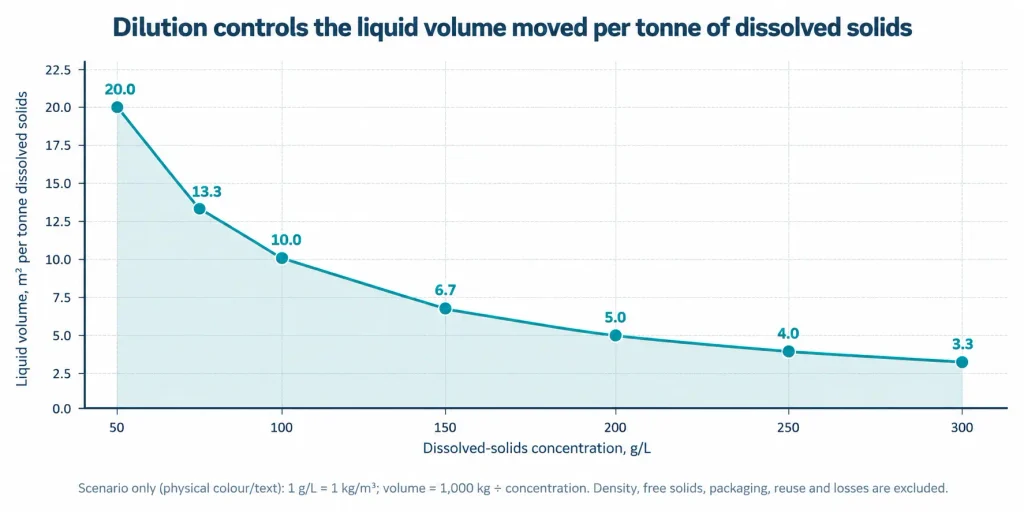
Figure 27.2. Scenario-only dilution burden. Higher source concentration reduces the liquid volume that must be moved for the same dissolved-solids inventory; it does not by itself prove a viable transport route.
Visible calculationLiquid volume, m³/t dissolved solids = 1,000 ÷ C, where C is dissolved-solids concentration in g/L (equivalent to kg/m³). This is an inventory calculation only. Density, free solids, entrainment, packaging, legal payload, cleaning, route and product yield must be added separately. |
|---|
| Transported form | What is moved | When it may be credible | Additional burdens | Typical stop signal |
|---|---|---|---|---|
| Dilute brine | Large water mass with dissolved target and impurities. | Very short pipeline, existing common sewer/utility corridor or avoided local treatment. | Pumping/haulage, corrosion, spill containment, receiving storage. | Transport cost and impact exceed shared-process benefit. |
| Pre-concentrated liquor | Reduced water with higher scaling, viscosity and corrosion risk. | Source has robust low-cost water recovery or evaporation. | Pretreatment, heat/power, crystallization during storage, tank material. | Source concentration creates unstable or unpumpable liquor. |
| Slurry / filter cake | Solids plus entrained mother liquor. | Target is already precipitated and hub performs washing/refining. | Dewatering, re-slurrying, dust/free liquid, low payload if cake is wet. | Entrained brine destroys grade or transport classification. |
| Washed intermediate | Controlled solid or solution requiring final finishing. | Source can qualify intermediate and preserve traceability. | Packaging, storage stability, lot release, rework. | Hub adds little value beyond ordinary toll finishing. |
| Finished product | Qualified material moved to user/export. | Treatment is stronger at source; hub is mainly logistics/market platform. | Product storage, dangerous goods, port interface and market exposure. | No shared process advantage remains. |
Table 27.4. The transported form should minimize total system burden, not merely source-site equipment.
Source segregation and pre-concentration are part of the hub design
The strongest hub model is often hybrid. Sources remove oil, suspended solids, incompatible organics or bulk hardness; recover fit-for-purpose water; and send a smaller, controlled intermediate to the hub. This protects the common plant from source-specific contaminants and avoids transporting water that can be recovered locally. The allocation should follow the first limiting constraint, not a desire to place all equipment at one location.
Source pre-concentration is not automatically beneficial. It can increase scaling, corrosion, viscosity, precipitation during storage and the severity of an upset. The source and hub must therefore share one concentration-path model, mass balance and acceptance envelope.
| Function | Prefer at source when | Prefer at hub when | Shared interface record |
|---|---|---|---|
| Segregation / equalization | Contaminant originates in a discrete process or campaign. | Several similar sources need common buffer storage. | Tank identity, campaign log, mixing prohibition and upset diversion. |
| Oil / solids / organics removal | Material risks transfer equipment or should not enter common product train. | Specialist centralized treatment has proven capacity and legal route. | Inlet limit, method, rejection rule and residual ownership. |
| Bulk hardness removal | Precipitation before transport improves stability and payload. | Hub can recover a qualified mineral and manage solids better. | Dose/mineralogy basis, filtrate chemistry and cake destination. |
| Water recovery | Source reuses water and moving liquid is costly. | Hub has superior energy, intake, reuse demand or integrated treatment. | Recovered-water quality, concentrate form and availability. |
| Selective concentration | Source has stable single chemistry and low-cost equipment. | Shared unit has higher utilization and multiple compatible campaigns. | Target and impurity mass, recovery, cleaning and carryover. |
| Thermal finishing | Waste heat and residual route exist at source. | Hub has waste heat, crystallizer, drying, storage and market access. | Feed BPE/chemistry, condensate quality, mother liquor and purge. |
Table 27.5. Source and hub duties should be divided by chemistry, transport burden and operational resilience.
Hub location must close utilities, receivers and residual routes
A hub is location-sensitive. Industrial parks and ports can offer shared utilities, storage, laboratories, emergency services, waste treatment, carriers and access to industrial users. UNIDO’s eco-industrial-park framework also emphasizes dedicated management, common infrastructure and risk systems; these are operating requirements, not branding.
The Port of Aalborg is documented by the European Commission as a long-running industrial-symbiosis example built around partnerships and place-based industrial transformation. It is relevant as an operating model, not as evidence that any port is suitable for brine treatment. A brine hub still needs compatible sources, permits, corrosion-resistant infrastructure, qualified products and a complete residual route.
| Location factor | Minimum evidence | Why it matters | Failure signal |
|---|---|---|---|
| Source catchment | Mapped sources, form, distance, route, variability and expansion. | Defines reliable compatible feed and transport system. | Hub depends on announced projects or uncommitted volumes. |
| Energy / heat | Electrical capacity, steam/heat grade, temperature, availability and price. | Controls concentration and thermal finishing. | Waste heat is intermittent, too low-grade or contractually unavailable. |
| Water / cooling | Process water, cooling system, condensate use and discharge/reuse route. | Hub can consume or produce significant water streams. | Water recovery creates a new discharge or cooling constraint. |
| Industrial users | Named chemical, mineral, construction, fertilizer or water users. | Shortens logistics and supports internal symbiosis. | Only global commodity demand is identified. |
| Port / logistics | Berth, bulk tanks/silos, road/rail, dangerous-goods capability and customs. | Enables reliable inbound/outbound movement. | Infrastructure is present but incompatible with material class or lot size. |
| Residual endpoints | Permitted liquid, sludge, mother-liquor and off-spec routes with capacity. | Keeps hub operable under rejection and downtime. | One residual has no routine and backup endpoint. |
| Management / emergency | Single operating authority, rules, monitoring, emergency response and liability. | Coordinates multi-tenant risk and common infrastructure. | Interfaces are split among parties with no accountable operator. |
Table 27.6. A hub location is credible only when utilities, markets, logistics, management and residuals all close.
Four industrial-symbiosis archetypes
The archetypes below are integration patterns, not standard flowsheets. Each depends on source chemistry, scale, maturity and contracts. Their purpose is to show where co-location may create a real interface between saline residuals and an industrial host.
| Archetype | Potential exchange | Technical gate | Commercial / operating gate | Evidence boundary |
|---|---|---|---|---|
| Desalination–chlor-alkali | NaCl-rich stream to purified concentrated brine; water, acid or alkali may circulate internally. | Ca/Mg/sulfate/organics control, concentration, membrane-electrolysis feed specification and purge. | Chlor-alkali demand, power, safety, continuous quality and liability for off-spec brine. | A pilot study concentrated SWRO brine toward chlor-alkali conditions; transfer remains feed- and plant-specific. [7] |
| Mining–mineral hub | Several mines send concentrated water, precipitate or mineral-rich intermediates to shared refining. | Ore/process additives, metals, sulfate, silica, radionuclides and source traceability. | Long distances, campaigns, product grade, mine-life mismatch and residual return. | No generic mine-brine compatibility or mineral yield is assumed. |
| Power / waste-heat host | Waste heat and utilities support evaporation, membrane distillation or crystallization. | Heat grade, exchanger approach, BPE, corrosion, availability and backup energy. | Host outage, heat price, integration CAPEX and loss of independent operation. | CARMEn and WATER-MINING cases show source-specific value from waste-heat coupling. [6,9] |
| Chemical-park platform | Shared brine purification, chlor-alkali, acid/base, storage and adjacent chemical users. | Impurity control, hazardous chemistry, common utilities and closed material balances. | Multi-party demand, HSE governance, contracts and product liability. | A Shanghai chemical-park study demonstrates chlorine-flow symbiosis; results are case-specific. [8] |
Table 27.7. Industrial-symbiosis archetypes identify integration opportunities, not universal process trains.
The 2026 CARMEn study is particularly instructive because it tested different saline streams—RO brine, NF retentate and saltworks bitterns—within one treatment concept. Performance and product quality changed materially with feed composition, while waste-heat coupling improved the assessed energy and economic case. The lesson for a hub is not to blend those streams indiscriminately; it is to preserve source identity and exploit shared equipment only where the chemistry permits.
The source-to-hub mass balance must remain auditable
Centralization creates at least three accounting boundaries: each source, the transport interface and the hub. The project must close water, target, impurities, reagents, products and residuals across all three. A hub balance that begins at the receiving tank hides source pretreatment losses and transported water; a source balance that ends at dispatch hides hub rejection, mother liquor and unsold product.
| Ledger item | Source-site record | Transport record | Hub record | Required closure |
|---|---|---|---|---|
| Water | Feed, recovered water, evaporation, cake moisture and dispatched liquid. | Loaded volume/mass, wash/heel, losses and returns. | Received, product water, evaporation, products moisture, purge and discharge. | Source dispatch = carrier receipt = hub receipt within stated uncertainty. |
| Target constituent | Contained mass, capture into intermediate and source residual. | Target mass in shipped form. | Received target, products, off-spec, purge and losses. | No value assigned to mass lost before on-spec product release. |
| Impurities | Removed, retained and added through reagents. | Impurity profile and contamination controls. | Blend accumulation, product rejection, mother liquor and purge. | Every accumulating species has a control or purge route. |
| Reagents / utilities | Source pretreatment and concentration burden. | Fuel, cleaning and temperature control where material. | Shared treatment, finishing, QA and residual burden. | No cost or environmental burden disappears at the custody point. |
| Products / residuals | Local water/product use and source residuals. | Returned/rejected loads. | Qualified products, unsold inventory, sludge, mother liquor and waste. | Routine and no-offtake endpoints close at design and upset conditions. |
Table 27.8. The hub balance must reconcile source dispatch, transport custody and hub outputs on one auditable basis.
Hub operation requires a single quality and governance system
Multi-source operation increases the need for one accountable operating system. The hub requires source approval, scheduling, receiving inspection, quarantine, tank allocation, blend authorization, campaign traceability, process control, product release, residual dispatch, emergency response and change control. A loose consortium without a party empowered to reject feed or stop transfers is not an operating model.
Industrial-symbiosis programmes repeatedly identify governance, stakeholder coordination and park management as conditions for maintaining exchanges over time. The hub operator must therefore own the common rules, while source contracts preserve responsibility for feed quality and undisclosed changes.
| Governance function | Accountable party | Minimum control | Failure if unclear |
|---|---|---|---|
| Source approval | Hub technical/quality authority. | Audit, fingerprint, acceptance envelope, trial loads and change notification. | Commercial team commits feed that plant cannot safely accept. |
| Scheduling / capacity | Hub operations planner. | Campaign plan, tank availability, minimum/maximum intake and outage windows. | Queues, demurrage or incompatible feeds arrive together. |
| Custody / sampling | Source, carrier and hub under agreed procedure. | Seals, samples, methods, mass/volume measurement and dispute sample. | Quality failure cannot be attributed or resolved. |
| Blend authorization | Named process/quality owner. | Digital batch record, recipe, limits and approval before transfer. | Operators average streams outside qualified envelope. |
| Product release | Independent quality function. | Lot definition, certificate, decision rule, quarantine and rejection. | Production pressure overrides qualification controls. |
| Residual ownership | Contracted legal and operating owner. | Classification, storage, transport, destination, cost and long-term liability. | Purge or rejected load becomes an orphaned liability. |
| Emergency / shutdown | Hub operator with source obligations. | Emergency storage, diversion, notification and restart qualification. | One hub outage forces uncontrolled source discharge or production stop. |
Table 27.9. A hub needs one enforceable operating and quality system across all source and product interfaces.
Commercial structure must allocate feed, capacity, yield and market risk
Centralization separates the brine producer, hub operator, utility host, logistics provider and product offtaker. The contract structure must state who owns the material at each point, who pays for rejected feed, who carries yield and energy risk, how capacity is reserved, how outages are handled and who funds residual treatment when product sales fail.
A tolling model can isolate hub processing from commodity price, while a purchase-and-sale model transfers more feed and market risk to the hub. Take-or-pay or capacity reservation can support fixed infrastructure, but only when source volume and quality obligations are equally enforceable. No model is bankable if one party receives upside while another retains unlimited quality, disposal or shutdown liability.
| Structure | Revenue / payment basis | Risk retained by source | Risk retained by hub | Critical clause |
|---|---|---|---|---|
| Toll treatment | Fee per accepted tonne/m³ or service unit. | Feed quality, delivery profile and often product ownership/market. | Process performance, capacity and agreed residual handling. | Accepted-feed definition, yield basis and off-spec disposition. |
| Purchase of intermediate | Hub buys qualified feed or intermediate. | Pre-delivery quality and continuity. | Yield, products, market, residuals and inventory after custody transfer. | Title, specification, price formula and rejection/return. |
| Product revenue share | Processing fee plus defined share of qualified product netback. | Feed and sometimes minimum volume. | Process, qualification, sale and transparency of deductions. | Waterfall, audit rights and no-sales case. |
| Capacity reservation / take-or-pay | Fixed payment for available capacity plus variable charge. | Volume commitment and quality. | Availability and throughput capability. | Force majeure, maintenance, unused capacity and make-up rights. |
| Joint venture / park utility | Equity returns and service/product contracts. | Shareholder commitments and source obligations. | Integrated operating, financing and market risk. | Governance, deadlock, expansion, exit and residual liability. |
Table 27.10. The commercial model must allocate the risks created by centralization, not merely divide product revenue.
Environmental and regulatory boundaries follow the material
A hub changes transport, storage, permitting and liability as well as treatment. The regulatory route depends on jurisdiction and on whether the moved material is wastewater, waste, by-product, product or dangerous goods. In the European Union, Regulation (EU) 2024/1157 establishes procedures and control regimes for shipments of waste based on origin, destination, route, type and treatment; it applies from 21 May 2026, subject to its detailed scope and transition provisions. The project must obtain legal advice for the actual stream and route.
Road transport of dangerous goods is governed internationally through ADR requirements for classification, tanks/packaging, consignment, loading, operation, documentation and trained participants. Bulk maritime transport may require classification and carriage conditions under MARPOL Annex II and the IBC Code; an unassessed mixture can require formal evaluation before carriage. These requirements must be screened before assuming that a port makes movement easy.
| Boundary | Question to close | Required owner / record | Do not assume |
|---|---|---|---|
| Source permit | May the source pretreat, concentrate, store and transfer the material? | Source permit owner; approved operating and emergency conditions. | Sending material to a hub removes source responsibility. |
| Material status | Is the load wastewater, waste, by-product, product or dangerous goods? | Legal/regulatory assessment for each source and form. | One commercial label governs all jurisdictions and stages. |
| Shipment / transport | What notification, consent, classification, tank, packaging and documentation apply? | Consignor, carrier, consignee and compliance file. | An ordinary tanker or bulk ship can carry any brine mixture. |
| Hub permit | Which feeds, processes, emissions, storage quantities and residuals are authorized? | Hub permit owner; feed list, capacity and monitoring. | A general wastewater permit covers product manufacture and hazardous storage. |
| Products | What product, chemical, construction, fertilizer, water or end-of-waste rules apply? | Product steward and qualification dossier. | Centralization automatically establishes product status. |
| Residuals / liability | Who owns purge, sludge, contaminated packaging, returns and long-term liability? | Contracted owner, destination, financial provision and records. | Residual responsibility follows product revenue. |
| Environmental comparison | Does the hub reduce total water, energy, emissions, transport and waste burden? | Common LCA/footprint boundary with source and no-hub alternatives. | Shared equipment is automatically environmentally superior. |
Table 27.11. Centralization adds legal and environmental interfaces that must be closed for the actual material and route.
Centralized-hub acceptance gate
A hub advances only when compatible feed, transported form, shared infrastructure, operating governance, markets, residual routes and contracts are strong enough to improve the total system. Weighted scoring cannot compensate for a fatal incompatibility, unpermitted shipment, missing residual route or source operation that depends on uninterrupted hub intake.
| Gate field | Proceed | Conditional / recycle | Stop | Required record |
|---|---|---|---|---|
| Compatible feed families | Representative real-feed evidence and controlled blend/segregation rules. | Additional campaign or blend testing required. | Uncontrolled reactions, contamination or legal incompatibility. | Source fingerprint and hub acceptance envelope. |
| Reliable aggregated scale | Committed compatible volumes align in time and justify shared duty. | Anchor source exists but expansion or campaigns remain uncertain. | Scale depends on announcements or incompatible annual averages. | Source schedule and capacity model. |
| Transported form | Payload, route, classification, storage and cost support hub benefit. | Pre-concentration or alternate mode still under test. | Moving water or hazardous/unstable material destroys case. | Source-to-hub logistics and mass balance. |
| Shared infrastructure | Utilities, storage, labs, finishing, port/users and redundancy are confirmed. | One utility or endpoint needs contract/permitting. | Critical utility, receiver or residual route is absent. | Site utility and infrastructure package. |
| Governance / contracts | One accountable operator and enforceable source, capacity, quality and liability terms. | Term sheet exists but key risk allocation is open. | No party accepts variability, outage, market or residual risk. | Operating model and contract matrix. |
| Total system economics | Hub beats best on-site/hybrid case under no-sales, outage and transport downside. | Value depends on limited upside pending evidence. | Scale benefit disappears after transport, preconditioning, losses and residuals. | Chapter 28 input model and downside cases. |
| Environmental / legal route | Permits, shipment and material status are credible; total burden is defensible. | Approval path is identified but incomplete. | No lawful route or impact shifts without control. | Regulatory register and comparative footprint. |
Table 27.12. Centralization proceeds only when chemistry, movement, infrastructure, governance and total burden close together.
Stop ruleDo not centralize an unqualified product, incompatible feeds or an absent market. First test a hybrid architecture: recover water and remove source-specific contaminants locally, then move only the stable intermediate that genuinely benefits from shared specialist infrastructure. |
|---|
Handover to Chapter 28 — how to build the business case
Chapter 28 integrates CAPEX, OPEX, avoided costs and risk-adjusted value. It needs the selected on-site, hub or hybrid architecture and a complete source-to-market boundary. The hub handover must separate source-site assets, common infrastructure, transport systems, product finishing and residual capacity so that equipment cost is not mistaken for total project cost.
The business case should include at least one no-hub alternative and one no-product-revenue case. Shared assets should be allocated by defensible capacity or service drivers, while common-mode outage, ramp-up, source default, buyer loss and residual fallback remain explicit sensitivities.
| Handover field | Required basis for Chapter 28 | Economic risk if missing |
|---|---|---|
| Selected architecture | On-site, centralized or hybrid scope; source and hub responsibilities. | CAPEX and OPEX are omitted or double counted across boundaries. |
| Committed source basis | Normal/design/upset volume, chemistry, availability, contract term and expansion. | Shared plant is sized on uncommitted or incompatible feed. |
| Transport system | Form, payload, distance, mode, tanks/containers, storage, cleaning, return and disruption. | Transporting water and handling are hidden outside treatment cost. |
| Shared assets / utilities | Installed and total project cost, capacity allocation, utility contracts, redundancy and owner. | Low utilization or utility upgrade is ignored. |
| Products / markets | Qualified volume, netback, receiver capacity, offtake and zero-sales fallback. | Hub economics depend on gross product revenue. |
| Residuals / liabilities | Source and hub sludge, mother liquor, purge, off-spec, permit, transport and endpoint. | A common residual becomes an unpriced liability. |
| Risk allocation | Quality, volume, yield, energy, downtime, price, credit, force majeure and change control. | Financial model assigns risk to a party that has not contractually accepted it. |
| Comparative cases | Best on-site/hybrid alternative, no-sales, anchor-source loss, hub outage and cost escalation. | Centralization is selected without proving incremental value and resilience. |
Table 27.13. Chapter 28 requires the complete source-to-hub-to-market cost and risk boundary.
Chapter conclusion
A centralized valorization hub can create value where several compatible sources share a genuine constraint: specialist operation, underutilized finishing equipment, waste heat, product-quality infrastructure, residual treatment, industrial users or port logistics. Eco-industrial-park and industrial-symbiosis experience supports the importance of shared infrastructure, place-based collaboration and dedicated management. It does not remove the need for project-specific chemistry, permits, contracts and mass balances.
The controlling issue is what crosses the source boundary. Moving dilute brine can transfer mostly water, cost and liability. The preferred architecture is often hybrid: segregate and recover water at source, pre-remove source-specific contaminants, and centralize only a stable intermediate that can be processed, qualified and placed more effectively at the hub.
The hub is therefore not a rescue for weak valorization. It advances only when feed compatibility, reliable scale, transported form, shared utilities, product/offtake, residual ownership, governance and total system economics all survive downside cases. Chapter 28 now converts that architecture into a complete business case.
Chapter 27 in one sentenceCentralize only the stable, compatible material and specialist functions whose shared value exceeds transport, coordination, outage and residual burdens across the complete system. |
|---|