

A claim is only comparable when basis and boundary match.
Controlled principleProcurement does not select the most attractive headline number. It selects the complete, testable and supportable system that meets the owner’s duty on a common feed, boundary, operating envelope, residual route and lifecycle basis. A lower quoted price or energy value has no decision meaning when the omitted scope and retained owner risks are different. |
|---|
Procurement begins by freezing the owner’s service—not by circulating vendor brochures
Chapter 33 hands procurement a tested configuration, feed and operating envelope, normalized performance, cleaning and materials evidence, residual duties, scale-up factors and unresolved uncertainty. Those records should be converted into an owner requirement before bidders are asked to optimize a solution. Otherwise each bidder solves a different problem and the evaluation becomes a comparison of narratives rather than offers.
The current World Bank procurement framework emphasizes value for money and the use of project-specific evaluation criteria. Its guidance on rated criteria requires the requested evidence, methodology and weighting to be stated in the procurement documents. For an MLD or ZLD plant, that discipline starts with one common service definition and a traceable schedule of owner-provided and vendor-provided information.
| Owner-basis field | Minimum controlled input | Bidder obligation | Evaluation use | Failure signal |
|---|---|---|---|---|
| Required service | Feed treated, recovered-water duty and quality, residual endpoint, operating profile and owner constraints. | Confirm compliance and state every qualification. | Defines the common functional requirement. | Bid optimizes a different recovery, quality or endpoint. |
| Feed envelope | Normal, design and upset flow/chemistry, temperature, additives, variability and ageing controls. | State guaranteed envelope and exclusions. | Prevents guarantees on a cleaner or narrower feed. | Guarantee basis omits known variability. |
| Battery limits | Physical, hydraulic, electrical, thermal, chemical, control, civil and data interfaces. | Mark included, optional and owner-supplied scope. | Allows boundary-normalized CAPEX/OPEX. | Essential interfaces are hidden in notes. |
| Availability profile | Planned operation, campaign/season, turndown, storage, redundancy and outage consequences. | Provide availability model and maintenance assumptions. | Links equipment duty to service continuity. | Nameplate capacity substitutes for annual service. |
| Acceptance basis | Performance-test feed, duration, measurements, balances, tolerances and remedies. | Accept, propose a justified alternative or identify an exception. | Makes guarantees testable before award. | Acceptance is defined after contract signature. |
Table 34.1. The owner basis must define one service, feed envelope, boundary and acceptance framework before bids are compared.
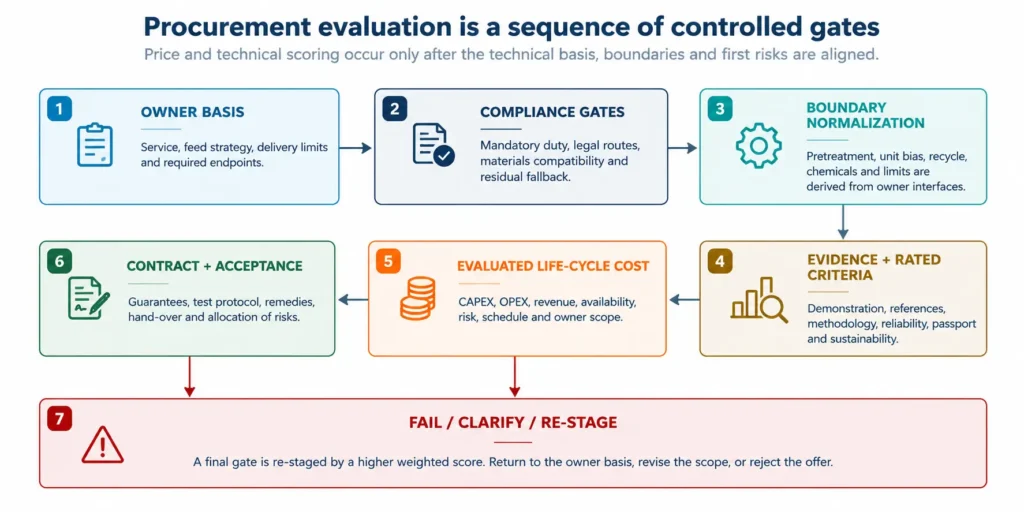
Figure 34.1. Procurement evaluation is a gated sequence. Price and weighted scoring enter only after the technical basis, boundary and fatal risks are aligned.
Separate mandatory compliance from rated differentiation
Not every criterion should be weighted. A bid that has no lawful residual route, cannot meet product-water duty, uses incompatible materials or offers an untestable guarantee should not outrank a compliant bid because it scores highly on presentation, innovation or price. Fatal requirements are pass/fail gates; rated criteria differentiate only among offers that remain capable of delivering the owner’s service.
World Bank rated-criteria guidance explicitly positions non-price criteria around project risks and quality factors such as methodology, performance, capacity, track record, risk management and sustainability. This guide applies that logic while retaining Brine Consulting’s hard-gate rule: weighted scoring cannot compensate for a failed service, legal, safety, residual or fallback condition.
| Criterion class | Examples | Evaluation method | Permitted outcome | Do not do |
|---|---|---|---|---|
| Mandatory service | Capacity, quality, feed envelope, residual endpoint, critical utilities. | Pass / conditional clarification / fail. | Only compliant or bounded offers proceed. | Average a failed duty into a total score. |
| Legal and environmental gate | Permit route, waste/product status, emissions, dangerous materials, disposal capacity. | Documented compliance and named responsibility. | Proceed only with a credible route and owner. | Treat future permitting as a generic vendor promise. |
| Technical integrity gate | Materials, pressure/temperature limits, mass balance, control and safety basis. | Datasheet and evidence review. | Clarify or reject material incompatibility or broken balance. | Credit a proprietary label instead of evidence. |
| Rated technical criteria | Methodology, integration, operability, references, support, innovation. | Published scoring descriptors and evidence. | Differentiates compliant bids. | Create criteria after seeing offers. |
| Commercial/lifecycle criteria | Evaluated cost, schedule, guarantees, spares, warranty, risk allocation. | Common adjustment and present-value basis. | Selects value, not lowest tender price alone. | Compare unadjusted prices with different scope. |
Table 34.2. Mandatory gates establish capability; rated criteria differentiate value among offers that pass the fatal requirements.
Normalize the feed, operating envelope and complete system boundary
A performance claim is comparable only when its denominator and boundary are the same. A membrane package may quote energy excluding pretreatment and interstage pumping; a thermal package may quote steam but not convert it to the agreed energy basis; a crystallizer may exclude mother-liquor purge, solids drying or off-spec handling. Procurement must reconstruct each offer to the owner’s source-to-endpoint boundary before scoring.
Normalization does not mean forcing all technologies into one flowsheet. It means that every bid carries the equipment, utilities, chemicals, losses, residuals and owner interfaces required to deliver the same service. Unpriced owner scope is an evaluated cost and an execution risk, not a free benefit.
| Normalization field | Common basis required | Bidder submission | Owner adjustment | Red flag |
|---|---|---|---|---|
| Hydraulic duty | Average/design/peak feed; stage and overall recovery; recycle and cleaning losses. | Block flows and complete water balance by case. | Reconstruct missing flow, storage and bypass duty. | Recovery uses a different feed or excludes losses. |
| Chemical basis | Major ions, density, temperature, additives and normal/upset distributions. | Guaranteed envelope and speciation/scale assumptions. | Apply the owner design cases consistently. | Single synthetic composition controls the offer. |
| Energy | Electrical and thermal energy by block and denominator; utility quality and conversion method. | Connected load, demand, SEC and heat duties. | Add omitted utilities and use one valuation basis. | Package SEC is presented as total-site SEC. |
| Chemicals and consumables | Purity, dose, excess, cleaning, media/membrane life and waste contribution. | Consumption guarantees and replacement schedule. | Price full annual duty and secondary salt load. | Dose excludes upset, CIP or reagent quality. |
| Residuals/products | Liquid, sludge, crystal, purge, wash, cleaning and off-spec outputs. | Mass, moisture, composition, classification and destination. | Add handling, transport, qualification and fallback. | A residual disappears because it is called product. |
| Infrastructure/interfaces | Civil, electrical, controls, storage, buildings, loading, data and tie-ins. | Battery-limit matrix and interface loads. | Estimate owner scope and schedule/interface risk. | Large unpriced balance-of-plant package. |
Table 34.3. Bid normalization converts different package claims into one feed, denominator and source-to-endpoint system boundary.
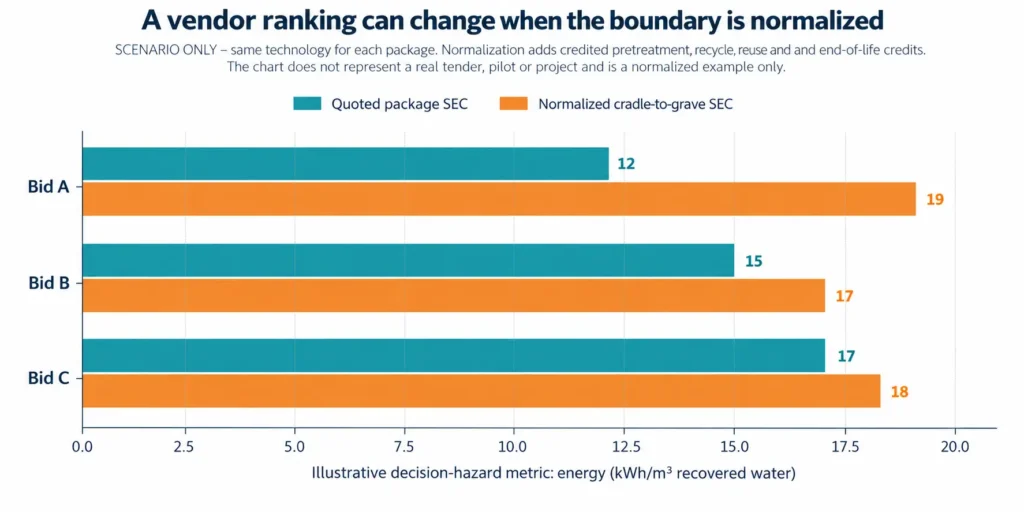
Figure 34.2. Scenario-only boundary-normalization example. Assumed values show how a quoted package-energy ranking can reverse after omitted pretreatment, recycle, residual and utility duties are added.
Guarantees must be measurable, attributable and linked to a defined acceptance test
A guarantee is not a bold value in a proposal. It is a contractual commitment with a stated feed and operating envelope, measurement method, test duration, balance and tolerance rules, exclusions, correction method, acceptance consequence and remedy. The promised quantity must be under the contractor’s control or the contract must state how shared causes are resolved.
IEC 60300-3-4:2022 emphasizes specification of quantitative and qualitative dependability requirements together with means of assurance. The same principle applies to process performance: requirements, evidence and verification must be designed as one package.
| Guarantee field | Required definition | Acceptance evidence | Qualification / exclusion test | Contract consequence to define |
|---|---|---|---|---|
| Capacity and service | Net treated feed and recovered-water duty at stated quality and availability. | Calibrated flows, laboratory results and balance closure. | Feed outside envelope, owner utility interruption or approved bypass. | Cure, retest, capacity remedy or accepted adjustment. |
| Water recovery / residual reduction | Stage and overall basis; routine and non-routine streams included. | Closed water balance over defined stable and transient periods. | Cleaning, purge, solids moisture and evaporation treatment. | Rework, design correction or performance remedy. |
| Energy and chemicals | Block and total-site basis; electrical/thermal separation; reagent purity and dose. | Metering plan, normalization and operating-state record. | Owner utility quality, ambient/feed correction and abnormal events. | Consumption remedy or price adjustment where applicable. |
| Product/residual quality | Chemical/physical form, moisture, impurity limits, off-spec fraction and destination. | Representative lots, methods and chain of custody. | Unqualified buyer, feed upset and owner-directed operation. | Reprocess, reject, fallback disposal and cost owner. |
| Availability / reliability | Defined calendar, exclusions, planned maintenance, redundancy and service metric. | Event log, downtime coding and production-accounting rules. | Force majeure, owner-caused outage and vendor maintenance. | Availability remedy, support action and chronic-failure trigger. |
Table 34.4. A guarantee is credible only when the basis, verification method, exclusions and consequence are defined before award.
Exclusions and interfaces are risk transfers, not footnotes
The commercial price is incomplete until exclusions are converted into named owner scope, cost, schedule and performance exposure. Common exclusions include feed conditioning, bulk chemical storage, utilities, sludge dewatering, drying, buildings, corrosion allowance, automation integration, hazardous-area requirements, laboratories, product qualification and disposal. Procurement should maintain one deviation and interface register through clarification and contract finalization.
| Exclusion / interface | Question to close | Owner exposure if retained | Required procurement treatment | Stop / escalate when |
|---|---|---|---|---|
| Pretreatment | Who removes solids, oil, hardness, silica, organics or biology to the guarantee feed? | CAPEX/OPEX, interface failure and guarantee escape. | Define outlet specification, control and responsibility. | No party guarantees the interface condition. |
| Utilities | Who supplies power quality, steam/heat, cooling, instrument air and water? | Connection, tariff, capacity and outage risk. | State quality, pressure/temperature, redundancy and metering. | Required utility is unavailable or unpriced. |
| Civil and balance of plant | Who provides tanks, foundations, buildings, drainage, roads and lifting? | Plot, geotechnical, constructability and schedule risk. | Issue load lists and included/excluded schedule. | Vendor layout cannot fit or access cannot be maintained. |
| Controls and data | Who integrates DCS/SCADA, cybersecurity, analyzers, historian and remote support? | Blind spots, interface delay and proprietary lock-in. | Define I/O, protocols, data ownership and support. | Black-box control prevents owner operation or verification. |
| Residual/product handling | Who stores, conditions, packages, transports, sells or disposes? | Plant stoppage when outlet fails. | Name routine and backup route with capacity. | Water plant depends on an uncommitted receiver. |
Table 34.5. Every exclusion should become an owned scope item, evaluated cost and explicit interface condition.
Evaluate the complete pretreatment, recycle, chemical and waste system
A bidder should not receive credit for a core separation device while excluding the systems that make it operable. The comparison must include the pretreatment that creates the guaranteed feed, the recycle and purge network that controls accumulation, the solids and cleaning systems that determine availability, and the fallback route that keeps the owner compliant when product sales or downstream equipment are unavailable.
| System block | Minimum bid disclosure | Performance dependency | Lifecycle burden | Evaluation question |
|---|---|---|---|---|
| Feed conditioning / pretreatment | Process duty, chemical path, separation, sludge and outlet envelope. | Protects membranes, evaporators, crystallizers and product quality. | Chemicals, sludge, filters, media, cleaning and operator attention. | Is the guaranteed feed achievable on the actual wastewater? |
| Concentration / recovery | Operating map, turndown, recycle, energy and cleaning. | Controls recovery, flux/duty and downstream load. | Membranes/media, pumps, heat transfer, CIP and outages. | Does performance survive normal/design/upset cases? |
| Crystallization / solids | Phase control, purge, washing, dewatering, drying and storage. | Controls salt purity, mother-liquor stability and plant continuity. | Steam/power, chemicals, fines, wash liquor and maintenance. | Are solids saleable, manageable or honestly disposed? |
| Controls / analytics | Critical analyzers, alarms, permissives, balance and operator actions. | Controls stable operation and guarantee verification. | Calibration, laboratory capability, software and support. | Can the owner diagnose and operate without vendor dependence? |
| Fallback / off-spec | Emergency storage, bypass, rework, disposal and restart logic. | Preserves lawful water and residual service during failure. | Standby capacity, inventory, transport and reprocessing. | Can the plant continue without product revenue or perfect uptime? |
Table 34.6. Technology evaluation must include the enabling and residual systems that create operable full-plant performance.
Materials evidence must match the real chemistry, temperature and cleaning regime
A generic “corrosion-resistant” claim is not a materials selection. Procurement should require a material-by-service schedule linked to chloride and other aggressive species, pH, temperature, oxygen/redox, velocity, solids abrasion, cleaning chemicals, vapour space, crevices and galvanic interfaces. Pilot coupons or reference experience can support the basis, but neither replaces design review for the actual service.
| Materials field | Required evidence | Condition to reproduce | Owner review | Failure signal |
|---|---|---|---|---|
| Wetted-material schedule | Material grade, lining/coating, gasket/elastomer and fastener by service. | Normal, upset, cleaning and shutdown chemistry. | Compatibility and traceability review. | One generic material is used across incompatible services. |
| Corrosion / erosion mechanism | Expected uniform, localized, stress, galvanic, abrasion or under-deposit risk. | Temperature, oxygen/redox, velocity, solids and crevices. | Mechanism-based allowance, monitoring and inspection. | Only general corrosion rate is discussed. |
| Fabrication and QA | Welding procedure, heat treatment, lining application, passivation and inspection. | Supplier/manufacturer route and repair method. | ITP, hold points, records and non-conformance control. | Material certificate exists but fabrication risk is unaddressed. |
| Cleaning compatibility | CIP reagents, concentration, temperature, exposure and rinse. | Routine and recovery cleaning cycles. | Materials and elastomer review plus waste implications. | Cleaning needed for performance damages equipment. |
| Monitoring / replaceability | Coupons/probes, inspection access, corrosion allowance and replaceable wear parts. | Full operating and maintenance lifecycle. | Inspection plan and replacement strategy. | Failure is detectable only after loss of containment. |
Table 34.7. Materials selection is a service-specific evidence package, not a vendor-standard materials list.
Availability requires reliability, maintainability, supportability and an honest production model
Nameplate capacity and component warranty do not establish annual service. The evaluation should convert redundancy, failure frequency, repair time, cleaning, planned maintenance, spares, logistics and operator response into an availability model. IEC 60300-3-10:2025 treats maintainability and maintenance as lifecycle activities linked to reliability, availability and supportability; IEC 60300-3-4 requires the acquirer to specify verifiable dependability requirements.
ISO 20815:2026 provides a current production-assurance and reliability-management framework for operators, contractors and vendors across asset development and operation. Although sector-specific, its lifecycle logic is directly useful: evaluate the system that delivers production, not isolated equipment reliabilities.
| Dependability field | Bidder input | Model treatment | Evidence / assurance | Common distortion |
|---|---|---|---|---|
| Reliability | Failure modes, rates or reference history for critical equipment and controls. | System reliability with common-cause and dependency logic. | Comparable references, FMEA and field data basis. | Generic MTBF without service or population. |
| Maintainability | Access, isolation, lifting, drain/flush, repair duration and staffing. | Mean restoration time and simultaneous maintenance constraints. | Maintenance task analysis and layout review. | Repair assumes instant access and no decontamination. |
| Supportability | Spares, consumables, tools, remote/site support, lead times and obsolescence. | Logistics delay and inventory policy. | Recommended spares, lead-time evidence and service commitment. | Warranty is treated as immediate recovery. |
| Planned maintenance / cleaning | Frequency, duration, sequence, train rotation and waste. | Annual service and capacity during planned outages. | Pilot/reference basis and maintenance programme. | Cleaning downtime is excluded from availability. |
| Redundancy and storage | N+1 philosophy, common utilities, tank buffers and bypass. | Delivered service under single failures and maintenance. | Failure scenarios and hydraulic inventory. | Redundant skids share one critical common failure. |
Table 34.8. Availability is a system-production result built from reliability, maintainability, support and operating assumptions.
Comparable references must match the duty, boundary and evidence level
A reference plant is useful only when the comparison states what is similar and what is not. Feed origin, chemistry, flow, concentration factor, product/residual duty, operating hours, pretreatment, materials, climate, scale, commissioning status and data ownership all matter. A large installation on an easier feed is not automatically stronger evidence than a smaller integrated plant on the same controlling chemistry.
GAO’s technology-readiness guidance distinguishes technology maturity from readiness for integration into a complete acquisition system. Procurement should therefore record both the maturity of critical components and the evidence that the offered configuration has operated as an integrated system.
| Reference field | Minimum evidence | Comparable when | Qualification required | No credit when |
|---|---|---|---|---|
| Feed and operating envelope | Origin, chemistry distribution, temperature, additives and variability. | Controlling foulants/scalants and severity are reasonably aligned. | State easier/harder differences and mitigation. | Only TDS or industry name is provided. |
| Configuration and boundary | Pretreatment, core process, recycle, solids, controls and endpoints. | The reference includes the systems credited in the bid. | Identify owner-supplied or different blocks. | Only hero equipment is referenced. |
| Scale and duration | Hydraulic/thermal scale, trains, turndown, operating hours and campaigns. | Relevant scale effects and time-dependent risks were exposed. | Explain scale-up and remaining uncertainty. | Short demonstration is called commercial operation. |
| Performance evidence | Normalized capacity, quality, energy, chemicals, availability and residuals. | Same denominators and credible data source. | Independent/owner/vendor data status stated. | Marketing number has no raw basis. |
| Contract and contactability | Owner/operator contact, date, role and permission for verification. | Reference can be checked and context discussed. | Confidential limits are transparent. | Anonymous logo list substitutes for evidence. |
Table 34.9. A reference is comparable only when feed, configuration, scale, duration, denominator and evidence source are visible.
Evaluate lifecycle value, not tender price
The evaluated cost should reconcile the vendor price with owner scope, energy and chemicals, replacements, spares, labour and specialist support, maintenance outages, residual handling, product qualification, financing/schedule effects and performance risk. The purpose is not false precision; it is to expose which bidder leaves the owner with materially different lifecycle obligations.
ISO 20400 provides guidance for integrating sustainability into procurement, while ISO 55001:2024 frames asset decisions around balancing performance, risk and expenditure over the lifecycle. These principles support a procurement evaluation that carries environmental and operational burdens into the award decision rather than treating them as post-award design issues.
| Evaluated-cost component | Common basis | Bid input | Owner adjustment | Downside test |
|---|---|---|---|---|
| Supply / EPC price | Currency, price date, taxes/duties, escalation, exclusions and schedule. | Firm/variable price and payment milestones. | Add omitted owner scope and interface cost. | Delay, inflation/FX and change-order exposure. |
| Energy and chemicals | Annual cases, tariffs, utility quality, reagent purity and availability. | Guaranteed and expected consumption. | Normalize to same service and operating hours. | Higher-energy, poorer-feed and dose escalation. |
| Replacement and maintenance | Membranes/media, wear parts, major overhaul, labour and downtime. | Life assumptions, warranty and spares. | Risk-adjusted replacement and lost service. | Shorter life and long lead-time failure. |
| Residual/product system | Handling, qualification, packaging, transport, disposal and fallback. | On/off-spec quantities and responsibilities. | No-revenue and receiver-outage case. | Product rejection and disposal-cost increase. |
| Availability and schedule | Commissioning curve, planned/unplanned outage and delivery date. | Ramp-up, reliability model and support plan. | Value production constraint and schedule risk. | Lower availability and late start. |
| End-of-life / lock-in | Decommissioning, proprietary controls, obsolescence and data/software access. | Licences, source/data rights and long-term support. | Price transition and owner capability. | Supplier exit or proprietary consumable escalation. |
Table 34.10. Evaluated lifecycle value includes owner scope, operating burdens, availability and downside risk—not only the tender price.
Allocate product-offtake and disposal risk without endangering the water obligation
Product recovery introduces a commercial dependency into a treatment asset. The contract must state who qualifies the product, secures the receiver, bears rejection and storage cost, manages unsold output and maintains compliant fallback capacity. The vendor may guarantee a physical product specification; it normally cannot guarantee a market unless it is also the contracted offtaker under enforceable terms.
The water and residual system should remain operable in the no-product-revenue case. Where the vendor or a project company takes offtake risk, the owner should still test counterparty continuity, quality disputes, logistics interruption and the practical route when the offtake arrangement fails.
| Risk item | Possible owner | Possible contractor/offtaker | Required evidence | Minimum fallback |
|---|---|---|---|---|
| Product specification | Owner defines use/buyer need; contractor guarantees process output. | Contractor controls production and QC. | Agreed methods, limits, lots and rejection protocol. | Rework, downgrade or disposal route. |
| Qualification / registration | Owner, contractor or joint workstream by jurisdiction. | Party with technical data and market responsibility. | Dated qualification plan, samples and compliance owner. | No revenue credit until qualified. |
| Market volume / price | Owner retains, shares or transfers through offtake contract. | Offtaker commits quantity/term/price formula and credit support. | Contract, capacity, buyer diligence and downside terms. | Secondary outlet or full residual capacity. |
| Storage and logistics | Owner site interface; contractor may design/operate. | Party controlling packaging, loading and transport. | Payload, frequency, stability, dangerous-goods/waste status. | Buffer capacity and alternate carrier/route. |
| Rejected / unsold output | Explicitly allocated; never implied. | Contractor/offtaker only if contract and capacity support it. | Cost, title, liability, timing and acceptance procedure. | Lawful disposal with no sales assumption. |
Table 34.11. Product and disposal risks must be allocated explicitly while preserving an independent compliant residual route.
Control clarifications, deviations and value engineering without moving the goalposts
Clarification should resolve ambiguity, not allow a bidder to redesign the competition after seeing rivals’ positions. All material deviations should be captured in a common register, answered consistently and converted into the final contract documents. Value engineering may be beneficial, but the owner must re-run the service, boundary, risk and lifecycle tests before accepting a scope reduction.
| Control | Minimum record | Permitted use | Governance trigger | Failure prevented |
|---|---|---|---|---|
| Clarification log | Question, common response, affected requirement and issue date. | Resolve ambiguity without changing competition unfairly. | Material answer issued to all affected bidders. | Different bidders price different hidden assumptions. |
| Deviation schedule | Requirement, bidder position, consequence, owner disposition and contract location. | Make exceptions visible and traceable. | Technical/commercial/legal approval for material deviations. | Exception disappears during contract compilation. |
| Bid normalization register | Omitted scope, evaluated cost, performance/risk adjustment and evidence. | Create one comparable lifecycle basis. | Independent check before final ranking. | Lowest price wins by excluding owner scope. |
| Value-engineering register | Proposed change, benefit, affected interfaces, evidence and residual risk. | Accept genuine whole-system improvement. | Revisit guarantees, permits, HAZID, O&M and lifecycle cost. | Scope reduction is labelled innovation. |
| Final contract reconciliation | Proposal, clarifications, schedules, guarantees, datasheets and drawings. | Establish one controlling obligation hierarchy. | Cross-functional review before signature. | Conflicting documents create post-award escape routes. |
Table 34.12. Clarifications and deviations must converge into one controlled technical and commercial contract basis.
Use a vendor comparison sheet that shows evidence, adjustments and fatal gaps
A comparison sheet should not collapse the evaluation into one opaque score. It should show the owner requirement, each bidder’s stated basis, evidence status, exclusions, normalization adjustment, residual risk and gate result. The detailed model can contain weighted criteria, but the decision sheet must still expose the reasons a bid is compliant, conditional or unacceptable.
| Comparison field | Owner basis | Bidder response + evidence | Normalization / retained risk | Status |
|---|---|---|---|---|
| Feed + duty | Normal/design/upset feed; net service and endpoint. | Quoted envelope, tested/reference/guaranteed status. | Differences, exclusions and design adjustment. | Pass / clarify / fail |
| Complete boundary | Pretreatment through product/residual fallback. | Included/optional/owner scope and interfaces. | Evaluated CAPEX/OPEX and schedule exposure. | Pass / clarify / fail |
| Guarantees | Capacity, quality, recovery, energy, chemicals, availability. | Values, test method, duration, tolerances and exclusions. | Testability and remedy gap. | Pass / clarify / fail |
| Operability + materials | Cleaning, control, redundancy, access, compatible materials. | Pilot/reference evidence and O&M plan. | Owner capability, spares and residual uncertainty. | Rated + hard gates |
| References + maturity | Comparable integrated operation and contactable evidence. | Reference matrix and data provenance. | Scale/configuration differences and maturity plan. | Rated + condition |
| Lifecycle + risk | Common economic, environmental and delivery basis. | Price, schedule, consumptions, support and risk allocation. | Evaluated value and mandatory downside cases. | Rank after gates |
Table 34.13. Vendor comparison sheet. The decision record should preserve the owner basis, evidence state, normalization and fatal-gap status.
Procurement and technology-evaluation acceptance gate
An offer may advance only when its service and boundary are reconstructable, critical claims are supported at the appropriate evidence level, guarantees are testable, interfaces and residuals are owned, lifecycle burdens are comparable and the contract can preserve the water and residual obligation under credible downside cases.
| Gate field | Proceed | Conditional / recycle | Stop | Required record |
|---|---|---|---|---|
| Basis and boundary | Common feed, service, battery limits and endpoints are complete. | Minor interface or owner input remains bounded. | Bids solve materially different problems. | Owner requirement and boundary matrix. |
| Technical compliance | Duty, materials, controls, legal and fallback requirements pass. | One non-fatal item has a dated closure plan. | Fatal service, safety, legal or residual condition fails. | Compliance and deviation schedule. |
| Evidence and references | Claims are demonstrated, comparable or explicitly guaranteed with maturity limits. | Scale-up/reference gap is priced and contractually controlled. | Marketing claims substitute for evidence. | Evidence and maturity register. |
| Guarantees / acceptance | Metrics, methods, feed, duration, tolerances, exclusions and remedies align. | Protocol detail closes before award under controlled condition. | Guarantee cannot be measured or has broad escape clauses. | Guarantee and test schedule. |
| Lifecycle value | CAPEX, OPEX, owner scope, availability, residuals and risks use one basis. | Secondary cost uncertainty remains within decision range. | Ranking depends on omitted scope or optimistic product revenue. | Normalized lifecycle model. |
| Risk allocation / delivery | Interfaces, offtake, disposal, schedule, support and data rights have capable owners. | One allocation awaits final commercial evidence. | Water service depends on an uncommitted third party or absent fallback. | Risk allocation and contract matrix. |
Table 34.14. Procurement advances only when capability, evidence, guarantees, lifecycle value and risk allocation are auditable.
Stop ruleStop, clarify or re-stage when bids cannot be normalized to the same feed and source-to-endpoint boundary; when a fatal service, materials, legal or residual condition is hidden inside weighted scoring; when guarantees are not measurable; or when the owner must supply unpriced systems that create the claimed performance. Do not award a water and residual obligation to a headline technology claim. |
|---|
Handover to Chapter 35 — operations and maintenance
Chapter 35 makes operability a design criterion. It should receive the awarded technical and commercial basis—not a cleaned-up vendor brochure. The handover must preserve the guaranteed operating envelope, final battery limits, operator tasks, automation and laboratory duties, maintenance and cleaning assumptions, spares and support commitments, materials inspection, salt/sludge handling, emergency storage, shutdown/restart logic and unresolved owner capabilities.
The operations team should participate before award and approve the maintainability, access, staffing, consumables, data and failure-recovery basis. Procurement conditions that are not translated into operating procedures, training, spares and performance monitoring will not protect availability after handover.
| Handover field | Required basis for Chapter 35 | Operations risk if missing |
|---|---|---|
| Final process and boundary | As-awarded PFD/P&ID basis, equipment, interfaces, recycle/purge, residual and fallback routes. | Operators inherit scope gaps and undocumented dependencies. |
| Operating envelope / guarantees | Normal/design/upset limits, controls, acceptance metrics, exclusions and remedies. | Operation outside the guarantee basis becomes routine. |
| Operator and laboratory tasks | Rounds, sampling, analyses, calibrations, product release, residual checks and escalation. | Automation assumptions exceed site capability. |
| Maintenance / cleaning basis | Tasks, frequency, duration, isolation, access, wastes, staffing and specialist support. | Availability model cannot be achieved. |
| Spares and supply chain | Commissioning/strategic/operating spares, consumables, lead times, tools and obsolescence plan. | Minor failures create long outages or vendor lock-in. |
| Materials / inspection | Material schedule, corrosion mechanisms, inspection points, limits and replaceable wear parts. | Degradation remains invisible until performance or containment fails. |
| Emergency and restart | Storage, bypass/fallback, safe shutdown, preservation, restart sequence and degraded operation. | Upsets create non-compliance or extended recovery. |
| Data / training / support | Raw and processed data rights, manuals, software, training, remote/site support and warranty workflow. | Owner cannot diagnose, optimize or enforce guarantees. |
Table 34.15. Chapter 35 requires the as-awarded operating, maintenance, support and failure-recovery basis.
Chapter conclusion
Procurement is where process evidence becomes an enforceable asset obligation. The correct comparison is not vendor against vendor at brochure level; it is each complete offer against one owner service, one feed envelope, one source-to-endpoint boundary and one lifecycle risk basis.
Mandatory gates should remove offers that cannot meet the service, legal, materials, residual or fallback requirements. Rated criteria can then differentiate methodology, integration, reliability, support, sustainability and value. Guarantees must be measurable; references must be comparable; exclusions must become owned scope; and product/offtake risk must never disable the water and residual obligation.
Chapter 35 now converts the awarded basis into operator capability, maintenance, monitoring, cleaning, spares, corrosion inspection, emergency storage and predictable degraded operation.
Chapter 34 in one sentenceSelect the complete, testable and supportable system on a common basis—because a cheaper or more efficient claim is not comparable when its feed, boundary, exclusions and retained risks are different. |
|---|