
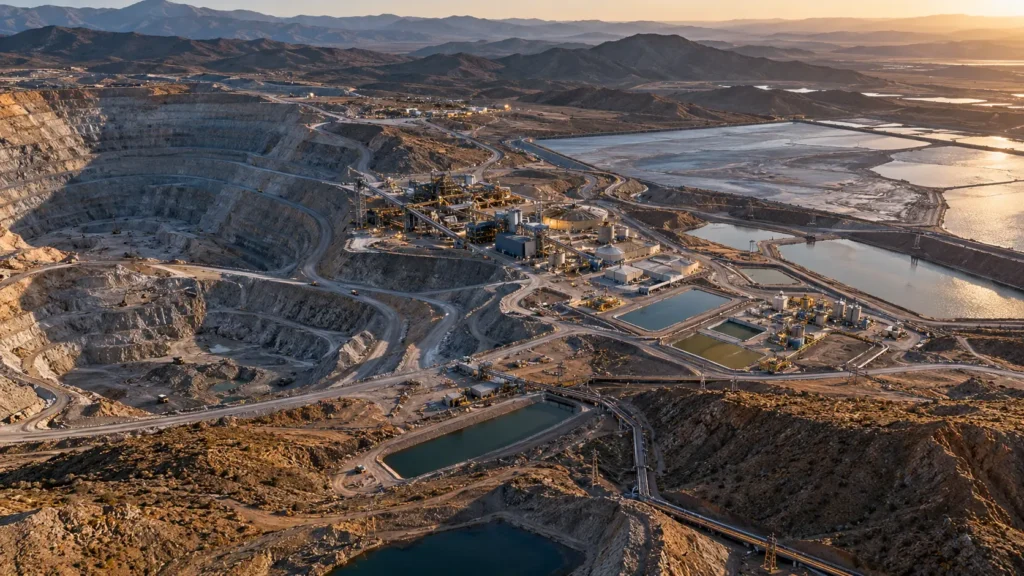
Site water value, tailings integration, logistics and operability may matter more than maximum recovery.
Controlled principleMining water is part of the production, hydrogeological and tailings system. The treatment train should be sized only after source waters, process demands, tailings return, discharge or disposal routes, site logistics and closure obligations have been mapped. High recovery is useful only when it improves the complete mine-water system. |
|---|
Start with the mine water circuit, not the treatment package
Mining sites rarely have one wastewater. Dewatering, contact water, process bleed, tailings reclaim, seepage, acid and metalliferous drainage (AMD) and naturally saline or hypersaline groundwater can have different origins, chemistry, timing and value. Australian government water-stewardship guidance treats mine water management as a site-wide risk and resource problem rather than an isolated treatment task, while IFC mining guidance similarly expects water management to be tailored to the mine type, site conditions and environmental assessment.
The first engineering question is therefore where water enters the mine, what duty it serves, what it contacts, how its chemistry evolves and where it can leave. A stream that can be diverted, directly reused or treated to a fit-for-purpose quality should not automatically be mixed with a metal-rich or hypersaline stream and sent to the most complex plant. Chapter 36’s failure logic applies directly: mixing can create a larger and more difficult residual problem before any membrane or evaporator is selected. [BC-36,BC-37]
| Source stream | Why it exists | Controlling evidence | First endpoint question |
|---|---|---|---|
| Mine dewatering / intercepted groundwater | Maintain dry workings and geotechnical access | Hydrogeology, salinity, metals, suspended solids, seasonal flow | Direct use, controlled discharge, polishing, or dedicated saline-water route |
| Contact / storm water | Manage rainfall and disturbed-area runoff | TSS, acidity/alkalinity, metals, hydrocarbons, seasonal peaks | Diversion/segregation first; treatment only where contact creates risk |
| Process water / plant bleed | Mineral processing and washing | Reagents, fines, dissolved salts, hardness, organics as process-specific | Internal recycle where quality permits; purge only to control accumulation |
| Tailings return / seepage | Tailings deposition and reclaim circuit | Fine solids, dissolved salts, reagents, oxidation products | Return to process if compatible; treatment only for a defined water-quality or tailings duty |
| AMD / metalliferous drainage | Oxidation/leaching of reactive materials | Acidity, sulfate, Fe/Al/Mn and other metals/metalloids; highly site-specific | Source control + neutralization/precipitation or other targeted treatment |
| Hypersaline groundwater / brine | Natural formation water or mine inflow | High ionic strength; Na/Cl may dominate but scaling ions and trace constituents still matter | Fit-for-purpose desalination, MLD or ZLD only after chemistry and residual route are defined |
Table 38.1. Mining water streams should be separated by source, duty and chemistry before they are combined into one treatment problem.
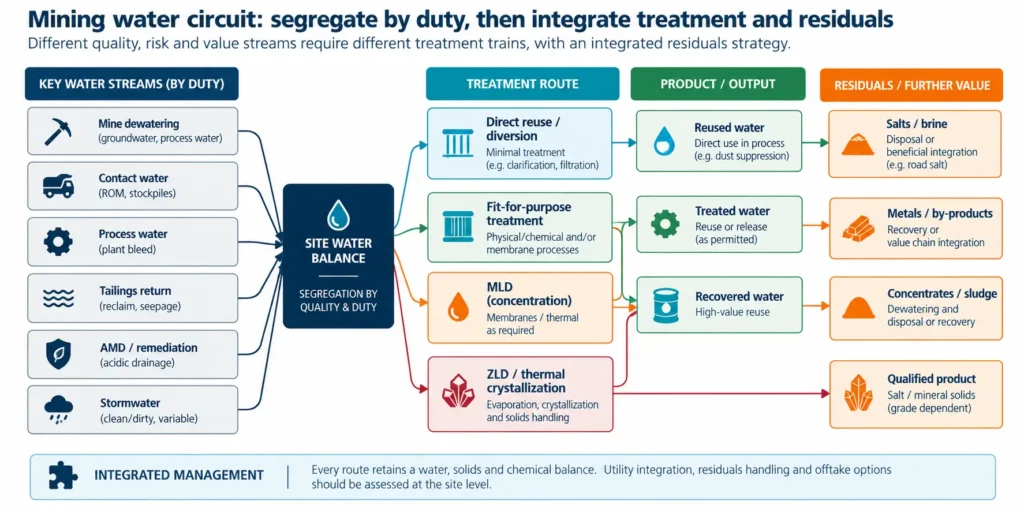
Figure 38.1. Mining water circuit and residual-integration map. The figure is a decision architecture, not a universal mining flowsheet.
Segregation can be more valuable than another recovery stage
Source reduction in mining often means keeping clean or reusable water out of the difficult circuit. Examples include diverting non-contact runoff, returning suitable dewatering water to process use, recovering tailings water before it accumulates additional salts, or isolating AMD from otherwise reusable water. EPA hard-rock mining guidance explicitly emphasizes pollution prevention and source control before long-term treatment where possible.
The benefit is not captured by a universal percentage. It is site-specific because flow, quality, rainfall, mine plan and internal demand change over time. The scenario below therefore shows only the accounting logic: the total water problem is fixed at 100 m³/h, but segregation prevents the entire flow from inheriting the chemistry and cost of the most difficult 25 m³/h fraction.
| Scenario | Total water basis | Direct reuse/diversion | Fit-for-purpose treatment | Intensive MLD/ZLD duty | Interpretation |
|---|---|---|---|---|---|
| Mixed end-of-pipe case | 100 m³/h combined | 0 | 0 | 100 m³/h | Illustrative only; all water inherits the most demanding treatment boundary |
| Segregated site-water case | 100 m³/h total | 45 m³/h | 30 m³/h | 25 m³/h | Illustrative allocation used only to show why segregation changes equipment duty |
Table 38.2. Scenario-only segregation basis for Figure 38.2; the numbers are illustrative and are not mining-industry benchmarks.
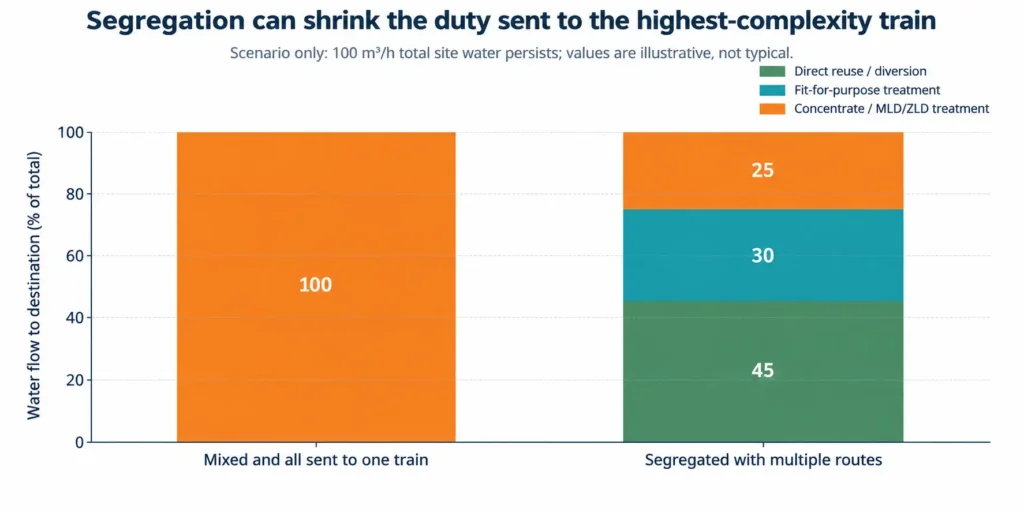
Figure 38.2. Scenario-only segregation effect on intensive-treatment duty. The graph demonstrates system-boundary logic, not a typical mine-water split.
Mine dewatering is a hydrogeological and production duty first
Dewatering flow is governed by mine geometry, aquifer behavior, rainfall, underground inflows and the mine schedule. Its value may be unusually high because inadequate dewatering can constrain access or production, while the same water may also be a useful on-site supply. The treatment design therefore needs the hydrogeological operating envelope, not a single average flow.
Where dewatering water is relatively clean, the preferred sequence is to preserve its quality and test direct or minimally treated uses before mixing. Where it is saline, metal-bearing or otherwise incompatible with the receiving process, the water can become a dedicated treatment stream. The target quality must be set by the intended user or permitted endpoint rather than an assumption that all mine water should become potable.
| Dewatering field | Required evidence | Failure if omitted |
|---|---|---|
| Hydraulic basis | Normal, seasonal, design and upset inflow; mine-stage forecast | Undersized equalization or treatment during wet/advance conditions |
| Water-quality basis | Representative distributions and geochemical evolution | One early-life sample becomes the lifetime design basis |
| Production coupling | Consequence of water shortage, pit/shaft flooding, pumping outage | Treatment availability specified without mine-production consequence |
| Internal use | Ore processing, dust suppression, wash, cooling or other defined duty | Over-treating water to drinking-water quality with no value |
| Residual route | Concentrate, sludge, purge, evaporation or off-site endpoint | Recovery target chosen before residual capacity is known |
Table 38.3. Mine dewatering treatment should be designed from hydrogeology, production consequence, reuse quality and residual capacity.
AMD is a source-control and geochemistry problem before it is a desalination problem
Acid and metalliferous drainage can develop when sulfide-bearing material is exposed to water and oxygen. EPA and Australian leading-practice guidance describe the resulting chain as acid generation with mobilization of sulfate and metals; water quality can change materially as neutralizing capacity is consumed. Prevention or reduction of source generation is therefore preferable where practicable, while existing AMD may require long-duration treatment.
Conventional neutralization can remove acidity and many dissolved metals by precipitation, but it creates a solids-management duty and does not make sulfate disappear. If downstream reuse, membrane concentration or discharge requires lower sulfate or different trace-contaminant control, those requirements must be evaluated as additional steps with their own residuals. AMD treatment should not be described as ‘softening’ when the real objective is broader geochemical stabilization.
| Control layer | Primary objective | Evidence required | Residual / limitation |
|---|---|---|---|
| Source prevention / isolation | Limit oxygen/water contact, divert clean water, control reactive materials | Mine design, waste-rock/tailings geochemistry and hydrology | Reduces long-term load; may not eliminate existing drainage |
| Neutralization + oxidation/precipitation | Control acidity and precipitate many metals | Acidity, Fe/Al/Mn and metal speciation, reagent demand, settling/dewatering | Metal-rich sludge; sulfate commonly remains significant |
| Sulfate-specific treatment | Meet reuse/discharge or downstream-concentration requirement | Required sulfate endpoint, calcium, ionic strength, competing ions | New concentrate, precipitate or regenerant |
| Membrane / concentration step | Recover water after adequate solids/metals control | Scaling/fouling chemistry, osmotic pressure, pretreatment robustness | Concentrate that still requires a finite endpoint |
Table 38.4. AMD treatment is a layered geochemical problem; each control step creates a new mass-balance and residual obligation.
Hypersaline groundwater should be screened as a water-supply and residual problem
Mining can encounter saline and hypersaline groundwater that is not AMD. USGS water-use information shows that saline groundwater is already used materially in mining contexts, reinforcing that salinity alone does not define whether a water is unusable. The design question is whether the water can serve a mine duty directly, after partial treatment, or only after substantial desalination.
For very saline water, conventional RO may be only one part of the concentration pathway, and the correct high-salinity technology must be selected from the full ionic composition, target product-water quality, recovery objective, site energy and the available concentrate endpoint. Hypersaline mine water is precisely where the booklet’s ‘chemistry before TDS’ rule matters: sulfate, hardness, silica, trace metals and additives can decide whether a membrane, precipitation, electrodialysis, solvent, evaporation or crystallization step is practical.
| Endpoint family | When it earns a screen | Minimum evidence | Key caution |
|---|---|---|---|
| Use without desalination | Receiving process tolerates salinity and trace constituents | Process-water specification and materials compatibility | Avoids unnecessary treatment but may increase circuit salt inventory |
| Partial desalination / blending | Moderate quality improvement creates sufficient value | Blend balance, process tolerance, concentrate route | May be superior to chasing maximum recovery |
| Membrane-led MLD | Chemistry and osmotic duty permit staged membrane/electrochemical concentration | Real-matrix testing, scaling control, pressure/current and cleaning basis | Residual concentrate remains |
| Thermal / hybrid concentration | Membrane limit or endpoint pushes to higher concentration | Heat/electricity, materials, scaling, solids, vapor/condensate quality | High energy and solids-management burden |
| Crystallization / ZLD | No routine liquid endpoint is permissible or justified | Full salt/impurity balance, mother-liquor purge, solids destination | ZLD does not remove waste; it changes its form |
Table 38.5. Hypersaline mine-water architecture should be selected from water value, chemistry and the concentrate endpoint—not from salinity alone.
Tailings-water recycle is part of the process and tailings design
Tailings return water can be one of the largest internal water-recovery opportunities at a mine, but it cannot be treated as a free reservoir. Recycle changes the dissolved-salt and reagent inventory in the plant, while tailings deposition, reclaim, seepage and water storage remain subject to the tailings facility’s safety and operating basis. The Global Industry Standard on Tailings Management and Australian tailings guidance both emphasize integrated, lifecycle management rather than treating the facility as an unbounded wastewater sink.
A mine-water MLD/ZLD concept should therefore show how any new concentrate, sludge or crystallizer residual affects tailings rheology, geochemistry, reclaim quality, seepage, water balance, storage and closure. ‘Send it to tailings’ is an interface statement, not a disposal endpoint, until the tailings engineer has accepted the mass, water and geochemical consequences.
| Tailings integration field | Required record | Decision enabled |
|---|---|---|
| Reclaim water quality | Salt/reagent/fines trend over campaigns | Process recovery, flotation/leach performance, corrosion/scaling |
| Tailings water balance | Deposition water, reclaim, rainfall, evaporation, seepage, pond/storage states | Hydraulic capacity and seasonal operating envelope |
| New treatment residual | Flow, solids %, dissolved load, mineralogy, hazardous constituents | Whether the TSF/paste/backfill system can accept it |
| Seepage / contact water | Hydraulic and geochemical pathways | Whether recycling concentrates a contaminant or transfers risk |
| Closure state | Long-term water generation, drainage and residual containment | Whether the operating solution creates a perpetual closure obligation |
Table 38.6. Tailings integration requires a controlled water, salt and solids interface; the TSF is not an undefined residual sink.
Sulfate and metals are often the chemistry gates
Mining waters can contain sulfate and metals across acidic, neutral and alkaline pH ranges. EPA notes that acidic conditions tend to mobilize many metals, while neutralized waters can still retain sulfate and some metals or metalloids. The implication for MLD/ZLD is that pH correction and bulk metal removal can unlock later water recovery, but they do not establish a generic membrane-ready feed.
The correct pretreatment removes the species that constrain the next step. For a sulfate-rich water this may mean calcium/sulfate precipitation or another sulfate-specific route; for a metal-bearing water it may mean staged pH control, oxidation/reduction or selective precipitation. The resulting sludge mineralogy, moisture and leachability must be tracked because a smaller liquid stream can be offset by a larger or more difficult solid.
| Chemistry variable | Why it controls design | Evidence before concentration |
|---|---|---|
| Acidity / alkalinity | Controls metal solubility, reagent demand and downstream pH window | Titration/alkalinity-acidity balance and speciation |
| Sulfate + calcium | Gypsum/anhydrite scale and sulfate endpoint | Ion balance, saturation/speciation and representative concentration testing |
| Fe / Al / Mn | Precipitation, sludge volume, fouling and filtration | Dissolved/total metals, oxidation state, pH-response testing |
| Trace metals / metalloids | Reuse/discharge constraints and solids classification | Species-specific analytical methods and destination criteria |
| Silica / colloids | Membrane/thermal fouling, solids separation | Reactive/colloidal basis, temperature/pH effects and pilot evidence |
| Process reagents | Complexation, flotation/leach interference, organics/fouling | Reagent inventory, degradation products and recycle accumulation |
Table 38.7. Mining-water pretreatment should be mechanism-specific and tied to the next process block.
Typical mining MLD/ZLD configurations are conditional architectures
Mining MLD/ZLD trains are best described as conditional architectures rather than recipes. The same mine may use direct reuse for one stream, conventional treatment for AMD, membrane concentration for a brackish stream and a thermal endpoint only for the final difficult fraction. IFC’s mining guidance and the Australian handbooks support site-specific environmental and water-management design rather than a single sector technology sequence.
| Architecture | When it fits | Illustrative block logic | Critical boundary |
|---|---|---|---|
| Segregated reuse + residual treatment | Several waters have different quality and clear internal users | Diversion/equalization → targeted polishing → reuse; difficult fraction isolated | Often the first mining screen because it protects high-value water |
| AMD treatment + reuse | Acidity/metals are primary constraints | Source control → neutralization/precipitation → solids separation → polishing/reuse as required | Sulfate and sludge remain explicit duties |
| Membrane-led MLD | Moderate-salinity stream has a viable concentrate endpoint | Pretreatment → RO/NF/ED/other justified concentrator → recovered water + concentrate | Do not assume concentrate disposal is free |
| Hybrid membrane-thermal MLD/ZLD | Membranes reduce thermal duty but cannot meet final endpoint alone | Selective pretreatment → membrane/electrochemical concentration → evaporator | Integration and materials dominate at high concentration |
| Thermal ZLD / crystallization | Routine liquid discharge is unavailable or project value supports full liquid elimination | Pretreatment → evaporator/crystallizer → condensate + solids + mother-liquor control | Highest complexity; solids and closure routes must be bankable |
Table 38.8. Mining MLD/ZLD configurations are assembled from site duties and residual endpoints; none is a universal default.
Remoteness changes the water value, operating model and logistics
Remote mines can face long distances to alternative water, disposal, reagents, specialist labor and spare parts. That can increase the value of recovered water and simultaneously make complex treatment harder to operate. The economic comparison must therefore include delivered water, pumping/transport, on-site energy, reagent logistics, waste haulage, critical-spares inventory and the production consequence of downtime—not only package OPEX.
Remote operation also changes the preferred technology. A theoretically efficient process that requires frequent specialist intervention, fragile consumables or off-site liquid handling may be inferior to a more conservative system with larger storage, simpler chemistry and stronger redundancy. Operability is an economic input in mining because a water-plant outage can become a mine-production constraint.
| Remote-site factor | Why it changes the decision | Required evidence |
|---|---|---|
| Alternative water distance / scarcity | Raises avoided-water value | Verify source capacity, quality, pumping/haulage and reliability |
| Power availability / heat | Changes feasible concentration routes | Use actual site generation, load, curtailment and outage basis |
| Reagents | Freight, storage and shelf-life burden | Bulk delivery frequency, dangerous-goods constraints, local alternatives |
| Spares / specialist support | Controls outage duration | Criticality, lead time, vendor access, remote monitoring and on-site skills |
| Residual transport | Can destroy MLD economics | Payload, classification, road/rail access, seasonal access and licensed receiver |
| Weather / season | Changes inflow and site access | Wet/dry or freeze/heat operating states and emergency storage |
Table 38.9. Remoteness can make water recovery more valuable while making high-complexity treatment less supportable.
Residual integration can create or destroy the mining case
The residual route should be selected with the mine’s existing solids systems, but integration must be technically accepted rather than assumed. Neutralization sludge may be compatible with a tailings or backfill route in one project and unacceptable in another. A crystallizer salt may be non-hazardous yet still have no market, while a metal-bearing sludge may require dedicated containment.
The book’s controlled terminology remains important: resource recovery does not automatically create a product. Mining projects should give revenue credit only to qualified material and preserve a no-sales fallback. A tailings reprocessing or metal-recovery opportunity can be valuable, but it should be assessed as a separate, evidence-based product route rather than used to make the water-treatment economics close by assumption.
| Residual | Minimum characterization | Permitted decision treatment |
|---|---|---|
| Neutralization / metal sludge | Mineralogy, metals, moisture, leachability | Tailings/paste/backfill if approved; dedicated disposal; reprocessing if qualified |
| Gypsum / sulfate solids | Purity, co-precipitated metals, wash requirement | Internal use, sale only if qualified, or managed solid residual |
| Membrane concentrate | Flow, full ionic composition, scaling/toxicity | Further concentration, evaporation, injection/disposal where lawful, or controlled storage |
| Crystallizer salt | Phase, impurities, moisture, consistency | Qualified product only with specification and receiver; otherwise residual |
| Mother liquor / purge | Non-crystallizing impurity inventory | Recycle with controlled purge to a finite endpoint |
| Cleaning / regeneration waste | Chemicals, metals, solids and episodic volume | Equalization/treatment or dedicated waste route |
Table 38.10. Mining residuals must have technically accepted, finite endpoints; tailings or product labels do not remove the obligation.
Recovered-water quality should be set by mineral-processing duty
The most bankable recovered-water value is often internal substitution: water returned to grinding, flotation, leaching, washing, dust suppression or another mine duty. But mineral processing can be sensitive to ionic strength, hardness, sulfate, chloride, residual reagents or trace metals. The ‘best’ recovered water is therefore the quality that protects the receiving process at the lowest total system burden, not necessarily the lowest TDS.
Qualification should involve the process owner. A water-treatment vendor cannot unilaterally decide that permeate is acceptable for flotation or leaching, and a mine cannot assume that higher-salinity recycle is harmless because it was historically tolerated. Bench or plant trials may be required where water chemistry affects recovery, reagent consumption, corrosion or product quality.
| Receiving duty | Qualification basis | Do not ignore |
|---|---|---|
| Grinding / classification | Solids handling and process-water balance | Scaling/corrosion, clay/fines behavior, equipment materials |
| Flotation | Mineral/reagent-specific water chemistry | Ionic strength, hardness, sulfate/chloride, residual organics/reagents |
| Leaching / extraction | Reaction chemistry and product purity | Interfering ions, oxidants/reductants, metals and acid/base demand |
| Dust suppression / wash | Operational and environmental use requirement | Salinity, metals, spray/drift impacts and deposition |
| Utility / cooling / boiler use | Utility-specific chemistry specification | Hardness, silica, conductivity, organics and corrosion control |
Table 38.11. Recovered-water quality should be qualified against the mine duty that creates the value.
The design must survive mine-plan, seasonal and closure states
Mining water systems evolve. Pit depth, underground development, ore source, waste-rock exposure, tailings deposition, rainfall and processing campaigns can all change flow and chemistry. A treatment plant designed around one steady-state year can become mis-sized or chemically inappropriate as the mine advances.
Closure is part of the boundary. AMD generation, pit-lake formation, seepage and water treatment can continue after production, and the operating organization may shrink precisely when a technically complex water plant still requires support. Australian mine-closure and AMD guidance therefore reinforce the need to consider long-term water and geochemical states rather than only the production phase.
| Mine state | What changes | Water-system response |
|---|---|---|
| Construction / early works | Variable contact water, dewatering ramp-up, limited permanent infrastructure | Temporary storage/treatment and staged capacity |
| Steady production | Defined process-water demand and established tailings circuit | Normal treatment and reuse optimization |
| Wet-season / extreme inflow | Higher hydraulic load and diluted/changed chemistry | Emergency storage, bypass/fallback and surge capacity |
| Ore / process campaign change | Reagent and contaminant profile changes | Re-characterization and change control |
| Expansion / deeper mining | Dewatering and water-value shift | Capacity and chemistry revalidation |
| Closure / post-closure | Reduced process demand but possible persistent drainage | Long-term treatment, passive options, containment and financial provision |
Table 38.12. Mining water treatment must be staged against the mine plan and closure state, not frozen at one design year.
The MLD-versus-ZLD decision is a mine-system optimization
MLD can be the stronger mining endpoint when a stable residual route exists, water recovery has captured most of the site value and the final increment would add disproportionate thermal, solids or operating burden. ZLD can be justified when routine liquid discharge is unavailable, the mine must internalize the residual, or recovered-water value and liability reduction support the additional complexity. Neither endpoint should be selected from a corporate label or a vendor recovery percentage.
| Decision factor | Pushes toward higher recovery / ZLD when… | Supports lower-complexity MLD when… |
|---|---|---|
| Water scarcity / delivered-water value | Higher internal value can justify greater recovery | Low water value weakens the case for the last recovery increment |
| Residual endpoint | Absent or unacceptable liquid route pushes toward ZLD | Secure, finite residual route can support MLD |
| Chemistry | Stable pretreatment/concentration envelope supports higher recovery | Silica, sulfate, metals or mixed salts can make the final increment fragile |
| Tailings integration | Accepted residual integration can reduce external disposal | TSF constraints can prohibit ‘send to tailings’ assumptions |
| Energy / utilities | Reliable low-burden energy or waste heat can support thermal steps | Remote or constrained energy can favor simpler MLD |
| Operability | Strong staffing, spares and redundancy support complexity | Remote support limitations can make theoretical recovery unbankable |
| Closure liability | Eliminating liquid discharge may reduce long-term liability in some cases | Complex perpetual treatment can create its own closure liability |
Table 38.13. Mining MLD/ZLD endpoint selection must combine water value, chemistry, residual route, tailings, energy, operability and closure.
Mining and metals sector acceptance gate
A mining concept should advance only when it can be reconstructed from the site water balance through the mine process and tailings interfaces to a finite residual and closure route. A recovery percentage cannot compensate for an undefined dewatering basis, incompatible process-water quality, untested AMD chemistry, unapproved tailings interface or an operating model that the remote site cannot support.
| Gate field | Proceed | Conditional / recycle | Stop |
|---|---|---|---|
| Site water balance | Sources, uses, recycle, losses and seasonal/design states close | One bounded source or demand needs field confirmation | Treatment starts from an incomplete or double-counted water balance |
| Chemistry / variability | Dewatering, AMD, hypersaline and process waters have controlled distributions | One non-fatal chemistry state needs testing | One sample or TDS defines the train |
| Process / tailings integration | Recovered water and residuals are accepted by process and tailings owners | Interface trial/approval is scheduled | Water case depends on unapproved tailings or process assumptions |
| Treatment evidence | Pretreatment, concentration, cleaning and solids steps have representative evidence | Scale-up uncertainty is bounded | Critical scale/metal/solids mechanism is untested |
| Residual / closure | Routine, upset, off-spec and post-closure routes are finite and permitted/approvable | One contingency route has dated closure | Indefinite storage, assumed product sale or undefined closure endpoint |
| O&M / logistics | Staffing, automation, reagents, spares, energy and support fit the remote site | Early-life specialist support closes a defined gap | Routine operation depends on unavailable people, supplies or vendor access |
| Economics | Avoided water/disposal and full residual costs survive no-product downside | One bounded commercial input awaits evidence | Case closes only with gross commodity revenue or omitted logistics |
Table 38.14. Mining concepts advance only when the water circuit, chemistry, process/tailings interfaces, residuals, operability and economics are auditable.
Stop ruleStop, segregate or re-stage when the project mixes chemically different waters without a demonstrated benefit; designs from one mine-water analysis or TDS; assumes tailings can accept a new residual without approval; requires unsupported remote-site O&M; or uses salt/mineral sales to hide an unresolved water or closure obligation. Do not maximize recovery before the mine-water system is coherent. |
|---|
Handover to Chapter 39 — oil, gas and refining
Chapter 39 moves from mining waters to produced water, flowback and refinery wastewater. The chemistry and operating context change, but the transferable lesson is the same: the industrial source and reuse objective define the treatment boundary. Chapter 39 should receive the controlled mining fields—source segregation, site water value, full chemistry distribution, pretreatment gates, residual endpoint, logistics, operability and no-product fallback—then reinterpret them for oil, organics, sulfides, hardness and extreme salinity.
The mining-specific lesson carried forward is that remoteness and disposal logistics can make internal reuse disproportionately valuable, while poor segregation can make the high-salinity treatment problem unnecessarily large. Oil and gas should therefore test internal versus external reuse and transport/disposal before committing to a maximum-recovery train.
| Mining expression | Controlled lesson | Oil/gas/refining translation for Chapter 39 |
|---|---|---|
| Mine-water segregation | Keep clean/reusable streams out of the difficult circuit | Separate produced-water qualities, stormwater and refinery streams by origin and reuse duty |
| AMD geochemistry | Pretreatment follows controlling species, not TDS | Oil/organics/sulfides/hardness become primary pretreatment gates |
| Hypersaline groundwater | High salinity is a water-value + residual problem | Extreme produced-water salinity requires endpoint-first screening |
| Tailings integration | Residual receiver is part of system design | Injection, disposal, evaporation or off-site transport must be finite and permitted |
| Remote-mine logistics | Water and waste transport can dominate lifecycle value | Produced-water trucking/pipelines and chemical/spares logistics enter the base case |
| No-product fallback | Recovered minerals cannot carry the water obligation | Hydrocarbon/mineral recovery remains upside unless qualified and reliable |
Table 38.15. Chapter 39 inherits the source-to-endpoint decision controls, not a mining equipment train.
Chapter conclusion
Mining and metals demonstrate why MLD and ZLD must be integrated with the industrial water circuit. Mine dewatering, contact water, AMD, hypersaline groundwater, process water and tailings return can have very different value and chemistry. Segregation and fit-for-purpose reuse can reduce the duty sent to intensive treatment; AMD needs source control and geochemical treatment; hypersaline water needs chemistry-specific concentration; and every new sludge, concentrate or crystal stream must be accepted by a real residual or product route.
The sector endpoint is therefore set by more than recovery. Site water value, remoteness, production consequence, tailings and mineral-processing integration, sulfate/metals chemistry, reagent and spare-part logistics, operating capability and closure can all outweigh the attraction of the final percentage point of water recovery. A mining MLD/ZLD project is strong when it solves the mine-water system rather than merely producing a high recovery number.
Chapter 38 in one sentenceMine-water recovery is bankable only when source segregation, site water value, chemistry, process and tailings integration, residual logistics, operability and closure are designed as one system. |
|---|