
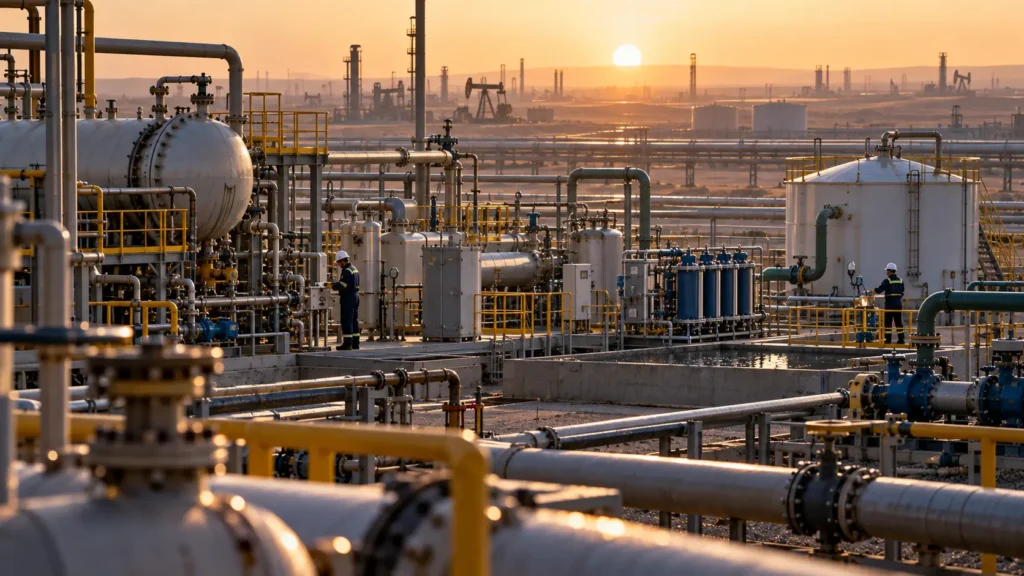
Pretreatment and the reuse objective are the primary gates; full mineral recovery is not the default.
Controlled principleProduced water and refinery wastewater should be treated to a defined receiving duty, not to an abstract purity target. Internal reuse, reinjection, disposal, discharge and external reuse carry different chemistry, regulatory, logistics and reliability requirements. The high-salinity plant should handle only the fraction that still needs salt removal after source segregation and fit-for-purpose pretreatment. |
|---|
Start with the reuse or disposal objective, not the desalination package
Oil, gas and refining sites can generate water streams that differ more in hydrocarbon content, dissolved gases, scaling tendency, salinity, additives and operating history than their TDS suggests. Produced water is co-produced with hydrocarbons; flowback is influenced by completion fluids and formation water; refinery wastewater is a collection of process-specific streams rather than one homogeneous effluent. [1–3,7,8]
The first design decision is therefore the receiving duty. In-field reuse or reinjection may tolerate constituents that would be unacceptable for an external industrial user; a permitted discharge may be controlled by a different pollutant set; and a disposal-limited site may value volume reduction even when high-purity water has little value. MLD/ZLD enters only after that endpoint has been made explicit.
| Source / duty | Primary value question | First chemistry question | Endpoint to screen first |
|---|---|---|---|
| Produced water — conventional / unconventional | Can the water displace fresh make-up, support reservoir operations or reduce disposal/transport? | Oil, TSS, dissolved salts, hardness/scale-formers, sulfide/dissolved gases, organics, metals/NORM as relevant. | In-field reuse/reinjection; lawful disposal; external reuse only against a defined specification. |
| Flowback / early-life returns | Can changing early-time water be segregated or reused without forcing the long-term plant to design for a transient peak? | Completion-fluid additives, suspended solids, formation-brine contribution and time-dependent composition. | Temporary/segregated management, reuse in completions, staged treatment, or disposal. |
| Refinery process wastewater | Which source can be reused, stripped or treated at-source before joining the main wastewater system? | Oil/grease, sulfide, ammonia, phenols/organics, solids, salts and process-specific contaminants. | Source control and reuse; conventional refinery WWT; segregated brine treatment only where needed. |
| External industrial reuse | What delivered-water specification and continuity are actually required? | All constituents that constrain the named end use plus transport/storage stability. | Fit-for-purpose treatment and regulatory qualification; no generic “reuse water” target. |
| Residual minimization / ZLD | Is liquid disposal/discharge the binding constraint after lower-burden reuse options? | Remaining salt load, scale-formers, organics, volatility, corrosion and residual-solids route. | Concentration/MLD; thermal/ZLD only when the residual endpoint justifies it. |
Table 39.1. The receiving duty determines the treatment boundary; “produced water treatment” is not a single specification.
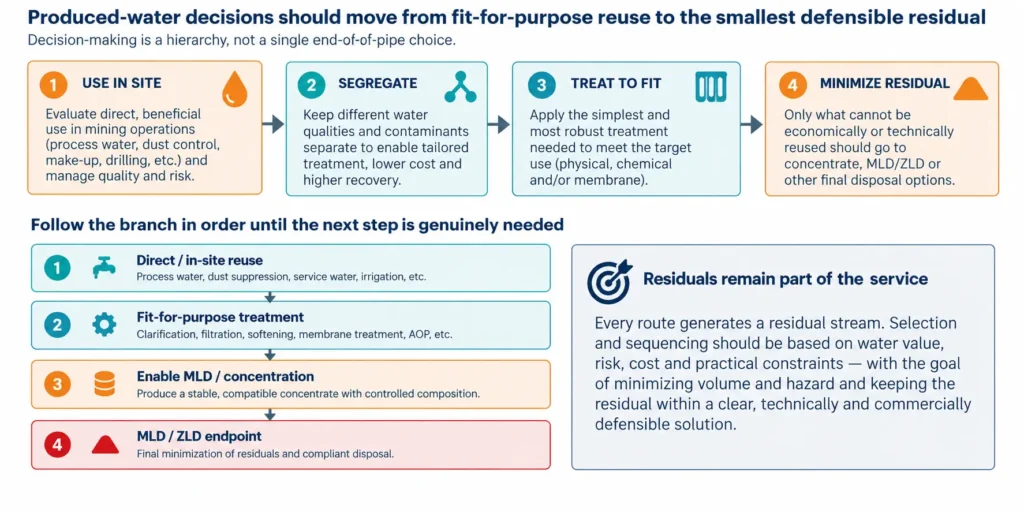
Figure 39.1. Produced-water decision pathway from reuse to minimized residual. It is a decision architecture, not a universal oil-and-gas treatment train.
Produced-water chemistry is a distribution in space and time
DOE notes that produced-water volume and characteristics can vary significantly between reservoirs and over time, depending on formation, hydrocarbon type, well age and operating method. EPA likewise treats produced-water management as a site- and jurisdiction-specific problem rather than a single national water-quality envelope.
A design basis should therefore preserve distributions and chemical form. “Oil” must distinguish free, dispersed and emulsified fractions when treatment selection depends on them; hardness must be resolved into actual ions and precipitation risks; sulfur chemistry must distinguish sulfide/H₂S from sulfate; organics should be tied to the reuse or discharge objective; and naturally occurring radionuclides require an explicit analytical and waste-handling decision where geology makes them relevant.
| Chemistry family | Why TDS cannot substitute | Evidence required | Design consequence |
|---|---|---|---|
| Hydrocarbons / oil and grease | Free oil, dispersed droplets, emulsions and dissolved organics behave differently. | Phase/droplet information where relevant, O&G method, TOC/COD and targeted organics tied to endpoint. | Separation/coalescence/flotation may precede polishing; dissolved organics can remain after visible oil is removed. |
| Salts / ionic composition | Equal TDS can hide radically different scaling, corrosion and osmotic-pressure behaviour. | Major ions, alkalinity, density, ionic strength, temperature and design/upset distribution. | Sets softening, sulfate/barite/gypsum risk, membrane/thermal feasibility and residual salt load. |
| Iron / sulfide / dissolved gases | Redox and pressure change can create precipitates, odor/toxicity, corrosion and fouling. | Field-preserved sampling where needed, Fe species, sulfide, pH/redox, gas handling basis. | May require degassing, oxidation/reduction control, precipitation and compatible materials. |
| Suspended solids / fines | Transient solids can dominate filters, membranes and injection compatibility. | TSS/turbidity/particle size, solids mineralogy and flowback timing. | Front-end solids removal and realistic backwash/sludge duty. |
| Organics / additives | Completion chemicals, BTEX/other hydrocarbons and process organics are use- and method-specific. | Target list derived from source history and receiving specification; analytical method limits. | Adsorption, oxidation, biology or other polishing only when tied to a named contaminant/duty. |
| NORM / TENORM potential | Radionuclides may partition to brine, scale and sludge and can concentrate as water is removed. | Site/basin screening and radionuclide analysis where applicable; waste classification route. | Changes residual handling, worker controls, cleaning, transport and disposal—not just water treatment. |
Table 39.2. Produced-water characterization must resolve the constituent families that control reuse, fouling, corrosion and residual handling.
Flowback should be treated as a changing operating state
For hydraulically fractured wells, EPA describes a temporal transition: early returned water is strongly influenced by injected fracturing fluid, while later produced water increasingly reflects formation geochemistry; composition also varies among and within formations. The practical implication is that an early campaign sample should not become the permanent plant design water.
Where flowback is material to the project, the sampling and operating plan should treat time since well opening, batch/campaign blending and source tankage as design variables. A staged or temporary treatment strategy can be more robust than sizing permanent high-salinity equipment for the most short-lived startup condition.
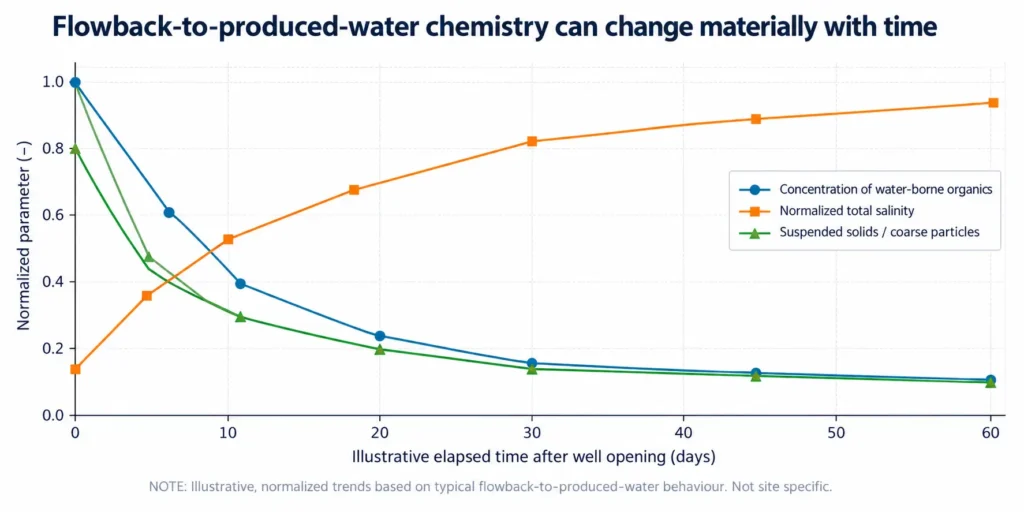
Figure 39.2. Scenario-only flowback-to-produced-water chemistry transition. The normalized traces illustrate changing source influence; they are not basin data, treatment limits or a prediction for any specific well.
| Operating period | Likely design emphasis | Data to preserve | Common failure |
|---|---|---|---|
| Completion / initial return | High solids and completion-fluid influence; rapid hydraulic change. | Time-stamped flow, source fluid/additives, TSS/particle size, oil/organics and ion chemistry. | Compositing the transient peak into a misleading “average produced water.” |
| Transition / flowback | Rapidly changing mixture of completion fluid and formation water. | Daily/lot chemistry trend, tank blending, scaling ions, organics and residual solids. | Fixing chemical dose or membrane design to one early sample. |
| Established production | Formation chemistry and well-age effects dominate the long-term basis. | Representative normal/design/upset distributions, production rate, interventions and chemical program. | Ignoring water-cut growth, workovers or changes in scale/corrosion inhibitor use. |
| Workover / stimulation upset | Short-term chemistry and solids can depart sharply from normal operation. | Event-specific samples, segregated storage and return-to-service criteria. | Sending upset water directly into a steady-state reuse train without protection. |
Table 39.3. Flowback and produced water should be sampled and operated as time-dependent states, not one immutable feed.
Source segregation can remove treatment duty before equipment is added
Segregation is particularly valuable where a site handles multiple wells, pads, water qualities, stormwater classes or refinery drains. Mixing a low-oil reusable stream with a high-oil/high-sulfide stream can create a larger pretreatment plant; mixing moderate-salinity water with an extreme brine can make all water appear to require high-pressure or thermal treatment.
The segregation decision should be tested by whole-system mass balance and operating practicality. Dedicated tankage, transfer pumps and quality monitoring have a cost, but they may avoid treating every cubic metre to the most difficult specification.
| Segregation decision | Keep separate when… | Combine only when… | Record required |
|---|---|---|---|
| Low-salinity vs extreme-salinity produced water | One stream can meet reuse/injection duty without desalination. | Blending is compatible with reuse, scaling and disposal constraints and reduces total burden. | Source flow/chemistry distribution and blend mass balance. |
| Low-oil vs oily/emulsified water | Pretreatment or recovered-oil handling differs materially. | Oil removal capacity and downstream duty remain controlled. | Oil fraction/method, separator performance and tank/interface plan. |
| Sulfide-rich / iron-rich stream | Oxidation/precipitation or gas controls would burden otherwise reusable water. | Reaction products and solids remain manageable and chemistry is intentional. | Redox/chemical model, dose, solids and vent/gas basis. |
| Flowback vs steady produced water | Transient water would oversize or destabilize long-term treatment. | Equalization/testing proves the blended design envelope. | Campaign plan and transition criteria. |
| Refinery stormwater / utility water vs process wastewater | Cleaner water can bypass contaminated sewers or receive simpler treatment. | Permit/process basis requires common treatment and hydraulic capacity is verified. | Drain map, contamination risk and operating controls. |
Table 39.4. Segregation should be justified by avoided treatment burden, not by a preference for more tanks.
Pretreatment is the primary technology gate
For oil and gas waters, desalination equipment rarely sees raw wellhead water in a successful design. The pretreatment train must first remove or stabilize the species that would make reuse, injection, membranes or thermal concentration unreliable. Ipieca identifies salts, minerals, metals and organic compounds as recurring produced-water constituents, while EPA oil-and-gas rules and studies emphasize the need to tie treatment to the management route.
The correct sequence is mechanism-based: remove bulk oil and solids where they are present; manage sulfide, iron and gas safely; address hardness and incompatible ions before concentration; and add organic or microbial polishing only when the receiving duty requires it. “Pretreatment” should include the residuals it creates.
| Gate | Function | Evidence before scale-up | New residual / interface | Failure signal |
|---|---|---|---|---|
| Bulk/free oil separation | Recover hydrocarbon phase and protect downstream unit operations. | Representative oil loading and separation behaviour across rates/temperature. | Recovered oil, oily solids, tank bottoms. | Visible carryover or unstable emulsion reaches filters/membranes. |
| Fine/dispersed oil + solids | Reduce droplets/fines that pass gravity separation. | DAF/DGF/coalescence/filter testing on real water as applicable. | Float/sludge, backwash, chemical solids. | Turbidity/O&G spikes drive rapid fouling. |
| Sulfide / iron / dissolved gas control | Protect safety, materials and downstream oxidation/precipitation steps. | Field-representative chemistry, gas handling and reaction/solids test. | Off-gas, iron/sulfur solids, chemical demand. | Uncontrolled odor/H₂S, black precipitate, corrosion or filter loading. |
| Hardness / scale-former control | Protect injection, membrane and thermal concentration from precipitation. | Speciation/model plus real-water precipitation/filtration evidence. | Sludge/cake and reagent ions. | Recovery target depends only on antiscalant or one saturation-index case. |
| Organics / microbiology polishing | Meet the named reuse/discharge or membrane protection duty. | Target analyte list, biodegradability/adsorption/oxidation tests as relevant. | Spent carbon/media, biomass, oxidation by-products, cleaning waste. | Treatment is selected without a receiving specification or analytical method. |
| Final particulate polishing | Protect membranes, injection or downstream equipment. | Particle/turbidity trend and filterability at design loading. | Backwash/concentrate. | Guard filters become the primary solids-handling system. |
Table 39.5. Pretreatment should remove the mechanisms that constrain the selected reuse or concentration step.
Internal reuse is usually the first reuse case to test
DOE’s 2026 produced-water fact sheet identifies oilfield reuse—particularly enhanced oil recovery and hydraulic fracturing—as established management uses, while non-oilfield reuse is an area of growing interest that requires treatment to the applicable standards. This does not mean internal reuse is automatically cheap; it means the receiving specification, logistics and liability are usually easier to define inside the operating system.
The hierarchy should therefore compare direct internal reuse, fit-for-purpose treatment for internal reuse, external industrial reuse, discharge/disposal and then residual minimization. External reuse can be valuable in water-stressed regions, but it adds qualification, continuity, storage, transport and jurisdiction-specific requirements. EPA’s reuse resources explicitly treat industrial reuse as an end-use category rather than one universal water specification.
| Reuse / management route | Primary benefit | Treatment basis | Additional dependency | Fallback if unavailable |
|---|---|---|---|---|
| In-field reuse / completions | Avoid freshwater purchase and/or disposal/transport. | Compatibility with fracturing/injection chemistry, solids and operations. | Well schedule, storage and blending. | Disposal/injection or alternate field use. |
| Reservoir reinjection / pressure support | Maintain reservoir operation while retaining water within field system. | Injection compatibility, solids/oil/scale and reservoir constraints. | Injection capacity, wells and reservoir management. | Alternate injection/disposal or treatment. |
| Refinery/process internal reuse | Displace utility/process water after source-specific treatment. | Receiving-unit specification; may require biological/tertiary/RO polishing. | Reliability, corrosion/scaling, turnaround states. | Return to wastewater system or make-up water source. |
| External industrial reuse | Create alternative supply for a named receiver. | End-use and jurisdiction-specific quality plus storage/transport stability. | Receiver qualification, contract, transport, permitting. | Full residual/disposal capacity with no revenue credit. |
| Permitted discharge / disposal | Provide a legally accepted endpoint. | Permit/well acceptance and site-specific pollutant controls. | Capacity, transport, monitoring and future regulatory risk. | Alternative disposal, storage or concentration. |
Table 39.6. Reuse value should be measured against a named receiving duty and a credible fallback.
Extreme salinity makes endpoint selection more important, not less
High salinity can dominate osmotic pressure, scaling and concentrate volume, but it does not remove the need to solve oil, organics, gases and solids first. An extreme produced-water brine may be unsuitable for conventional desalination without substantial conditioning, while another high-TDS stream may be acceptable for a field reuse that does not require salt removal.
Accordingly, concentration technologies should be screened after the salt-removal objective is proven. The relevant endpoint may be modest volume reduction for lower disposal cost, partial desalination to meet a reuse blend specification, or thermal concentration/ZLD where liquid residual cannot leave the defined boundary. No universal salinity or recovery threshold is imposed in this guide.
| Salt-management question | If yes | If no | Design control |
|---|---|---|---|
| Does the selected reuse require substantial salt removal? | Screen desalination/concentration after pretreatment and scaling control. | Avoid desalination unless another system benefit justifies it. | Receiver specification and blend model. |
| Is a liquid disposal route available at acceptable capacity/cost/risk? | Test MLD optimum before ZLD. | Assess higher concentration, evaporation or ZLD endpoint. | Finite routine + upset residual route. |
| Can chemistry be conditioned for the next concentration step? | Advance with mass balance, pilot evidence and materials basis. | Stop, lower recovery, change endpoint or isolate the incompatible stream. | Scale/fouling/corrosion evidence. |
| Does water value justify the final recovery increment? | Compare lifecycle cost, reliability and outage consequence. | Stop at lower recovery with a managed residual. | Marginal-cost and sensitivity model. |
| Is a mineral/product route independently qualified? | Credit only qualified net value and preserve no-sales fallback. | Treat solids/brine as residuals, not revenue. | Chapter 22–26 qualification package. |
Table 39.7. Extreme salinity should trigger endpoint-first screening rather than an automatic ZLD response.
Refinery wastewater needs source control before high-salinity treatment
EPA identifies distinct refinery wastewater streams including desalter water, sour water, other process water, spent caustic, tank bottoms, cooling-tower water, boiler/condensate blowdown, source-water-treatment wastes and stormwater. These streams have different pollutant and salinity burdens and should not be collapsed into one generic “refinery wastewater” analysis.
EPA’s current refinery framework and 2019 detailed study describe in-plant controls such as sour-water stripping and sewer segregation, followed by oil/water separation, biological treatment, clarification and polishing. The study also documents reuse-oriented tertiary treatment work. For an MLD/ZLD project, the lesson is to preserve these front-end functions and isolate the salt-bearing or reuse-limiting fraction rather than thermally treating the entire refinery effluent by default.
| Refinery stream | Controlling issue | Preferred first action | When advanced salt treatment enters |
|---|---|---|---|
| Desalter water | Salts, oil/emulsion, suspended solids and crude-specific contaminants. | Segregate, recover oil, equalize/pretreat; manage salt load intentionally. | When reuse or discharge residual salinity cannot be met after conventional treatment. |
| Sour water | Sulfide/H₂S, ammonia, phenols and organics. | Sour-water stripping / process recovery where applicable; reuse stripped water when fit. | Only after volatile/reactive contaminants are controlled. |
| Spent caustic / special chemical wastes | Extreme pH and concentrated sulfur/organic species can disrupt common WWT. | Segregated chemical management or dedicated treatment. | Not a generic membrane feed; evaluate separately. |
| Oily process drains / tank bottoms | Free/dispersed oil and solids. | Oil/water separation, recovered-oil return where appropriate, solids management. | After oil/solids removal if dissolved salts then control reuse. |
| Biologically treated effluent | Residual organics, nutrients, solids and dissolved salts. | Tertiary filtration/adsorption or reuse polishing to duty. | RO/concentration when dissolved salts limit the named reuse. |
| Cooling / boiler / source-water-treatment wastes | Utility-specific salt or chemical concentrates. | Apply Chapter 37 utility optimization and segregation. | Dedicated brine treatment if these streams dominate residual salt load. |
Table 39.8. Refinery high-salinity treatment should sit downstream of source-specific process and wastewater controls.
Typical oil/gas/refining MLD and ZLD configurations are conditional architectures
The architectures below are decision patterns, not standard trains. Their common feature is front-end segregation and pretreatment matched to the receiving duty; salt removal and thermal steps are added only where the residual endpoint requires them.
| Architecture | When it can make sense | Core blocks | Primary residuals / cautions |
|---|---|---|---|
| In-field reuse without desalination | Salt is acceptable to receiving operation and disposal avoidance has value. | Segregation → oil/solids control → chemistry conditioning → storage/blending. | Sludge/filters, incompatible-ion scaling, variable well schedule. |
| Partial desalination / reuse blend | A lower-salinity fraction can meet reuse after blending or partial salt removal. | Pretreatment → membrane/electromembrane or justified concentrator → blend/polish. | Concentrate route, organic fouling, scaling and materials. |
| MLD for disposal minimization | Disposal remains available but volume/cost/logistics are limiting. | Pretreatment → selective chemistry control → membrane/high-salinity concentration → finite liquid residual. | Residual brine must have real capacity and transport/disposal route. |
| Thermal ZLD | Routine liquid residual cannot leave system and solids endpoint is credible. | Pretreatment → preconcentration where justified → evaporation/crystallization → dewatering/purge logic. | High energy, corrosion/scale, volatile organics, mother liquor, solid/TENORM handling. |
| Refinery reuse / segregated brine | Main WWT can produce reuse water but one or more brine side streams limit recovery. | Source control/SWS/oil separation/biology → tertiary treatment → RO; segregated concentrate management. | Do not send spent caustic/oily sludges or incompatible side streams into a generic RO/ZLD train. |
Table 39.9. Oil/gas/refining MLD/ZLD architectures should be selected by reuse duty and residual endpoint, not by sector label.
Disposal and transport are process units in the economic boundary
EPA’s produced-water management work notes that underground injection remains a major management route in the United States and that limits of injection are evident in some regions; DOE likewise frames reuse and treatment partly as alternatives to disposal. The project-specific question is not whether injection or transport is “good” or “bad,” but whether the permitted capacity, distance, reliability, monitoring and long-term operating risk are acceptable for the actual water.
Where water is trucked or piped to disposal, logistics capacity can become the binding design constraint. A concentration project should therefore compare avoided transport and disposal against the additional pretreatment, energy, chemical, maintenance and residual-solids burden. Temporary storage is not a routine endpoint.
| Logistics / endpoint field | Evidence required | Failure mode | Design response |
|---|---|---|---|
| Injection/disposal capacity | Permitted receiver, acceptance chemistry, daily/annual capacity, outage history and backup. | Treatment plant runs but residual has nowhere to go. | Reserve backup capacity, storage for defined duration, or reduce residual volume. |
| Transport mode / distance | Pipeline/truck/rail feasibility, payload, road access, loading/unloading, weather and restrictions. | Freight and outage risk erase treatment economics. | Local reuse, pipeline, concentration or alternative receiver. |
| Storage | Routine and upset inventory, containment and incompatible-stream segregation. | Tankage becomes indefinite disposal or blends away quality control. | Finite design event and operating-state triggers. |
| Discharge / external reuse | Current jurisdiction-specific permit/end-use requirements. | Technology meets internal spec but legal route is absent. | Regulatory qualification before final design. |
| Commercial receiver | Contract term, quantity, quality, rejection and outage basis. | Receiver shutdown stops water service. | No-revenue/no-receiver fallback and residual capacity. |
Table 39.10. Disposal, transport and receiver capacity belong inside the treatment system boundary.
Treatment can concentrate NORM, scale, oily sludge and other residual hazards
EPA identifies produced water, mineral scale, sludges/sediments and contaminated equipment as oil-and-gas TENORM waste types where naturally occurring radionuclides are present. The relevance varies strongly by geology and operation, so screening and analytical requirements should be site-specific rather than assumed universal.
Water recovery can change the partitioning of these constituents. Hardness removal, oxidation, filtration and crystallization can move contaminants from water into a much smaller solid mass. That may improve the water endpoint while making the solid-handling, worker-exposure or disposal route more demanding. ZLD does not remove this obligation; it makes it more explicit.
| Residual | Origin | What must be characterized | Endpoint question |
|---|---|---|---|
| Recovered oil / hydrocarbon | Primary/secondary separation and tank skimming. | Water/solids contamination and suitability for reprocessing. | Can it return to process, or is it a managed waste? |
| Oily sludge / flotation solids | Oil separation, DAF/DGF, tank bottoms, chemical coagulation. | Oil, metals, water content, dewaterability and classification. | Finite dewatering, transport and disposal/recovery route. |
| Scale / precipitated solids | Hardness, barium/strontium/sulfate/carbonate, iron/sulfide reactions. | Mineralogy, contaminants, moisture and radionuclides where relevant. | Maintenance/cleaning plan and lawful solid endpoint. |
| Spent media / membranes / carbon | Filtration, adsorption and polishing. | Captured contaminants, regeneration/cleaning chemicals and classification. | Replacement frequency, vendor return or disposal. |
| Concentrated brine / mother liquor | Membrane or thermal concentration. | Full ionic/organic/radionuclide distribution, volatility and corrosion. | Routine liquid or solid endpoint with upset capacity. |
| Off-spec reuse water | Feed upset, treatment drift or receiver rejection. | Reason for failure and safe storage/rework quality. | Can it be reprocessed without stopping the essential water service? |
Table 39.11. Residual management must follow contaminant mass as water is separated and concentrated.
Operability and materials must reflect hydrocarbons, sulfides and brine
High-salinity oil-and-gas systems combine several degradation mechanisms: chloride-driven corrosion, sulfide exposure, scaling, hydrocarbon/organic fouling, solids erosion, chemical incompatibility and cleaning duty. Materials and cleaning programs should therefore be selected against the real normal/upset chemistry and temperature, not against TDS alone.
Remote fields add another constraint: the most technically elegant treatment train can be the wrong project if it requires specialist attendance, rare spares, unstable reagents or laboratory capability that the site cannot sustain. Chapter 35’s operability test remains controlling.
| Operability field | Design basis | Monitoring / task | Stop condition |
|---|---|---|---|
| Materials / corrosion | Chloride, sulfide, oxygen/redox, pH, temperature and cleaning exposures. | Inspection points, corrosion monitoring and chemistry excursions. | Critical material has no demonstrated compatibility or inspection route. |
| Fouling / scaling | Oil/organics, solids, hardness, silica and sulfate/barite risks as applicable. | Normalized performance, pressure drop, filter loading, scale indicators. | Recovery depends on uncontrolled deposition or unproven cleaning. |
| Chemicals | Demulsifier/coagulant/oxidant/antiscalant/biocide/cleaning chemicals tied to mechanism. | Dose control, storage, compatibility and residual chemical impact. | Chemical program is proprietary/undefined or unavailable at site. |
| Remote support / spares | Lead times, vendor access, specialist tasks and critical single points. | Spare inventory, remote diagnostics and competence plan. | Routine failure produces an unbounded outage. |
| Shutdown / restart | Well turndown, pad campaigns, refinery turnaround, storage and preservation. | Defined normal/degraded/offline/restart procedures. | Restart creates off-spec water or residual overflow with no controlled state. |
Table 39.12. Oil/gas/refining operability must be designed around the chemical and logistics realities of the site.
The business case should value avoided water and disposal before speculative minerals
Produced water may contain potentially valuable minerals, and DOE is actively supporting research into critical-mineral extraction. That is a legitimate opportunity screen—not permission to carry mineral revenue into the base water-management case before concentration, selectivity, purity, volume, legal route, buyer and netback have been qualified.
The primary economic comparison should therefore capture avoided freshwater purchase, avoided disposal/injection, avoided transport, production continuity, treatment cost, residual handling and availability. External reuse adds qualification and logistics; mineral or chemical recovery remains incremental upside unless it passes the product gates established in Chapters 22–26.
| Value / cost item | Base-case treatment | Downside test | Do not do |
|---|---|---|---|
| Avoided freshwater / make-up | Use site-specific displaced water quantity, quality and delivered cost. | Lower internal demand or alternate supply becomes available. | Value every recovered cubic metre at premium potable-water cost. |
| Avoided disposal / injection | Use actual accepted volume, fee, transport and capacity basis. | Receiver outage, higher distance/cost, new acceptance limits. | Assume disposal is free or infinitely available. |
| Treatment OPEX/CAPEX | Complete source-to-endpoint system including pretreatment, residuals and downtime. | Higher fouling/chemical use, lower availability, replacement and upset handling. | Compare a vendor package with an incomplete boundary. |
| External reuse value | Qualified end-use netback or defensible avoided-purchase value. | Receiver takes less, rejects off-spec water or changes specification. | Treat a generic “beneficial reuse” concept as contracted demand. |
| Mineral / chemical recovery | Incremental value only after Chapter 22–26 qualification. | No-product-revenue case and full residual handling. | Multiply element inventory by headline commodity price. |
Table 39.13. The oil/gas/refining business case should survive without speculative product or mineral revenue.
Oil, gas and refining sector acceptance gate
A sector concept should advance only when the source waters, reuse/disposal objective, pretreatment mechanisms, salt-management boundary, residual route, regulatory/logistics basis and operating model are reconstructable from evidence. A high recovery number does not compensate for a missing reuse specification or an unmanaged oily/radioactive solid.
| Gate field | Proceed | Conditional / recycle | Stop | Required record |
|---|---|---|---|---|
| Source / variability | Produced water, flowback and refinery streams have representative normal/design/upset bases. | One transient state needs further campaign data. | Design rests on one composite sample or mixed sources of different duty. | Source, flow and sampling register. |
| Reuse / endpoint | Named receiving duty or disposal route and specification are controlled. | Receiver qualification is bounded with fallback. | “Reuse” or “ZLD” is an undefined objective. | Endpoint and water-quality specification. |
| Pretreatment | Oil, solids, sulfide/gas, hardness/scale and organics are controlled as relevant. | One non-fatal mechanism awaits pilot closure. | High-salinity unit must solve uncontrolled upstream contamination. | Pretreatment and residual test package. |
| Salt / concentration | Salt removal is justified by endpoint and chemistry can support the selected step. | Recovery remains bounded by testable chemistry uncertainty. | Maximum recovery is the objective without residual/economic logic. | Concentration envelope and mass balance. |
| Residual / TENORM | All routine/upset liquids and solids have finite lawful routes; NORM/TENORM screened where relevant. | One route is time-limited but controlled. | Water recovery creates an unclassified/unaccepted residual. | Residual characterization and capacity plan. |
| O&M / logistics | Operators, materials, spares, chemicals, transport and restart are executable. | Early-life vendor support closes a defined gap. | Routine service depends on unavailable expertise or a single fragile logistics link. | O&M, supply-chain and operating-state plan. |
| Economics / commercial | Avoided water/disposal and full residual costs are auditable; no-product fallback survives. | One bounded receiver/commercial input awaits evidence. | Case closes only with unqualified external reuse/mineral revenue or omitted disposal cost. | Lifecycle model and downside cases. |
Table 39.14. Oil/gas/refining concepts advance only when reuse, chemistry, residuals, logistics and operability are auditable.
Stop ruleStop, segregate or re-stage when produced water, flowback and refinery streams are mixed without a demonstrated system benefit; when a reuse target is undefined; when oil/organics/sulfides or scale-formers remain uncontrolled upstream of concentration; when external reuse or disposal lacks a current legal/logistics route; or when mineral revenue is required to make an unresolved water-management obligation appear economic. Do not use ZLD to avoid defining the receiving duty. |
|---|
Handover to Chapter 40 — chemical and process industries
Chapter 40 moves from petroleum systems to chemical and process industries, where wastewater can change by batch, campaign, product slate, catalyst, solvent and cleaning event. The central lesson carries forward intact: preserve source identity and prevent product loss before creating an end-of-pipe high-salinity problem.
The handover should therefore translate oil/gas/refining source segregation, contaminant-specific pretreatment, internal reuse, residual ownership and no-product fallback into campaign segregation, product-loss prevention, internal chemical recovery and batch-specific treatment. Chapter 40 should receive the operating history—not a blended “average plant wastewater.”
| Oil/gas/refining expression | Controlled lesson | Chemical/process translation for Chapter 40 |
|---|---|---|
| Separate produced-water qualities and refinery drains | Source identity can be more valuable than centralized treatment. | Segregate batches, product wash waters, mother liquors, regenerants and cleaning streams before mixing. |
| Oil / sulfide / hardness pretreatment gates | Treat the species that constrains the next step. | COD/solvent/catalyst/specific-ion gates should control the train, not TDS alone. |
| In-field / internal reuse first | A known internal receiving duty can be more bankable than external sales. | Test internal chemical recovery, rinse reuse and return-to-process before merchant-product routes. |
| Flowback and well-state variability | Time and operating state belong in the design basis. | Campaign, grade change, CIP and batch upset must be separate design states. |
| Disposal / transport as process boundary | Residual receiver and logistics are part of the system. | Hazardous/special waste, solvent recovery, high-COD residual and salt routes must be explicit. |
| Mineral upside only after qualification | Resource presence is not a bankable product. | Recovered chemicals/by-products need specification, consistency, legal route and netback before revenue. |
Table 39.15. Chapter 40 inherits source-segregation and fit-for-purpose decision controls, not an oil-and-gas equipment train.
Chapter conclusion
Oil, gas and refining demonstrate why “high salinity” is only one layer of the water problem. Produced water can combine salts, hydrocarbons, metals, gases, solids, treatment chemicals and NORM-related residual issues; flowback can change quickly with time; and refineries generate distinct source waters whose pollutants and reuse opportunities differ by process. The correct front end is therefore segregation, representative characterization and fit-for-purpose pretreatment.
The endpoint should then follow the receiving duty. Internal reuse or reinjection may avoid desalination altogether; external reuse requires a named quality and legal pathway; disposal and transport must be treated as finite process units; and MLD/ZLD is justified only when the remaining liquid residual is the binding constraint. Mineral recovery can be valuable, but it is an upside route that must survive the same product qualification and no-revenue downside tests as any other brine valorization claim.
Chapter 39 in one sentenceTreat produced water, flowback and refinery wastewater to the receiving duty: segregate sources, control oil/organics/sulfides/scale first, and add high-salinity concentration only when it reduces the complete residual burden. |
|---|